
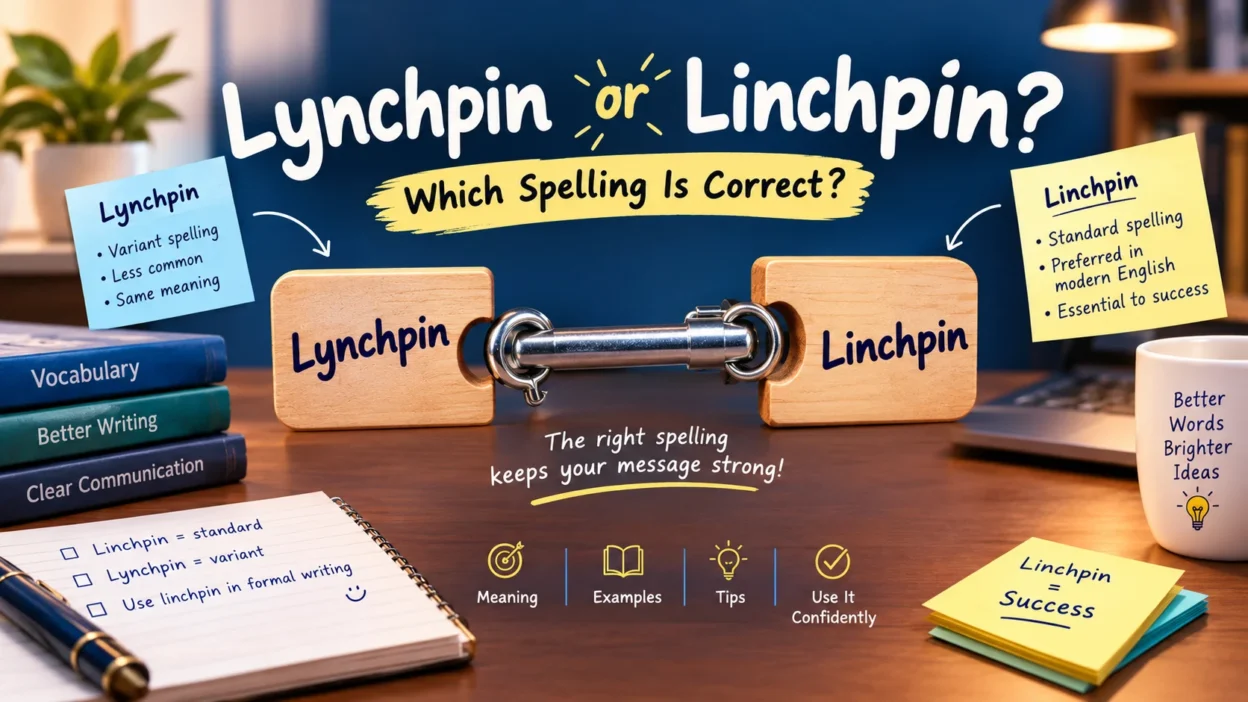
Have you ever wondered if the correct spelling is “lynchpin” or “linchpin”? These two words look almost identical, and it is easy to mix them up when writing. However, only one is the standard spelling in modern English.
The correct spelling is “linchpin.” It refers to a person, thing, or idea that is essential to the success or stability of a system, plan, or organization. For example, you might say, “Communication is the linchpin of a successful team.” Although “lynchpin” appears in some writing, it is generally considered a nonstandard variant or misspelling of “linchpin.” Understanding the difference helps you write more clearly and confidently, whether you are working on an essay, a business report, or an everyday message.
In this guide, you will learn the meaning of linchpin, why people confuse it with lynchpin, how to use it correctly, and how to remember the standard spelling.
Quick Answer: Lynchpin or Linchpin?
Linchpin is the standard and preferred spelling in modern English. It means a person, thing, or idea that holds something together or is essential to its success. Lynchpin is a less common variant spelling, but linchpin is the safer choice for formal writing, academic work, and professional communication.
Why Do People Confuse Lynchpin and Linchpin?
People confuse these spellings because they sound alike and have the same general meaning when used as variants.
There are three main reasons for the confusion:
- Similar pronunciation: Both spellings are commonly pronounced the same way.
- Similar appearance: The only difference is the vowel in the first syllable: “i” in linchpin and “y” in lynchpin.
- Unfamiliar origin: The word comes from a mechanical device used to keep a wheel or other part in place, which makes its spelling less intuitive for many readers.
Because “lynchpin” appears in some dictionaries and written sources as a variant, people may assume both spellings are equally preferred. However, linchpin remains the standard spelling to use in most situations.
1. Linchpin: Meaning, Definition, and Usage
What Does Linchpin Mean?
Linchpin (noun) refers to a person or thing that is essential to the success, stability, or operation of something.
It can describe:
- A person whose contribution is vital to a team.
- An idea that supports an entire argument.
- A policy that holds a plan together.
- A key component that keeps a system working.
Examples of Linchpin in Sentences
- Trust is the linchpin of a healthy relationship.
- She is the linchpin of the entire project.
- Education is a linchpin of economic development.
- Good communication is the linchpin of teamwork.
- The new bridge is a linchpin of the city’s transportation network.
Where Does the Word Linchpin Come From?
The word linchpin originally referred to a pin used to secure a wheel or axle and prevent it from slipping off.
Over time, the word developed a figurative meaning. Today, it often describes a person, idea, or component that holds a larger system together.
2. Lynchpin: Meaning, Definition, and Usage
What Does Lynchpin Mean?
Lynchpin is a variant spelling of linchpin. It is used with the same general meaning: a person, thing, or idea that is essential to the success or stability of something.
However, it is less common and is generally not the preferred spelling in standard modern English.
Examples of Lynchpin in Sentences
- The manager was described as the lynchpin of the department.
- Strong leadership served as the lynchpin of the initiative.
- The agreement became the lynchpin of the partnership.
- Her research was the lynchpin of the entire proposal.
- The central railway line acted as the lynchpin of the region’s transport system.
These examples illustrate how the variant spelling may appear in writing. For standard spelling, use linchpin instead.
3. Lynchpin vs. Linchpin: Comparison Table
|
Feature
|
Linchpin
|
Lynchpin
|
| — | — | — |
|
Spelling status
|
Standard spelling
|
Variant spelling
|
|
Meaning
|
Essential person or thing
|
Same general meaning
|
|
Part of speech
|
Noun
|
Noun
|
|
Pronunciation
|
Commonly /ˈlɪntʃ.pɪn/
|
Commonly the same
|
|
Usage
|
Preferred in modern writing
|
Less common
|
|
Formal writing
|
Recommended
|
Generally avoid
|
|
Example
|
She is the linchpin of the team.
|
She is the lynchpin of the team.
|
Key takeaway: Both spellings may communicate the same idea, but linchpin is the standard choice.
4. When Should You Use Each Spelling?
When to Use Linchpin
Use linchpin when writing:
- Academic essays and research papers.
- Business reports and professional emails.
- News articles and formal documents.
- Everyday communication where standard spelling matters.
Examples:
- “Customer satisfaction is the linchpin of our business strategy.”
- “The lead engineer is the linchpin of the development team.”
When to Use Lynchpin
You may encounter lynchpin in published writing, older material, or sources that accept it as a variant.
If you are quoting a source, preserve its original spelling. Otherwise, choose linchpin for consistency and standard usage.
5. 12 Examples of Linchpin in Sentences
Here are 12 practical examples showing how to use the standard spelling naturally.
- Business: Customer trust is the linchpin of a successful company.
- Education: A strong foundation in mathematics is the linchpin of advanced scientific study.
- Teamwork: Clear communication is the linchpin of effective teamwork.
- Leadership: She became the linchpin of the entire organization.
- Technology: Data security is the linchpin of the new software system.
- Relationships: Mutual respect is the linchpin of a lasting friendship.
- Government: The agreement became the linchpin of the reform plan.
- Healthcare: Accurate diagnosis is the linchpin of effective treatment.
- Sports: The captain was the linchpin of the team’s defense.
- Research: This discovery is the linchpin of the scientist’s argument.
- Transportation: The central station is the linchpin of the city’s railway network.
- Personal development: Consistency is the linchpin of long-term progress.
6. Common Mistakes to Avoid
Mistake 1: Assuming Both Spellings Are Equally Preferred
Although lynchpin is used as a variant, linchpin is the standard spelling.
Incorrect assumption: “Both spellings are equally common and preferred.”
Better understanding: Linchpin is the recommended spelling in most contexts.
Mistake 2: Confusing Linchpin With a Person’s Name
Linchpin is a common noun, not usually a proper name.
Example: “The coordinator is the linchpin of the project.”
Mistake 3: Using Linchpin to Mean Something Merely Helpful
A linchpin is not just something useful. It is something essential to the success, stability, or operation of a larger whole.
Example: “The lead designer is the linchpin of the project” means the designer plays a vital role.
Mistake 4: Misspelling the Word in Formal Writing
Using “lynchpin” in a formal document may be understood, but linchpin is the more conventional choice.
7. Memory Trick: How to Remember Linchpin
Here is a simple way to remember the correct spelling:
Linchpin = Link + Pin
Think of a pin that keeps parts connected. A linchpin holds things together, just as a key person or idea holds a plan or organization together.
Remember:
- Linchpin → Standard spelling.
- Lynchpin → Variant spelling.
If you are unsure which spelling to use, choose linchpin.
8. American vs. British English: Is There a Difference?
There is no major difference in meaning between American and British English.
|
Variety
|
Preferred spelling
|
| — | — |
|
American English
|
Linchpin
|
|
British English
|
Linchpin
|
|
Other English varieties
|
Linchpin is the standard choice
|
The spelling “lynchpin” may appear in different varieties of English, but it is not a separate American or British form with a different meaning.
9. Similar Words to Linchpin
Several words have meanings similar to linchpin, but they are not always interchangeable.
|
Word
|
Meaning
|
Example
|
| — | — | — |
|
Keystone
|
A central supporting element
|
Trust is the keystone of the partnership.
|
|
Cornerstone
|
A fundamental basis
|
Education is the cornerstone of progress.
|
|
Backbone
|
The main source of strength or support
|
Volunteers are the backbone of the organization.
|
|
Mainstay
|
A principal source of support
|
Tourism is a mainstay of the local economy.
|
|
Key element
|
An essential part
|
Planning is a key element of success.
|
|
Pivotal factor
|
Something that has a central influence
|
Timing was a pivotal factor in the decision.
|
|
Foundation
|
The underlying basis of something
|
Honesty is the foundation of a strong relationship.
|
10. Final Verdict: Lynchpin or Linchpin?
Linchpin is the standard spelling and the preferred choice in modern English. It refers to a person, thing, or idea that is essential to the success or stability of something.
“Lynchpin” is a recognized variant spelling, but it is less common and generally not recommended for formal writing.
If you are writing an essay, report, article, or professional email, use linchpin.
11. Frequently Asked Questions (FAQs)
1. Is it lynchpin or linchpin?
Linchpin is the standard spelling. Lynchpin is a less common variant that has the same general meaning.
2. What does linchpin mean in simple English?
A linchpin is a person or thing that is very important to the success or stability of something.
3. Is lynchpin a real word?
Yes. Lynchpin is used as a variant spelling of linchpin, although linchpin is the preferred form in standard modern English.
4. How do you pronounce linchpin?
Linchpin is commonly pronounced LINCH-pin, with the stress on the first syllable.
5. Can I use lynchpin in formal writing?
You may encounter it in published sources, but linchpin is the safer and more widely preferred spelling for formal writing.
6. What is an example of linchpin in a sentence?
“Good communication is the linchpin of a successful team.”
7. What is another word for linchpin?
Depending on the context, alternatives include keystone, cornerstone, backbone, mainstay, and key element.
Remember This
- Linchpin is the standard spelling.
- Lynchpin is a less common variant.
- Both refer to something or someone essential to a larger system or plan.
- Use linchpin in formal, academic, and professional writing.
- A linchpin is something that holds things together or makes success possible.
Conclusion
The difference between lynchpin and linchpin is mainly a matter of spelling preference. Both forms are used to describe a person, thing, or idea that is essential to the success or stability of something. However, linchpin is the standard spelling and the one most appropriate for everyday, academic, and professional writing.
Remember the simple connection between a pin and something that holds parts together. When you need to describe an essential person, idea, or component, choose linchpin. This will help you communicate clearly and use the word confidently in your writing.

David Henry is a language enthusiast and content writer specializing in synonyms, vocabulary, and word meanings. He creates clear, engaging resources that help readers improve their writing, communication, and English skills.