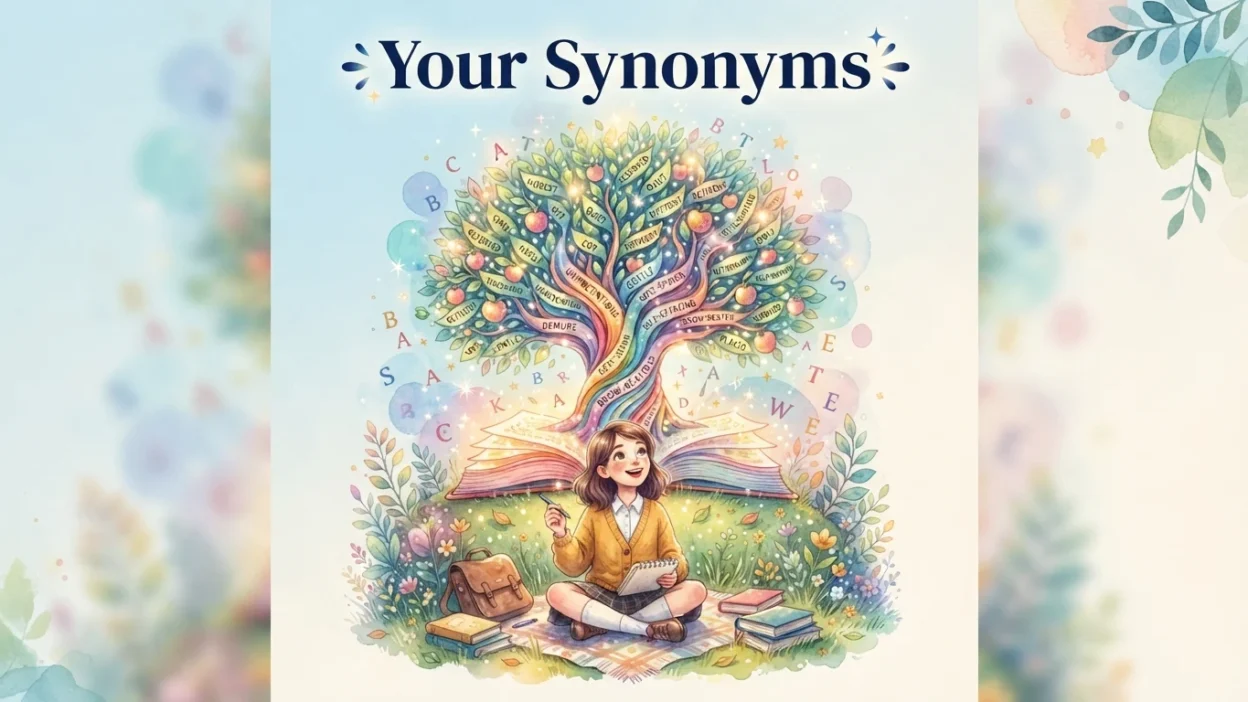
Have you ever felt like you are using the same words over and over again? Maybe you are writing an essay and keep repeating “good” or “nice,” or perhaps you are trying to describe someone’s personality and can only think of “shy.” This is where learning your synonyms becomes an essential tool.
A synonym is a word that has the same or nearly the same meaning as another word . Think of them as different colored crayons in your vocabulary box. Instead of only having “blue,” you have “azure,” “navy,” and “sky blue.” Mastering your synonyms helps you become a more effective and engaging communicator . It is a skill that benefits everyone, especially students, writers, and people learning English as a second language.
So, if you are ready to expand your word bank and learn how to use the exact right word for every situation, you have come to the right place. This guide will help you understand what your synonyms are, how to use them wisely, and even provide a detailed look at a specific word: demure.
Demure Meaning in Simple English
Before we dive into the list of synonyms, let’s clearly understand the word “demure.”
Demure (pronounced dih-MYOOR) is an adjective. When describing a person, it usually means they are quiet, polite, and modest . These people do not try to attract a lot of attention to themselves. They often appear shy or reserved. When describing something like clothing or a style, demure means not flashy or showy. Think of a simple, elegant dress with a high neckline .
30 Synonyms of Demure (with Simple Explanations)
Here is a list of 30 synonyms of demure. For each one, we’ve included a simple meaning, an example sentence, and the best situation to use it.
Gentle & Reserved
- Modest
- Meaning: Having a humble opinion of yourself; not boastful.
- Example: “The famous scientist was surprisingly modest about his achievements.”
- Best For: Describing someone who doesn’t brag.
- Reserved
- Meaning: Tending to keep your feelings or thoughts private.
- Example: “He was a quiet, reserved man who didn’t like loud parties.”
- Best For: Describing someone who is private and not very open.
- Shy
- Meaning: Nervous or uncomfortable around other people.
- Example: “The shy child hid behind her mother’s leg.”
- Best For: Describing someone who feels anxious in social situations.
- Bashful
- Meaning: Easily embarrassed or shy. Often used with a sweet, childlike quality.
- Example: “She gave a bashful smile when she received the compliment.”
- Best For: Describing cute or endearing shyness.
- Retiring
- Meaning: Shy and avoiding attention.
- Example: “He was a quiet, retiring person who preferred to work in the background.”
- Best For: Describing someone who actively avoids the spotlight.
- Meek
- Meaning: Quiet, gentle, and easily persuaded; not assertive.
- Example: “He was a meek and mild-mannered man.”
- Best For: Describing someone who is very gentle and submissive.
- Reticent
- Meaning: Not willing to say much about your thoughts; secretive.
- Example: “She was reticent about her plans for the future.”
- Best For: Describing someone who is very private and doesn’t share information.
Humble & Unassuming
- Unassuming
- Meaning: Not wanting to be noticed or thought of as important.
- Example: “Despite his fame, he remained unassuming and friendly.”
- Best For: Describing a powerful or successful person who stays humble.
- Self-effacing
- Meaning: Not wanting to be noticed; putting others before yourself.
- Example: “Her self-effacing humor made everyone feel comfortable.”
- Best For: Describing someone who always defers to others.
- Humble
- Meaning: Having a low opinion of your own importance; not proud.
- Example: “He came from a humble background.”
- Best For: Describing someone who is not arrogant.
- Diffident
- Meaning: Lacking confidence in yourself; shy and hesitant.
- Example: “The new employee was diffident and reserved in meetings.”
- Best For: Describing someone who doesn’t have much self-confidence.
Quiet & Polite
- Quiet
- Meaning: Making very little noise; not talkative.
- Example: “She was a quiet student who always listened carefully.”
- Best For: General description of a silent or calm person.
- Polite
- Meaning: Showing good manners and respect for others.
- Example: “The children were very polite to their guests.”
- Best For: Describing someone with excellent manners.
- Polished
- Meaning: Showing a high level of skill, style, and refinement; elegant.
- Example: “He had a polished and professional demeanor.”
- Best For: Describing someone who is sophisticated and refined.
- Decorous
- Meaning: Behaving in a proper, polite, and socially acceptable way.
- Example: “The wedding ceremony was a decorous affair.”
- Best For: Describing formal or correct behavior.
A Little Coy (Slightly Playful)
- Coy
- Meaning: Behaving in a shy, modest way that is also a little teasing or flirtatious; pretending to be shy.
- Example: “She gave him a coy smile and looked away.”
- Best For: Describing playful shyness.
- Prim
- Meaning: Very formal, proper, and easily shocked by anything rude.
- Example: “The prim librarian was very strict about the rules.”
- Best For: Describing someone who is very correct and proper.
- Prudish
- Meaning: Easily shocked by matters related to sex; overly proper.
- Example: “His novels were too racy for his prudish aunt.”
- Best For: A more negative way of describing someone who is too proper.
- Prissy
- Meaning: Fussy and overly concerned with being proper.
- Example: “She was a bit prissy, always correcting people’s grammar.”
- Best For: A negative way to describe someone who is annoyingly proper.
Not Showy (For Things and Styles)
- Sober
- Meaning: Not colorful or flashy; serious and plain.
- Example: “He wore a sober gray suit to the interview.”
- Best For: Describing plain, professional clothing or style.
- Plain
- Meaning: Simple and not decorated; ordinary.
- Example: “She wore a plain, black dress.”
- Best For: Describing something unadorned or simple.
- Unpretentious
- Meaning: Not trying to seem more important or fancy than it really is.
- Example: “It was an unpretentious little restaurant, but the food was great.”
- Best For: Describing something or someone that is genuine and not fake.
- Sedate
- Meaning: Calm, slow, and peaceful; not exciting.
- Example: “The town was a sedate and quiet place to live.”
- Best For: Describing a calm and unhurried atmosphere or person.
- Subdued
- Meaning: Not very bright, loud, or strong; quiet and serious.
- Example: “The party was a subdued affair after the bad news.”
- Best For: Describing a quiet or toned-down mood or color.
- Restrained
- Meaning: Showing controlled behavior; not too emotional or colorful.
- Example: “Her decor was restrained and elegant.”
- Best For: Describing a person who is calm in a formal way.
Traditional & Formal
- Staid
- Meaning: Serious, dull, and old-fashioned; not fun.
- Example: “The company had a staid, old-fashioned image.”
- Best For: Describing a person or organization that is very traditional.
- Strait-laced
- Meaning: Having very strict, old-fashioned morals and manners.
- Example: “He was criticized for being boring, strait-laced, and narrow-minded.”
- Best For: A negative description of someone who is too traditional.
- Proper
- Meaning: Following social rules and behaving in a correct way.
- Example: “Her grandmother was a very proper Victorian lady.”
- Best For: Describing formal, correct behavior.
A Touch of Seriousness
- Grave
- Meaning: Serious and solemn; suggesting something important or bad.
- Example: “His face was grave as he delivered the news.”
- Best For: Describing serious or somber situations.
- Solemn
- Meaning: Serious and dignified; not cheerful.
- Example: “They made a solemn promise to each other.”
- Best For: Describing formal and serious moments.
Demure: Synonyms Comparison Table
Here’s a quick comparison table to help you see how some of these synonyms differ. Notice their intensity, how formal they are, and the feeling (connotation) they carry.
| Synonym | Tone/Intensity | Use For… | Formality |
|---|---|---|---|
| Modest | Humble, Neutral | A person or achievement. | Neutral |
| Shy | Nervous, Social | A person with social anxiety. | Informal |
| Bashful | Sweet, Endearing | A cute, embarrassed smile or gesture. | Informal |
| Coy | Playful, Teasing | A flirtatious or mischievous look. | Neutral |
| Prim | Strict, Proper | Someone who is very correct and formal. | Neutral |
| Reserved | Private, Restrained | A person who doesn’t share their feelings. | Neutral |
| Retiring | Quiet, Avoids attention | Someone who doesn’t like being the center of attention. | Formal |
| Self-effacing | Humble, Unobtrusive | Someone who puts others before themselves. | Formal |
| Unassuming | Modest, Genuine | A successful person who remains humble. | Neutral |
| Reticent | Secretive, Private | Someone who doesn’t reveal their thoughts. | Formal |
How to Choose the Right Synonym
Picking the perfect word from your synonyms is a skill. It is about finding the right fit for your sentence’s “mood.” As you improve your vocabulary, you will find that words have more than just a simple definition; they have a feeling behind them .
Step 1: Check the Mood (Connotation)
Ask yourself if the word sounds positive, negative, or neutral. For instance, “slim” is usually a positive way to describe someone’s figure, while “skinny” can be a bit negative or critical . The word “slim” is a good synonym for “thin,” but it sends a very different message.
Step 2: Think About Formality
Not all your synonyms can be used everywhere. Would you tell your friend “I am commencing my homework”? That sounds funny because “commence” is very formal. You would say “I am starting my homework.” Use formal synonyms for writing reports or essays, and save the informal ones for text messages and conversations .
Step 3: Check the Word’s Partners (Collocation)
Some words just “hang out” with certain other words. You wouldn’t say “I need to make a decision” but you could also say “I need to reach a decision.” Similarly, you have a “strong accent,” but you might say a “powerful engine.” Using the correct collocation is a sign of a fluent and natural-sounding English speaker .
Conclusion: Your Journey to Richer Vocabulary
Learning to use your synonyms effectively is a powerful way to become a better writer and speaker. It’s a journey where you move from using simple words to finding the perfect word that expresses exactly what you mean. Remember to start by understanding the basic meaning of a word, then check its feeling (connotation), formality level, and the words it typically partners with .
if you are a student working on an essay, an ESL learner trying to sound more natural, or a writer polishing your work, understanding your synonyms will open up new ways to express yourself.

David Henry is a language enthusiast and content writer specializing in synonyms, vocabulary, and word meanings. He creates clear, engaging resources that help readers improve their writing, communication, and English skills.