
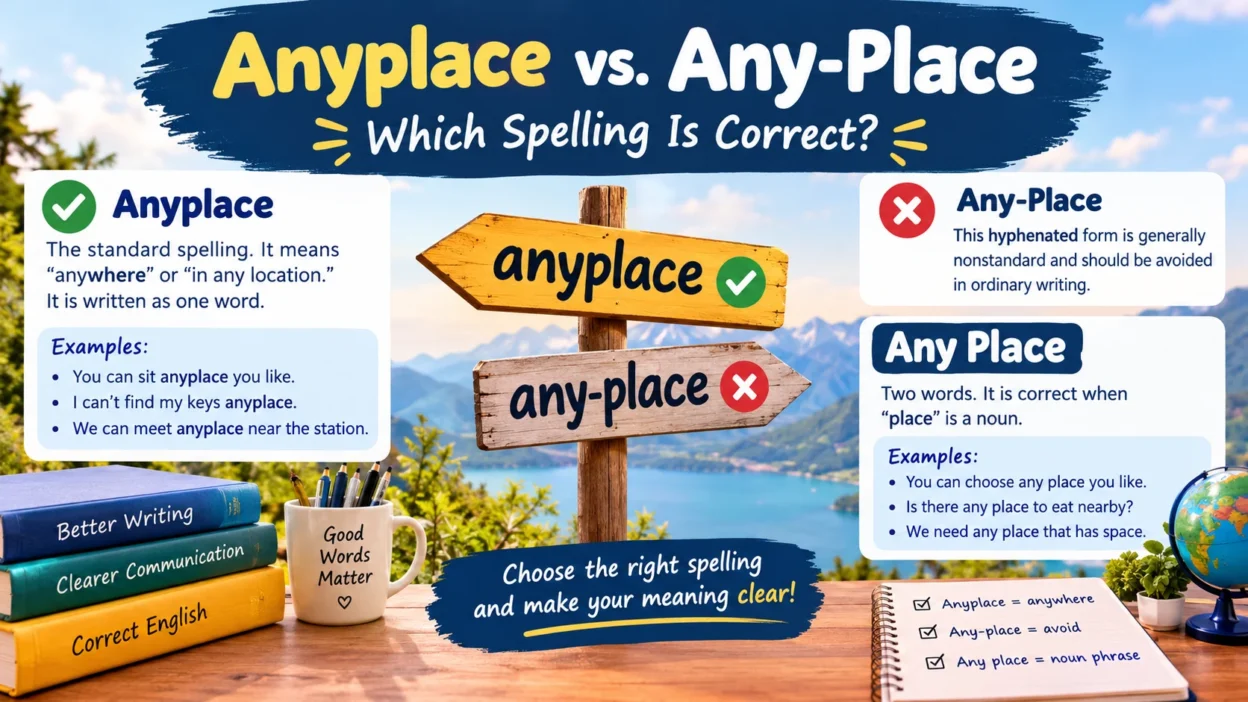
When deciding between anyplace vs. any-place, the correct choice in modern English is anyplace, written as one word. It means “anywhere” or “in any location.” The hyphenated form any-place is generally considered nonstandard and is rarely used in ordinary writing. If you want to express that something can happen or exist in any location, use anyplace.
Both students and experienced writers sometimes wonder if anyplace should be hyphenated. This confusion often arises because English uses hyphens in some compound words, while other combinations are written as one word or two separate words. However, anyplace is an established compound adverb, and its standard spelling does not require a hyphen.
In this guide, you will learn the difference between anyplace and any-place, understand how to use the correct spelling in sentences, and discover related words such as anywhere, everyplace, and someplace.
Quick Answer
Anyplace is the standard spelling in modern English. It means “anywhere” or “in any location.” The hyphenated spelling any-place is generally nonstandard and should be avoided in everyday writing. Use anyplace in sentences such as “You can sit anyplace you like.” For a more formal alternative, consider anywhere.
Why Do People Confuse Anyplace and Any-Place?
People confuse these spellings because English compound words follow different spelling patterns. Some combinations use hyphens, some are written as single words, and others remain separate words.
For example:
- Anyplace: The standard one-word spelling.
- Any-place: A generally nonstandard hyphenated spelling.
- Any place: Two words used when any modifies the noun place.
The distinction between anyplace and any place is particularly important because both can be correct, depending on the sentence.
1. Anyplace: Meaning, Definition, and Usage
Anyplace is an adverb meaning anywhere or in any location. It is commonly used in informal and conversational English.
Examples of Anyplace
- You can sit anyplace you like.
- I cannot find my keys anyplace.
- We can meet anyplace near the station.
- She feels comfortable anyplace she goes.
- You can work from anyplace with an internet connection.
In each example, anyplace refers to a location without specifying one particular spot.
Is Anyplace One Word?
Yes. Anyplace is conventionally written as one word when it means “anywhere.”
Correct: You can put the box anyplace.
Incorrect in standard usage: You can put the box any-place.
For formal writing, anywhere is often a natural alternative.
2. Any-Place: Meaning, Definition, and Usage
Any-place is not the standard spelling of the adverb meaning “anywhere.” In ordinary modern English, the hyphen is unnecessary.
However, the two-word phrase any place is correct when place functions as a noun.
For example:
- You may choose any place in the room.
- Is there any place available for parking?
- We can meet at any place that is convenient for everyone.
In these sentences, any determines the noun place. The words are separate, and no hyphen is needed.
Should You Ever Write Any-Place?
In everyday writing, use anyplace when you mean “anywhere” and any place when you mean an unspecified location as a noun phrase. Avoid any-place unless you are reproducing a specific title, quotation, or unusual stylistic choice that deliberately uses the hyphen.
Anyplace vs. Any-Place vs. Any Place: Comparison Table
| Feature | Anyplace | Any-place | Any place |
|---|---|---|---|
| Standard spelling | Yes | Generally no | Yes |
| Written as | One word | Hyphenated | Two words |
| Grammatical role | Adverb | Nonstandard in ordinary usage | Noun phrase |
| Meaning | Anywhere | Usually intended to mean anywhere | Any unspecified location |
| Example | Sit anyplace you like. | Avoid this spelling. | Choose any place you like. |
| Best use | Everyday and informal writing | Generally avoid | When referring to a place as a noun |
When Should You Use Each Form?
Use Anyplace When You Mean Anywhere
Choose anyplace when discussing an unspecified location.
Examples:
- You can park anyplace along this street.
- I looked anyplace I could think of.
- They can travel anyplace they want.
Use Any Place When Place Is a Noun
Choose any place when the sentence treats place as a noun, often followed by a phrase that describes or identifies it.
Examples:
- Is there any place where we can rest?
- You can choose any place on the map.
- We need any place that can accommodate twenty guests.
A useful test is to ask if you could naturally say “any location.” If so, any place may be appropriate as a noun phrase.
Avoid Any-Place in Ordinary Writing
The hyphenated form is not the conventional choice. Unless a specific stylistic context requires it, write either anyplace or any place.
12 Examples of Anyplace and Any Place in Sentences
Here are practical examples showing the difference.
- Anyplace: You can sit anyplace in the classroom.
- Anyplace: I cannot find my phone anyplace.
- Anyplace: We can meet anyplace after lunch.
- Anyplace: She feels at home anyplace in the world.
- Anyplace: You can access the website from anyplace with internet access.
- Anyplace: He would rather be anyplace but here.
- Any place: Is there any place to buy water nearby?
- Any place: You can choose any place on the list.
- Any place: We could not find any place to park.
- Any place: They need any place that offers enough space.
- Any place: I would like to visit any place with beautiful mountains.
- Any place: Is there any place where we can talk privately?
Notice that the examples with anyplace use it as an adverb, while the examples with any place use place as a noun.
Common Mistakes to Avoid
Mistake 1: Adding an Unnecessary Hyphen
Incorrect: You can sit any-place you want.
Correct: You can sit anyplace you want.
Mistake 2: Treating Anyplace and Any Place as Identical in Every Sentence
Although their meanings can overlap, their grammatical roles differ.
- Anyplace: You can go anyplace.
- Any place: You can choose any place you prefer.
Mistake 3: Assuming Every Compound Word Needs a Hyphen
English spelling does not require hyphens in all compound words. Established forms such as anyplace are written as one word.
Mistake 4: Using Anyplace When a More Formal Word Is Better
Anyplace is acceptable, but anywhere may sound more natural in academic, professional, or formal writing.
Less formal: You can work anyplace.
More formal: You can work anywhere.
Memory Trick: How to Remember the Correct Spelling
Remember this simple rule:
Anyplace = Anywhere
When anyplace means “anywhere,” write it as one word without a hyphen.
For the noun phrase, remember:
Any + place = any place
For example, “Is there any place to sit?” refers to a place as a noun.
Avoid any-place in normal writing because the hyphen is unnecessary.
American vs. British English
The spelling distinction between anyplace and any-place is not primarily an American-versus-British spelling issue.
- American English: Anyplace is used, especially in informal speech and writing. Anywhere is also common.
- British English: Anyplace is understood, but anywhere is often the more natural choice.
- Both varieties: Any place is correct when place functions as a noun.
- Both varieties: Any-place is generally avoided in ordinary modern writing.
If you are writing for an international audience, anywhere is a widely understood alternative.
Similar Words to Anyplace
Several related words express similar meanings, but their usage differs slightly.
| Word | Meaning | Example |
|---|---|---|
| Anywhere | In or to any location | You can sit anywhere. |
| Everywhere | In all places | I looked everywhere. |
| Somewhere | In or to an unspecified place | Let’s go somewhere quiet. |
| Anyplace | Anywhere; in any location | You can work anyplace. |
| Someplace | Somewhere; in some location | I left it someplace safe. |
| Everyplace | Every location; less common in some contexts | We searched everyplace. |
For most formal and general-purpose writing, anywhere is an excellent alternative to anyplace.
Final Verdict: Anyplace or Any-Place?
Anyplace is the correct standard spelling when you mean “anywhere.” It is written as one word and does not need a hyphen.
Use any place when place is a noun, as in “Is there any place to sit?” Avoid any-place in ordinary writing because it is not the conventional spelling.
When in doubt, choose anyplace for the adverb or any place for the noun phrase. You can also use anywhere for a simple, widely understood alternative.
Frequently Asked Questions
1. Is anyplace one word or two?
Anyplace is one word when it means “anywhere.” For example, “You can sit anyplace.” The two-word phrase any place is also correct when place functions as a noun.
2. Is any-place grammatically correct?
Any-place is generally nonstandard in modern everyday English. The usual choices are anyplace and any place, depending on the sentence.
3. Is anyplace a real word?
Yes. Anyplace is an established English word meaning “anywhere” or “in any location.” It is especially common in informal English.
4. What is the difference between anyplace and anywhere?
Both can mean “in or to any location.” Anywhere is widely used across different registers and is often preferred in formal writing, while anyplace can sound more conversational.
5. Is any place correct English?
Yes. Any place is correct when place is used as a noun. For example, “We need any place that has enough room.” In some contexts, “We need a place” would sound more natural.
6. Do Americans say anyplace?
Yes. American English uses anyplace, particularly in informal conversation. Americans also commonly use anywhere, which works in both casual and formal contexts.
7. Which spelling should I use in formal writing?
Use anywhere for a clear, broadly accepted alternative. If you prefer anyplace, write it as one word. Use any place when the sentence requires a noun phrase.
Remember This
- Anyplace: Correct one-word spelling meaning “anywhere.”
- Any-place: Generally nonstandard; avoid it in ordinary writing.
- Any place: Correct two-word noun phrase.
- Anywhere: A widely used alternative, especially in formal writing.
Conclusion
The difference between anyplace and any-place is straightforward: anyplace is the standard one-word spelling when you mean “anywhere,” while any-place is generally not used in conventional modern English. Understanding this distinction will help you write more accurately and avoid unnecessary hyphens.
Remember that any place is also correct when place functions as a noun. By choosing between anyplace, any place, and anywhere according to the sentence, you can communicate your meaning clearly in everyday conversations, academic assignments, and professional writing.

David Henry is a language enthusiast and content writer specializing in synonyms, vocabulary, and word meanings. He creates clear, engaging resources that help readers improve their writing, communication, and English skills.