Choosing between “I will like to” and “I would like to” can be confusing for English learners because both phrases contain the word like. However, they do not express the same meaning, and one is much more natural when making requests or expressing preferences.
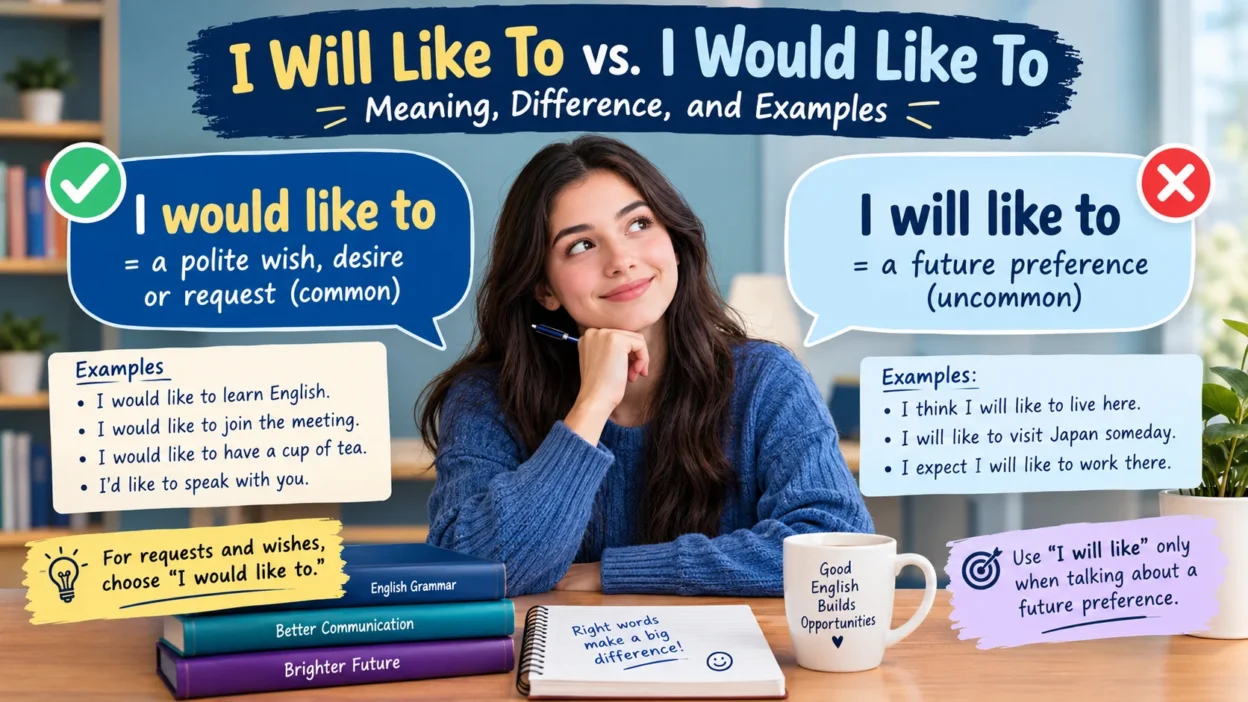
“I would like to” is the correct and natural phrase for politely expressing what you want to do. For example, “I would like to learn English” expresses a present wish or desire. “I will like to” is generally unnatural when expressing a current preference, but it can be grammatically possible when talking about a future preference, such as “I think I will like to live here.”
Understanding the difference helps you speak more politely, write more accurately, and communicate confidently in everyday conversations. if you are talking to a teacher, ordering food, applying for a job, or discussing future plans, choosing the right expression makes your English sound more natural.
Quick Answer
“I would like to” is the standard expression for politely saying what you want or wish to do. “I will like to” refers to liking something in the future, but it is uncommon in ordinary requests. For example, say “I would like to join the meeting,” not “I will like to join the meeting.”
Why Do People Confuse “I Will Like To” and “I Would Like To”?
People often confuse these expressions because both include the verb like and the word to before another verb. They may also assume that will and would can be used interchangeably.
However, the two expressions communicate different ideas:
- I would like to: Expresses a wish, desire, or polite intention.
- I will like to: Suggests a future liking or preference, although this construction is uncommon in everyday English.
The main difference is not simply about grammar. It is also about meaning, politeness, and natural usage.
What Does “I Would Like To” Mean?
“I would like to” is a polite way to express a desire, preference, or intention. It is commonly used in conversations, professional communication, formal requests, and everyday situations.
The structure is:
Subject + would like to + base form of the verb
Examples:
- I would like to speak with the manager.
- She would like to study medicine.
- We would like to book a table.
- They would like to visit London.
In each example, the speaker expresses something they want to do.
When Is “I Would Like To” Used?
Use this expression when you want to sound polite, respectful, or professional.
1. Making a polite request
“I would like to ask you a question.”
2. Expressing a desire
“I would like to learn another language.”
3. Talking about plans or intentions
“I would like to travel abroad next year.”
4. Ordering something
“I would like to have a cup of tea.”
In everyday speech, “I would like to” is often shortened to “I’d like to.”
Example: “I’d like to speak with you.”
What Does “I Will Like To” Mean?
“I will like to” combines the future auxiliary verb will with like. It may be grammatically possible when like refers to a future preference, but it is not the usual way to express a present wish or make a polite request.
The structure is:
Subject + will + like + to + base form of the verb
For example:
- I think I will like to live in this city.
- Perhaps I will like to work remotely in the future.
- I expect I will like to learn more about this subject.
These examples refer to an anticipated future preference. Even here, speakers may prefer more natural alternatives depending on the intended meaning.
When Is “I Will Like To” Appropriate?
Use it cautiously when you genuinely mean that you expect to have a particular preference in the future.
For example:
“I have never tried working abroad, but I think I will like to experience it someday.”
A more natural alternative in many contexts would be:
“I think I will enjoy working abroad someday.”
When you want to express a current wish, choose “I would like to” instead.
Comparison Table: “I Will Like To” vs. “I Would Like To”
| Feature | I will like to | I would like to |
|---|---|---|
| Main meaning | Anticipated future preference | Present wish or desire |
| Common in everyday English | Uncommon | Very common |
| Polite requests | Generally unnatural | Natural and polite |
| Formal communication | Rarely appropriate for requests | Appropriate |
| Expressing a current wish | Not the standard choice | Correct |
| Example | I think I will like to live there. | I would like to live there. |
| Best alternative | I expect I will enjoy it. | I’d like to do it. |
When Should You Use Each Expression?
Use “I Would Like To” for Wishes and Requests
Choose “I would like to” when you want to tell someone what you want to do now or in the future.
Examples:
- I would like to join your team.
- I would like to discuss this issue.
- I would like to improve my writing.
- I would like to visit my grandparents.
Although the action may happen in the future, the desire exists now.
Use “I Will Like To” Only for a Future Preference
This construction is unusual, so consider if another phrase communicates your meaning more naturally.
For example:
Less natural: “I will like to work with you.”
More natural: “I would like to work with you.”
If you mean that you expect to enjoy a future experience, you could say:
“I think I will enjoy working with you.”
The important distinction is between wanting something now and expecting to like something in the future.
12 Examples of “I Will Like To” vs. “I Would Like To”
Here are practical examples to help you choose the right expression.
| Less natural or context-dependent | More natural expression |
|---|---|
| I will like to ask a question. | I would like to ask a question. |
| I will like to learn English. | I would like to learn English. |
| I will like to order a coffee. | I would like to order a coffee. |
| I will like to meet your family. | I would like to meet your family. |
| I will like to apply for this job. | I would like to apply for this job. |
| I will like to travel abroad. | I would like to travel abroad. |
| I will like to speak with you. | I would like to speak with you. |
| I will like to attend the event. | I would like to attend the event. |
| I will like to help you. | I would like to help you. |
| I will like to buy this book. | I would like to buy this book. |
| I will like to join the course. | I would like to join the course. |
| I will like to know more. | I would like to know more. |
In these examples, the second expression is the natural choice because each sentence communicates a present desire or intention.
More Examples in Context
At a restaurant:
“I would like to order the chicken sandwich, please.”
At school:
“I would like to ask my teacher for help.”
At work:
“I would like to discuss the project with you.”
Talking about future expectations:
“I have enjoyed the previous books, so I think I will like the next one.”
Notice that the final example uses will like naturally because it predicts a future feeling. It does not use will like to to make a request.
Common Mistakes to Avoid
1. Using “I Will Like To” for a Polite Request
Incorrect or unnatural: “I will like to speak to the manager.”
Correct: “I would like to speak to the manager.”
2. Assuming “Will” and “Would” Always Mean the Same Thing
Will commonly expresses future actions or predictions. Would can express hypothetical situations, preferences, and polite requests.
Example:
- “I will call you tomorrow.” — A future action.
- “I would like to call you.” — A desire or intention.
3. Forgetting “To” Before the Main Verb
Correct: “I would like to learn English.”
Incorrect: “I would like learn English.”
After would like, use to followed by the base form of the verb.
4. Confusing “Would Like” with “Like”
These expressions have different meanings.
- “I like swimming.” — You enjoy swimming.
- “I would like to swim.” — You want to swim.
5. Using “I Would Like To” When Predicting Enjoyment
If you mean that you expect to enjoy a future experience, use will like or will enjoy where appropriate.
Example: “I think I will like this new course.”
Memory Trick: How to Remember the Difference
Remember this simple rule:
- Would = want: “I would like to learn.”
- Will = future: “I will learn tomorrow.”
- Will like = future preference: “I think I will like this book.”
Whenever you are making a request, expressing a wish, or explaining what you want to do, choose “I would like to.”
This rule works in most everyday and professional situations.
American vs. British English
There is no significant difference between American and British English in the basic use of these expressions.
Both varieties commonly use “I would like to” to express a polite wish or request.
Examples:
- American English: “I would like to make a reservation.”
- British English: “I would like to make a reservation.”
Both are correct and natural.
In informal conversation, speakers in both varieties often use the contraction “I’d like to.”
Example: “I’d like to have some tea.”
The phrase “I will like to” is not the standard choice for polite requests in either variety.
Similar Words and Expressions
Several expressions can help you communicate wishes, preferences, and future expectations more naturally.
| Expression | Meaning | Example |
|---|---|---|
| I would like to | A polite wish or desire | I would like to join. |
| I’d love to | An enthusiastic desire | I’d love to help. |
| I want to | A direct desire | I want to learn. |
| I wish to | A formal expression of desire | I wish to apply. |
| I hope to | A desired future outcome | I hope to succeed. |
| I plan to | An intention or plan | I plan to travel. |
| I will | A future action or decision | I will call you. |
| I expect I will like | A prediction about future preference | I expect I will like the course. |
These alternatives are not always interchangeable. Choose the expression that matches your intended meaning and the level of politeness you need.
Final Verdict: I Will Like To or I Would Like To?
“I would like to” is the correct and natural choice when expressing a wish, desire, or polite request.
For example:
- Correct and natural: “I would like to learn English.”
- Unnatural for a current wish: “I will like to learn English.”
However, “will like” can be appropriate when predicting a future preference, as in “I think I will like this movie.”
The key is to understand what you want to communicate: use would like to for what you want to do, and use will like when predicting what you will enjoy or prefer.
Frequently Asked Questions (FAQs)
1. Is “I will like to” grammatically correct?
It can be grammatically possible in certain contexts, but it is uncommon and usually unnatural for expressing a current wish. In most situations, “I would like to” is the better choice.
2. Is “I would like to” more polite than “I will like to”?
Yes. “I would like to” is the standard polite expression for requests and wishes. “I will like to” does not normally communicate the same polite meaning.
3. Can I say “I will like to join you”?
It is generally better to say, “I would like to join you.” If you are predicting that you will enjoy joining someone in a future activity, you could say, “I think I will enjoy joining you.”
4. What is the difference between “I would like to” and “I want to”?
Both express desire, but “I would like to” is generally more polite and softer. “I want to” is more direct and is often suitable in casual conversations.
5. Can I use “I’d like to” instead of “I would like to”?
Yes. “I’d like to” is the standard contraction of “I would like to.” It is common in spoken English and informal writing.
6. Is “I will like to” correct in American and British English?
Neither American nor British English typically uses “I will like to” for polite requests. Both commonly use “I would like to.” The basic distinction is the same in both varieties.
7. Which is correct: “I would like to learn” or “I would like learning”?
When expressing a desire to do something, “I would like to learn” is the standard construction. For example, “I would like to learn Spanish.” The phrase “I would like learning” is not the usual way to express this meaning.
Remember This
- Use “I would like to” to express a wish, desire, or polite request.
- Use “I will like” when predicting a future preference.
- Use “I’d like to” as a natural contraction of “I would like to.”
- Remember that the action can happen in the future even when you use “I would like to.”
Conclusion
The difference between “I will like to” and “I would like to” is mainly about meaning and natural usage. “I would like to” is the standard expression for communicating what you want to do, making polite requests, and expressing intentions. It works well in everyday conversations, education, and professional communication.
“I will like to” is uncommon when expressing a current desire, although “will like” can be correct when predicting future preferences. By understanding this distinction and practicing the examples in this guide, you can choose the right expression, avoid common grammar mistakes, and speak English more confidently.

David Henry is a language enthusiast and content writer specializing in synonyms, vocabulary, and word meanings. He creates clear, engaging resources that help readers improve their writing, communication, and English skills.