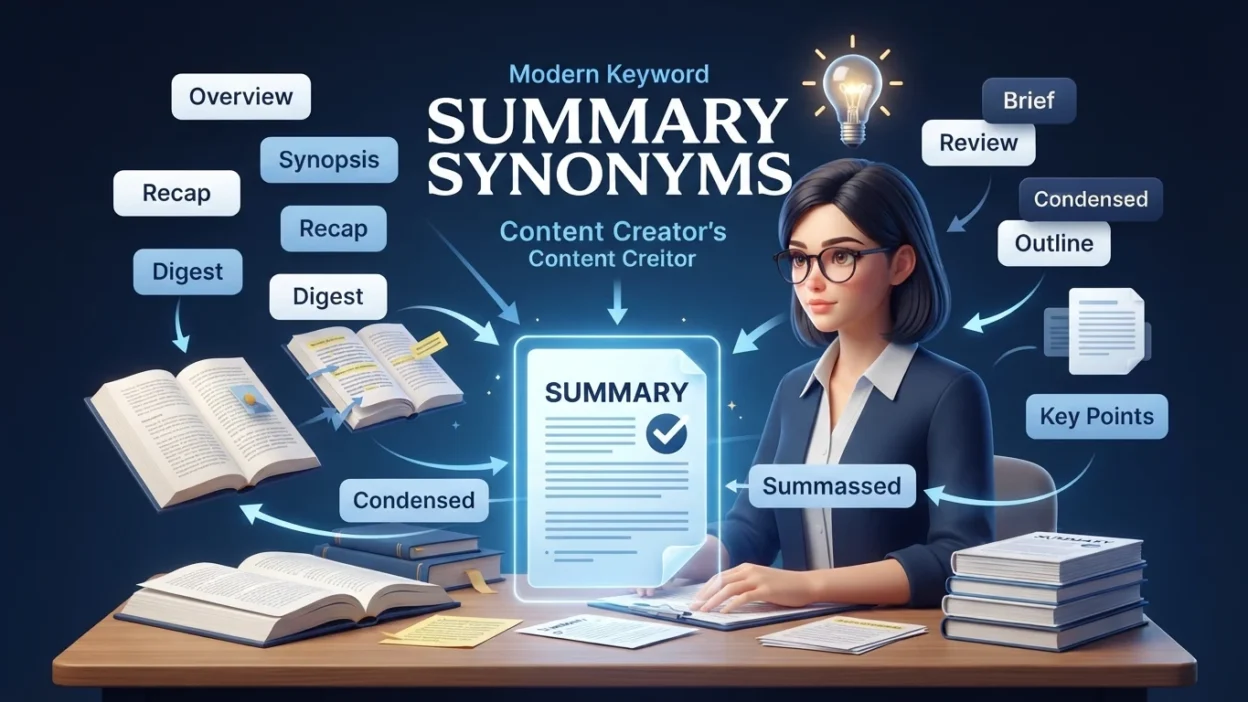
Finding the right summary synonyms can make your writing clearer, more precise, and more engaging. if you are a student, ESL learner, writer, or content creator, knowing different ways to describe a summary helps you avoid repetition and choose words that fit the situation.
A summary is a short version of a longer piece of information. It presents the main ideas, important points, or essential details without including everything from the original text. Depending on your purpose, you might need a word that means a brief overview, a condensed explanation, a review, or a final statement.
Before exploring summary synonyms, however, there is an important correction to the requested topic: “demure” is not related to “summary.” Demure means modest, reserved, or quiet in behavior or appearance. Therefore, the synonyms below focus correctly on summary and its related meanings so the article matches the target keyword and search intent.
What Does “Summary” Mean?
A summary is a shortened explanation of the main points of something longer, such as an article, book, report, speech, meeting, or research paper.
Example:
The teacher asked the students to write a summary of the chapter.
Here, the students are expected to explain the chapter’s most important ideas without repeating every detail.
Tone and Usage of “Summary”
The word summary is neutral and widely used in academic, professional, and everyday English.
You can use it when discussing:
- Books and articles
- Research papers
- Meetings
- Reports
- Presentations
- News stories
- Movies and television shows
- Speeches
- Academic assignments
- Business documents
30 Summary Synonyms
Below are 30 useful alternatives to summary, with simple meanings, examples, and usage contexts.
1. Overview
Meaning: A general description of the main points.
Example:
The report provides an overview of the company’s annual performance.
Best usage: Academic, business, and professional writing.
2. Synopsis
Meaning: A brief account of the main events or ideas.
Example:
The publisher requested a synopsis of the novel.
Best usage: Books, films, stories, and creative writing.
3. Recap
Meaning: A short explanation of what happened previously.
Example:
The presenter gave a quick recap of yesterday’s meeting.
Best usage: Informal speech, meetings, television, and online content.
4. Abstract
Meaning: A brief description of the main points of a research paper or academic work.
Example:
Read the abstract before deciding whether the research is relevant.
Best usage: Academic and scientific writing.
5. Digest
Meaning: A condensed collection or explanation of important information.
Example:
The weekly digest highlights the most important industry news.
Best usage: Newsletters, media, business, and information services.
6. Outline
Meaning: A structured presentation of the main points.
Example:
She prepared an outline before writing her essay.
Best usage: Essays, presentations, speeches, and planning.
7. Review
Meaning: An examination or discussion of something that may include its main points.
Example:
The manager gave a review of the team’s progress.
Best usage: Evaluations, books, products, projects, and meetings.
8. Recapitulation
Meaning: A formal repetition or restatement of the main points.
Example:
The final section offers a recapitulation of the study’s findings.
Best usage: Formal and academic writing.
9. Condensation
Meaning: A shortened version of something that keeps its essential information.
Example:
The textbook includes a condensation of the original historical account.
Best usage: Formal, literary, and academic contexts.
10. Abridgment
Meaning: A shortened version of a longer text.
Example:
The student read an abridgment of the classic novel.
Best usage: Books and literary works.
11. Digest version
Meaning: A shortened form containing the most important information.
Example:
Here is the digest version of the proposal for busy executives.
Best usage: Business and informal explanations.
12. Brief
Meaning: A short statement or explanation of essential information.
Example:
The lawyer prepared a brief summary of the case.
Best usage: Professional, legal, academic, and business contexts.
13. Synopsis
Meaning: A concise account of the essential content of a work.
Example:
The author wrote a synopsis to explain the story to potential publishers.
Best usage: Stories, novels, films, and publishing.
14. Recap
Meaning: A concise review of events or information already discussed.
Example:
Let’s have a quick recap before we begin the next lesson.
Best usage: Informal and conversational situations.
15. Abstracted account
Meaning: A shortened account containing the essential information.
Example:
The database provides an abstracted account of each research study.
Best usage: Research and information management.
16. Account
Meaning: A description or report of events or information.
Example:
The journalist gave an account of the day’s events.
Best usage: News, history, storytelling, and reporting.
17. Report
Meaning: A written or spoken presentation of information.
Example:
The manager submitted a report on the project’s progress.
Best usage: Business, academic, professional, and official contexts.
18. Statement
Meaning: A clear expression of information, facts, or ideas.
Example:
The final statement explains the project’s main objectives.
Best usage: Formal and professional contexts.
19. Briefing
Meaning: A concise explanation of important information, often given to someone who needs to understand a situation quickly.
Example:
The director attended a morning briefing about the new project.
Best usage: Business, government, military, and professional settings.
20. Recapitulatory account
Meaning: An account that brings together previously discussed information.
Example:
The conclusion provides a recapitulatory account of the major arguments.
Best usage: Highly formal or academic writing.
21. Digest summary
Meaning: A condensed presentation of the most useful information.
Example:
The newsletter contains a digest summary of recent developments.
Best usage: News, business, and informational content.
22. Condensed version
Meaning: A shorter version of an original text or explanation.
Example:
The website offers a condensed version of the full report.
Best usage: General, academic, and digital content.
23. Short account
Meaning: A brief description of events, ideas, or information.
Example:
He gave us a short account of what happened.
Best usage: Everyday and narrative English.
24. Brief account
Meaning: A concise description containing important information.
Example:
The article begins with a brief account of the historical background.
Best usage: Academic, journalistic, and formal writing.
25. Capsule
Meaning: A very short version of something that communicates its essential idea.
Example:
The introduction provides a capsule of the author’s main argument.
Best usage: Creative and concise writing.
26. Capsule summary
Meaning: An extremely brief summary of the most important information.
Example:
The executive received a capsule summary before the meeting.
Best usage: Business and professional communication.
27. Recap statement
Meaning: A statement that briefly repeats the important information.
Example:
The speaker ended with a recap statement of the three main recommendations.
Best usage: Presentations, lessons, and meetings.
28. Abstract summary
Meaning: A concise presentation of the central ideas of a larger work.
Example:
The researcher included an abstract summary of the experiment.
Best usage: Academic and research contexts.
29. Executive summary
Meaning: A concise presentation of the most important information in a longer report.
Example:
The executive summary explains the proposal’s goals and expected results.
Best usage: Business reports, proposals, and professional documents.
30. Bottom line
Meaning: The most important conclusion or essential point.
Example:
The bottom line is that the project needs more funding.
Best usage: Informal business and conversational English.
Summary Synonyms at a Glance
| Synonym | Main Meaning | Best Context |
|---|---|---|
| Overview | General picture | Academic/business |
| Synopsis | Brief account | Books/films |
| Recap | Review of previous information | Informal |
| Abstract | Academic summary | Research |
| Digest | Condensed information | News/business |
| Outline | Main points in structure | Essays/planning |
| Review | Examination or discussion | Projects/books |
| Abridgment | Shortened text | Literature |
| Briefing | Concise information | Professional |
| Executive summary | Key business information | Reports |
| Bottom line | Most important conclusion | Conversational/business |
| Condensed version | Shortened original | General |
| Brief account | Short description | Formal/general |
| Capsule | Extremely short version | Concise writing |
Summary vs. Overview
These words are similar, but they are not always interchangeable.
A summary usually condenses the important points of a longer piece of information.
An overview gives a general picture of a subject without necessarily condensing a specific original text.
Summary:
The article summary explains its three main arguments.
Overview:
The introduction provides an overview of the topic.
Summary vs. Synopsis
A synopsis is commonly used for stories, books, films, and other creative works.
A summary has a much wider range of uses.
Summary:
I wrote a summary of the research paper.
Synopsis:
The writer submitted a synopsis of her new novel.
Summary vs. Abstract
An abstract is particularly associated with academic, scientific, and research writing.
A summary can be used in almost any context.
Abstract:
The research abstract explains the methodology and findings.
Summary:
The student wrote a summary of the entire article.
Summary vs. Recap
A recap usually refers to information that has already been discussed or events that have already happened.
A summary can describe the contents of a document, book, speech, or discussion.
Recap:
Let’s recap what we learned yesterday.
Summary:
Here is a summary of the entire chapter.
How to Choose the Right Summary Synonym
Choosing the best synonym depends on your audience, purpose, and tone.
For Academic Writing
Use:
- Abstract
- Overview
- Outline
- Recapitulation
- Condensed version
These words work well in essays, research papers, assignments, and scholarly writing.
For Business Writing
Use:
- Executive summary
- Briefing
- Overview
- Brief
- Report
These choices sound professional and are useful for reports, proposals, presentations, and meetings.
For Books and Stories
Use:
- Synopsis
- Abridgment
- Brief account
- Condensed version
- Short account
These words are especially suitable when discussing literature, films, and narratives.
For Casual Conversation
Use:
- Recap
- Brief
- Overview
- Bottom line
- Short account
These options sound natural in everyday conversations and informal discussions.
For Extremely Short Explanations
Use:
- Capsule
- Capsule summary
- Brief
- Bottom line
- Condensed version
These choices emphasize brevity and essential information.
Why Use Different Summary Synonyms?
Using different vocabulary can make your writing more natural and precise.
Instead of repeatedly writing:
“Here is a summary…”
you could write:
“Here is a brief overview…”
or:
“The following synopsis explains the story…”
or:
“The executive summary highlights the proposal’s main objectives.”
Each expression communicates a slightly different idea.
Common Mistakes When Using Summary Synonyms
1. Treating Every Synonym as Identical
Although synonyms share similar meanings, they often have different contexts.
For example, abstract is more appropriate for academic research than recap.
2. Using Formal Words in Casual Situations
Words such as recapitulation and abridgment can sound overly formal in everyday conversation.
In casual situations, recap or overview is usually more natural.
3. Confusing a Review With a Summary
A review may include opinions or evaluation, while a summary mainly presents important information.
4. Confusing an Outline With a Summary
An outline generally organizes main points, while a summary explains the essential content in shortened form.
Frequently Asked Questions About Summary Synonyms
What is the best synonym for summary?
Overview is one of the most versatile alternatives, while synopsis, abstract, and recap may be better depending on context.
What is a formal word for summary?
Formal alternatives include abstract, recapitulation, abridgment, and condensation.
What is a simple synonym for summary?
Simple choices include overview, brief, recap, and short account.
What is a synonym for a short summary?
You can use brief, capsule, overview, recap, or condensed version.
Is synopsis the same as summary?
They are closely related, but synopsis is especially common when describing books, films, stories, or other creative works.
Is recap a synonym for summary?
Yes. Recap can mean a short review or summary of information that has already been discussed.
Final Thoughts
Understanding summary synonyms gives you more flexibility when writing and speaking. Instead of relying on one word repeatedly, you can select a term that matches your exact meaning and audience.
Use overview for a general picture, synopsis for stories and creative works, abstract for research, recap for previously discussed information, and executive summary for professional reports. Choosing the right word makes your English more accurate, natural, and effective.

Daniel Jack is a language enthusiast and content writer who specializes in synonyms, vocabulary, and word meanings. He creates clear, engaging resources that help readers improve communication and expand their English skills.