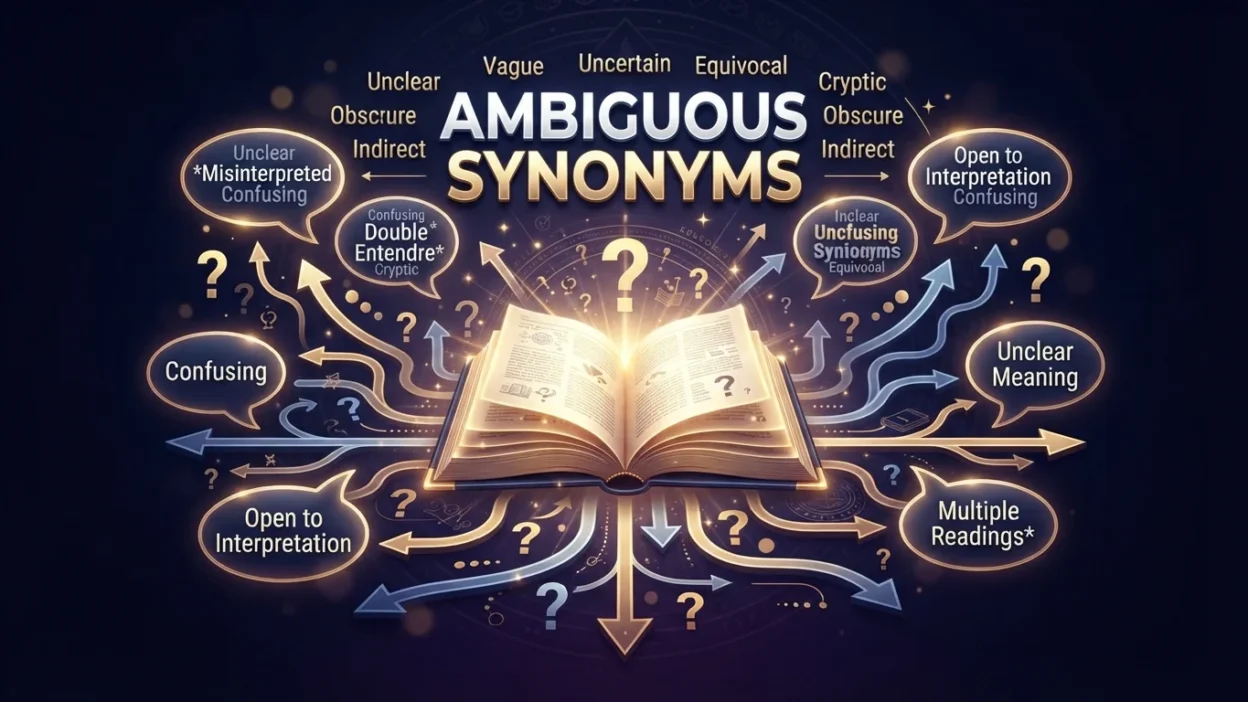
When something is ambiguous, it can have more than one possible meaning or may not be clear enough to understand immediately. The word is useful when describing unclear language, uncertain situations, confusing statements, or information that can be interpreted in different ways.
Learning ambiguous synonyms can help students, ESL learners, writers, and content creators communicate with greater accuracy. Although words such as unclear, vague, uncertain, and equivocal are related to ambiguous, each one has a slightly different meaning or tone.
This guide explains 30 useful synonyms for ambiguous in simple English, with examples and usage contexts. It also shows how to choose the best alternative depending on what you want to express.
Note: The original instructions mentioned “demure” and synonyms of “demure,” but the target keyword is “ambiguous synonyms.” To keep the article accurate, relevant, and SEO-friendly, this guide focuses on ambiguous and its synonyms.
What Does “Ambiguous” Mean?
Ambiguous means unclear, open to more than one interpretation, or having multiple possible meanings.
For example:
“The manager gave an ambiguous answer.”
This means the manager’s answer was not clear and could be understood in different ways.
The word ambiguous can describe language, instructions, messages, behavior, situations, or decisions.
Ambiguous in Simple English
Ambiguous = not clear because there are two or more possible meanings or interpretations.
Tone and Usage
“Ambiguous” is usually neutral or slightly critical. It is common in academic writing, professional communication, literature, journalism, and everyday conversation.
For example:
- Academic: “The question is ambiguous.”
- Professional: “The instructions are ambiguous.”
- Literary: “The ending of the novel is intentionally ambiguous.”
- Everyday: “His message was ambiguous, so I wasn’t sure what he meant.”
30 Ambiguous Synonyms
Below are 30 useful alternatives to ambiguous, explained in simple English.
1. Unclear
Meaning: Difficult to understand or not expressed clearly.
Example: “The teacher’s instructions were unclear.”
Best usage: Everyday speech, instructions, explanations, and communication.
2. Vague
Meaning: Not specific or detailed enough.
Example: “She gave a vague description of the person.”
Best usage: When information lacks specific details.
3. Uncertain
Meaning: Not known, definite, or sure.
Example: “The outcome of the competition remains uncertain.”
Best usage: Situations involving doubt or an unknown result.
4. Equivocal
Meaning: Deliberately unclear or open to different interpretations.
Example: “The politician gave an equivocal response.”
Best usage: Formal writing, politics, debates, and careful statements.
5. Indefinite
Meaning: Not clearly fixed, defined, or limited.
Example: “The project was postponed for an indefinite period.”
Best usage: Time, plans, limits, and formal contexts.
6. Obscure
Meaning: Difficult to understand, see, or recognize.
Example: “The meaning of the ancient inscription is obscure.”
Best usage: Difficult ideas, historical references, or unfamiliar information.
7. Confusing
Meaning: Difficult to understand because something is complicated or unclear.
Example: “The new software has a confusing interface.”
Best usage: Everyday situations, instructions, explanations, and experiences.
8. Puzzling
Meaning: Difficult to explain or understand.
Example: “His sudden decision was puzzling.”
Best usage: Strange behavior, surprising events, or unusual situations.
9. Cryptic
Meaning: Mysteriously unclear and difficult to understand.
Example: “She sent me a cryptic message.”
Best usage: Mysterious messages, clues, comments, or statements.
10. Ambivalent
Meaning: Having mixed or conflicting feelings about something.
Example: “He felt ambivalent about moving to another city.”
Best usage: Emotions, attitudes, opinions, and personal decisions.
11. Doubtful
Meaning: Not certain or likely to be true.
Example: “It is doubtful that the team will finish today.”
Best usage: Predictions, possibilities, and situations involving uncertainty.
12. Indistinct
Meaning: Not clear or sharply defined.
Example: “We could hear an indistinct voice in the distance.”
Best usage: Sounds, images, shapes, boundaries, and unclear impressions.
13. Nebulous
Meaning: Very unclear, vague, or difficult to define.
Example: “The company has a nebulous plan for future growth.”
Best usage: Abstract ideas, plans, goals, and concepts.
14. Fuzzy
Meaning: Unclear, imprecise, or difficult to remember or understand.
Example: “I have a fuzzy memory of that event.”
Best usage: Informal conversations, memories, ideas, and details.
15. Murky
Meaning: Difficult to understand, especially because information is hidden or complicated.
Example: “The details surrounding the agreement remain murky.”
Best usage: Complicated situations, unclear motives, and hidden information.
16. Ambagious
Meaning: Using indirect or complicated language rather than expressing something directly.
Example: “His ambagious explanation made the simple issue seem complicated.”
Best usage: Formal or literary descriptions of indirect communication.
17. Double-edged
Meaning: Having two possible effects, meanings, or consequences.
Example: “Her comment was double-edged and could be seen as praise or criticism.”
Best usage: Statements, actions, or situations with opposing interpretations or effects.
18. Open-ended
Meaning: Not limited to one definite answer or outcome.
Example: “The interviewer asked an open-ended question.”
Best usage: Questions, discussions, stories, and situations with multiple possible outcomes.
19. Interpretive
Meaning: Requiring personal interpretation to understand its meaning.
Example: “The poem has an interpretive quality that encourages different readings.”
Best usage: Literature, art, poetry, and academic discussion.
20. Indeterminate
Meaning: Not clearly decided, established, or known.
Example: “The exact cause of the problem is indeterminate.”
Best usage: Academic, scientific, technical, and formal writing.
21. Unresolved
Meaning: Not settled, answered, or solved.
Example: “Several questions about the incident remain unresolved.”
Best usage: Problems, disputes, questions, and investigations.
22. Inconclusive
Meaning: Not providing a definite answer or result.
Example: “The evidence was inconclusive.”
Best usage: Research, investigations, experiments, medical studies, and debates.
23. Ambagious
Meaning: Indirect or difficult to follow because the expression does not communicate an idea plainly.
Example: “The writer’s ambagious style made the argument harder to follow.”
Best usage: Formal descriptions of indirect language.
24. Imprecise
Meaning: Not exact or accurate enough.
Example: “The report uses imprecise language to describe the results.”
Best usage: Measurements, descriptions, definitions, and technical writing.
25. General
Meaning: Not specific or detailed.
Example: “His answer was too general to address the question.”
Best usage: Explanations, answers, descriptions, and broad statements.
26. Indirect
Meaning: Not stated or expressed directly.
Example: “Her indirect response left us wondering what she really wanted.”
Best usage: Communication, hints, suggestions, and social situations.
27. Meaningless
Meaning: Lacking a clear or understandable meaning in a particular context.
Example: “Without context, the phrase seemed meaningless.”
Best usage: Statements or expressions that fail to communicate useful meaning.
28. Oblique
Meaning: Indirect and not expressed in a straightforward way.
Example: “He made an oblique reference to the disagreement.”
Best usage: Formal writing, criticism, literature, and indirect references.
29. Elusive
Meaning: Difficult to identify, define, understand, or achieve.
Example: “A clear explanation remained elusive.”
Best usage: Ideas, answers, solutions, meanings, or things that are difficult to grasp.
30. Noncommittal
Meaning: Not clearly expressing a definite opinion, decision, or commitment.
Example: “The manager remained noncommittal about the proposed changes.”
Best usage: Opinions, decisions, negotiations, and professional communication.
Comparison Table: Ambiguous Synonyms
| Synonym | Main Meaning | Best Used For | Tone |
|---|---|---|---|
| Unclear | Hard to understand | General communication | Neutral |
| Vague | Lacking detail | Descriptions and answers | Neutral |
| Uncertain | Not known or definite | Outcomes and possibilities | Neutral |
| Equivocal | Intentionally unclear | Formal statements | Formal |
| Indefinite | Not fixed or defined | Time and plans | Formal |
| Obscure | Difficult to understand | Ideas and references | Formal |
| Confusing | Hard to understand | Everyday situations | Casual |
| Puzzling | Difficult to explain | Strange situations | Neutral |
| Cryptic | Mysteriously unclear | Messages and clues | Descriptive |
| Ambivalent | Mixed feelings | Emotions and opinions | Neutral |
| Doubtful | Unlikely or uncertain | Predictions | Neutral |
| Indistinct | Not sharply defined | Sounds and images | Neutral |
| Nebulous | Extremely vague | Abstract ideas | Formal |
| Fuzzy | Imprecise or unclear | Memories and ideas | Informal |
| Murky | Unclear or complicated | Situations and information | Neutral |
| Open-ended | No single fixed answer | Questions and discussions | Neutral |
| Inconclusive | No definite result | Evidence and research | Formal |
| Imprecise | Not exact | Technical descriptions | Formal |
| Indirect | Not directly expressed | Communication | Neutral |
| Oblique | Indirectly expressed | References and comments | Formal |
Ambiguous vs. Vague: What’s the Difference?
Ambiguous and vague are close in meaning, but they are not always interchangeable.
Something is ambiguous when it can reasonably have two or more possible meanings.
“I saw her duck.”
This sentence can mean that I saw the woman lower her head, or that I saw the bird belonging to her.
Something is vague when it lacks enough detail to provide a clear or specific picture.
“I’ll meet you sometime soon.”
This is vague because “sometime soon” does not give a specific time.
Simple rule:
- Ambiguous = more than one possible interpretation
- Vague = not enough specific information
Ambiguous vs. Unclear
These words overlap, but unclear is broader.
Unclear simply means something is difficult to understand.
Ambiguous specifically suggests that something may have multiple possible meanings or interpretations.
For example:
“The instructions are unclear.”
You may simply not understand them.
“The instructions are ambiguous.”
The instructions may allow two or more interpretations.
Ambiguous vs. Uncertain
Ambiguous usually describes something that can be interpreted in multiple ways.
Uncertain describes something that is not known, definite, or predictable.
For example:
“The statement is ambiguous.”
There are multiple possible interpretations.
“The result is uncertain.”
Nobody knows what the result will be.
How to Choose the Right Ambiguous Synonym
Choosing the best synonym depends on what kind of uncertainty or lack of clarity you want to communicate.
For Everyday Conversations
Choose:
- Unclear
- Confusing
- Vague
- Fuzzy
These are natural and easy to understand.
Example:
“The directions were unclear.”
For Formal or Academic Writing
Choose:
- Equivocal
- Indeterminate
- Inconclusive
- Imprecise
- Obscure
- Nebulous
These words can make formal writing more precise when used correctly.
Example:
“The available evidence was inconclusive.”
When Something Has Multiple Interpretations
Choose:
- Ambiguous
- Equivocal
- Open-ended
- Interpretive
- Double-edged
These words work well when different readers or listeners may understand something differently.
When Information Lacks Detail
Choose:
- Vague
- General
- Imprecise
- Indefinite
These are especially useful when a statement does not provide enough specific information.
When Someone Avoids a Direct Answer
Choose:
- Equivocal
- Indirect
- Oblique
- Noncommittal
These are useful for describing communication where someone does not clearly state their position.
When Something Is Difficult to Understand
Choose:
- Obscure
- Cryptic
- Puzzling
- Murky
- Nebulous
These work well for difficult ideas, strange messages, or complicated situations.
Why Learn Ambiguous Synonyms?
Knowing different synonyms for ambiguous improves your vocabulary and helps you communicate more precisely.
Instead of repeatedly saying “unclear,” you can choose a more exact word.
For example:
- A vague answer lacks detail.
- An equivocal answer avoids a definite position.
- An inconclusive test does not provide a definite result.
- A cryptic message is mysterious and difficult to decode.
- An indeterminate result has not been clearly established.
- An ambivalent person has conflicting feelings.
These differences matter in essays, professional writing, conversations, and content creation.
Frequently Asked Questions About Ambiguous Synonyms
What is the best synonym for ambiguous?
Unclear is one of the simplest general synonyms. However, vague, equivocal, uncertain, and indeterminate may be better depending on the context.
What is a simple word for ambiguous?
Unclear is probably the easiest everyday alternative to ambiguous.
Is vague the same as ambiguous?
Not exactly. Vague means lacking clear detail, while ambiguous usually means having multiple possible interpretations.
What is the opposite of ambiguous?
Common opposites include clear, definite, explicit, specific, precise, and unambiguous.
What is a formal synonym for ambiguous?
Depending on the context, equivocal, indeterminate, obscure, or inconclusive can work in formal writing.
Can ambiguous have a positive meaning?
Yes. Ambiguity is not always a weakness. In literature, poetry, art, and storytelling, ambiguity can encourage readers to think about multiple interpretations.
Final Thoughts on Ambiguous Synonyms
Understanding ambiguous synonyms is about more than memorizing a list of similar words. The best synonym depends on exactly what is unclear and why.
Use unclear for general lack of understanding, vague when details are missing, uncertain for unknown outcomes, and equivocal for deliberately noncommittal language. Words such as cryptic, obscure, murky, and nebulous are useful when something is especially difficult to interpret.
For students, ESL learners, writers, and content creators, learning these distinctions can make communication more natural and precise. Rather than using the same word repeatedly, choose the synonym that best expresses your intended meaning and tone.

David Henry is a language enthusiast and content writer specializing in synonyms, vocabulary, and word meanings. He creates clear, engaging resources that help readers improve their writing, communication, and English skills.