Introduction
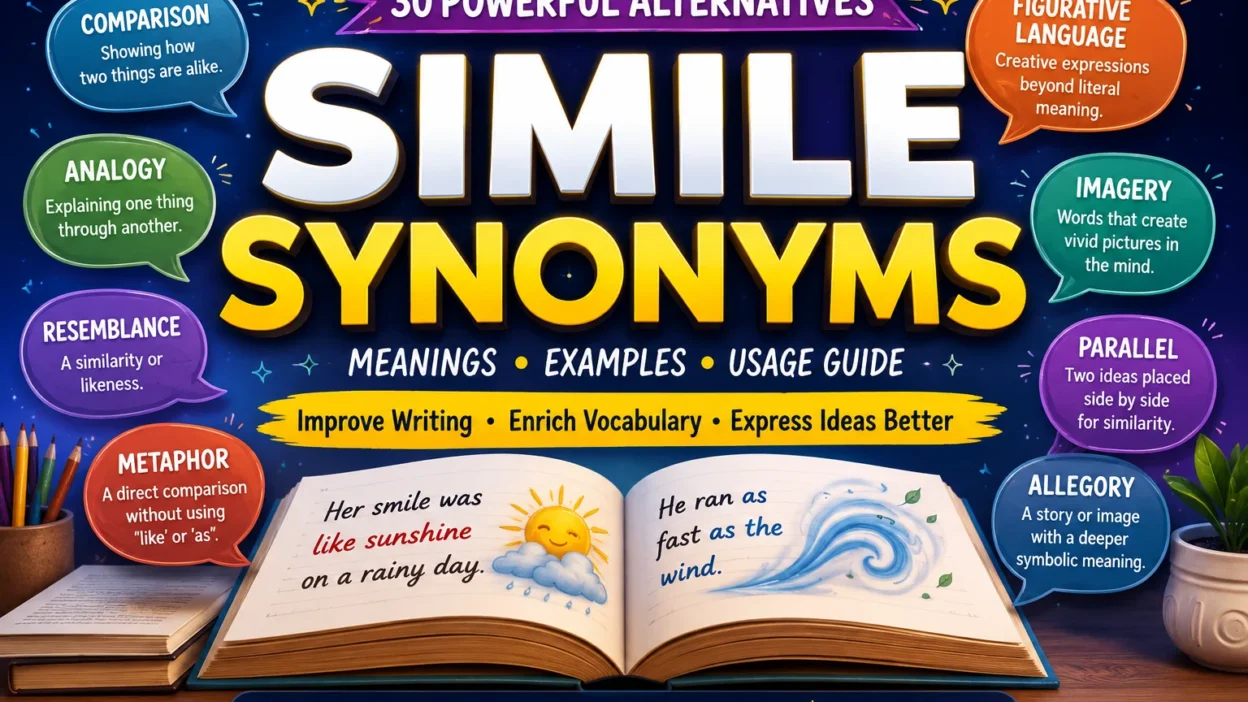
Finding the right simile synonyms can help students, ESL learners, writers, and content creators express comparisons more naturally and accurately. A simile is a figure of speech that compares two different things, usually by using words such as “like” or “as.” For example, “Her smile was like sunshine” compares a smile to sunshine to create a vivid image.
However, the best alternative to the word simile depends on what you mean. Some related terms describe a direct comparison, while others refer to broader forms of figurative language, analogy, imagery, or comparison. Understanding these differences can make your writing clearer and more expressive.
This guide explains 30 simile synonyms and closely related words, along with simple meanings, example sentences, and the situations where each term works best.
What Does “Simile” Mean?
A simile is a literary device that compares two different things using words such as like, as, similar to, or resembles.
Simple definition
Simile: A comparison between two different things to make an idea easier to imagine or understand.
Example
“The baby was as quiet as a mouse.”
The sentence compares the baby’s quietness with a mouse to create a clear mental picture.
Tone and usage
Similes are common in:
- Creative writing
- Poetry
- Stories
- Speeches
- Advertising
- Everyday conversation
- Descriptive essays
- Social media content
A simile can make writing colorful, emotional, humorous, dramatic, or memorable.
30 Simile Synonyms and Related Words
Not every word below is a perfect dictionary synonym for simile. Some are closely related terms used when discussing comparison and figurative language. Choosing the right one depends on your intended meaning.
1. Comparison
Meaning: Showing how two things are alike or different.
Example:
“Her voice was compared to a soft melody.”
Best usage context: General writing, education, and everyday explanations.
2. Analogy
Meaning: A comparison used to explain an idea by showing how it is similar to something else.
Example:
“Learning a language is like building a bridge between cultures.”
Best usage context: Essays, teaching, academic writing, and explanations.
3. Resemblance
Meaning: A similarity between two people, things, or ideas.
Example:
“There is a strong resemblance between his writing style and his teacher’s.”
Best usage context: Describing similarity rather than a specific figure of speech.
4. Similarity
Meaning: A quality or feature that two things share.
Example:
“The writer highlights the similarity between the ocean and the sky.”
Best usage context: Academic, analytical, and formal writing.
5. Metaphor
Meaning: A comparison that says one thing is another without normally using “like” or “as.”
Example:
“Her voice was music to my ears.”
Best usage context: Literature, poetry, creative writing, and figurative language.
Note: A metaphor is closely related to a simile but is not the same thing.
6. Figurative Comparison
Meaning: A comparison that creates meaning beyond the literal words.
Example:
“The author uses a figurative comparison to describe the character’s courage.”
Best usage context: Literary analysis and educational writing.
7. Figure of Speech
Meaning: A creative or nonliteral way of using language.
Example:
“The phrase ‘as busy as a bee’ is a figure of speech.”
Best usage context: Grammar lessons, literature, and language learning.
8. Figurative Language
Meaning: Language that uses creative comparisons or expressions rather than only literal meanings.
Example:
“The poem uses figurative language to describe love.”
Best usage context: Literature, poetry, and classroom discussions.
9. Illustration
Meaning: An example or comparison that makes an idea easier to understand.
Example:
“The teacher used an illustration to explain the difficult concept.”
Best usage context: Education and explanatory writing.
10. Parallel
Meaning: Something that is similar to another thing in a particular way.
Example:
“The writer draws a parallel between childhood and spring.”
Best usage context: Essays, literary criticism, and formal analysis.
11. Parallelism
Meaning: A relationship in which two ideas or structures are presented as similar or corresponding.
Example:
“The poem creates parallelism between nature and human emotions.”
Best usage context: Literary analysis and advanced writing.
12. Correlation
Meaning: A connection or relationship between two things.
Example:
“The study examines the correlation between sleep and concentration.”
Best usage context: Academic, scientific, and analytical writing.
Note: This is not normally a literary synonym for simile.
13. Association
Meaning: A connection made between two ideas, objects, or concepts.
Example:
“The writer creates an association between darkness and fear.”
Best usage context: Literary analysis, psychology, and general writing.
14. Connection
Meaning: A relationship or link between two things.
Example:
“The story creates a connection between the character’s journey and the changing seasons.”
Best usage context: General writing and literary discussion.
15. Link
Meaning: A relationship connecting one idea or thing with another.
Example:
“The author establishes a link between freedom and happiness.”
Best usage context: Simple explanations, essays, and analytical writing.
16. Parallel Comparison
Meaning: A comparison that places two related ideas side by side.
Example:
“The article makes a parallel comparison between traditional and modern education.”
Best usage context: Essays, reports, and educational content.
17. Equivalence
Meaning: A state in which two things are considered equal or similar in a particular respect.
Example:
“The poem suggests an equivalence between courage and hope.”
Best usage context: Formal, academic, and analytical contexts.
18. Similar Expression
Meaning: A phrase or expression that communicates an idea similar to another expression.
Example:
“‘As cold as ice’ is a similar expression to other comparisons describing extreme cold.”
Best usage context: ESL learning and vocabulary development.
19. Descriptive Comparison
Meaning: A comparison used to make a description clearer or more vivid.
Example:
“Her eyes were like stars” is a descriptive comparison.
Best usage context: Creative writing, storytelling, and poetry.
20. Poetic Comparison
Meaning: A creative comparison commonly used in poetry or artistic writing.
Example:
“The poet uses a poetic comparison to describe the moon as a silver lamp.”
Best usage context: Poetry and literary criticism.
21. Literary Comparison
Meaning: A comparison used as part of literary expression or analysis.
Example:
“The author makes a literary comparison between the storm and the hero’s anger.”
Best usage context: Literature classes, essays, and book reviews.
22. Imagery
Meaning: Descriptive language that helps readers form a mental picture or experience.
Example:
“The simile creates vivid imagery by comparing the snow to a white blanket.”
Best usage context: Poetry, storytelling, and literary analysis.
Note: Imagery is broader than simile.
23. Description
Meaning: Words used to explain what something looks, sounds, feels, tastes, or seems like.
Example:
“The writer’s description makes the forest feel mysterious.”
Best usage context: General writing and storytelling.
24. Symbolic Comparison
Meaning: A comparison in which one thing represents or suggests another idea.
Example:
“The author uses a symbolic comparison between a broken window and lost trust.”
Best usage context: Literary analysis and creative writing.
25. Representation
Meaning: Something that stands for, reflects, or expresses another idea.
Example:
“The river becomes a representation of the character’s changing life.”
Best usage context: Literature, art, and academic analysis.
26. Metonymic Expression
Meaning: An expression in which one related thing is used to refer to another.
Example:
“The crown announced a new policy” uses “crown” to refer to the monarch or monarchy.
Best usage context: Advanced literary and rhetorical analysis.
Note: Metonymy is different from simile.
27. Allegory
Meaning: A story, image, or extended expression in which characters or events represent deeper ideas.
Example:
“The story works as an allegory for the struggle between freedom and control.”
Best usage context: Literature, political writing, and symbolic storytelling.
28. Comparison Phrase
Meaning: A phrase that directly compares one thing with another.
Example:
“Her face was like a rose” contains a comparison phrase.
Best usage context: ESL learning, grammar lessons, and writing instruction.
29. Comparative Expression
Meaning: A phrase or construction that expresses similarity or difference.
Example:
“The writer uses a comparative expression to make the character’s speed easier to imagine.”
Best usage context: Grammar, vocabulary, and language education.
30. Figurative Analogy
Meaning: A creative comparison that explains or emphasizes an idea through another image or concept.
Example:
“The teacher described memory as a library, creating a figurative analogy.”
Best usage context: Essays, teaching, speeches, and creative writing.
Quick Comparison Table: Simile and Related Terms
| Term | Main Meaning | Best Used For |
|---|---|---|
| Simile | Comparison using “like” or “as” | Creative descriptions |
| Comparison | Showing similarities or differences | General writing |
| Analogy | Explaining one idea through another | Teaching and essays |
| Metaphor | Direct figurative comparison | Creative writing |
| Resemblance | Similarity between things | Describing likeness |
| Similarity | Shared quality or feature | Academic writing |
| Figure of speech | Nonliteral language | Language study |
| Figurative language | Creative, nonliteral expression | Literature |
| Imagery | Language creating mental pictures | Poetry and stories |
| Allegory | Extended symbolic meaning | Literature and storytelling |
| Parallelism | Correspondence between ideas | Literary analysis |
| Description | Detailed explanation of something | General writing |
Simile vs. Metaphor: What’s the Difference?
Similes and metaphors are closely related, but they work differently.
A simile usually uses words such as like or as:
“The child was as quick as a rabbit.”
A metaphor makes a direct comparison:
“The child was a rabbit on the track.”
The first example tells the reader that the child is similar to a rabbit. The second presents the child as a rabbit in a figurative sense.
Easy rule
Simile = comparison using “like” or “as.”
Metaphor = direct comparison without “like” or “as.”
Simile vs. Analogy
A simile is usually short and descriptive, while an analogy is often used to explain a larger or more complicated idea.
Simile
“The water was as smooth as glass.”
Analogy
“Learning to write well is like learning to play an instrument: both require regular practice.”
The simile creates an image. The analogy helps explain an idea.
Simile vs. Comparison
The word comparison is much broader than simile.
A comparison can involve:
- Similarities
- Differences
- Objects
- People
- Ideas
- Literary devices
A simile is one specific type of comparison.
For example:
“Her hair was like silk.”
This is both a comparison and a simile.
How to Choose the Right Simile Synonym
The best alternative depends on what you are trying to communicate.
For general comparison
Use:
- Comparison
- Similarity
- Resemblance
- Connection
- Link
These words are useful when you are simply discussing how two things relate.
For creative writing
Use:
- Simile
- Metaphor
- Imagery
- Poetic comparison
- Descriptive comparison
These terms are particularly useful when discussing expressive or artistic language.
For academic writing
Use:
- Analogy
- Comparison
- Parallel
- Parallelism
- Correlation
- Equivalence
These choices work well when explaining relationships between concepts.
For literary analysis
Use:
- Simile
- Metaphor
- Figurative language
- Figure of speech
- Literary comparison
- Symbolic comparison
- Imagery
- Allegory
These terms help you describe how authors create meaning.
For ESL learners
Start with simple words such as:
- Comparison
- Similarity
- Resemblance
- Description
- Connection
- Comparison phrase
These are easier to understand before moving to more advanced literary terminology.
Examples of Similes in Everyday English
Similes are not limited to poems and novels. They are common in everyday communication.
Examples
- “He runs like the wind.”
- “The room was as quiet as a library.”
- “Her cheeks were red like roses.”
- “The new computer is as fast as lightning.”
- “The baby slept like a log.”
- “His hands were cold as ice.”
These expressions help listeners quickly imagine a quality, action, or situation.
Why Are Similes Useful?
Similes make language more vivid and memorable.
Instead of writing:
“The athlete was very fast.”
A writer might say:
“The athlete was as fast as lightning.”
The second sentence gives the reader a stronger mental image.
Similes can also:
- Make descriptions more interesting
- Explain unfamiliar ideas
- Create emotional effects
- Improve storytelling
- Add personality to writing
- Make speeches memorable
- Help readers visualize scenes
Common Mistakes When Using Similes
1. Mixing similes and metaphors
Avoid combining two different structures unnecessarily.
Unclear:
“Her voice was like music that was a golden river.”
Better:
“Her voice was like music.”
Or:
“Her voice was a golden river.”
2. Using weak comparisons
A comparison should help the reader understand or visualize something.
Instead of an ordinary comparison, choose an image that adds meaning.
Weak:
“The car was like a car.”
Better:
“The car moved like a silent shadow.”
3. Using too many similes
Too many comparisons can make writing feel forced.
Use similes where they add value rather than placing one in every sentence.
4. Forgetting the intended tone
A humorous simile may not fit a serious essay.
For example, “He moved like a confused penguin” may work in comedy but not in formal academic writing.
Always consider your audience and purpose.
Simile Synonyms for Different Writing Situations
| Writing Situation | Recommended Term |
|---|---|
| Creative description | Simile |
| Explaining a complex concept | Analogy |
| Direct figurative comparison | Metaphor |
| Discussing shared qualities | Similarity |
| Describing likeness | Resemblance |
| Creating mental pictures | Imagery |
| Discussing nonliteral language | Figurative language |
| Analyzing poetry | Poetic comparison |
| Academic comparison | Comparison |
| Symbolic storytelling | Allegory |
| Discussing literary techniques | Figure of speech |
Frequently Asked Questions About Simile Synonyms
What is the closest synonym for simile?
Comparison is one of the closest general alternatives. However, simile specifically refers to a comparison that commonly uses like or as.
Is metaphor a synonym for simile?
Not exactly. A metaphor and a simile are both forms of figurative comparison, but their structures are different.
What is another word for a comparison?
Depending on the context, alternatives include analogy, similarity, resemblance, parallel, connection, and comparison itself.
What is a simile in simple English?
A simile is a comparison between two different things using words such as like or as.
Can “analogy” replace “simile”?
Sometimes, but not always. An analogy is generally used to explain an idea through similarity, while a simile is usually a shorter figurative comparison.
Why do writers use similes?
Writers use similes to make descriptions clearer, more vivid, emotional, memorable, and imaginative.
Final Thoughts on Simile Synonyms
Understanding simile synonyms is about more than memorizing alternative words. The important skill is knowing how each related term works and when it fits your sentence.
Comparison, similarity, resemblance, analogy, metaphor, imagery, figurative language, and literary comparison can all relate to the idea of a simile, but they do not have exactly the same meanings.
For everyday writing, comparison and similarity are useful choices. For creative writing, simile, metaphor, imagery, and poetic comparison are more precise. For academic or explanatory writing, analogy and comparison may be better options.
When you understand these differences, you can choose vocabulary that matches your meaning, audience, and tone. if you are a student, ESL learner, writer, or content creator, using the right term can make your communication more accurate and effective.

Amber Amy is a passionate writer at SynonymLot, dedicated to helping readers discover better words, expand their vocabulary, and improve their writing through clear, accurate, and easy-to-understand synonym guides.