
If you have ever checked the if in another country, you may have wondered why one temperature is given in Fahrenheit while another is shown in Celsius. Both are temperature scales used to describe how hot or cold something is, but they use different reference points and numbers. Celsius is widely used around the world, while Fahrenheit is mainly used in the United States and a few other places.
The good news is that understanding Fahrenheit vs Celsius is easier than it first appears. Once you know their basic reference points and the simple conversion formulas, you can quickly compare temperatures. Whether you are reading a weather forecast, following a cooking recipe, traveling, studying science, or learning English, knowing the difference can prevent confusion.
Quick Answer
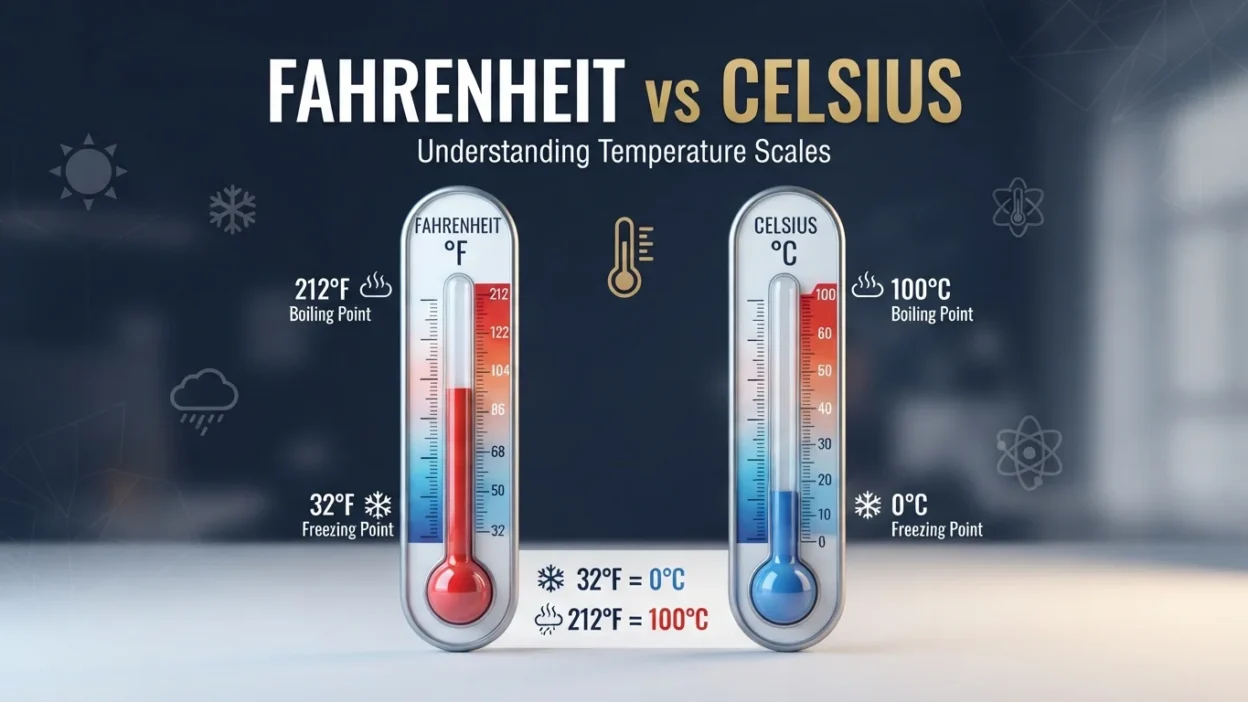
Celsius and Fahrenheit are two different temperature scales. Celsius sets water’s freezing point at 0°C and boiling point at 100°C at standard atmospheric pressure. Fahrenheit sets those points at 32°F and 212°F. To convert between them, use simple formulas: °F = (°C × 9/5) + 32 and °C = (°F − 32) × 5/9.
Why Do People Confuse Fahrenheit and Celsius?
People often confuse Fahrenheit and Celsius because both measure the same thing: temperature. The difference is the scale used to express that temperature.
For example:
- 0°C = 32°F
- 20°C = 68°F
- 30°C = 86°F
- 37°C = 98.6°F
- 100°C = 212°F
The numbers can therefore look very different even when they describe exactly the same temperature.
Another reason for confusion is that Fahrenheit and Celsius are common in different parts of the world. Someone familiar with Celsius may see 75°F and not immediately know whether that feels cold or hot. Likewise, someone accustomed to Fahrenheit may need to mentally convert 25°C.
What Is Fahrenheit?
Fahrenheit (°F) is a temperature scale named after physicist Daniel Gabriel Fahrenheit. It is commonly used for everyday temperatures in the United States.
Some useful Fahrenheit reference points are:
- 32°F = water freezes
- 50°F = cool weather
- 68°F = mild indoor or outdoor temperature
- 86°F = hot weather
- 98.6°F = traditional reference value for normal human body temperature
- 212°F = water boils at standard atmospheric pressure
Fahrenheit is particularly familiar in American weather reports, household thermostats, and some cooking instructions.
Fahrenheit Example
If a weather report says 80°F, that is about 26.7°C. It generally describes warm weather.
What Is Celsius?
Celsius (°C) is a temperature scale used in most countries around the world. It is also the standard temperature scale commonly used in scientific contexts.
The Celsius scale is based on two familiar points for water at standard atmospheric pressure:
- 0°C = water freezes
- 100°C = water boils
Between these points are 100 degrees, which makes the scale especially convenient for many scientific and educational purposes.
Celsius Example
If the weather forecast says 25°C, that is 77°F. For many people, this represents warm and comfortable weather.
Fahrenheit vs Celsius: Comparison Table
| Feature | Fahrenheit | Celsius |
|---|---|---|
| Symbol | °F | °C |
| Freezing point of water | 32°F | 0°C |
| Boiling point of water | 212°F | 100°C |
| Common everyday use | United States | Most countries |
| Degree size | Smaller | Larger |
| Main reference system | Fahrenheit scale | Celsius scale |
| Common weather example | 70°F | 21°C |
| Scientific use | Less common | Common |
When Should You Use Fahrenheit or Celsius?
The correct scale often depends on your location, audience, or field.
Use Fahrenheit When:
- You are writing for an American audience.
- You are discussing U.S. weather forecasts.
- You are following a recipe that gives temperatures in Fahrenheit.
- You are using an American thermostat.
- You are describing temperatures in a context where Fahrenheit is the established convention.
Use Celsius When:
- You are writing for an international audience.
- You are discussing temperatures in most countries outside the United States.
- You are working with standard scientific measurements.
- You are following a recipe using Celsius.
- You are discussing weather in countries that use the metric system.
When communicating internationally, giving both values can be helpful. For example: 25°C (77°F).
Fahrenheit vs Celsius: 10+ Everyday Examples
Here are some common temperature conversions to help you develop an intuitive understanding.
1. Freezing Point
0°C = 32°F
This is the freezing point of water under standard atmospheric pressure.
2. Cold Winter Weather
−10°C = 14°F
This is very cold weather in many places.
3. Cool Weather
10°C = 50°F
A temperature of 10°C can feel cool, especially with wind or rain.
4. Mild Weather
15°C = 59°F
This is generally considered mild rather than hot.
5. Comfortable Temperature
20°C = 68°F
This is a common reference point for a comfortable indoor or outdoor temperature.
6. Warm Weather
25°C = 77°F
This is warm weather for many people.
7. Hot Weather
30°C = 86°F
A temperature of 30°C is generally considered hot.
8. Very Hot Weather
35°C = 95°F
This can feel very hot, particularly with high humidity.
9. Human Body Temperature Reference
37°C = 98.6°F
This is the traditional reference value often used for human body temperature, although normal body temperature varies among individuals and circumstances.
10. Water Boiling Point
100°C = 212°F
Water boils at 100°C at standard atmospheric pressure.
11. Freezing in Fahrenheit
32°F = 0°C
This is an important conversion to remember because Fahrenheit and Celsius use different numbers for the freezing point of water.
12. Room Temperature Example
72°F ≈ 22.2°C
A room at 72°F is roughly 22°C.
How Do You Convert Fahrenheit to Celsius?
To convert Fahrenheit to Celsius, subtract 32 and multiply by 5/9.
Formula:
°C = (°F − 32) × 5/9
Example
Suppose the temperature is 86°F.
First subtract 32:
86 − 32 = 54
Then multiply by 5/9:
54 × 5/9 = 30
Therefore:
86°F = 30°C
How Do You Convert Celsius to Fahrenheit?
To convert Celsius to Fahrenheit, multiply by 9/5 and then add 32.
Formula:
°F = (°C × 9/5) + 32
Example
Suppose the temperature is 25°C.
First multiply by 9/5:
25 × 9/5 = 45
Then add 32:
45 + 32 = 77
Therefore:
25°C = 77°F
Common Mistakes
1. Assuming the Scales Have the Same Numbers
A common mistake is thinking that 30°C equals 30°F. It does not.
30°C = 86°F
2. Forgetting the 32
When converting Fahrenheit to Celsius, you must subtract 32 before multiplying by 5/9.
Incorrect:
°C = °F × 5/9
Correct:
°C = (°F − 32) × 5/9
3. Mixing Up the Formulas
Remember:
- Fahrenheit → Celsius: subtract 32, then multiply by 5/9
- Celsius → Fahrenheit: multiply by 9/5, then add 32
4. Treating Celsius and Centigrade as Completely Different Scales
Celsius and the older term centigrade refer to the same temperature scale in ordinary modern usage. Celsius is the standard term today.
5. Assuming a Temperature Feels Exactly the Same to Everyone
Temperature perception can vary because of humidity, wind, clothing, activity, and individual differences. A numerical temperature does not guarantee that everyone will experience it in exactly the same way.
Memory Trick
A simple way to remember the basic relationship is:
Celsius → Fahrenheit: multiply, then add 32.
Fahrenheit → Celsius: subtract 32, then multiply.
You can also memorize a few useful pairs:
- 0°C = 32°F
- 20°C = 68°F
- 25°C = 77°F
- 30°C = 86°F
- 100°C = 212°F
These reference points make estimating temperatures much easier.
American vs British English
The terms Fahrenheit and Celsius are used in both American and British English. The major difference is often the temperature scale preferred in everyday contexts.
In the United States, weather forecasts commonly use Fahrenheit.
In the United Kingdom, weather forecasts commonly use Celsius.
For example:
- American weather report: “It will be 75°F today.”
- British weather report: “It will be 24°C today.”
Both sentences describe approximately the same warm temperature.
The spelling and pronunciation of the scale names generally do not create the same kind of American-British vocabulary difference seen with words such as color/colour or center/centre. The main distinction is practical usage.
Similar Words and Related Temperature Terms
Several words and expressions are connected with Fahrenheit and Celsius.
Temperature
The general measure of how hot or cold something is.
Example:
“The temperature is 25°C today.”
Degree
A unit used to express temperature on a scale.
Example:
“The temperature dropped by five degrees.”
Thermometer
A device used to measure temperature.
Example:
“Use a thermometer to check the water temperature.”
Celsius
A temperature scale using degrees Celsius, written as °C.
Example:
“The recipe says to heat the oven to 180°C.”
Fahrenheit
A temperature scale using degrees Fahrenheit, written as °F.
Example:
“The oven should be set to 350°F.”
Freezing Point
The temperature at which a substance changes from liquid to solid under specified conditions.
For water at standard atmospheric pressure, it is 0°C or 32°F.
Boiling Point
The temperature at which a liquid boils under specified conditions.
For water at standard atmospheric pressure, it is 100°C or 212°F.
Final Verdict
Fahrenheit and Celsius are two different ways of measuring temperature. Neither describes a different physical kind of temperature; they simply use different numerical scales.
For quick reference, remember that 0°C equals 32°F, 20°C equals 68°F, and 30°C equals 86°F. If you frequently work with both systems, learning a few common conversions can make weather forecasts, recipes, travel information, and everyday conversations much easier to understand.
FAQs
Is Celsius the same as Fahrenheit?
No. Celsius and Fahrenheit are different temperature scales. They measure the same physical quantity but use different numerical values and reference points.
Which is colder, 0°C or 0°F?
0°F is colder than 0°C. In fact, 0°F is approximately −17.8°C.
What is 20°C in Fahrenheit?
20°C = 68°F.
What is 30°C in Fahrenheit?
30°C = 86°F.
What is 100°F in Celsius?
100°F is approximately 37.8°C.
What is the difference between Celsius and Fahrenheit?
The scales have different numerical reference points and different-sized degrees. Water freezes at 0°C and 32°F, while it boils at 100°C and 212°F under standard atmospheric pressure.
Which temperature scale is used in the United States?
The United States commonly uses Fahrenheit for everyday temperatures, especially weather reports and household temperature settings.
Which temperature scale is used in most countries?
Celsius is the commonly used everyday temperature scale in most countries around the world.
Remember This
The most useful Fahrenheit-to-Celsius relationship is:
°C = (°F − 32) × 5/9
The Celsius-to-Fahrenheit relationship is:
°F = (°C × 9/5) + 32
And these five conversions are worth remembering:
0°C = 32°F
10°C = 50°F
20°C = 68°F
30°C = 86°F
100°C = 212°F
Conclusion
Understanding Fahrenheit vs Celsius is mainly about learning that the two scales use different numbers for the same temperatures. Celsius is common internationally and in science, while Fahrenheit remains especially common in everyday life in the United States. Knowing a few key reference points makes the difference much easier to understand.
Whether you are checking the weather, cooking, traveling, studying, or communicating with someone from another country, temperature conversions are a useful everyday skill. Once you remember 0°C = 32°F and learn the basic conversion formulas, switching between Fahrenheit and Celsius becomes straightforward.

David Henry is a language enthusiast and content writer specializing in synonyms, vocabulary, and word meanings. He creates clear, engaging resources that help readers improve their writing, communication, and English skills.