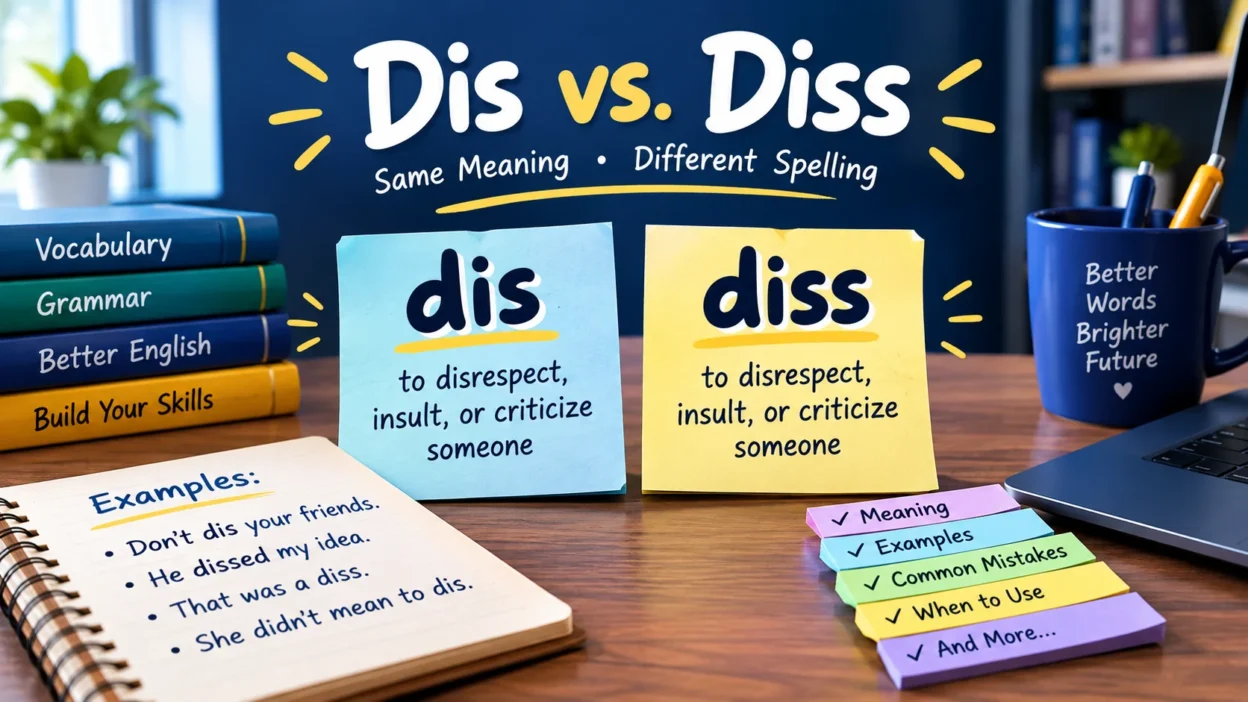
Have you ever seen the words dis and diss and wondered which spelling is correct? Although they look and sound almost identical, they have slightly different uses. Both words are commonly associated with disrespect, insults, and informal language, especially in conversations about music, pop culture, and everyday communication.
The main difference between dis and diss is their spelling and usage. Dis is an informal word meaning to disrespect, criticize, or insult someone. Diss is a variant spelling of the same word, often used in slang, hip-hop culture, and informal writing. Both spellings are widely recognized, but dis is also used as a prefix in words such as disagree and dislike, where it has a different grammatical function.
In this guide, you will learn what each word means, how to use it correctly, and how to distinguish between them with practical examples. You will also discover common mistakes, useful memory tricks, and the differences between American and British English.
Quick Answer: Dis vs. Diss
Dis and diss both mean to disrespect, insult, or criticize someone in informal English. Dis is a common spelling, while diss is an alternative spelling frequently associated with slang and hip-hop culture. Both can be used as verbs or nouns, as in “Don’t dis me” and “That was a diss.”
Why Do People Confuse Dis and Diss?
People often confuse dis and diss because they:
- Have the same pronunciation in everyday English.
- Share the same general meaning when used as slang.
- Appear in informal conversations, social media posts, and music.
- Can both describe an insult or an act of disrespect.
- Are sometimes used interchangeably in casual writing.
The confusion is understandable because neither spelling changes the basic meaning when the word is used as slang.
However, dis- also appears as a prefix in standard English words such as disagree, dislike, and disapprove. In these cases, it is not the slang word dis.
1. What Does Dis Mean?
Dis is an informal verb or noun that means to disrespect, insult, criticize, or show a lack of regard for someone or something.
It is commonly used in casual conversations, online discussions, and popular culture.
Dis as a Verb
As a verb, dis means to insult or treat someone disrespectfully.
Examples:
- Don’t dis your friends just to impress others.
- He dissed my idea during the meeting.
- She felt that her classmates were dissing her.
Dis as a Noun
As a noun, dis refers to an insult or an act of disrespect.
Examples:
- That comment was a direct dis.
- His joke sounded like a dis against his teammate.
- I didn’t mean that as a dis.
Origin and Usage of Dis
The slang word dis is associated with the shortening of disrespect. It became particularly familiar through African American English and hip-hop culture and is now widely used in informal English.
The word can be used in everyday conversations, but it is generally less appropriate in formal academic or professional writing.
2. What Does Diss Mean?
Diss is an alternative spelling of the informal word dis. It means to disrespect, insult, or criticize someone or something.
The spelling diss is especially familiar in hip-hop culture, music discussions, and informal online communication.
Diss as a Verb
As a verb, diss means to insult or show disrespect toward someone.
Examples:
- Don’t diss someone for making a mistake.
- The rapper dissed his rival in a new song.
- She thought her friend was dissing her outfit.
Diss as a Noun
As a noun, diss refers to an insult or a disrespectful remark.
Examples:
- His comment was a harsh diss.
- The song contains a diss directed at another artist.
- She responded to the diss with a joke.
Origin and Usage of Diss
The spelling diss is a variant of dis and is often associated with the word disrespect. It is especially common in discussions of diss tracks, which are songs that criticize or insult another person, often a rival.
The spelling is widely understood in informal English.
Dis vs. Diss: Comparison Table
|
Feature
|
Dis
|
Diss
|
| — | — | — |
|
Meaning
|
To disrespect or insult
|
To disrespect or insult
|
|
Part of speech
|
Verb or noun
|
Verb or noun
|
|
Pronunciation
|
/dɪs/
|
/dɪs/
|
|
Tone
|
Informal, slang
|
Informal, slang
|
|
Common context
|
Everyday slang and casual speech
|
Slang, music, and hip-hop culture
|
|
Example as a verb
|
Don’t dis him.
|
Don’t diss him.
|
|
Example as a noun
|
That was a dis.
|
That was a diss.
|
|
Formal writing
|
Generally avoided as slang
|
Generally avoided as slang
|
Key takeaway: When dis and diss are used as slang, they generally have the same meaning. The difference is mainly spelling and usage preference.
When Should You Use Dis or Diss?
Choosing between dis and diss depends on the context and the style of writing.
When to Use Dis
Use dis when:
- You want a short, informal way to express disrespect.
- You are writing casual dialogue or a social media post.
- You are using the spelling commonly seen in everyday slang.
Example: “Don’t dis your teammates.”
When to Use Diss
Use diss when:
- You are discussing insults in hip-hop or music culture.
- You are writing about a diss track or a verbal insult.
- You prefer the alternative spelling in informal writing.
Example: “The artist released a diss track about his rival.”
When Neither Is Appropriate
In formal writing, consider using words such as insult, disrespect, criticize, or belittle.
Example:
- Informal: “He dissed my work.”
- Formal: “He criticized my work.”
12 Examples of Dis and Diss in Sentences
Here are practical examples showing how both spellings work in everyday English.
Examples Using Dis
- Don’t dis your friends when they are trying to help you.
- He dissed my suggestion without listening to the details.
- That remark sounded like a dis against the entire team.
- She didn’t mean to dis anyone during the discussion.
- Stop dissing people because of their appearance.
- His comment was an unnecessary dis.
Examples Using Diss
- The rapper released a diss track aimed at his rival.
- Don’t diss someone just because they have a different opinion.
- She felt hurt when her classmates dissed her presentation.
- That was a clever diss, but it was still disrespectful.
- The singer responded to the diss with a new song.
- He thought the joke was funny, but his friend took it as a diss.
Common Mistakes When Using Dis and Diss
Even though the words are similar, learners sometimes use them incorrectly.
Mistake 1: Thinking They Have Completely Different Meanings
Incorrect assumption: Dis means disrespect, while diss means something entirely different.
Correction: Both spellings can express disrespect or an insult when used as slang.
Mistake 2: Treating Diss as a Formal Word
Incorrect: “The manager issued a diss regarding the employee’s performance.”
Better: “The manager criticized the employee’s performance.”
Diss is informal and may sound inappropriate in professional communication.
Mistake 3: Confusing Dis With the Prefix Dis-
The prefix dis- appears in words such as:
- Disagree
- Dislike
- Disapprove
- Disconnect
These words are not examples of the slang word dis.
Mistake 4: Using Dis or Diss in Academic Writing
Instead of writing “The author dissed the opposing argument,” use a more precise phrase such as “The author criticized the opposing argument.”
Mistake 5: Forgetting the Correct Verb Forms
Both spellings can take regular verb endings.
|
Base form
|
Past tense
|
-ing form
|
| — | — | — |
|
Dis
|
D is s e d (dissed)
|
Dissing
|
|
Diss
|
Dissed
|
Dissing
|
The correct past-tense spelling is dissed, and the -ing form is dissing.
Memory Trick: How to Remember Dis vs. Diss
Use this simple trick:
- Dis = disrespect: Think of the connection between dis and disrespect.
- Diss = insult: Think of a diss track or a disrespectful remark.
Remember that both spellings can describe the same action. If you are writing about a song that insults another artist, diss track is a familiar expression.
American vs. British English: Dis or Diss?
Both dis and diss are understood in American and British English when used as informal slang.
|
Variety
|
Common usage
|
| — | — |
|
American English
|
Both spellings appear in casual speech and writing.
|
|
British English
|
Both spellings are understood in informal contexts.
|
|
Hip-hop culture
|
Diss is especially familiar in expressions such as diss track.
|
|
Formal English
|
More precise words such as insult or criticize are preferred.
|
There is no strict American-versus-British spelling rule that makes one spelling universally correct and the other incorrect.
Similar Words to Dis and Diss
If you want to express disrespect or criticism more precisely, consider these alternatives.
|
Word
|
Meaning
|
Example
|
| — | — | — |
|
Insult
|
To offend someone with words or actions
|
He insulted his teammate.
|
|
Disrespect
|
To show a lack of respect
|
Don’t disrespect your classmates.
|
|
Criticize
|
To express disapproval or point out faults
|
She criticized the proposal.
|
|
Mock
|
To make fun of someone
|
They mocked his accent.
|
|
Belittle
|
To make someone seem less important
|
He belittled her achievements.
|
|
Ridicule
|
To make someone the object of laughter or scorn
|
The audience ridiculed the idea.
|
|
Offend
|
To upset or hurt someone’s feelings
|
His remark offended her.
|
|
Put down
|
To make someone feel inferior
|
She put down her colleague.
|
These words are not always interchangeable. For example, criticize can be neutral or constructive, while insult usually involves an offensive or disrespectful act.
Final Verdict: Dis vs. Diss
Dis and diss are both acceptable informal spellings when referring to an insult or an act of disrespect.
- Use dis for a common informal spelling.
- Use diss when discussing slang, music, or expressions such as diss track.
- Use insult, disrespect, or criticize in formal writing.
The most important point is that both spellings can carry the same meaning. The choice depends on context and writing style rather than a strict difference in definition.
Frequently Asked Questions (FAQs)
1. Is dis or diss the correct spelling?
Both dis and diss are recognized informal spellings of the slang word meaning to insult or disrespect someone. Neither is universally incorrect in this context.
2. What does diss mean in slang?
In slang, diss means to insult, criticize, or disrespect someone. It can also refer to an insulting comment or remark.
3. Is dis short for disrespect?
Yes. The slang word dis is associated with disrespect and is used to describe an insult or an act of disrespect.
4. What is a diss track?
A diss track is a song that criticizes, insults, or challenges another person, often a rival in music or popular culture.
5. Is dis a real word?
Yes. Dis is recognized as an informal slang word meaning to disrespect or insult someone. It can also appear as a prefix in standard English words.
6. Can diss be used as a verb?
Yes. Diss can be used as a verb. For example, “He dissed my idea” means that he criticized or disrespected the idea.
7. Are dis and diss pronounced the same?
Yes. When used as slang, both are generally pronounced /dɪs/, rhyming with miss and kiss.
Remember This
- Dis: An informal spelling meaning to disrespect or insult.
- Diss: An alternative spelling with the same general meaning.
- Diss track: A song that criticizes or insults someone.
- Formal alternatives: Insult, disrespect, criticize, or belittle.
Both spellings work in informal English, but the right choice depends on the context.
Conclusion
The difference between dis and diss is mainly a matter of spelling and usage. Both words can mean to insult, criticize, or disrespect someone, and both are commonly used in informal English. The spelling diss is especially familiar in music-related expressions such as diss track.
For everyday slang, either spelling can work. For academic, professional, or formal writing, choose a more precise word such as insult, disrespect, or criticize. Understanding the context will help you use these words naturally and confidently.

David Henry is a language enthusiast and content writer specializing in synonyms, vocabulary, and word meanings. He creates clear, engaging resources that help readers improve their writing, communication, and English skills.