Have you ever wondered if to use “agreed” or “agree” in a sentence? Both words come from the same verb, agree, but they are used in different grammatical situations. Choosing the correct form depends on the tense, sentence structure, and meaning you want to express.
The word “agree” is the base form of the verb. It is used to express that someone shares an opinion, accepts an idea, or has the same view as another person. “Agreed” is the past tense and past participle of “agree.” It describes agreement that happened in the past or is used with helping verbs to form different grammatical structures. For example, you can say “I agree with you” when you share someone’s opinion now, but “I agreed with you” when describing a past situation. Understanding these differences will help you write more naturally, avoid common grammar mistakes, and communicate clearly in everyday conversations, academic writing, and professional settings.
Quick Answer: Agreed or Agree?
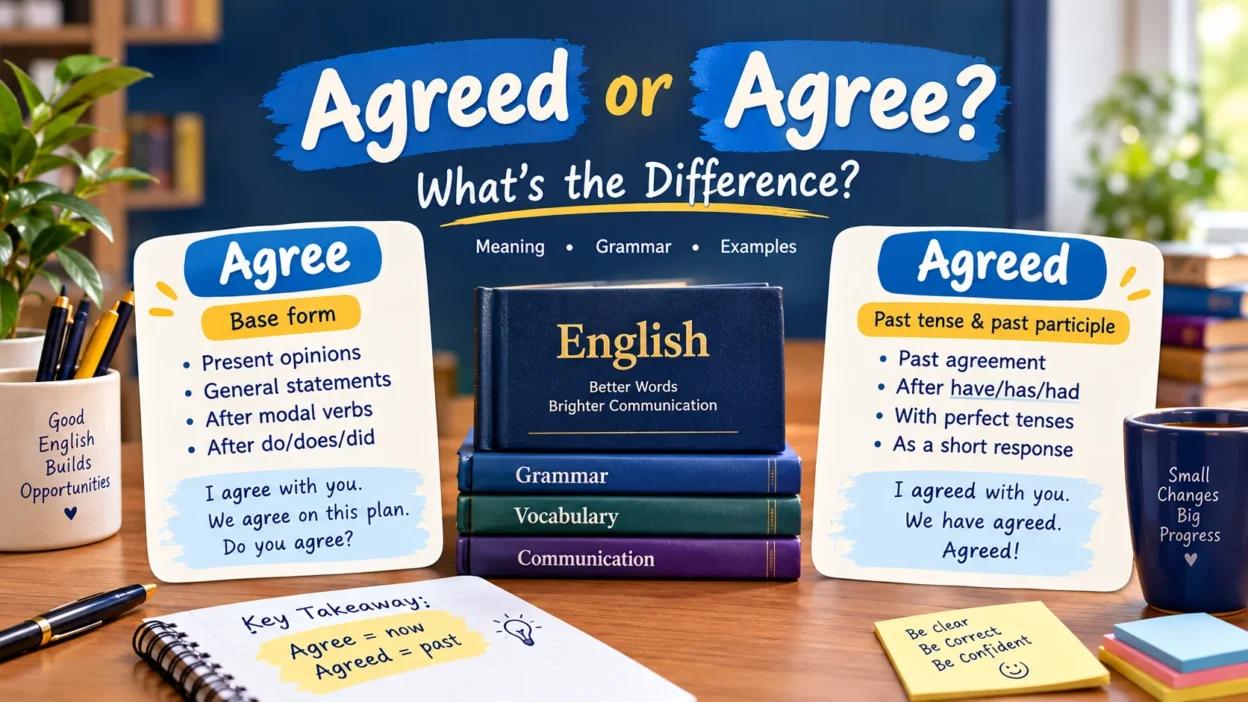
“Agree” is the base form of the verb, used for present situations, general opinions, and after certain helping verbs. “Agreed” is the past tense and past participle, used for past agreement and perfect or passive-like constructions. For example, “I agree with you” expresses a current opinion, while “I agreed with you” describes a past opinion.
Why Do People Confuse Agree and Agreed?
People often confuse “agree” and “agreed” because both words express the same basic idea: sharing an opinion or accepting something.
However, English grammar requires different verb forms depending on when the action happens and how the sentence is structured.
Here are the main reasons for the confusion:
- Similar meanings: Both words express agreement or shared opinions.
- Different tenses: “Agree” is the base form, while “agreed” is the simple past and past participle.
- Helping verbs: Some sentences require “agree,” while others require “agreed.”
- Everyday speech: People sometimes use shortened expressions such as “Agreed!” to show that they share an opinion.
- Sentence structure: The correct form depends on the subject and the auxiliary verb.
Understanding these differences makes it easier to choose the right word.
1. What Does Agree Mean?
Agree is a verb that means to have the same opinion as someone, accept a suggestion, or reach a mutual decision.
It is the base form of the verb and can be used in the present tense, infinitives, and certain constructions involving helping verbs.
Common Uses of Agree
1. Expressing a current opinion
Use “agree” when you share someone’s opinion in the present.
- I agree with your opinion.
- We agree that education is important.
2. Accepting a suggestion or proposal
Use “agree” when someone accepts an idea or proposal.
- I agree to your proposal.
- They agree to help us.
3. Reaching a mutual understanding
Use “agree” when people share a decision or understanding.
- We agree on the final plan.
- They agree about the meeting time.
Examples of Agree in Sentences
- I agree with your decision.
- We agree on this issue.
- They agree to work together.
- Do you agree with me?
- I do not agree with that statement.
2. What Does Agreed Mean?
Agreed is the simple past tense and past participle of the verb “agree.” It is used to describe an agreement that happened in the past or to form perfect and other verb constructions.
Common Uses of Agreed
1. Describing a past agreement
Use “agreed” when someone accepted an idea or shared an opinion in the past.
- I agreed with her yesterday.
- They agreed to the proposal last week.
2. Forming perfect tenses
Use “agreed” after helping verbs such as “have,” “has,” or “had.”
- I have agreed to the terms.
- She had agreed before the meeting began.
3. Expressing agreement as a short response
“Agreed!” can be used as a standalone response to show that you accept or share someone’s opinion.
- “We should leave early.” “Agreed!”
- “This plan is practical.” “Agreed!”
Examples of Agreed in Sentences
- I agreed with your suggestion.
- They agreed to the new schedule.
- She has agreed to join the team.
- We had agreed on the price.
- Everyone agreed that the decision was fair.
Agree vs. Agreed: Comparison Table
|
Feature
|
Agree
|
Agreed
|
| — | — | — |
|
Word form
|
Base form
|
Past tense and past participle
|
|
Main use
|
Present opinions and general agreement
|
Past agreement and perfect constructions
|
|
Example
|
I agree with you.
|
I agreed with you.
|
|
With “to”
|
To agree
|
To have agreed
|
|
With “have”
|
Have to agree (different structure)
|
Have agreed
|
|
Standalone response
|
Less common
|
“Agreed!” is common
|
|
Meaning
|
Share an opinion or accept something
|
Shared an opinion or accepted something
|
When Should You Use Agree or Agreed?
Choosing between these words depends on the tense and grammatical structure of your sentence.
Use Agree When:
- You are expressing a present opinion: “I agree with you.”
- You are describing a general belief: “Most people agree that exercise is important.”
- You are using the infinitive: “I want to agree with your proposal.”
- You are using a modal verb: “I can agree with that decision.”
- You are forming a question with “do”: “Do you agree?”
Use Agreed When:
- You are describing a past event: “We agreed yesterday.”
- You are using the present perfect: “I have agreed to the terms.”
- You are using the past perfect: “She had agreed before the discussion.”
- You are using the past tense with a subject: “They agreed to the plan.”
- You are responding briefly to show agreement: “Agreed!”
12 Examples of Agree and Agreed in Sentences
Here are practical examples that show how each word works in everyday English.
Examples Using Agree
- I agree with your opinion about the project.
- We agree that honesty is important.
- Do you agree with the new policy?
- They agree to help us with the event.
- I agree on the main points of the discussion.
- She can agree to the terms if they are fair.
Examples Using Agreed
- I agreed with your suggestion yesterday.
- They agreed to meet after work.
- We have agreed on a new schedule.
- She had agreed before the meeting started.
- Everyone agreed that the idea was useful.
- “Let’s finish the work today.” “Agreed!”
Common Mistakes When Using Agree and Agreed
Even experienced English learners sometimes use the wrong form of this verb. Here are some common mistakes and their corrections.
|
Incorrect
|
Correct
|
Explanation
|
| — | — | — |
|
I agreed with you now.
|
I agree with you now.
|
Use the present form for a current opinion.
|
|
I have agree with her.
|
I have agreed with her.
|
Use the past participle after “have.”
|
|
She did agreed with me.
|
She did agree with me.
|
Use the base form after “did.”
|
|
I am agree with you.
|
I agree with you.
|
“Agree” is a verb, not an adjective in this structure.
|
|
They has agreed.
|
They have agreed.
|
Use “have” with “they.”
|
|
I agree yesterday.
|
I agreed yesterday.
|
Use the past tense with a finished past-time reference.
|
Important Grammar Rule
After auxiliary verbs such as “do,” “does,” and “did,” use the base form agree, not “agreed.”
- Correct: Did you agree?
- Incorrect: Did you agreed?
After “have,” “has,” or “had,” use agreed.
- Correct: She has agreed.
- Incorrect: She has agree.
Memory Trick: How to Remember Agree vs. Agreed
Use this simple trick to remember the difference:
- Agree = now or base form. Think of sharing an opinion in the present.
- Agreed = past or participle. Think of an agreement that has already happened.
Easy Memory Examples
- Now: “I agree with you.”
- Yesterday: “I agreed with you.”
- Already: “I have agreed with you.”
Remember: If you use “did,” “do,” or “does,” choose “agree.” If you use “have,” “has,” or “had,” choose “agreed.”
American vs. British English: Agree or Agreed
There is no meaningful difference between American and British English in the basic grammatical use of “agree” and “agreed.”
Both varieties use:
- “I agree with you” for present agreement.
- “I agreed with you” for past agreement.
- “I have agreed to the proposal” for present perfect agreement.
The spelling is also identical in American and British English.
Differences may occur in pronunciation or conversational style, but the standard grammar remains the same.
Similar Words Related to Agree and Agreed
Several words are related to “agree” and “agreed,” but they are not always interchangeable.
|
Word
|
Meaning
|
Example
|
| — | — | — |
|
Consent
|
Give permission or approval
|
She consented to the request.
|
|
Accept
|
Receive or approve something
|
I accept your offer.
|
|
Approve
|
Officially support or authorize
|
The manager approved the plan.
|
|
Assent
|
Express agreement, often formally
|
He assented to the proposal.
|
|
Concur
|
Share the same opinion
|
I concur with your assessment.
|
|
Accord
|
Give or grant; also describe agreement
|
The two sides reached an accord.
|
These words can express agreement in different situations, but “agree” remains the most common general-purpose verb.
Final Verdict: Agree or Agreed?
The difference between agree and agreed is mainly grammatical.
- Use agree for present opinions, general statements, infinitives, and after modal or do-support verbs.
- Use agreed for past agreement, after “have,” “has,” or “had,” and as a short response expressing agreement.
For example, “I agree with you” describes a current opinion, while “I agreed with you yesterday” describes a past opinion.
Choosing the correct form makes your English clearer and more natural.
Frequently Asked Questions (FAQs)
1. Is it correct to say “I agree” or “I agreed”?
Both are correct, but they are used in different situations. “I agree” expresses a current opinion, while “I agreed” describes an agreement in the past.
2. Should I say “I have agreed” or “I have agree”?
The correct expression is “I have agreed.” The present perfect tense requires the past participle “agreed” after “have.”
3. Is “agreed” past tense or present tense?
“Agreed” is the simple past tense and past participle of “agree.” It is not the present tense.
4. Can I use “agreed” as a one-word response?
Yes. “Agreed!” is a common standalone response that expresses acceptance or agreement with another person’s statement or suggestion.
5. Is “I am agree” grammatically correct?
No. The correct expression is “I agree.” Since “agree” is a verb, you do not need “am” before it in this sentence.
6. Should I use “agree” after “did”?
Yes. Use the base form “agree” after “did.” For example, “Did you agree with the decision?” is correct, while “Did you agreed?” is incorrect.
7. What is the difference between “agree with” and “agree to”?
“Agree with” usually means sharing an opinion or supporting a person or idea. “Agree to” usually means accepting a proposal, request, or arrangement.
Examples:
- I agree with your opinion.
- I agreed to the proposal.
Remember This
Agree vs. Agreed: The Simple Rule
- Agree: Present or base form — “I agree with you.”
- Agreed: Past tense or past participle — “I agreed with you.”
- Have/has/had + agreed: “She has agreed.”
- Did + agree: “Did you agree?”
- Agreed!: A short response showing agreement.
Conclusion
Understanding the difference between “agree” and “agreed” is an important part of learning English grammar. Although both words express the same basic idea, they serve different grammatical purposes. “Agree” is used for present opinions, general statements, and base-form constructions, while “agreed” is used for past events and as a past participle in perfect tenses.
The easiest way to remember the difference is to look at the time and structure of your sentence. Say “I agree” when you share an opinion now, “I agreed” when describing a past situation, and “I have agreed” when using the present perfect tense. With regular practice, you can use both forms confidently in conversations, writing, and professional communication.

Daniel Jack is a language enthusiast and content writer who specializes in synonyms, vocabulary, and word meanings. He creates clear, engaging resources that help readers improve communication and expand their English skills.