
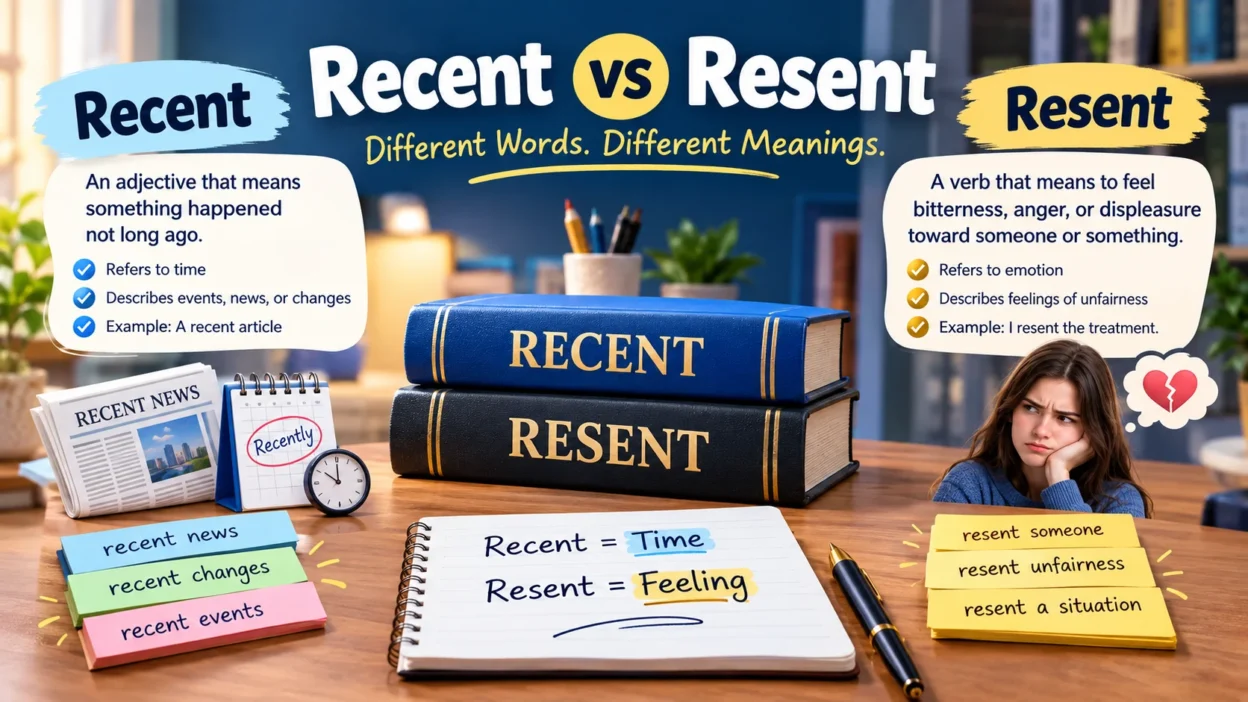
The words recent and resent may look and sound similar, but they have completely different meanings. Understanding the difference between recent and resent can help you avoid spelling mistakes and communicate more clearly in English.
Recent is an adjective that describes something that happened not long ago. For example, “I read a recent article about climate change.” Resent is a verb that means to feel bitterness, anger, or displeasure toward someone or something because of a perceived unfairness. For example, “She began to resent her coworker for taking credit for her work.”
Although these words differ by only one letter, they are used in very different situations. One refers to time, while the other describes an emotional reaction. In this guide, you will learn their meanings, grammatical roles, pronunciation, and common uses, along with practical examples to help you choose the correct word every time.
Quick Answer: Recent vs Resent
Recent means happening, occurring, or existing not long ago. It is an adjective used to describe something new or close to the present. Resent means to feel anger, bitterness, or displeasure about someone or something. It is a verb. Use recent when talking about time and resent when expressing negative feelings.
Why Do People Confuse Recent and Resent?
People often confuse recent and resent because their spellings are nearly identical. Both words contain the letters “r,” “e,” “e,” and “t,” but the order of the middle letters differs.
Here are the main reasons for the confusion:
- Similar spelling: The words differ by only one letter position.
- Similar pronunciation: Both begin with the same consonant sound and have similar endings.
- Unfamiliar meanings: English learners may not know that resent is related to feelings of bitterness.
- Different grammatical roles: Recent is an adjective, while resent is a verb.
The easiest way to distinguish them is to remember that recent describes time, while resent describes an emotion.
1. What Does Recent Mean?
Recent is an adjective that means something happened, appeared, or existed not long ago.
It is used to describe events, changes, experiences, information, and other things that are relatively close to the present.
Definition of Recent
- Part of speech: Adjective
- Meaning: Happening or occurring not long ago; belonging to the near past.
- Synonyms: New, latest, current, fresh, and up-to-date (depending on context).
- Opposite: Old, earlier, or distant in the past, depending on the context.
Examples of Recent in Sentences
- I read a recent article about healthy eating.
- Her recent promotion made her very happy.
- We discussed the recent changes to the school schedule.
- The company announced a recent update to its software.
When Should You Use Recent?
Use recent when describing something that happened or became relevant in the near past.
Common expressions include:
- Recent events
- Recent news
- Recent changes
- Recent studies
- Recent experience
- Recent developments
Example: “The recent rainfall helped the farmers.”
Here, recent describes rainfall that happened not long ago.
2. What Does Resent Mean?
Resent is a verb that means to feel bitterness, anger, or displeasure toward someone or something because you believe you have been treated unfairly or unfairly burdened.
It often describes an emotional reaction to unfair treatment, criticism, or an unwanted situation.
Definition of Resent
- Part of speech: Verb
- Meaning: To feel bitterness or anger about something perceived as unfair, offensive, or unpleasant.
- Synonyms: Begrudge, dislike, feel bitter about, and take offense at (depending on context).
- Related noun: Resentment.
Examples of Resent in Sentences
- I resent the way he speaks to me.
- She began to resent her brother for receiving special treatment.
- He resents being blamed for mistakes he did not make.
- They resent the extra responsibilities placed on them without additional support.
When Should You Use Resent?
Use resent when expressing bitterness, anger, or displeasure toward a person, action, situation, or experience.
Common expressions include:
- Resent someone
- Resent something
- Resent being treated unfairly
- Resent doing something
- Resent the fact that something happened
Example: “She resents working late every Friday.”
Here, resents expresses her negative feelings about having to work late.
Recent vs Resent: Comparison Table
|
Feature
|
Recent
|
Resent
|
| — | — | — |
|
Part of speech
|
Adjective
|
Verb
|
|
Meaning
|
Happened not long ago
|
Feel bitterness or anger
|
|
Main idea
|
Time
|
Emotion
|
|
Common use
|
Recent news
|
Resent unfair treatment
|
|
Example
|
A recent event
|
I resent his behavior.
|
|
Related word
|
Recently
|
Resentment
|
|
Opposite
|
Old, distant
|
Appreciate, accept (depending on context)
|
When to Use Recent vs Resent
Choosing the correct word depends on what you want to communicate.
Use Recent When Talking About Time
Use recent to describe something that happened, appeared, or changed not long ago.
Examples:
- “I enjoyed her recent book.”
- “The recent storm caused damage.”
- “Have you heard about the recent announcement?”
Use Resent When Talking About Feelings
Use resent when someone feels bitterness or anger about a person, action, or situation.
Examples:
- “I resent being interrupted.”
- “He resents his manager’s unfair decisions.”
- “She resents the extra work assigned to her.”
A Simple Way to Decide
Ask yourself:
- Am I describing something that happened not long ago? Use recent.
- Am I describing a feeling of bitterness or anger? Use resent.
10+ Examples of Recent vs Resent in Sentences
These examples show how the two words work in everyday English.
Examples Using Recent
- Recent: I attended a recent meeting with my classmates.
- Recent: Her recent achievement impressed everyone.
- Recent: The recent weather changes surprised us.
- Recent: We need to review the recent updates.
- Recent: Recent research suggests that sleep is important for learning.
- Recent: He shared a recent photo from his vacation.
Examples Using Resent
- Resent: I resent being treated unfairly.
- Resent: She resents her friend for breaking a promise.
- Resent: They resent the decision to cancel their vacation.
- Resent: He began to resent his colleague’s constant criticism.
- Resent: I resent having to do everyone’s work.
- Resent: She resents the fact that nobody listened to her.
Examples Showing Both Words
13. Recent and resent: After the recent changes at work, several employees began to resent the new rules.
14. Recent and resent: His recent promotion made his coworker resent him.
15. Recent and resent: The recent decision caused many people to resent the management.
These examples show that recent describes when something happened, while resent describes how someone feels about it.
Common Mistakes When Using Recent and Resent
Here are some common errors and their corrections.
Mistake 1: Using Resent Instead of Recent
❌ “I read a resent article about technology.”
✅ “I read a recent article about technology.”
Why? Recent describes an article published or written not long ago.
Mistake 2: Using Recent Instead of Resent
❌ “I recent the way he treated me.”
✅ “I resent the way he treated me.”
Why? Resent is the verb needed to express bitterness or displeasure.
Mistake 3: Confusing Resent With Recently
❌ “I resent visited my grandparents.”
✅ “I recently visited my grandparents.”
Why? Recently is the adverb form of recent and describes when an action happened.
Mistake 4: Using Resent Without Understanding Its Meaning
❌ “I resent my new phone because I bought it yesterday.”
✅ “I recently bought a new phone.”
Why? Resent expresses negative feelings, not the fact that something happened in the past.
Mistake 5: Forgetting the Correct Verb Form
❌ “She resent the unfair treatment.”
✅ “She resents the unfair treatment.”
Why? In the present tense, resent becomes resents with third-person singular subjects such as he, she, or it.
Memory Trick: How to Remember Recent vs Resent
Use this simple memory trick:
- Recent = Recent time. Both begin with “rec,” helping you associate recent with something that happened not long ago.
- Resent = Resentment. The word resent is closely related to resentment, which means a feeling of bitterness or anger.
Easy Reminder
Recent = Time. Resent = Feeling.
Remembering these two short phrases will help you choose the right word in writing and conversation.
American vs British English: Recent and Resent
There is no difference in the basic meaning or spelling of recent and resent between American and British English.
|
Word
|
American English
|
British English
|
| — | — | — |
|
Recent
|
Recent
|
Recent
|
|
Resent
|
Resent
|
Resent
|
|
Recently
|
Recently
|
Recently
|
|
Resentment
|
Resentment
|
Resentment
|
Both varieties use recent to describe something that happened not long ago and resent to express bitterness or displeasure.
The pronunciation may vary slightly depending on the speaker’s accent, but the meanings and spellings remain the same.
Similar Words Related to Recent and Resent
Several words are related to recent and resent. Understanding them can help you expand your vocabulary.
Words Related to Recent
|
Word
|
Meaning
|
Example
|
| — | — | — |
|
Recently
|
Not long ago
|
I recently moved here.
|
|
Latest
|
Most recent or newest
|
This is the latest version.
|
|
New
|
Not old or previously known
|
She bought a new laptop.
|
|
Current
|
Happening or existing now
|
The current situation is difficult.
|
|
Fresh
|
New or recently produced
|
We bought fresh bread.
|
Words Related to Resent
|
Word
|
Meaning
|
Example
|
| — | — | — |
|
Resentment
|
A feeling of bitterness
|
He felt resentment toward his boss.
|
|
Begrudge
|
To feel unwillingness or resentment about giving or allowing something
|
She begrudged him his success.
|
|
Bitter
|
Feeling anger or disappointment
|
He felt bitter about the decision.
|
|
Dislike
|
To feel negatively toward someone or something
|
I dislike unfair treatment.
|
|
Take offense
|
To feel upset or insulted
|
She took offense at his comment.
|
Final Verdict: Recent vs Resent
Recent and resent are different words with different meanings and grammatical functions.
- Use recent when describing something that happened or appeared not long ago.
- Use resent when expressing bitterness, anger, or displeasure toward someone or something.
For example, “I read a recent report” describes a report from the near past, while “I resent his behavior” expresses a negative feeling.
Remember: recent is about time, and resent is about emotion.
Frequently Asked Questions (FAQs)
1. What is the main difference between recent and resent?
Recent is an adjective meaning something happened not long ago. Resent is a verb meaning to feel bitterness or anger toward someone or something. Recent relates to time, while resent relates to emotions.
2. Is recent a noun or a verb?
Recent is an adjective. It describes a person, event, object, or situation that is new or happened not long ago.
Example: “The recent announcement surprised everyone.”
3. What does resent mean in simple words?
Resent means to feel angry, bitter, or upset about something you believe is unfair or unpleasant.
Example: “I resent being blamed for the mistake.”
4. What is the difference between resent and recently?
Resent is a verb that expresses bitterness or displeasure. Recently is an adverb that means something happened not long ago.
Example: “I recently moved here” describes a past event, while “I resent the decision” expresses a negative feeling.
5. Can recent and resent be used in the same sentence?
Yes. They can appear together when describing a recent event that causes someone to feel resentment.
Example: “The recent changes made employees resent their new manager.”
6. What is the noun form of resent?
The noun form is resentment, which means a feeling of bitterness, anger, or displeasure toward someone or something.
Example: “She felt resentment after being treated unfairly.”
7. How do you remember the difference between recent and resent?
Remember that recent relates to time, while resent relates to feelings. Recent means something happened not long ago, and resent means feeling bitterness or anger.
Remember This
- Recent: Something that happened not long ago.
- Resent: To feel bitterness, anger, or displeasure.
- Recently: The adverb form of recent.
- Resentment: The noun form of resent.
Quick rule: Recent = Time. Resent = Feeling.
Conclusion
Understanding the difference between recent and resent is simple once you remember their meanings. Recent is an adjective used to describe something that happened not long ago, while resent is a verb that expresses bitterness or displeasure toward someone or something. Although their spellings are similar, their uses are very different.
By practicing the examples and remembering the connection between recent and time and resent and resentment, you can avoid common spelling and grammar mistakes. Whether you are writing an essay, sending a message, or speaking English, choosing the correct word will make your communication clearer and more accurate.

David Henry is a language enthusiast and content writer specializing in synonyms, vocabulary, and word meanings. He creates clear, engaging resources that help readers improve their writing, communication, and English skills.