Have you ever wondered if to write “pass time,” “past time,” or “pastime”? These three expressions look and sound similar, but they have different meanings and uses. Choosing the correct one can make your writing clearer and help you avoid common English mistakes.
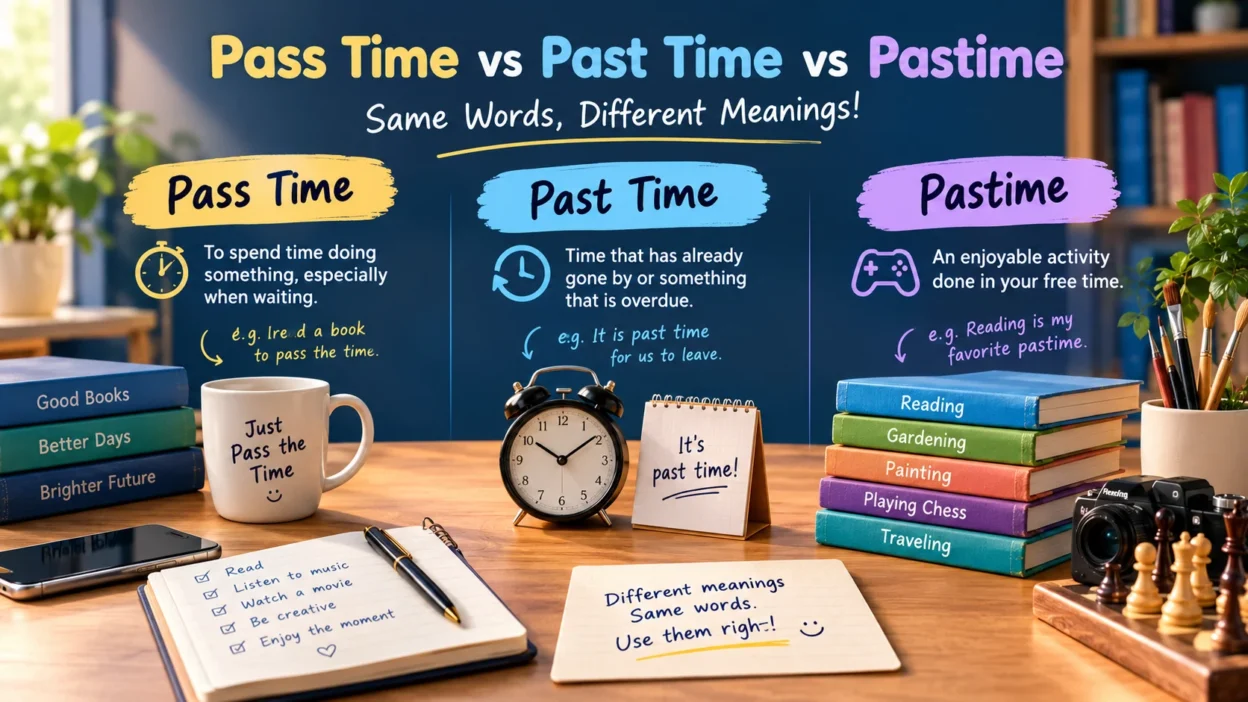
The main difference is that “pass time” means to spend time doing something, “past time” refers to time that has already gone by or something that is overdue, and “pastime” is a noun for an activity someone enjoys doing in their free time. Although these expressions are closely related in spelling and pronunciation, they are not interchangeable. In this guide, you will learn what each expression means, how to use it in everyday English, and how to remember the difference with simple examples.
Quick Answer
Pass time means to spend time doing something, often while waiting. Past time refers to time that has already passed or can mean that it is time for something to happen. Pastime is a noun meaning a hobby or enjoyable leisure activity, such as reading, gardening, or playing chess.
Why Do People Confuse Pass Time, Past Time, and Pastime?
People often confuse these expressions because they sound similar when spoken and contain the same two words or word parts: pass, past, and time.
However, their grammatical roles and meanings are different:
- Pass time: A verb phrase describing the act of spending time.
- Past time: A phrase referring to time that has gone by or an appropriate or overdue time for something.
- Pastime: A single noun referring to an enjoyable activity done during free time.
Understanding how each expression works in a sentence makes it easier to choose the right one.
1. What Does Pass Time Mean?
Pass time is a verb phrase that means to spend time doing something, especially when waiting or when you have nothing urgent to do.
It often appears in the expression “pass the time,” where the is commonly included.
Meaning of Pass Time
To pass time means to keep yourself occupied while time goes by.
You can pass time by:
- Reading a book.
- Listening to music.
- Watching a movie.
- Playing a game.
- Talking with a friend.
Examples of Pass Time
- I read a book to pass the time while waiting for the bus.
- She played a game to pass time during the long journey.
- We watched a movie to pass the time on a rainy afternoon.
- He listened to music to pass the time at the airport.
- They chatted to pass the time before the meeting began.
Is Pass Time or Pass the Time More Natural?
Both can be understood, but “pass the time” is the more common and natural expression when talking about keeping yourself occupied.
For example:
- Natural: I played a game to pass the time.
- Also possible: I played a game to pass time.
2. What Does Past Time Mean?
Past time is a two-word phrase that can refer to time that has already gone by. It can also appear in the expression “It is past time…”, meaning that something should have happened already or should happen now.
The exact meaning depends on the sentence.
Meaning of Past Time
The word past can refer to something that has already happened or gone by.
For example:
- The past time of my childhood is filled with happy memories. (More naturally: My childhood is filled with happy memories.)
- We discussed events from the past time. (More naturally: We discussed events from the past.)
A particularly common expression is “It is past time,” which means that something is overdue.
Examples of Past Time
- It is past time for us to leave.
- It is past time you apologized for your mistake.
- The deadline is past, so we cannot submit the form now.
- She enjoys reading about the past.
- It is past time we started preparing for the exam.
What Does “It Is Past Time” Mean?
The expression “It is past time” means that something should have happened earlier and is now overdue.
For example:
- It is past time for the meeting to begin.
- It is past time we cleaned the house.
In the second example, the phrase suggests that cleaning should have been done earlier.
3. What Does Pastime Mean?
Pastime is a noun that means an activity someone enjoys doing during their free time.
A pastime is usually something people do for pleasure, relaxation, or entertainment rather than as a job or responsibility.
Meaning of Pastime
A pastime is an enjoyable way to spend leisure time.
Common pastimes include:
- Reading books.
- Gardening.
- Painting.
- Playing chess.
- Collecting stamps.
- Cooking for fun.
- Hiking.
- Listening to music.
Examples of Pastime
- Reading is my favorite pastime.
- Gardening is a relaxing pastime for my grandmother.
- His favorite pastime is playing chess.
- Photography has become a popular pastime among students.
- Watching movies is a common pastime for many people.
Is Pastime One Word or Two?
Pastime is always written as one word when it means a hobby or leisure activity.
Correct: Reading is my favorite pastime.
Incorrect: Reading is my favorite past time.
Pass Time vs Past Time vs Pastime: Comparison Table
|
Expression
|
Meaning
|
Part of speech
|
Example
|
| — | — | — | — |
|
Pass time
|
Spend time doing something
|
Verb phrase
|
I read to pass the time.
|
|
Past time
|
Time that has gone by; something overdue
|
Noun phrase or expression
|
It is past time to leave.
|
|
Pastime
|
An enjoyable leisure activity
|
Noun
|
Reading is my favorite pastime.
|
When Should You Use Each Expression?
Choosing the right expression depends on what you want to communicate.
Use Pass Time When You Mean Spending Time
Use “pass time” when describing an activity that helps you occupy yourself while waiting or during a quiet period.
Examples:
- I play games to pass the time.
- She reads magazines to pass the time on the train.
Use Past Time When You Mean Something Is Overdue
Use “past time” in expressions that indicate something should already have happened.
Examples:
- It is past time for us to go home.
- It is past time you took your studies seriously.
Use Pastime When You Mean a Hobby
Use “pastime” when naming an activity you enjoy doing in your free time.
Examples:
- Swimming is my favorite pastime.
- His favorite pastime is collecting coins.
12 Examples of Pass Time, Past Time, and Pastime in Sentences
Here are 12 examples to help you understand how these expressions work in everyday English.
Examples of Pass Time
- I read a novel to pass the time during my flight.
- She played cards to pass the time while waiting for her friend.
- We watched videos to pass the time on the bus.
- He listened to podcasts to pass the time during his commute.
Examples of Past Time
- It is past time for the children to go to bed.
- It is past time we discussed the problem honestly.
- The clock showed that the scheduled time had passed.
- It is past time for the company to update its policies.
Examples of Pastime
- Reading is a relaxing pastime for me.
- Her favorite pastime is painting landscapes.
- Gardening is a popular pastime in our neighborhood.
- Playing chess is his favorite pastime on weekends.
Common Mistakes to Avoid
Even fluent English speakers sometimes mix up these expressions in writing. Here are some common mistakes and their corrections.
Mistake 1: Writing “Past Time” Instead of “Pastime”
Incorrect: My favorite past time is reading.
Correct: My favorite pastime is reading.
Why? Pastime is a single noun meaning a leisure activity.
Mistake 2: Using “Pastime” as a Verb
Incorrect: I pastime by watching television.
Correct: I pass the time by watching television.
Why? Pastime is a noun, not a verb.
Mistake 3: Using “Pass Time” When You Mean a Hobby
Incorrect: My favorite pass time is swimming.
Correct: My favorite pastime is swimming.
Why? A hobby is called a pastime.
Mistake 4: Confusing “Past Time” With “Pass Time”
Incorrect: I read books to past time.
Correct: I read books to pass the time.
Why? Pass is the verb used to describe spending time.
Mistake 5: Forgetting “The” in “Pass the Time”
Although “pass time” is possible, “pass the time” is usually more natural in everyday English.
Less natural: I watched TV to pass time.
More natural: I watched TV to pass the time.
Memory Trick: How to Remember the Difference
Use this simple trick to remember all three expressions:
- Pass time = Spend time. Think of passing time while waiting.
- Past time = Overdue or already gone. Think of something that should have happened earlier.
- Pastime = Hobby. Think of a fun activity you enjoy.
Easy Memory Sentence
“I pass the time by reading. Reading is my favorite pastime. It is past time for me to go to bed.”
This sentence uses all three expressions correctly.
American vs. British English: Is There a Difference?
The meanings of pass time, past time, and pastime are generally the same in American and British English.
|
Expression
|
American English
|
British English
|
| — | — | — |
|
Pass time
|
Used to mean spending time
|
Used to mean spending time
|
|
Past time
|
Used in expressions such as “It is past time”
|
Used in the same way
|
|
Pastime
|
Means a leisure activity
|
Means a leisure activity
|
There is no major spelling difference between American and British English for these expressions.
Similar Words and Expressions
Here are some related words and phrases that can help expand your vocabulary.
|
Word or phrase
|
Meaning
|
Example
|
| — | — | — |
|
Hobby
|
An activity done for pleasure
|
Painting is my hobby.
|
|
Leisure activity
|
Something done during free time
|
Hiking is a popular leisure activity.
|
|
Recreation
|
An activity that refreshes or entertains
|
Swimming is a form of recreation.
|
|
Occupy time
|
Keep yourself busy
|
I read to occupy my time.
|
|
Spend time
|
Use time doing something
|
I spend time with my family.
|
|
Kill time
|
Do something to make waiting feel shorter
|
We played cards to kill time.
|
|
Free time
|
Time available for personal activities
|
I read during my free time.
|
|
Leisure
|
Time free from work or duties
|
She enjoys outdoor leisure activities.
|
Final Verdict: Pass Time vs Past Time vs Pastime
The difference is simple once you understand the meaning of each expression.
- Pass time is a verb phrase that means to spend time doing something.
- Past time refers to time that has gone by or something that is overdue.
- Pastime is a noun that means an enjoyable activity done in your free time.
Remember that pass the time is commonly used when talking about waiting, past time often appears in expressions about something being overdue, and pastime refers to a hobby or leisure activity.
FAQs
1. Is it pass time or pastime?
Both expressions are correct, but they have different meanings. Pass time means to spend time doing something, while pastime is a noun meaning an enjoyable leisure activity.
2. Is pastime one word or two?
Pastime is one word. It means a hobby or an activity someone enjoys during free time.
Example: Reading is my favorite pastime.
3. What is the difference between past time and pastime?
Past time is a two-word phrase that can refer to time that has gone by or something that is overdue. Pastime is a single word meaning a hobby or leisure activity.
4. Is “pass the time” grammatically correct?
Yes. “Pass the time” is a common and natural expression meaning to spend time doing something, especially while waiting.
Example: I played a game to pass the time.
5. What is an example of a pastime?
Reading, gardening, painting, playing chess, and collecting stamps are examples of pastimes because they are activities people enjoy during their free time.
6. What does “It is past time” mean?
“It is past time” means that something should have happened already or is overdue.
Example: It is past time for us to leave.
7. Can I use “past time” instead of “pastime”?
No, not when you mean a hobby or leisure activity. The correct word is pastime.
Correct: Gardening is my favorite pastime.
Remember This
- Pass time: Spend time doing something.
- Past time: Time that has passed or something that is overdue.
- Pastime: A hobby or enjoyable leisure activity.
Conclusion
Understanding the difference between pass time, past time, and pastime helps you write more clearly and avoid common spelling and grammar mistakes. Although these expressions sound similar, each has a distinct meaning and purpose. Use pass time when describing how you spend time, past time when referring to something overdue or time that has gone by, and pastime when talking about a hobby.
With a little practice, you can use all three expressions confidently in everyday conversations, school assignments, emails, and other forms of writing. Remember the simple connection: passing time is an action, past time relates to time that has gone by or something overdue, and a pastime is something you enjoy doing.

David Henry is a language enthusiast and content writer specializing in synonyms, vocabulary, and word meanings. He creates clear, engaging resources that help readers improve their writing, communication, and English skills.