
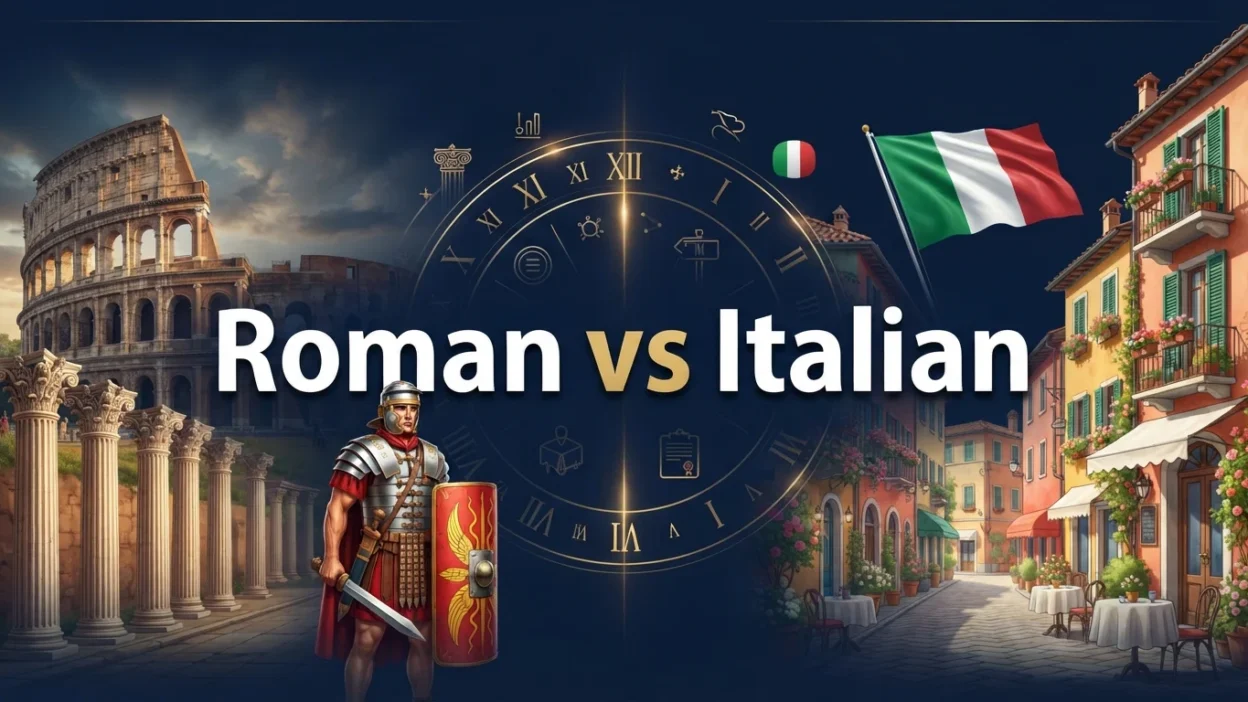
The words Roman and Italian are closely related, but they do not mean the same thing. Roman usually refers to something connected to ancient Rome, the city of Rome, or its people. Italian refers to something connected to Italy, its people, language, or culture. Although Rome is the capital of Italy today, the two terms have different meanings and uses.
Understanding the difference between Roman and Italian can help you use these words correctly when talking about history, nationality, language, food, and culture. For example, ancient Roman soldiers belonged to the Roman Empire, while modern Italian citizens belong to the country of Italy. Similarly, Roman history and Italian history are connected, but they are not identical. In this guide, you will learn what each word means, how to use it in everyday English, and how to avoid common mistakes.
Quick Answer: Roman vs Italian
Roman refers to something or someone connected to Rome, especially ancient Rome and its civilization. Italian refers to something or someone connected to Italy, including its people, language, and culture. A Roman can be Italian in a modern geographical or cultural context, but the terms are not interchangeable. Ancient Romans and modern Italians belong to different historical contexts.
Why Do People Confuse Roman and Italian?
People often confuse these terms because Rome is the capital of Italy and has played a central role in Italian history.
However, the words describe different things:
- Roman: Connected to Rome, its people, or the Roman civilization.
- Italian: Connected to Italy, its citizens, language, or national culture.
The confusion becomes more noticeable when discussing ancient history, modern nationality, food, and language.
For example, the Roman Empire existed long before modern Italy became a unified country in 1861.
What Does Roman Mean?
Roman is an adjective and a noun used to describe something or someone connected to Rome.
The word can refer to ancient Roman civilization, the city of Rome, or people associated with Rome.
Roman as an Adjective
As an adjective, Roman describes things related to Rome or Roman civilization.
Examples:
- Roman Empire: The ancient empire centered on Rome.
- Roman architecture: Buildings and design associated with Roman traditions.
- Roman law: Legal principles developed in ancient Rome.
- Roman history: The history of Rome and its civilization.
Roman as a Noun
As a noun, Roman can refer to a person from Rome or a member of the ancient Roman people.
Examples:
- He is a Roman who lives in the capital of Italy.
- The Romans built roads and aqueducts throughout their empire.
In historical contexts, Roman can refer to people who were citizens of the Roman Empire, not just residents of the city of Rome.
What Does Italian Mean?
Italian is an adjective and a noun that refers to Italy, its people, language, or culture.
It is commonly used when discussing nationality, food, art, traditions, and the Italian language.
Italian as an Adjective
As an adjective, Italian describes something connected to Italy.
Examples:
- Italian food: Food associated with Italy.
- Italian language: The language spoken in Italy and by Italian-speaking communities.
- Italian culture: The traditions, customs, and cultural heritage of Italy.
- Italian art: Art associated with Italy and its artistic traditions.
Italian as a Noun
As a noun, Italian refers to a person from Italy or someone of Italian nationality.
Examples:
- She is Italian.
- The Italian spoke fluent Italian.
The word Italian can also refer to the Italian language.
Roman vs Italian: Comparison Table
|
Feature
|
Roman
|
Italian
|
| — | — | — |
|
Basic meaning
|
Related to Rome
|
Related to Italy
|
|
Historical connection
|
Ancient Rome and Roman civilization
|
Italy, past and present
|
|
Nationality
|
May refer to a person from Rome or an ancient Roman
|
A person from Italy
|
|
Language
|
Latin was the main language of ancient Rome
|
Italian is the modern national language of Italy
|
|
Culture
|
Roman traditions and civilization
|
Italian traditions and culture
|
|
Food
|
Roman-style dishes and cuisine
|
Cuisine from different regions of Italy
|
|
Example
|
Roman Empire
|
Italian Republic
|
When Should You Use Roman or Italian?
Choose the word that matches the place, people, or historical period you are describing.
Use Roman When:
- Talking about ancient Rome or the Roman Empire.
- Describing historical Roman architecture, law, or military traditions.
- Referring to someone from the city of Rome.
- Discussing Roman mythology, literature, or civilization.
Example: The Colosseum is a famous example of Roman architecture.
Use Italian When:
- Talking about Italy as a modern country.
- Describing Italian nationality or citizenship.
- Referring to the Italian language.
- Discussing Italian food, fashion, art, or culture.
Example: Italian is the main language of Italy.
12 Examples of Roman vs Italian in Sentences
These examples show how the two words work in different contexts.
- Roman: The Roman Empire controlled a vast territory in ancient times.
- Italian: My friend is Italian and lives in Milan.
- Roman: The Colosseum is a famous Roman landmark.
- Italian: Italian is widely spoken in Italy.
- Roman: Roman soldiers built roads across the empire.
- Italian: Italian cuisine includes pasta, risotto, and pizza.
- Roman: The Romans developed impressive engineering techniques.
- Italian: She enjoys learning about Italian art and fashion.
- Roman: Roman mythology includes gods such as Jupiter and Mars.
- Italian: The Italian government is based in Rome.
- Roman: Roman law influenced many later legal systems.
- Italian: He bought an Italian leather jacket.
Common Mistakes When Using Roman and Italian
Mistake 1: Calling Ancient Romans Italian
Incorrect: Ancient Romans were all Italian citizens.
Correct: Ancient Romans belonged to the Roman civilization, which existed before the modern Italian nation-state.
Mistake 2: Calling Italian a Roman Language
Incorrect: Italian is the language of ancient Rome.
Correct: Latin was the main language of ancient Rome. Italian developed from Latin over many centuries.
Mistake 3: Using Roman and Italian Interchangeably
Incorrect: The Italian Empire built the Colosseum.
Correct: The Roman Empire built the Colosseum.
Mistake 4: Assuming Every Roman Is Italian by Nationality
Incorrect: Every Roman must have Italian citizenship.
Correct: A person from Rome may be Italian, but nationality and place of residence are not exactly the same.
Mistake 5: Confusing Roman Culture With All Italian Culture
Incorrect: All Italian traditions are Roman traditions.
Correct: Italian culture includes many regional traditions and historical influences, including but not limited to ancient Rome.
Memory Trick: How to Remember Roman vs Italian
Use this simple trick:
- Roman = Rome. Think of the Roman Empire, the Colosseum, and ancient Roman history.
- Italian = Italy. Think of the country, its language, people, and modern culture.
Easy reminder: Rome is a city; Italy is a country. Roman relates to Rome, while Italian relates to Italy.
Roman vs Italian in American and British English
There is no major difference between American and British English in the meanings of Roman and Italian.
Both varieties use:
- Roman for things connected to Rome or ancient Roman civilization.
- Italian for things connected to Italy, its people, language, and culture.
The spelling of both words is the same in American and British English.
Examples:
- American English: Roman architecture is fascinating.
- British English: Roman architecture is fascinating.
- American English: She enjoys Italian food.
- British English: She enjoys Italian food.
Similar Words Related to Roman and Italian
Here are some related terms that can help you understand the distinction.
|
Word
|
Meaning
|
| — | — |
|
Latin
|
The language of ancient Rome and the source of Italian
|
|
Rome
|
The capital city of Italy
|
|
Italy
|
A country in southern Europe
|
|
Roman Empire
|
The ancient empire centered on Rome
|
|
Romano
|
An Italian word and name element meaning Roman or related to Rome
|
|
Italic
|
Related to the ancient Italic peoples or the Italic language family
|
|
Romanesque
|
An architectural style that developed in medieval Europe
|
|
Latin American
|
Related to Latin America, not specifically to ancient Rome
|
Final Verdict: Roman vs Italian
Roman and Italian are related but have different meanings.
- Use Roman when referring to Rome, ancient Roman civilization, or people connected to the city of Rome.
- Use Italian when referring to Italy, its people, language, or culture.
The key distinction is that Rome is a city, while Italy is a country. Ancient Roman civilization and modern Italian national identity are historically connected, but they are not interchangeable.
Frequently Asked Questions (FAQs)
1. Is Roman the same as Italian?
No. Roman refers to Rome and its historical or cultural connections, while Italian refers to Italy, its people, language, and culture.
2. Are Romans Italian?
Modern Romans are generally Italian citizens or residents of Italy, but ancient Romans lived before the modern Italian nation-state existed. Roman identity also extended beyond the city of Rome.
3. Is Roman a nationality?
Roman can describe a person’s connection to the city of Rome or ancient Roman citizenship. Today, Italian is the nationality associated with the modern country of Italy.
4. Is Italian derived from Roman?
Italian developed from Latin, the language of ancient Rome. It evolved over many centuries into the modern language spoken in Italy and elsewhere.
5. What is the difference between Roman and Italian food?
Roman food refers specifically to the cuisine associated with Rome and its traditions. Italian food is a broader term that includes regional cuisines from across Italy.
6. Was the Roman Empire part of Italy?
The Roman Empire was centered on Rome, which is in modern-day Italy. However, the empire extended across many regions of Europe, North Africa, and the Middle East.
7. Is Rome Italian or Roman?
Rome is a city in Italy. The city is Italian in its modern national context and has a long Roman history.
Remember This
- Roman = Rome and Roman civilization.
- Italian = Italy, its people, language, and culture.
- Ancient Romans and modern Italians are connected through history, but the terms have different meanings.
Conclusion
The difference between Roman and Italian comes down to the connection each word describes. Roman refers to Rome, its people, and its ancient civilization, while Italian refers to Italy, its citizens, language, and culture. Although the two terms overlap in some modern contexts, they should not be used interchangeably.
Remember that Rome is the capital of Italy, but Roman history is not the same as the history of modern Italy. By understanding this distinction, you can use both words accurately when discussing history, language, food, nationality, and culture.

David Henry is a language enthusiast and content writer specializing in synonyms, vocabulary, and word meanings. He creates clear, engaging resources that help readers improve their writing, communication, and English skills.