
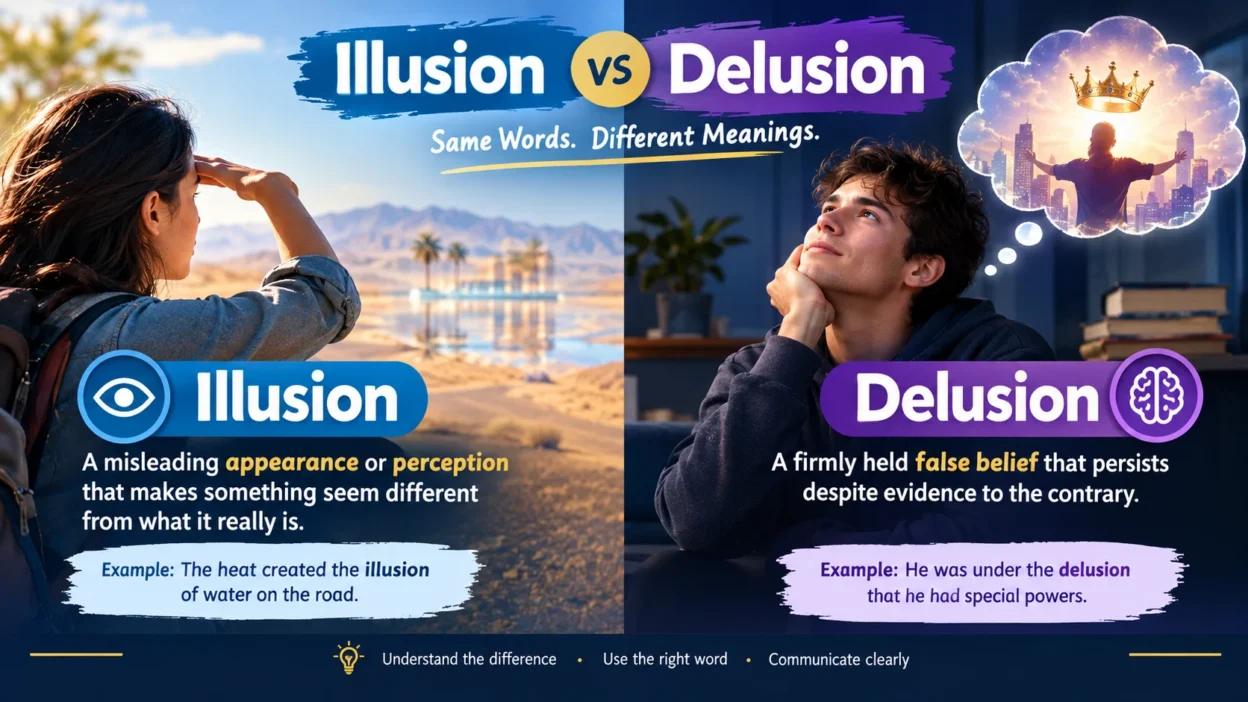
The words illusion and delusion may look and sound similar, but they have different meanings. Both are related to how people understand or experience reality, yet they describe different situations. Understanding the difference between illusion vs delusion can help you choose the right word in everyday conversations, academic writing, and professional communication.
An illusion is something that appears different from reality, often because of how we see, hear, or interpret something. A delusion is a firmly held belief that does not match reality, even when there is strong evidence against it. For example, a mirage in a desert is an illusion, while a person firmly believing that they have a special power without supporting evidence may be described as having a delusion. These words are also used in psychology, literature, and everyday expressions, so knowing their meanings helps you use them accurately.
Quick Answer: Illusion vs Delusion
An illusion is a misleading perception or appearance that makes something seem different from what it really is. A delusion is a firmly held false belief that persists despite evidence to the contrary. In simple terms, an illusion involves how something appears, while a delusion involves what someone believes to be true.
Why Do People Confuse Illusion and Delusion?
People often confuse these words because both involve a difference between reality and what someone perceives or believes.
However, the main difference lies in how the misunderstanding happens:
- Illusion: Something appears misleading because of perception, interpretation, or external conditions.
- Delusion: Someone holds a belief that is disconnected from reality, even when evidence challenges it.
For example, seeing a straight stick appear bent in water is an illusion. Believing that a stranger is secretly communicating with you through television broadcasts, despite evidence to the contrary, may be an example of a delusional belief.
The two words are related, but they are not interchangeable.
What Does Illusion Mean?
An illusion is a misleading appearance, perception, or impression that makes something seem different from what it actually is.
Illusions can happen naturally, through optical effects, or because of how the brain interprets sensory information. They can also be created intentionally through art, magic, or special effects.
Definition of Illusion
Illusion (noun): A false or misleading perception or impression of reality.
Examples of Illusion
- The optical illusion made the two equal-length lines look different.
- The magician created the illusion of making a coin disappear.
- The desert traveler mistook a mirage for an oasis.
- She had the illusion that success would come without effort.
Types of Illusions
1. Optical illusion: A visual effect that makes something appear different from its actual form.
Example: A drawing that looks like it is moving even though it is still.
2. Auditory illusion: A sound that is perceived differently from the actual sound.
Example: Hearing a familiar word in a noise that does not clearly contain it.
3. Cognitive illusion: A misleading impression caused by how the mind interprets information.
Example: Assuming that a product is better simply because it is more expensive.
4. Figurative illusion: An unrealistic impression or expectation about a situation.
Example: He lived under the illusion that money could solve every problem.
What Does Delusion Mean?
A delusion is a firmly held belief that is not supported by reality and remains strong despite clear contradictory evidence.
In everyday language, the word can describe an unrealistic belief or mistaken idea. In clinical psychology and psychiatry, delusion has a more specific meaning and may refer to a symptom associated with certain mental health conditions.
Definition of Delusion
Delusion (noun): A firmly held belief that is inconsistent with reality and is maintained despite strong evidence against it.
Examples of Delusion
- He was under the delusion that he could never make a mistake.
- She lived in the delusion that everyone secretly admired her.
- The character’s delusion prevented him from recognizing the truth.
- His belief that he could control the weather was described as a delusion in the story.
Types of Delusions
In clinical contexts, delusions may involve different themes, including:
1. Grandiose delusions: Beliefs about having exceptional power, status, identity, or abilities.
2. Persecutory delusions: Beliefs that someone is being targeted, harmed, or plotted against, without sufficient evidence.
3. Referential delusions: Beliefs that ordinary events or messages have a special personal meaning.
4. Jealous delusions: Firm beliefs about a partner’s infidelity without adequate supporting evidence.
These are clinical terms. A single unusual or mistaken belief does not automatically mean someone has a mental health condition.
Illusion vs Delusion: Comparison Table
|
Feature
|
Illusion
|
Delusion
|
| — | — | — |
|
Meaning
|
Misleading perception or appearance
|
Firmly held false belief
|
|
Main focus
|
What something seems to be
|
What someone believes
|
|
Common cause
|
Sensory effects or interpretation
|
Belief that conflicts with reality
|
|
Evidence
|
May be corrected by examining the stimulus
|
Often persists despite contrary evidence
|
|
Example
|
A mirage that looks like water
|
A firmly held belief in an unsupported personal power
|
|
Common use
|
Vision, sound, impressions, expectations
|
Beliefs, mistaken convictions, clinical contexts
|
|
Part of speech
|
Noun
|
Noun
|
When Should You Use Illusion or Delusion?
Choosing the right word depends on whether you are describing a misleading appearance or a firmly held belief.
When to Use Illusion
Use illusion when something appears different from reality or creates a misleading impression.
Common expressions include:
- Optical illusion
- Illusion of control
- Illusion of safety
- Illusion of success
- Under the illusion that
Example: The lighting created the illusion of a larger room.
Here, the room only appeared larger than it really was.
When to Use Delusion
Use delusion when describing a firmly held belief that does not match reality.
Common expressions include:
- Delusion of grandeur
- Under the delusion that
- Living in a delusion
- Delusional belief
Example: He was under the delusion that he could win every competition without practicing.
Here, the focus is on an unrealistic belief rather than a misleading sensory appearance.
Illusion vs Delusion: 12 Examples in Sentences
Here are 12 practical examples to help you understand the difference.
Examples of Illusion
1. The mirror created the illusion of a much larger room. The room appeared bigger than it actually was.
2. The magician performed an illusion that amazed the audience. The trick created a misleading appearance.
3. The road shimmered in the heat, creating the illusion of water. The heat made the road look wet.
4. The painting used an optical illusion to make the shapes appear to move. The visual effect changed how viewers perceived the image.
5. She was under the illusion that the job would be easy. She had an unrealistic impression of the job.
6. The advertisement created the illusion of a perfect lifestyle. It presented an idealized impression of life.
Examples of Delusion
7. He was under the delusion that he could predict every future event. He firmly believed something without a reliable basis.
8. The character’s delusion made it difficult for him to accept the truth. His belief conflicted with reality.
9. She lived in the delusion that everyone agreed with her. She held an unrealistic belief about other people’s opinions.
10. The novel explores a man’s delusion of unlimited power. The story focuses on a belief that does not reflect reality.
11. He refused to reconsider his delusion despite clear evidence. His belief remained firm even when challenged.
12. The story portrays a delusion that changes how the main character understands the world. The character’s belief shapes his understanding of reality.
Common Mistakes When Using Illusion and Delusion
Even fluent English speakers sometimes mix up these words. Here are common mistakes to avoid.
Mistake 1: Using Delusion for Every Misleading Appearance
Incorrect: The optical delusion made the lines look different.
Correct: The optical illusion made the lines look different.
An optical illusion affects how something appears visually.
Mistake 2: Using Illusion for a Firmly Held False Belief
Incorrect: He had the illusion that he was being watched by secret agents, despite strong evidence against it.
Better: He had the delusion that he was being watched by secret agents.
The second sentence describes a firmly held belief rather than a misleading appearance.
Mistake 3: Assuming Illusions Are Always Visual
Illusions can involve hearing, perception, and impressions, not just sight.
Example: The sound illusion made two different tones seem identical.
Mistake 4: Using Delusion as a Casual Insult
Calling someone delusional simply because you disagree with them can be inaccurate and hurtful.
Use the word carefully, especially when discussing mental health.
Mistake 5: Treating Every False Belief as a Clinical Delusion
A mistaken belief, an unrealistic expectation, and a clinical delusion are not necessarily the same thing. Clinical assessment depends on the person’s circumstances and symptoms.
Memory Trick: How to Remember Illusion vs Delusion
Use this simple memory trick:
- Illusion = Looks misleading. Think of an optical illusion that tricks your eyes.
- Delusion = Belief misleading. Think of a firmly held belief that conflicts with reality.
Another easy way to remember:
I in illusion can remind you of image.
D in delusion can remind you of deeply held belief.
These associations are just memory aids, but they can help you remember the distinction.
American vs British English: Illusion and Delusion
There is no major difference in meaning or spelling between American and British English for illusion and delusion.
Both varieties use the words in the same general ways:
|
Expression
|
American English
|
British English
|
| — | — | — |
|
Optical illusion
|
Correct
|
Correct
|
|
Under the illusion that
|
Correct
|
Correct
|
|
Under the delusion that
|
Correct
|
Correct
|
|
Delusion of grandeur
|
Correct
|
Correct
|
The choice between the two words depends on meaning, not regional spelling or pronunciation.
Similar Words: Illusion vs Delusion and Related Terms
Several English words are related to illusion and delusion, but each has a distinct meaning.
|
Word
|
Meaning
|
Example
|
| — | — | — |
|
Hallucination
|
A sensory experience without an external stimulus
|
He reported hearing a voice when no one was speaking.
|
|
Misconception
|
An incorrect understanding or idea
|
It is a misconception that all snakes are dangerous.
|
|
Misperception
|
An inaccurate perception of something
|
The shadow caused a misperception of the object’s shape.
|
|
Fantasy
|
An imagined situation or experience
|
She enjoyed imagining a fantasy world.
|
|
Fallacy
|
An error in reasoning
|
The argument was based on a logical fallacy.
|
|
Mirage
|
An optical phenomenon that can make distant objects appear displaced or create the appearance of water
|
A mirage appeared on the hot road.
|
Illusion vs Hallucination
An illusion involves misinterpreting an actual stimulus, while a hallucination is a sensory experience without a corresponding external stimulus.
For example, mistaking a coat hanging in a dark room for a person is an illusion. Hearing a voice when no one is speaking may be a hallucination.
Delusion vs Misconception
A misconception is an incorrect understanding that can often be corrected with information. A delusion is a firmly held belief that may persist despite strong evidence against it.
Final Verdict: Illusion vs Delusion
The key difference between illusion and delusion is perception versus belief.
- An illusion is a misleading appearance or perception of reality.
- A delusion is a firmly held belief that conflicts with reality.
Use illusion for misleading appearances, sensory effects, or unrealistic impressions. Use delusion for firmly held beliefs that are disconnected from reality.
FAQs About Illusion vs Delusion
1. What is the main difference between illusion and delusion?
An illusion is a misleading perception or appearance, while a delusion is a firmly held belief that does not match reality.
2. Is an illusion the same as a delusion?
No. An illusion involves how something appears or is perceived, while a delusion involves a belief that conflicts with reality.
3. Can you give a simple example of illusion vs delusion?
An optical illusion makes a stationary image appear to move. A delusion may involve a person firmly believing they have extraordinary powers without supporting evidence.
4. Is a delusion always related to mental illness?
No. The word can be used informally to describe an unrealistic belief. In clinical settings, delusions may be symptoms of certain mental health conditions and require professional assessment.
5. What is the difference between illusion and hallucination?
An illusion is a misinterpretation of something that is actually present. A hallucination is a sensory experience without a corresponding external stimulus.
6. Can an illusion be created intentionally?
Yes. Magicians, artists, filmmakers, and designers can intentionally create illusions to make things appear different from reality.
7. What does “under the illusion” mean?
“Under the illusion” means believing or assuming something that is not true or having a misleading impression of a situation.
Example: She was under the illusion that the meeting had been canceled.
Remember This
Illusion vs Delusion
Illusion = Appearance
Something seems different from what it really is.
Example: An optical illusion makes a picture appear to move.
Delusion = Belief
A firmly held belief conflicts with reality.
Example: A person firmly believes they have an extraordinary ability without supporting evidence.
Conclusion
Understanding the difference between illusion and delusion helps you communicate more clearly and choose the right word for the situation. An illusion is a misleading appearance or perception, while a delusion is a firmly held belief that does not match reality. Although both words relate to how people experience the world, they describe different things.
When writing or speaking, remember that an illusion affects how something seems, while a delusion concerns what someone believes. By learning their meanings and practicing with examples, you can use both words accurately in everyday conversations, academic writing, and professional communication.

David Henry is a language enthusiast and content writer specializing in synonyms, vocabulary, and word meanings. He creates clear, engaging resources that help readers improve their writing, communication, and English skills.