
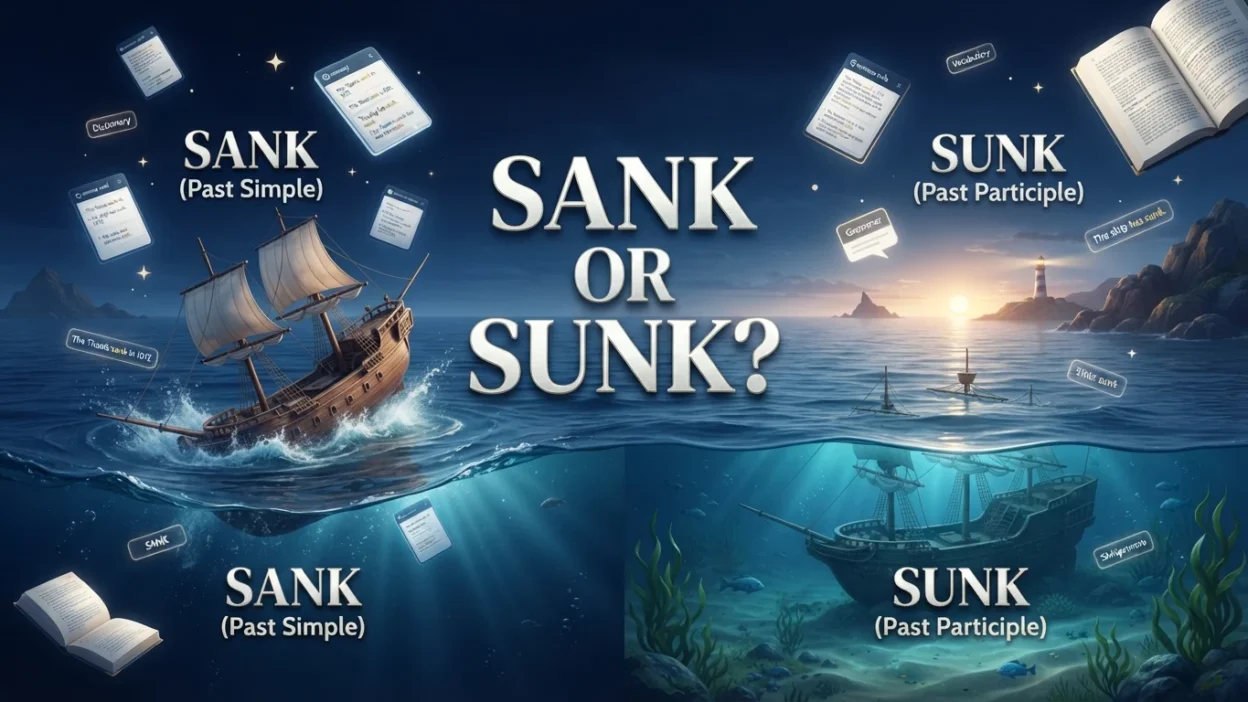
Many English learners wonder whether sank or sunk is the correct word. The answer is simple: both are correct, but they are used differently. They come from the verb sink, but each form has a different grammatical job.
Understanding the difference between sank and sunk can improve your speaking and writing. These words often appear in news stories, literature, conversations, and academic writing. Because they look similar and relate to the same action, many people mix them up.
If you learn one easy rule—sank is usually the simple past form, while sunk is usually the past participle—you can avoid most mistakes. This guide explains everything with simple definitions, examples, comparison tables, memory tips, and common usage patterns.
Quick Answer
Sank is the simple past tense of sink: The ship sank yesterday.
Sunk is usually the past participle and is often used with helping verbs: The ship has sunk. In some cases, sunk can also be used as an adjective, such as sunk costs or sunken treasure.
Why Do People Confuse “Sank” and “Sunk”?
People confuse these words because both come from the verb sink and both describe something going below the surface of water or moving downward.
The forms are:
- Base verb: sink
- Simple past: sank
- Past participle: sunk
Many English verbs change form in irregular ways, and sink is one of them. Learners sometimes say:
❌ The boat has sank.
But the correct sentence is:
✅ The boat has sunk.
What Does “Sank” Mean?
Sank is the simple past tense of sink. It describes an action that happened and finished in the past.
Structure
Subject + sank
Examples
- The ship sank during the storm.
- My keys sank to the bottom of the pool.
- The economy sank into recession.
- His heart sank when he heard the news.
- The sun sank below the horizon.
Use sank when no helping verb such as has, have, or had is present.
What Does “Sunk” Mean?
Sunk is the past participle of sink. It is usually used with helping verbs.
Structure
- has sunk
- have sunk
- had sunk
- was sunk
Examples
- The boat has sunk.
- Several ships had sunk before rescue teams arrived.
- The treasure was sunk beneath the sea.
- Costs have sunk dramatically.
- His hopes had sunk by evening.
“Sunk” as an Adjective
Sometimes sunk acts like an adjective:
- sunk costs
- sunk investment
- sunk feelings
Related adjective:
- sunken ship
- sunken eyes
Sank vs Sunk: Comparison Table
| Feature | Sank | Sunk |
|---|---|---|
| Word type | Simple past tense | Past participle |
| Used alone? | Yes | Usually with helping verbs |
| Example | The ship sank. | The ship has sunk. |
| Time reference | Completed past action | Connected to another time or verb |
| Common helpers | None | has, have, had, was |
When Should You Use Sank or Sunk?
Use sank when talking about a completed event in the past:
- The stone sank immediately.
- The market sank last year.
Use sunk with helping verbs:
- The stone has sunk.
- The market had sunk before recovery began.
Easy Rule
- Yesterday → sank
- Has/Have/Had → sunk
10+ Examples of Sank and Sunk
Examples with “Sank”
- The boat sank near the island.
- The ball sank into the mud.
- Her spirits sank after the bad news.
- The sun sank slowly.
- The company’s profits sank last year.
- The coin sank to the bottom.
- Temperatures sank overnight.
Examples with “Sunk”
- The ship has sunk.
- Their hopes had sunk completely.
- Prices have sunk since spring.
- The vessel was sunk during the battle.
- Millions of dollars have been sunk into the project.
Common Mistakes
Incorrect:
❌ The ship has sank.
✅ The ship has sunk.
❌ They had sank before help arrived.
✅ They had sunk before help arrived.
❌ The stone sunk yesterday.
✅ The stone sank yesterday.
Remember that sunk usually needs a helping verb.
Memory Trick
Think of this simple pattern:
Sink → Sank → Sunk
If you see has, have, or had, choose sunk.
- Yesterday, it sank.
- It has sunk already.
American vs British English
There is no major difference between American and British English for sank and sunk. Both varieties follow the same grammar rules:
- The ship sank.
- The ship has sunk.
However, expressions such as sunk cost are especially common in business and economics worldwide.
Similar Words
These irregular verb patterns work in a similar way:
| Base Verb | Past | Past Participle |
|---|---|---|
| Drink | Drank | Drunk |
| Ring | Rang | Rung |
| Sing | Sang | Sung |
| Begin | Began | Begun |
| Sink | Sank | Sunk |
Learning these patterns makes irregular verbs easier to remember.
Final Verdict
Use sank as the simple past tense:
✅ The ship sank.
Use sunk as the past participle:
✅ The ship has sunk.
Both words are correct, but they serve different grammatical purposes. The key is to look for helping verbs.
FAQs
Is it “has sank” or “has sunk”?
The correct form is has sunk.
✅ The boat has sunk.
Can I say “the ship sunk yesterday”?
Standard grammar prefers:
✅ The ship sank yesterday.
Is “sunk” a real word?
Yes. It is the past participle of sink and can also be used as an adjective.
What is the past tense of sink?
The simple past tense is sank.
What is the past participle of sink?
The past participle is sunk.
What does “sunk cost” mean?
A sunk cost is money already spent that cannot be recovered.
Do British and American English use different forms?
No. Both use sank and sunk in the same way.
Remember This
Sink → Sank → Sunk
- Sank = simple past
- Sunk = past participle
- Has/Have/Had + Sunk
This one rule will help you avoid most mistakes.
Conclusion
The difference between sank and sunk is based on grammar, not meaning. Both words come from the verb sink, but each has a specific role. Sank describes a completed past action, while sunk usually follows helping verbs.
Whenever you are unsure, look for words such as has, have, had, or was. If you see one, choose sunk. If not, sank is often the correct choice. With practice, using these two words correctly becomes easy and natural.

David Henry is a language enthusiast and content writer specializing in synonyms, vocabulary, and word meanings. He creates clear, engaging resources that help readers improve their writing, communication, and English skills.