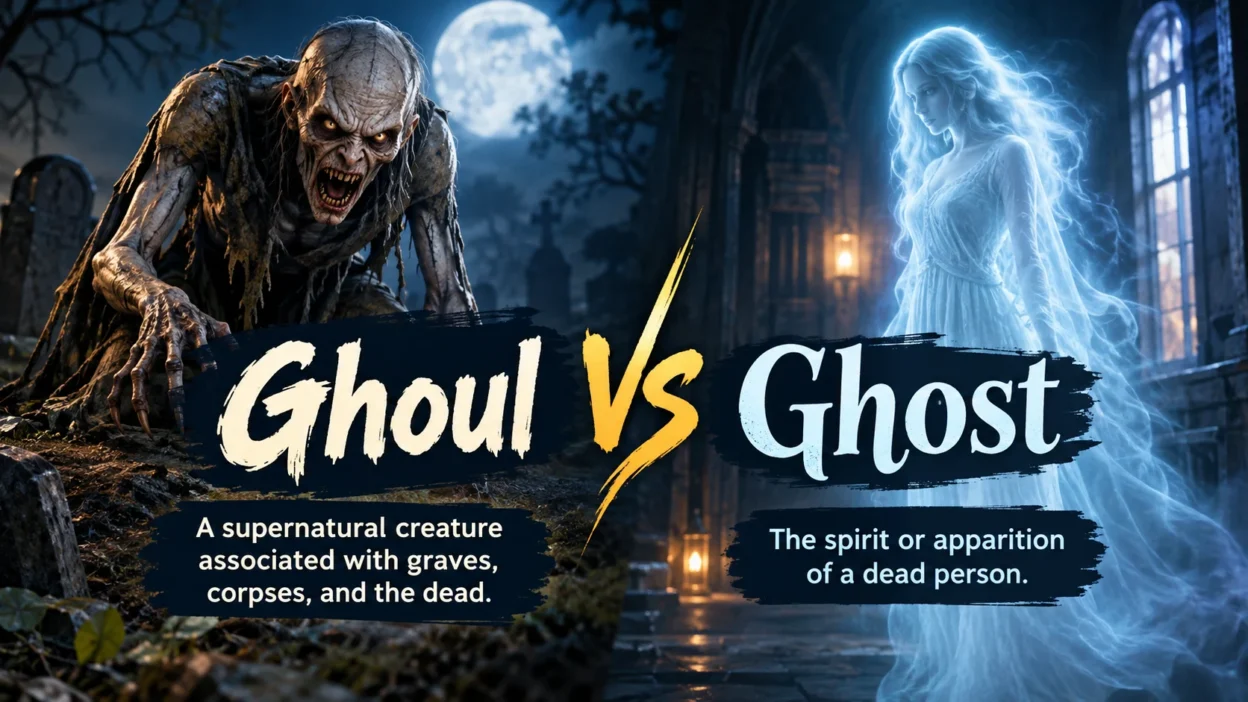
If you have ever wondered about ghoul vs ghost, you are not alone. Both words are connected with supernatural stories, death, and frightening creatures, but they do not mean the same thing. A ghost is usually described as the spirit or apparition of a dead person, while a ghoul is traditionally a supernatural creature associated with graves, corpses, and the consumption of human flesh.
The main difference is therefore about what kind of supernatural being each word describes. Ghosts are commonly portrayed as spirits that appear to the living, whereas ghouls are usually portrayed as physical, frightening creatures connected to burial places and dead bodies. Modern books, films, games, and fantasy stories sometimes use these terms differently, so understanding their traditional meanings can help you choose the right word.
Quick Answer
A ghost is usually the spirit or apparition of a dead person, often appearing to haunt a place. A ghoul is a supernatural creature traditionally associated with graves, corpses, and eating human flesh. In short, a ghost is generally a spirit, while a ghoul is generally a monster or creature.
Why Do People Confuse Ghoul and Ghost?
People often confuse ghoul and ghost because both words are strongly associated with horror and supernatural fiction. Movies, video games, novels, and Halloween stories frequently place ghosts, ghouls, zombies, vampires, and other creatures in the same fictional world.
There is also some variation in modern fantasy. A writer may create a ghoul that behaves like an undead monster or use a ghost-like creature in a way that differs from traditional folklore.
However, their basic meanings remain different:
- Ghost → the spirit or apparition of a dead person.
- Ghoul → a supernatural creature traditionally associated with graves and corpses.
- Zombie → an undead body or reanimated corpse in many modern traditions.
- Monster → a broad term for a frightening or unnatural creature.
Knowing these basic distinctions makes it much easier to understand horror stories and choose the right word.
First Word: Ghoul
A ghoul is a supernatural creature traditionally associated with graves, cemeteries, corpses, and the dead. The word comes through English from Arabic ghūl, a creature in Arabic folklore associated with graveyards and consuming human flesh.
In traditional stories, a ghoul is not simply a dead person’s spirit. It is a frightening creature that interacts physically with bodies and burial places.
In modern fantasy and horror, ghouls may be shown as:
- Undead creatures
- Graveyard monsters
- Flesh-eating beings
- Creatures that hunt humans
- Supernatural enemies in games and fiction
Example
The travelers became frightened when they discovered a ghoul hiding near the ancient cemetery.
Here, ghoul refers to a supernatural creature rather than the spirit of a dead person.
Second Word: Ghost
A ghost is generally understood as the spirit or apparition of a person who has died. Ghosts are often said to appear in places connected with their lives, deaths, or strong memories.
Unlike a ghoul, a ghost is usually imagined as non-physical or spirit-like.
Ghosts are commonly associated with:
- Haunted houses
- Cemeteries
- Old buildings
- Unexplained sounds
- Apparitions
- Spirits of deceased people
- Haunting or supernatural activity
Example
The old mansion was said to be haunted by the ghost of a woman who had died there many years ago.
The word ghost focuses on a spirit or apparition rather than a physical monster.
Ghoul vs Ghost: Comparison Table
| Feature | Ghoul | Ghost |
|---|---|---|
| Basic meaning | A supernatural creature associated with graves and corpses | A spirit or apparition of a dead person |
| Typical appearance | Physical, monstrous, frightening creature | Spirit, shadow, apparition, or transparent figure |
| Connection with death | Often associated with corpses and burial places | Usually represents a deceased person’s spirit |
| Physical creature? | Traditionally more creature-like | Usually non-physical or spirit-like |
| Common setting | Graves, cemeteries, ruins | Haunted houses, buildings, cemeteries |
| Common role | Monster or supernatural threat | Spirit or haunting presence |
| Origin | Arabic folklore through the word ghūl | Germanic/Old English linguistic roots |
| Common modern use | Horror, fantasy, games, fiction | Horror, folklore, stories, everyday metaphor |
When Should You Use Ghoul vs Ghost?
Use ghoul when you are talking about a supernatural creature associated with graves, corpses, or frightening physical behavior.
Example:
The fantasy game features a ghoul that guards the underground tomb.
Use ghost when you mean the spirit or apparition of a dead person.
Example:
She claimed that she saw a ghost in the hallway.
A simple way to decide is to ask:
Is it mainly a spirit? → Use ghost.
Is it mainly a supernatural creature or monster connected with corpses? → Use ghoul.
10+ Examples of Ghoul and Ghost
Examples with Ghoul
- The hero fought a ghoul in the abandoned cemetery.
- The villagers believed a ghoul lived near the old burial ground.
- The fantasy novel describes ghouls as creatures that feed on corpses.
- The adventurers encountered several ghouls beneath the ruined castle.
- The horror game includes a ghoul as one of its enemies.
- The legend warned travelers about a ghoul hiding among the graves.
Examples with Ghost
- The family believed a ghost haunted their old house.
- He said he saw a ghost standing beside the window.
- The story is about a ghost searching for its lost family.
- The children were frightened by the ghost in the hallway.
- The castle is famous for stories about a mysterious ghost.
- The ghost disappeared when the lights came on.
One Example Showing the Difference
The ghost appeared as a pale figure, while the ghoul attacked the travelers physically.
This sentence clearly separates the two ideas: the ghost is an apparition, while the ghoul is a physical supernatural creature.
Common Mistakes
Mistake 1: Using “ghoul” for every dead person’s spirit
A ghoul is not simply another word for a ghost.
Incorrect idea:
The ghoul of my grandfather appeared in the room.
If you mean the spirit of a deceased person, ghost is normally the appropriate word.
Mistake 2: Assuming every undead creature is a ghoul
Not every undead creature is a ghoul. Depending on the story, it might be a zombie, vampire, skeleton, ghost, or another fictional being.
Mistake 3: Thinking “ghoul” and “ghost” are synonyms
They can both appear in supernatural stories, but they describe different kinds of beings.
Mistake 4: Assuming every modern story follows traditional folklore
Fantasy writers and game designers can redefine supernatural creatures. A ghoul in one fictional universe may have different abilities or characteristics from a ghoul in another.
Memory Trick
Remember:
Ghost = Gone spirit
Think of a ghost as the spirit of someone who is gone.
Ghoul = Grave creature
Think of a ghoul as a frightening creature connected with graves and corpses.
A quick memory sentence is:
A ghost haunts; a ghoul hunts.
This is a memory aid rather than a strict rule for every fictional story, but it can help beginners remember the basic distinction.
American vs British English
There is no major difference in the basic meanings of “ghoul” and “ghost” between American and British English.
Both varieties of English use:
- Ghost for a spirit or apparition, especially one associated with a dead person.
- Ghoul for a supernatural creature traditionally associated with graves, corpses, or consuming human flesh.
The words may appear more or less often depending on the type of literature, entertainment, or cultural context, but their core meanings remain broadly the same.
Similar Words
Several words are related to ghoul and ghost, but they are not interchangeable.
Spirit
A spirit is a broad term that can refer to a supernatural being, a soul, or a non-physical entity.
Apparition
An apparition is a ghostly or supernatural appearance, often a visible figure.
Specter
A specter or spectre is a ghost or frightening supernatural apparition.
Phantom
A phantom can mean a ghost, apparition, or something that seems to exist but cannot be clearly identified.
Zombie
A zombie is generally an undead or reanimated corpse in modern popular culture. Its characteristics vary across different traditions and fictional settings.
Wraith
A wraith is a ghost-like or spirit-like supernatural figure, especially in fantasy and horror.
Monster
Monster is a much broader word for a frightening, strange, or unnatural creature. A ghoul can be a monster, but not every monster is a ghoul.
Final Verdict
The easiest distinction is:
Ghoul = supernatural creature associated with graves and corpses.
Ghost = spirit or apparition of a dead person.
Although both appear frequently in horror and supernatural fiction, they represent different concepts. A ghost is generally understood as a spirit, while a ghoul is generally understood as a frightening creature.
If you are describing the spirit of someone who has died, choose ghost. If you are describing a grave-associated supernatural monster, ghoul is usually the better choice.
FAQs About Ghoul vs Ghost
1. Is a ghoul the same as a ghost?
No. A ghoul and a ghost are different supernatural beings. A ghost is generally the spirit or apparition of a dead person, while a ghoul is traditionally a creature associated with graves, corpses, and consuming human flesh.
2. Is a ghoul undead?
In modern fantasy and horror, ghouls are often portrayed as undead creatures. However, different fictional worlds can define them differently. The traditional folklore concept is broader and comes from older supernatural traditions.
3. Can a ghost become a ghoul?
There is no universal rule that a ghost becomes a ghoul. Some fictional stories may create such a transformation, but it is a feature of that particular story rather than a standard definition.
4. Are ghouls real?
Ghouls belong to folklore, mythology, and fiction. There is no reliable scientific evidence that supernatural ghouls exist as described in these traditions.
5. What is scarier, a ghoul or a ghost?
That depends on the story and the reader. Ghouls are often portrayed as physical monsters, while ghosts are commonly portrayed as mysterious or frightening spirits.
6. What is the difference between a ghoul and a zombie?
A ghoul is traditionally a supernatural creature associated with graves and corpses, while a zombie is generally portrayed in modern fiction as a reanimated or undead corpse. The exact characteristics depend on the fictional setting.
7. What is another word for ghost?
Depending on the context, related words include spirit, apparition, specter, spectre, phantom, and wraith. These words are not always exact synonyms and can have different shades of meaning.
Remember This
Ghost = a spirit or apparition.
Ghoul = a supernatural creature associated with graves and corpses.
When in doubt, remember the simple contrast:
Ghosts are spirits; ghouls are creatures.
Conclusion
Understanding ghoul vs ghost becomes easy once you focus on the type of supernatural being each word describes. A ghost is generally the spirit or apparition of a deceased person, while a ghoul is traditionally a frightening creature connected with graves, corpses, and the dead.
Modern horror, fantasy books, movies, and games may give these creatures different characteristics, so context always matters. Still, the traditional distinction is useful for students, ESL learners, writers, and anyone who wants to use these supernatural terms correctly and naturally.

Daniel Jack is a language enthusiast and content writer who specializes in synonyms, vocabulary, and word meanings. He creates clear, engaging resources that help readers improve communication and expand their English skills.