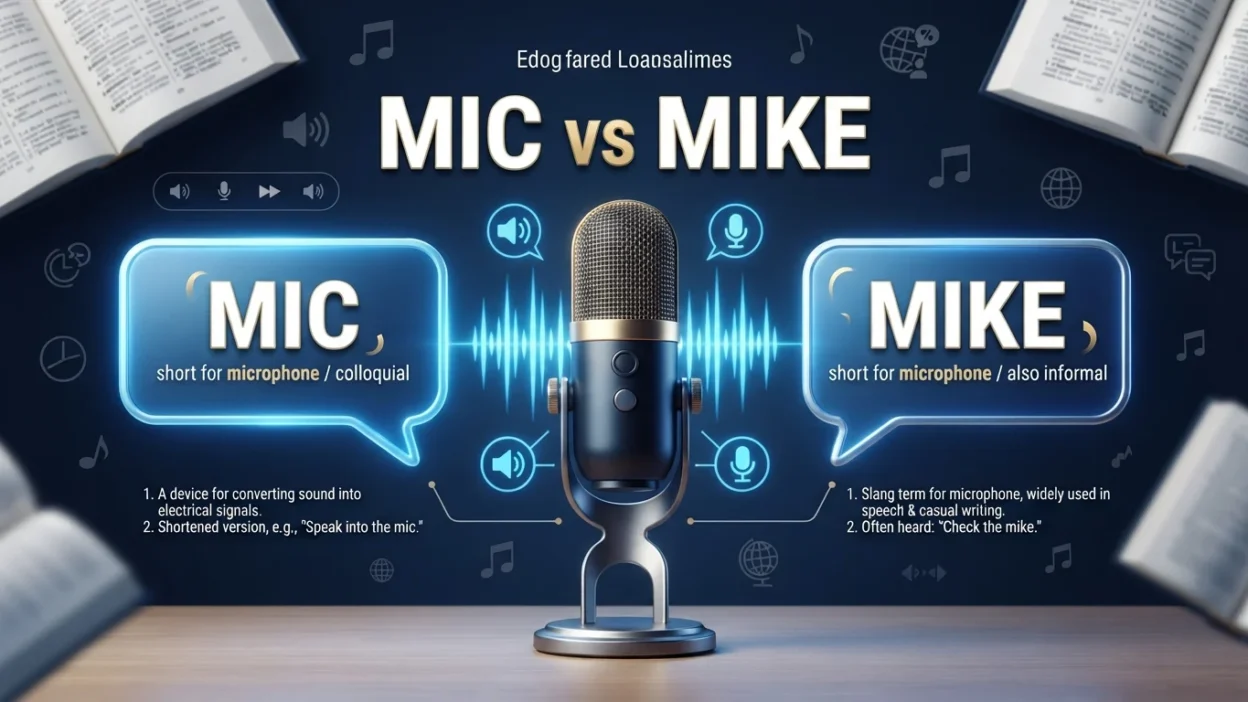
If you have ever seen both “mic” and “mike,” you may wonder whether they mean the same thing. In most everyday English, mic and mike both refer to a microphone, the device used to capture or amplify sound. The main difference is spelling, style, and context. Mic is the more common modern abbreviation, especially in writing, while mike is an older spelling that remains correct and is still used in some contexts.
Quick Answer
Mic and mike can both mean microphone. Mic is the standard modern abbreviation and is especially common in technology, music, and casual writing. Mike is an older alternative spelling that is still accepted, particularly in expressions such as “mic/mike check” and “drop the mike.”
Why Do People Confuse “Mic” and “Mike”?
The confusion comes mainly from pronunciation. Both mic and mike are generally pronounced like the name Mike (/maɪk/).
The abbreviation mic comes directly from microphone. Because “mic” is pronounced like the word “mike,” English speakers sometimes spell the abbreviation phonetically as mike.
For example:
- Please turn on the mic.
- Please turn on the mike.
Both can refer to the same piece of equipment.
However, mic is now generally preferred when you are writing about a microphone as a piece of audio equipment.
What Does “Mic” Mean?
Mic is a shortened form of microphone.
A microphone is a device that picks up sound, such as speech, singing, music, or other audio.
Examples
- The singer held the mic close to her mouth.
- My mic isn’t working during the meeting.
- He bought a new USB mic for recording podcasts.
- Please mute your mic when you’re not speaking.
“Mic” is especially common in:
- Music
- Podcasting
- Streaming
- Online meetings
- Gaming
- Audio production
- Casual communication
What Does “Mike” Mean?
Mike can also be used as a spelling of the abbreviation for microphone.
It is pronounced exactly like the common male name Mike.
Examples
- The performer stepped up to the mike.
- He spoke into the mike during the interview.
- The old radio had a mike attached to it.
Although mike is a legitimate spelling, many modern writers prefer mic because it more clearly reflects the word microphone.
Mic vs Mike: Comparison Table
| Feature | Mic | Mike |
|---|---|---|
| Meaning | Microphone | Microphone |
| Pronunciation | /maɪk/ | /maɪk/ |
| Full word | Microphone | Microphone |
| Common in modern writing | Very common | Less common |
| Common in technology | Yes | Less common |
| Common in music | Yes | Yes |
| Informal abbreviation | Yes | Yes |
| Can refer to audio equipment | Yes | Yes |
| Capitalization | Usually lowercase | Usually lowercase |
| Also a person’s name | No | Yes |
When Should You Use “Mic” or “Mike”?
Use “mic” for modern everyday writing
Mic is usually the clearest choice when you mean a microphone.
- My mic is muted.
- Check your mic before the presentation.
- This mic produces clear audio.
- She bought a wireless mic.
Use “mike” when it fits an established expression or style
Mike can appear in older writing and familiar expressions.
For example:
- Drop the mike.
- Mike check.
That said, mic check is also extremely common in modern usage.
12 Examples of “Mic” and “Mike”
- My mic stopped working during the call.
- Please speak closer to the mic.
- The singer picked up the mic.
- I need to buy a better microphone for my podcast.
- Can you mute your mic?
- The microphone was connected to a wireless receiver.
- He spoke into the mike during the broadcast.
- The reporter held the mike toward the politician.
- The audio sounds better with this mic.
- She adjusted the mike before the interview.
- The host asked everyone to check their mics.
- The performer finished with a dramatic “drop the mike” moment.
Common Mistakes With “Mic” and “Mike”
Mistake 1: Thinking “mic” and “Mike” have different meanings
When referring to a microphone, they can mean the same thing.
Correct:
Please turn on the mic.
Also correct:
Please turn on the mike.
Mistake 2: Assuming “mike” is always a person’s name
Context matters.
- Mike is coming later. → person’s name
- Put the mike on the stand. → microphone
Mistake 3: Writing “mick” for microphone
Mick is generally not the standard spelling for a microphone.
Use mic or mike instead.
Mistake 4: Thinking “mic” must be pronounced like “mick”
When mic means microphone, it is normally pronounced /maɪk/, like Mike.
Memory Trick
Remember:
Mic = microphone
Think of the first three letters of microphone:
MIC → MICrophone
And remember:
Mike = an alternative spelling for mic
So if you are unsure, mic is usually the safest modern choice.
American vs British English
Both mic and mike can be found in American and British English.
There is no simple rule that says one spelling belongs exclusively to American English and the other exclusively to British English.
In modern usage, mic is widely recognized and commonly used in both varieties, especially in technical, musical, broadcasting, and digital contexts.
Mike remains understandable and established, but it may look more traditional or less common in some modern contexts.
Similar Words
Several words are related to mic and mike:
- Microphone — the full form
- Mic — a common abbreviation of microphone
- Mike — an alternative spelling of the abbreviation
- Microphone stand — equipment used to hold a microphone
- Headset mic — a microphone attached to a headset
- Lavalier mic — a small microphone commonly clipped to clothing
- Wireless mic — a microphone that transmits audio without a cable
- USB mic — a microphone that connects through USB
Final Verdict
Mic and mike can both mean microphone, and they are pronounced the same way when used with this meaning.
For most modern writing, mic is the more natural and widely used choice. Mike is still a recognized alternative, particularly in established expressions and older usage.
If you are writing about audio equipment and want the clearest modern abbreviation, mic is generally the better choice.
Frequently Asked Questions
Is “mic” short for microphone?
Yes. Mic is a common shortened form of microphone.
Is “mike” another word for microphone?
Yes. Mike is an established alternative spelling for the shortened form of microphone.
Is “mic” or “mike” more common?
Mic is generally more common in modern writing, especially in technology, music, podcasting, streaming, and online communication.
Are “mic” and “mike” pronounced the same?
Yes. When they mean microphone, both are normally pronounced like the name Mike.
Is “mike” grammatically correct?
Yes. Mike can be used as a spelling of the abbreviation for microphone. However, mic is often preferred in modern usage.
Should I write “mic check” or “mike check”?
Both forms can be found. Mic check is a very common modern spelling, while mike check is also established.
Is “mic” formal English?
“Mic” is an accepted abbreviation, but microphone is more appropriate when you need a fully formal or highly precise style.
Is “mick” a spelling of microphone?
Usually, no. When referring to a microphone, use mic or mike.
Remember This
Mic = microphone
Mike = alternative spelling of mic
Both are pronounced “Mike.”
Mic is generally the more common modern choice.
Conclusion
The difference between mic and mike is mainly one of spelling and usage rather than meaning. Both can refer to a microphone, and both are pronounced the same way when used in this context. The word mic is especially common in modern digital, musical, and technical communication.
If you are writing a sentence today and need a short form of microphone, mic is usually the most natural choice. However, mike is not automatically wrong; it remains an established alternative spelling that readers will understand.

David Henry is a language enthusiast and content writer specializing in synonyms, vocabulary, and word meanings. He creates clear, engaging resources that help readers improve their writing, communication, and English skills.