Have you ever wondered whether to say “you are correct” or “you are right” when agreeing with someone? Both expressions are grammatically correct and communicate that someone has said something true or accurate. However, they differ slightly in tone, formality, and everyday usage.
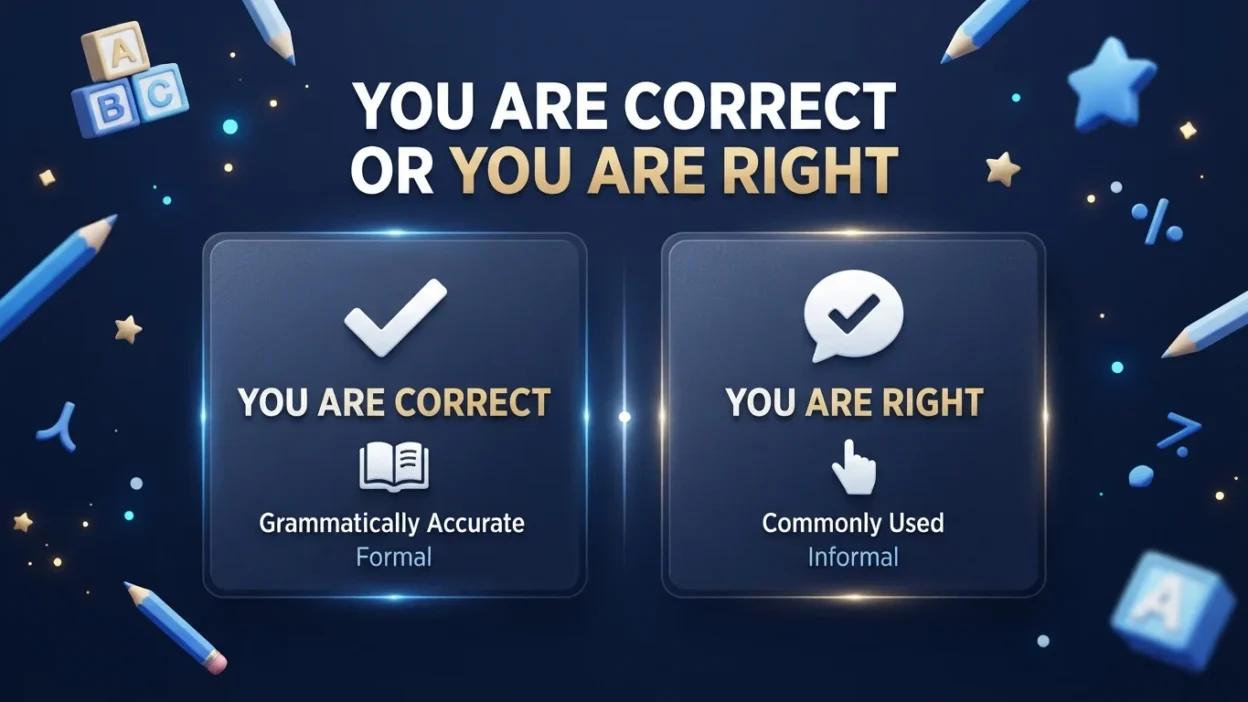
“You are right” is the more common expression in everyday conversations. People use it when agreeing with someone, acknowledging a good point, or admitting that another person has the correct answer. “You are correct” sounds more formal, precise, and sometimes more focused on facts, answers, or information.
Understanding the difference between these two expressions can help you speak more naturally, write more clearly, and choose the right phrase for different situations. Whether you are talking to friends, answering a question in class, or writing a professional email, knowing when to use each expression will make your English more effective.
Quick Answer: You Are Correct vs. You Are Right
“You are right” and “you are correct” both mean that someone is accurate or has said something true. “You are right” is more natural in everyday conversation, while “you are correct” is often used in formal, academic, or factual contexts. Both expressions are grammatically correct and can often be used interchangeably.
Why Do People Confuse “You Are Correct” and “You Are Right”?
People often confuse these expressions because they share a similar meaning. Both can be used to agree with someone or confirm that a statement, answer, or belief is accurate.
For example:
- “You are right about the answer.”
- “You are correct about the answer.”
Both sentences are understandable and grammatically correct.
The main difference is their tone and typical usage:
- You are right: More conversational, natural, and common in everyday speech.
- You are correct: More formal, precise, and often used when confirming facts or answers.
The expressions are not always interchangeable in every context, especially when “right” means morally justified or refers to a person’s rights.
1. What Does “You Are Correct” Mean?
“You are correct” means that someone’s answer, statement, information, or understanding is accurate and agrees with the facts.
It is often used in situations where accuracy matters, such as education, professional communication, examinations, and factual discussions.
Examples of “You Are Correct”
- “You are correct; the capital of France is Paris.”
- “You are correct in saying that water freezes at 0°C under standard atmospheric pressure.”
- “Your calculation is accurate. You are correct.”
- “You are correct about the meeting time.”
- “You are correct that the document needs another revision.”
When Is “You Are Correct” Used?
Use “you are correct” when you want to:
- Confirm a factual statement.
- Acknowledge an accurate answer.
- Sound formal or professional.
- Give precise feedback in an academic or technical setting.
Example: “You are correct. The final answer is 42.”
This expression clearly confirms that the answer is accurate.
2. What Does “You Are Right” Mean?
“You are right” means that someone’s statement, opinion, answer, judgment, or understanding is correct or reasonable.
It is widely used in everyday English and can express agreement, acknowledgment, or acceptance of another person’s point.
Examples of “You Are Right”
- “You are right; we should leave early.”
- “You are right about the movie.”
- “You are right. I forgot to bring my notebook.”
- “You are right to ask questions before making a decision.”
- “You are right that we need more time.”
When Is “You Are Right” Used?
Use “you are right” when you want to:
- Agree with someone’s opinion or suggestion.
- Acknowledge that another person has made a good point.
- Admit that someone else was correct.
- Speak naturally in everyday conversations.
Example: “You are right. I should have listened to your advice.”
This sentence expresses agreement and acknowledgment in a natural, conversational way.
3. Comparison Table: You Are Correct vs. You Are Right
|
Feature
|
You Are Correct
|
You Are Right
|
| — | — | — |
|
Meaning
|
Accurate or factually true
|
Correct, justified, or reasonable
|
|
Tone
|
More formal and precise
|
More conversational and flexible
|
|
Common use
|
Facts, answers, and information
|
Opinions, advice, answers, and agreement
|
|
Everyday speech
|
Less common
|
More common
|
|
Academic settings
|
Frequently appropriate
|
Also appropriate
|
|
Professional settings
|
Formal confirmation
|
Natural agreement
|
|
Example
|
“You are correct about the result.”
|
“You are right about the result.”
|
4. When Should You Use Each Expression?
Use “You Are Correct” When Confirming Facts
This expression is suitable when someone provides accurate information or gives the right answer.
Example: “You are correct. The experiment supports your conclusion.”
Use “You Are Right” When Agreeing With an Opinion
This phrase sounds natural when you agree with someone’s point of view or suggestion.
Example: “You are right. We should discuss this before deciding.”
Use “You Are Right” When Admitting a Mistake
When someone points out an error and you accept it, “you are right” is a common choice.
Example: “You are right. I misunderstood the instructions.”
Use “You Are Correct” in Formal Feedback
Teachers, examiners, and professionals may use this phrase to confirm that an answer or statement is accurate.
Example: “You are correct. Your solution follows the required method.”
5. You Are Correct or You Are Right: 12 Examples
Here are 12 practical examples showing how both expressions work in everyday and formal situations.
|
Situation
|
Example
|
| — | — |
|
Classroom
|
“You are correct. The answer is 15.”
|
|
Everyday conversation
|
“You are right. Let’s take a taxi.”
|
|
Workplace
|
“You are correct about the figures in the report.”
|
|
Giving advice
|
“You are right to be careful.”
|
|
Admitting a mistake
|
“You are right. I made a mistake.”
|
|
Confirming a fact
|
“You are correct. The meeting starts at 10 a.m.”
|
|
Discussing a plan
|
“You are right. We need another option.”
|
|
Answering a question
|
“You are correct. That is the right answer.”
|
|
Discussing an opinion
|
“You are right about how difficult the task is.”
|
|
Checking information
|
“You are correct; the date is September 25.”
|
|
Friendly conversation
|
“You are right! That sounds like a great idea.”
|
|
Professional feedback
|
“You are correct in your assessment of the issue.”
|
6. Common Mistakes to Avoid
Mistake 1: Thinking “You Are Correct” Is Always Better
Both expressions are correct. “You are correct” may sound unnecessarily formal in a relaxed conversation.
- Natural: “You’re right! I forgot.”
- More formal: “You are correct. I forgot.”
Mistake 2: Thinking “You Are Right” Only Refers to Facts
“You are right” can refer to opinions, decisions, advice, and moral judgments.
Example: “You are right to stand up for yourself.”
Here, “right” means justified or reasonable, not simply factually accurate.
Mistake 3: Using “You Are Correct” to Express Every Kind of Agreement
“You are correct” usually focuses on accuracy. When you want to agree naturally with someone’s suggestion, “you are right” is often more suitable.
Example:
- Natural: “You’re right. Let’s try a different approach.”
- More formal: “You are correct. Let’s try a different approach.”
Mistake 4: Forgetting the Verb “Are”
Both expressions need the verb “are” when the subject is “you.”
- Correct: “You are right.”
- Correct: “You are correct.”
- Incorrect: “You right.”
- Incorrect: “You correct.”
In casual speech, contractions are also correct: “You’re right” and “You’re correct.”
7. Memory Trick: How to Remember the Difference
Use this simple memory trick:
- Right = Real-life agreement. Think of everyday conversations, opinions, and suggestions.
- Correct = Confirmed accuracy. Think of facts, answers, and precise information.
For example:
- Your friend suggests leaving early: “You’re right.”
- Your teacher checks your answer: “You are correct.”
Remember that this is a helpful general guide, not a strict grammatical rule.
8. American vs. British English
Both “you are correct” and “you are right” are standard expressions in American and British English.
|
Expression
|
American English
|
British English
|
| — | — | — |
|
You are right
|
Common in everyday speech
|
Common in everyday speech
|
|
You are correct
|
Used in formal and factual contexts
|
Used in formal and factual contexts
|
|
You’re right
|
Common conversational contraction
|
Common conversational contraction
|
|
You’re correct
|
Natural, but often more formal
|
Natural, but often more formal
|
There is no major difference in meaning between American and British English for these expressions. The choice depends more on context, tone, and personal speaking style than on regional grammar.
9. Similar Words and Expressions
Several expressions can communicate agreement or accuracy, but each has a slightly different tone.
|
Expression
|
Meaning
|
Example
|
| — | — | — |
|
You’re absolutely right
|
Strong agreement
|
“You’re absolutely right about that.”
|
|
That’s correct
|
Confirms accuracy
|
“That’s correct. The answer is 12.”
|
|
Exactly
|
Strong agreement with a point
|
“Exactly! That’s what I meant.”
|
|
That’s true
|
Acknowledges a true statement
|
“That’s true. We need more time.”
|
|
You’re mistaken
|
Says someone is incorrect
|
“You’re mistaken about the date.”
|
|
You have a point
|
Acknowledges a reasonable argument
|
“You have a point about the cost.”
|
|
That’s right
|
Confirms or agrees
|
“That’s right. The office closes at five.”
|
10. Final Verdict: Which Expression Should You Choose?
Both “you are correct” and “you are right” are grammatically correct, but they are often used in different situations.
- Choose “you are right” for everyday conversations, opinions, suggestions, and natural agreement.
- Choose “you are correct” when confirming facts, answers, or information in a formal or precise context.
If you are unsure which one to use in a casual conversation, “you are right” is usually a natural choice. If you are confirming a factual answer, either expression can work.
11. Frequently Asked Questions (FAQs)
1. Is it correct to say “you are correct”?
Yes. “You are correct” is grammatically correct and means that someone’s statement, answer, or information is accurate.
2. Is “you are right” more natural than “you are correct”?
In everyday conversation, “you are right” is generally more common and conversational. “You are correct” is also natural, especially when confirming factual information.
3. What is the difference between “you are right” and “you are correct”?
“You are right” can express agreement, a reasonable opinion, or a correct answer. “You are correct” usually emphasizes factual accuracy or correctness.
4. Can I use “you are correct” in casual conversation?
Yes. It is perfectly acceptable in casual conversation, although it may sound more formal than “you are right.”
5. Is “you’re right” grammatically correct?
Yes. “You’re right” is the contraction of “you are right” and is widely used in spoken and written English.
6. Can “you are right” refer to an opinion?
Yes. It can acknowledge that someone’s opinion, judgment, or suggestion is reasonable or justified.
7. Which expression should I use in an exam or classroom?
Both expressions are appropriate. “You are correct” is often used to confirm an accurate answer, while “you are right” is also perfectly acceptable.
12. Remember This
- “You are right” is common in everyday conversation and when agreeing with someone.
- “You are correct” is often used to confirm facts, answers, and accurate information.
- Both expressions are grammatically correct.
- The best choice depends on the context and the meaning you want to convey.
Conclusion
“You are correct” and “you are right” are two useful English expressions that communicate accuracy and agreement. Although they share a similar meaning, “you are right” is more conversational, while “you are correct” often sounds more formal and precise. Learning the difference can help you communicate more naturally in everyday conversations, classrooms, and professional settings.
The easiest way to remember the distinction is to use “you are right” when agreeing with someone and “you are correct” when confirming factual accuracy. Both expressions are widely accepted in American and British English, so choose the one that best fits your situation and intended tone.

Daniel Jack is a language enthusiast and content writer who specializes in synonyms, vocabulary, and word meanings. He creates clear, engaging resources that help readers improve communication and expand their English skills.