
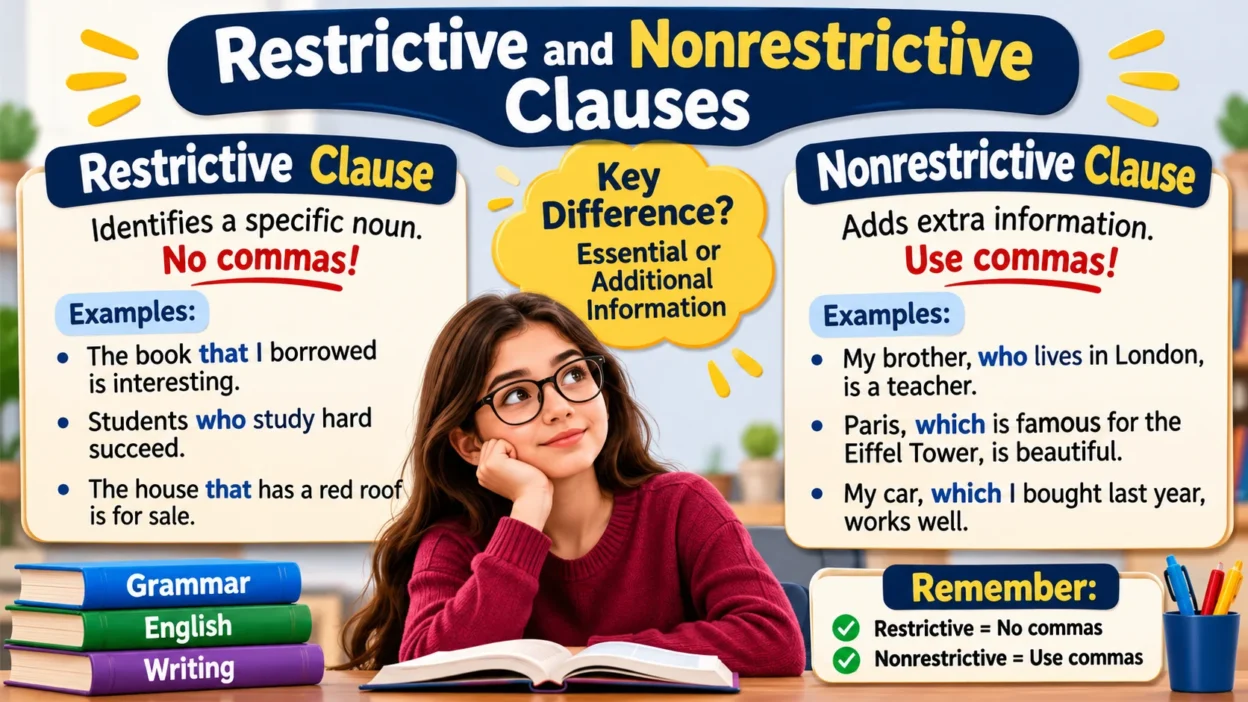
Understanding the difference between restrictive and nonrestrictive clauses is an important part of learning English grammar. Both types of clauses provide additional information about nouns, but they serve different purposes in a sentence. A restrictive clause identifies exactly which person, place, thing, or idea the writer means, while a nonrestrictive clause adds extra information that is not essential to identifying the noun.
Although these clauses may look similar, they follow different punctuation rules. Restrictive clauses generally do not require commas, whereas nonrestrictive clauses are separated from the rest of the sentence by commas. Knowing when to use each type can help you write clearer sentences, avoid grammatical mistakes, and communicate your ideas more effectively. Whether you are a student, ESL learner, beginner, or experienced writer, understanding these two clause types will strengthen your grammar and writing skills.
Quick Answer
A restrictive clause provides essential information that identifies a specific noun and does not use commas. A nonrestrictive clause adds extra, nonessential information about a noun and is separated by commas. The main difference is whether the information is necessary to understand which person or thing the sentence refers to.
Why Do People Confuse Restrictive and Nonrestrictive Clauses?
People often confuse restrictive and nonrestrictive clauses because both provide information about nouns and frequently begin with relative pronouns such as who, which, and that.
However, their purposes are different:
- Restrictive clauses identify or limit the noun being discussed.
- Nonrestrictive clauses provide additional details about an already identified noun.
- Restrictive clauses generally do not use commas.
- Nonrestrictive clauses require commas to separate the extra information.
The biggest challenge is understanding whether the information is essential to the sentence’s meaning.
Consider these examples:
- Restrictive: The students who studied passed the examination.
- Nonrestrictive: The students, who studied, passed the examination.
In the first sentence, only the students who studied passed. In the second, the sentence suggests that the students being discussed all studied and passed.
What Is a Restrictive Clause?
A restrictive clause is a dependent clause that provides essential information about a noun. It identifies exactly which person or thing the sentence refers to.
Without this information, the reader may not understand which specific noun is being discussed.
Restrictive clauses are also called essential clauses or defining relative clauses.
Examples of Restrictive Clauses
- The woman who lives next door is a doctor.
- The book that I borrowed is interesting.
- Students who arrive late must wait outside.
- The house that has a red roof belongs to my uncle.
- People who exercise regularly often improve their fitness.
In these examples, the clauses identify particular people or things.
Important Grammar Rules for Restrictive Clauses
- Do not place commas around restrictive clauses.
- Use them when information is necessary to identify a noun.
- They commonly begin with who, whom, whose, that, or which, depending on the construction and style.
- The relative pronoun can sometimes be omitted when it functions as the object.
Example:
– The movie (that) we watched was excellent.
Here, that can be omitted because it is the object of the verb watched.
What Is a Nonrestrictive Clause?
A nonrestrictive clause is a dependent clause that adds extra information about a noun without identifying or limiting it.
The noun is already sufficiently identified, so the additional information is not necessary to understand the main message.
Nonrestrictive clauses are also called nonessential clauses or nondefining relative clauses.
Examples of Nonrestrictive Clauses
- My brother, who lives in London, is a teacher.
- Paris, which is famous for the Eiffel Tower, attracts millions of visitors.
- Sarah, who is my best friend, loves reading.
- My laptop, which I bought last year, works perfectly.
- Mr. Johnson, who teaches English, is very helpful.
In these sentences, the clauses provide additional details about nouns that are already identified.
Important Grammar Rules for Nonrestrictive Clauses
- Use commas to separate nonrestrictive clauses from the main sentence.
- Use them when information is additional rather than essential.
- Use who, whom, whose, or which as appropriate.
- In standard edited English, do not use that to introduce a nonrestrictive relative clause.
- Do not omit the relative pronoun from a nonrestrictive clause.
Example:
My car, which I bought recently, is very comfortable.
The sentence still makes sense without the additional information:
My car is very comfortable.
Restrictive vs Nonrestrictive Clauses: Comparison Table
| Feature | Restrictive Clause | Nonrestrictive Clause |
|---|---|---|
| Purpose | Identifies a noun | Adds extra information |
| Importance | Essential | Nonessential |
| Commas | Not used | Required |
| Other name | Defining clause | Nondefining clause |
| Common pronouns | Who, that, which | Who, whom, which |
| Can be removed? | Usually changes the meaning | Usually preserves the main meaning |
| Example | The dog that barked ran away. | My dog, which is small, ran away. |
When Should You Use Each Type?
Choosing between restrictive and nonrestrictive clauses depends on the information you want to communicate.
When to Use Restrictive Clauses
Use a restrictive clause when you need to identify a particular person, object, place, or group.
Examples:
- The employees who work remotely receive special equipment.
- The phone that has a broken screen belongs to me.
- The students who completed their assignments can leave.
In each sentence, the clause identifies a specific group or item.
When to Use Nonrestrictive Clauses
Use a nonrestrictive clause when the noun is already identified and you want to provide additional information.
Examples:
- My mother, who is a nurse, works at a hospital.
- The Amazon River, which flows through South America, is one of the world’s major rivers.
- James, who enjoys playing football, joined the school team.
The additional information makes the sentences more descriptive without defining which person or thing is being discussed.
15 Examples of Restrictive and Nonrestrictive Clauses
The following examples demonstrate how these clauses work in everyday English.
Restrictive Clause Examples
- The girl who won the competition is my cousin.
- The restaurant that serves Italian food is always busy.
- Employees who arrive early can choose their seats.
- The shoes that I purchased yesterday are comfortable.
- The teacher who helped me is very kind.
- People who drink enough water support their overall health.
- The house that stands on the corner is for sale.
- The students who passed the test celebrated together.
Nonrestrictive Clause Examples
- My father, who enjoys gardening, grows vegetables.
- London, which is the capital of England, attracts many tourists.
- My phone, which has a large screen, is easy to use.
- Emma, who studies medicine, wants to become a doctor.
- The Eiffel Tower, which is located in Paris, is a famous landmark.
- Our teacher, who is very experienced, explains difficult topics clearly.
- My bicycle, which I received as a birthday gift, is blue.
How Does Punctuation Change the Meaning?
Compare these two sentences:
- Restrictive: My brothers who live abroad are visiting me.
- Nonrestrictive: My brothers, who live abroad, are visiting me.
The first sentence identifies the brothers who live abroad, suggesting that the speaker may have other brothers elsewhere.
The second sentence presents the fact that the speaker’s brothers live abroad as additional information. It suggests that all the brothers being discussed live abroad.
This demonstrates why commas are important in English grammar.
Common Mistakes with Restrictive and Nonrestrictive Clauses
Even experienced English speakers sometimes make mistakes when using these clauses.
Here are some common errors and their corrections.
1. Using Commas with Restrictive Clauses
Incorrect: The students, who studied hard passed the exam.
Correct: The students who studied hard passed the exam.
Why? The clause identifies which students passed, so commas are unnecessary.
2. Forgetting Commas with Nonrestrictive Clauses
Incorrect: My sister who lives in Canada is a doctor.
Correct: My sister, who lives in Canada, is a doctor.
Why? If the sentence refers to one already identified sister, the clause provides additional information.
3. Using “That” in Nonrestrictive Clauses
Incorrect: My car, that is very old, needs repairs.
Correct: My car, which is very old, needs repairs.
Why? Standard English uses which rather than that to introduce nonrestrictive relative clauses.
4. Omitting the Relative Pronoun in a Nonrestrictive Clause
Incorrect: My friend, lives in New York, is visiting me.
Correct: My friend, who lives in New York, is visiting me.
Why? A nonrestrictive relative clause needs its relative pronoun.
5. Assuming Every “Which” Clause Is Nonrestrictive
Incorrect assumption: Every clause beginning with which requires commas.
Correct understanding: Which can introduce either a restrictive or a nonrestrictive clause.
Examples:
- Restrictive: The book which has a blue cover is mine.
- Nonrestrictive: This book, which has a blue cover, is mine.
In American English, that is often preferred for restrictive clauses, although restrictive which is also used.
Memory Trick: How to Remember the Difference
You can remember the difference with two simple ideas:
- Restrictive = Required: The information is needed to identify the noun.
- Nonrestrictive = Not Required: The information adds extra details but is not necessary to identify the noun.
Another useful trick is to remove the clause.
If removing it changes which person or thing the sentence refers to, it is probably restrictive.
If removing it leaves the main identification and message intact, it is probably nonrestrictive.
Remember:
Restrictive = No commas.
Nonrestrictive = Use commas.
American vs British English: Are the Rules Different?
The basic grammar rules for restrictive and nonrestrictive clauses are the same in American and British English.
Both varieties use:
- No commas for restrictive clauses.
- Commas for nonrestrictive clauses.
- Who for people and which for things in appropriate relative clauses.
- That primarily for restrictive clauses in standard usage.
However, there is a difference in common style preferences.
American English:
American writers often prefer that for restrictive clauses and which for nonrestrictive clauses.
Example:
- The car that I bought is expensive.
- My car, which I bought last year, is expensive.
British English:
British English commonly allows which in restrictive clauses as well as nonrestrictive clauses.
Example:
- The car which I bought is expensive.
- My car, which I bought last year, is expensive.
These are general preferences rather than absolute rules. The most important distinction in both varieties is whether the clause is essential or additional.
Similar Grammar Terms You Should Know
Understanding related grammar terms can make restrictive and nonrestrictive clauses easier to recognize.
1. Defining Relative Clause
A defining relative clause identifies a particular noun. It is another name for a restrictive clause.
Example: The man who called you is waiting outside.
2. Nondefining Relative Clause
A nondefining relative clause adds extra information about an already identified noun. It is another name for a nonrestrictive clause.
Example: John, who called you yesterday, is waiting outside.
3. Essential Clause
An essential clause provides information necessary to identify the noun.
Example: The students who passed the exam received certificates.
4. Nonessential Clause
A nonessential clause provides additional information that can be removed without changing the basic identification of the noun.
Example: My teacher, who speaks three languages, is very knowledgeable.
5. Relative Pronoun
A relative pronoun introduces a relative clause and connects it to a noun or pronoun.
Common relative pronouns include:
- Who
- Whom
- Whose
- Which
- That
6. Dependent Clause
A dependent clause contains a subject and a verb but cannot normally stand alone as a complete sentence.
Both restrictive and nonrestrictive relative clauses are dependent clauses.
Frequently Asked Questions (FAQs)
1. What is the main difference between restrictive and nonrestrictive clauses?
A restrictive clause provides essential information that identifies a noun, while a nonrestrictive clause adds extra information about an already identified noun. Restrictive clauses do not use commas, whereas nonrestrictive clauses are separated by commas.
2. Do restrictive clauses need commas?
No. Restrictive clauses do not need commas because their information is essential to identifying the noun.
Example: The woman who teaches English is my aunt.
3. Do nonrestrictive clauses always require commas?
Yes. In standard English punctuation, nonrestrictive clauses are separated from the main sentence by commas. If the clause appears in the middle of a sentence, use a comma before and after it.
Example: My uncle, who lives in Australia, is visiting us.
4. Can I use “that” in a nonrestrictive clause?
No. In standard edited English, that should not introduce a nonrestrictive relative clause. Use who for people or which for things, as appropriate.
Incorrect: My laptop, that is new, works well.
Correct: My laptop, which is new, works well.
5. Can a restrictive clause be removed from a sentence?
A restrictive clause can sometimes be removed grammatically, but doing so may change the meaning by making the noun less specific or changing which person or thing is being discussed.
For example:
- The students who studied passed.
- The students passed.
The second sentence no longer specifies which students passed.
6. Are restrictive clauses and defining clauses the same?
Yes. Restrictive clauses and defining relative clauses are two names for the same grammatical structure. Both provide essential information that identifies a noun.
7. Are nonrestrictive clauses and nonessential clauses the same?
Yes. Nonrestrictive clauses are also called nonessential or nondefining clauses because they add information that is not necessary to identify the noun.
Remember This
Keep these essential grammar rules in mind:
- Restrictive clauses identify specific nouns.
- Nonrestrictive clauses add extra information.
- Restrictive clauses do not take commas.
- Nonrestrictive clauses require commas.
- That is not used to introduce nonrestrictive relative clauses in standard edited English.
- Removing a nonrestrictive clause usually leaves the main meaning intact.
- Removing a restrictive clause can change the meaning of the sentence.
The most important thing to remember is that punctuation depends on the purpose of the information, not simply on which relative pronoun introduces the clause.
Conclusion
Restrictive and nonrestrictive clauses are two important parts of English grammar that help writers provide information clearly and accurately. A restrictive clause identifies exactly which person or thing is being discussed, while a nonrestrictive clause adds extra details about an already identified noun. Although both types provide information, their meanings and punctuation rules are different.
To use them correctly, ask yourself if the information is essential to identifying the noun. If it is essential, use a restrictive clause without commas. If it is additional, use a nonrestrictive clause with commas. Practicing these rules with everyday examples will help you improve your grammar, punctuation, and overall writing skills.

David Henry is a language enthusiast and content writer specializing in synonyms, vocabulary, and word meanings. He creates clear, engaging resources that help readers improve their writing, communication, and English skills.


