
Have you ever wondered if to use marinade or marinate when talking about preparing food? These two words are closely related, but they have different meanings and grammatical roles. Knowing the difference will help you write recipes correctly, follow cooking instructions, and communicate clearly in everyday English.
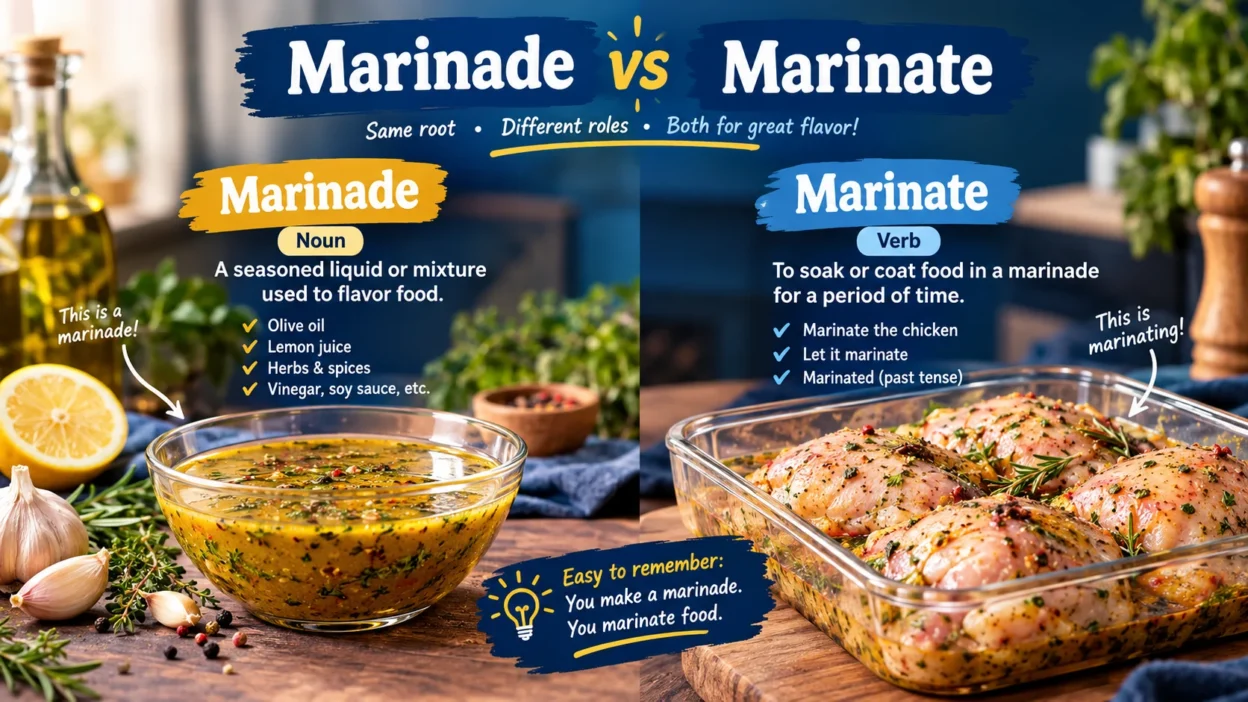
The main difference between marinade and marinate is that marinade is a noun, while marinate is a verb. A marinade is a seasoned liquid or mixture used to add flavor and sometimes help tenderize food. To marinate means to soak or coat food in that mixture for a period of time before cooking. For example, you prepare a marinade using olive oil, lemon juice, and herbs, and then marinate chicken in it for several hours. Although both words are commonly used in cooking, they cannot always replace each other in a sentence. Understanding their meanings, pronunciation, and grammatical functions makes it easier to choose the correct word.
Quick Answer
Marinade is a noun that means a seasoned liquid or mixture used to flavor food before cooking. Marinate is a verb that means to soak or coat food in that mixture. Example: “Prepare a marinade for the chicken, then marinate it overnight.” Use marinade for the mixture and marinate for the action.
Why Do People Confuse Marinade and Marinate?
People often confuse these words because they share the same root, look almost identical, and are both associated with preparing food.
There are three main reasons for the confusion:
- Similar spelling: Both words contain the same letters in nearly the same order.
- Related meanings: Both are connected to the process of adding flavor to food.
- Different grammatical roles: One names a substance, while the other describes an action.
The easiest way to distinguish them is to ask yourself whether you mean the mixture or the process.
What Does Marinade Mean?
Marinade is a noun that refers to a seasoned liquid or mixture in which food is soaked or coated before cooking.
A marinade often contains ingredients such as:
- Olive oil or another cooking oil
- Lemon juice, vinegar, or another acidic ingredient
- Garlic, herbs, and spices
- Soy sauce, yogurt, or other flavoring ingredients
Marinades are commonly used for meat, poultry, seafood, tofu, and vegetables.
Examples of Marinade in Sentences
- The chicken marinade contains garlic, lemon juice, and olive oil.
- I made a spicy marinade for the grilled fish.
- This marinade gives the vegetables a delicious flavor.
- Add the marinade to a bowl before putting in the beef.
- The recipe calls for a simple marinade made with herbs and vinegar.
In each sentence, marinade refers to the mixture itself.
Is Marinade a Noun or a Verb?
Marinade is a noun. It names the mixture used to season food.
- Correct: The marinade smells delicious.
- Correct: I prepared a marinade for the chicken.
- Incorrect: I will marinade the chicken overnight.
In standard English, use marinate when describing the action.
What Does Marinate Mean?
Marinate is a verb that means to soak or coat food in a seasoned liquid or mixture for a period of time before cooking.
The process helps flavor the food. Depending on the ingredients and the food being prepared, marinating may also affect its texture.
Examples of Marinate in Sentences
- Marinate the chicken for at least two hours.
- I usually marinate beef in soy sauce and garlic.
- You should marinate the tofu before grilling it.
- Let the fish marinate in the refrigerator.
- We marinated the vegetables in olive oil and herbs.
In each sentence, marinate describes an action.
Is Marinate a Noun or a Verb?
Marinate is a verb. It describes the process of soaking or coating food in a marinade.
Its common forms include:
|
Verb form
|
Example
|
| — | — |
|
Base form
|
Marinate the chicken.
|
|
Third-person singular
|
She marinates the fish.
|
|
Present participle
|
The meat is marinating.
|
|
Past tense
|
We marinated the beef.
|
|
Past participle
|
The chicken has been marinated.
|
Marinade vs. Marinate: Comparison Table
|
Feature
|
Marinade
|
Marinate
|
| — | — | — |
|
Part of speech
|
Noun
|
Verb
|
|
Meaning
|
A seasoned mixture
|
The act of soaking or coating food
|
|
Main purpose
|
Names the mixture
|
Describes the process
|
|
Example
|
The marinade is ready.
|
Marinate the chicken.
|
|
Common context
|
Recipes and ingredients
|
Cooking instructions
|
|
Related word
|
Marinades (plural)
|
Marinated, marinating
|
In short: A marinade is what you use, and marinate is what you do.
When Should You Use Marinade or Marinate?
Choosing the correct word becomes simple when you identify what your sentence is describing.
Use Marinade When Talking About the Mixture
Use marinade when you are referring to the liquid or mixture used to season food.
Examples:
- The marinade needs more salt.
- This marinade is perfect for grilled vegetables.
- Pour the marinade over the chicken.
Use Marinate When Talking About the Action
Use marinate when describing the process of soaking or coating food in a mixture.
Examples:
- Marinate the chicken for three hours.
- I like to marinate vegetables before grilling them.
- Let the meat marinate overnight in the refrigerator.
How to Choose the Correct Word
Ask yourself:
- Am I talking about the mixture? Use marinade.
- Am I talking about the action? Use marinate.
This simple distinction works in recipes, cooking blogs, everyday conversations, and food-related writing.
12 Examples of Marinade vs. Marinate in Sentences
Here are practical examples that show how both words work in everyday English.
|
Marinade (noun)
|
Marinate (verb)
|
| — | — |
|
1. The marinade contains fresh herbs.
|
Marinate the chicken with fresh herbs.
|
|
2. I prepared a lemon marinade.
|
I will marinate the fish in lemon juice.
|
|
3. This marinade tastes delicious.
|
Let the tofu marinate for an hour.
|
|
4. The marinade is ready to use.
|
Marinate the beef before grilling.
|
|
5. She made a spicy marinade.
|
She marinates vegetables every weekend.
|
|
6. The marinade includes soy sauce.
|
The meat is marinating in soy sauce.
|
|
7. Use a yogurt-based marinade.
|
Marinate the chicken in yogurt.
|
|
8. The marinade adds flavor to the dish.
|
We marinated the vegetables overnight.
|
|
9. I need a marinade for the shrimp.
|
I need to marinate the shrimp.
|
|
10. The marinade smells wonderful.
|
The chicken has been marinated properly.
|
|
11. This marinade is easy to prepare.
|
You can marinate the meat in advance.
|
|
12. Save some marinade for the recipe.
|
Let the ingredients marinate in the refrigerator.
|
These examples demonstrate the key difference: marinade names the mixture, while marinate describes the action.
Common Mistakes When Using Marinade and Marinate
Even experienced English speakers sometimes mix up these words. Here are common mistakes and their corrections.
Mistake 1: Using Marinade as a Verb
- Incorrect: I will marinade the chicken.
- Correct: I will marinate the chicken.
Use marinate because the sentence describes an action.
Mistake 2: Using Marinate as a Noun
- Incorrect: This marinate tastes delicious.
- Correct: This marinade tastes delicious.
Use marinade because the sentence refers to a mixture.
Mistake 3: Confusing the Mixture With the Process
- Incorrect: Add the marinate to the bowl.
- Correct: Add the marinade to the bowl.
The mixture is the marinade, not the action of marinating.
Mistake 4: Using the Wrong Verb Form
- Incorrect: The chicken is marinade in garlic sauce.
- Correct: The chicken is marinating in garlic sauce.
- Also correct: The chicken is marinated in garlic sauce.
Use marinating for an ongoing action and marinated for a completed process or a description of the food.
Mistake 5: Forgetting the Noun-Verb Difference in Recipes
- Incorrect: Prepare the sauce and marinade the meat.
- Correct: Prepare the sauce and marinate the meat.
Remember that the instruction describes what you should do, so the verb marinate is needed.
Memory Trick: How to Remember Marinade vs. Marinate
A simple trick can help you remember the difference.
Marinade = Mixture
Both marinade and mixture refer to something you can prepare and use.
Marinate = Action
Both marinate and operate end in a similar sound, but the important point is that marinate describes an action.
Another easy reminder:
- You make a marinade.
- You marinate food.
For example: “I made a marinade, then marinated the chicken.”
Marinade vs. Marinate in American and British English
The words marinade and marinate have the same basic meanings in American and British English.
|
Word
|
American English
|
British English
|
| — | — | — |
|
Marinade
|
A seasoned mixture
|
A seasoned mixture
|
|
Marinate
|
To soak or coat food in a mixture
|
To soak or coat food in a mixture
|
There is no major spelling difference between the two varieties of English for these words.
Both American and British speakers use marinade as a noun and marinate as a verb.
Similar Words Related to Marinade and Marinate
Several other cooking-related words are connected to these terms, but their meanings are not identical.
1. Season
Season means to add salt, spices, herbs, or other ingredients to food to improve its flavor.
Example: Season the chicken with salt and pepper.
2. Soak
Soak means to leave something in a liquid for a period of time.
Example: Soak the beans in water overnight.
3. Brine
Brine is a mixture of salt and water, sometimes with other ingredients, used to soak food.
Example: Place the turkey in a saltwater brine.
4. Tenderize
Tenderize means to make food, especially meat, softer and easier to chew.
Example: The chef used a meat mallet to tenderize the beef.
5. Infuse
Infuse means to allow a substance to absorb flavor from another ingredient or liquid.
Example: Infuse the oil with garlic and herbs.
6. Pickle
Pickle can mean preserving food in vinegar or a brine, often to develop a distinctive flavor.
Example: They pickle cucumbers in vinegar.
These words are related to food preparation, but they cannot always replace marinade or marinate.
Final Verdict: Marinade vs. Marinate
The difference between marinade and marinate is simple: marinade is a noun, and marinate is a verb.
Use marinade when referring to the seasoned mixture used to flavor food. Use marinate when describing the process of soaking or coating food in that mixture.
For example:
- “The marinade is ready.” — Noun
- “Marinate the chicken for two hours.” — Verb
Remembering this distinction will help you write clearer recipes and avoid common grammar mistakes.
Frequently Asked Questions (FAQs)
1. Is it marinade or marinate?
Both words are correct, but they have different grammatical roles. Marinade is a noun referring to a seasoned mixture, while marinate is a verb describing the process of soaking or coating food in that mixture.
2. Can marinade be used as a verb?
In standard English, marinade is used as a noun, not as the usual verb. The correct verb is marinate. For example, say “Marinate the chicken,” not “Marinade the chicken.”
3. What is the difference between marinade and marinating?
A marinade is the seasoned mixture used to flavor food. Marinating is the ongoing process of soaking or coating food in that mixture. Example: “The marinade is ready, and the chicken is marinating.”
4. Is marinated a correct word?
Yes. Marinated is the past tense and past participle of the verb marinate. Example: “The chicken was marinated in lemon juice and herbs.”
5. How do you use marinade in a sentence?
Use marinade as a noun to refer to the mixture. Example: “I prepared a marinade with olive oil, garlic, lemon juice, and herbs.”
6. How do you use marinate in a sentence?
Use marinate as a verb to describe the action of soaking or coating food in a seasoned mixture. Example: “Marinate the beef in the refrigerator for several hours.”
7. Are marinade and marinate pronounced differently?
Yes. In common English pronunciation, marinade is often pronounced MAIR-uh-nayd, while marinate is often pronounced MAIR-uh-nayt. The final sound differs: marinade ends with a /d/ sound, while marinate ends with a /t/ sound.
Remember This
- Marinade = Noun: The seasoned mixture used to flavor food.
- Marinate = Verb: The action of soaking or coating food in that mixture.
- Marinated = Past tense or past participle: Food that has undergone the marinating process.
Easy example: Make a marinade, then marinate the chicken.
Conclusion
Understanding the difference between marinade and marinate is easy once you remember that one is a noun and the other is a verb. A marinade is the seasoned mixture used to flavor food, while marinate describes the action of soaking or coating food in that mixture. Both words are common in recipes and everyday cooking conversations.
The next time you prepare a meal, remember to use marinade when talking about the ingredients and marinate when describing the process. This simple distinction will help you use both words correctly, write clearer cooking instructions, and improve your everyday English.

David Henry is a language enthusiast and content writer specializing in synonyms, vocabulary, and word meanings. He creates clear, engaging resources that help readers improve their writing, communication, and English skills.