
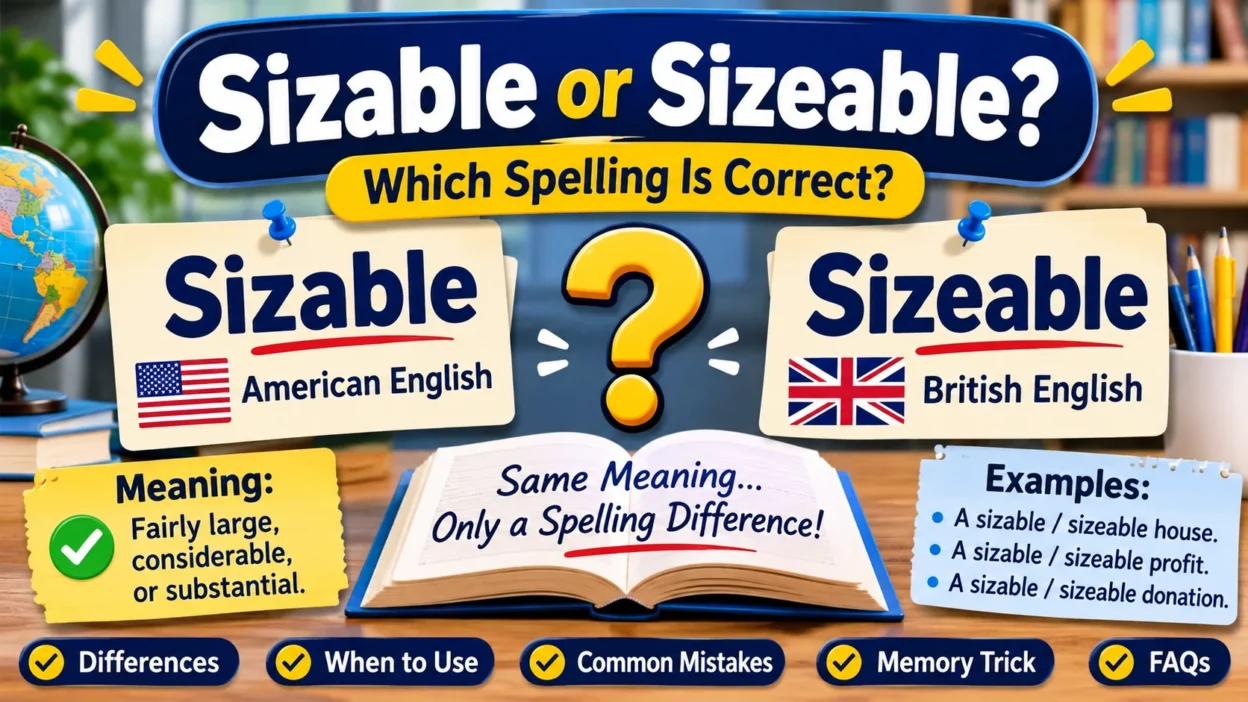
The words sizable and sizeable have the same meaning, but their spelling differs depending on the English variety being used. Both are correct ways to describe something that is fairly large, considerable, or substantial in size or amount. The main difference is that sizable is the preferred spelling in American English, while sizeable is more commonly used in British English.
Choosing between these spellings can be confusing, especially for students, ESL learners, writers, and anyone learning the differences between American and British English. Since both versions are widely recognized, it is important to understand when each spelling is appropriate and how to use it naturally in sentences.
if you are writing an academic assignment, a professional email, a blog post, or everyday English, this guide explains the meaning of sizable and sizeable, their spelling differences, practical examples, and common mistakes to avoid.
Quick Answer: Sizable or Sizeable?
Both sizable and sizeable are correct English spellings. They have exactly the same meaning: fairly large, considerable, or substantial. The difference is regional spelling preference. American English generally uses sizable, while British English generally prefers sizeable. Choose the spelling that matches your audience and remain consistent throughout your writing.
Why Do People Confuse Sizable and Sizeable?
People confuse these words because they:
- Have exactly the same pronunciation.
- Share the same meaning.
- Perform the same grammatical function.
- Differ by only one letter.
- Follow different American and British spelling conventions.
The confusion also comes from the fact that English has several spelling variations, including color/colour, favorite/favourite, and organize/organise.
Similarly, sizable and sizeable represent two regional spelling preferences rather than two different words.
1. Sizable: Meaning, Definition, and Usage
Sizable is the standard American English spelling of an adjective meaning fairly large, considerable, or substantial.
It describes something that is noticeably large in size, quantity, amount, or importance.
Examples:
- The company made a sizable profit last year.
- She received a sizable scholarship from the university.
- We need a sizable room for the meeting.
- The project requires a sizable investment.
- He has a sizable collection of books.
When to use sizable:
Use sizable when writing for:
- American readers.
- US-based businesses and organizations.
- American academic institutions.
- Websites following American English spelling conventions.
- General communication using US English.
Synonyms of sizable:
- Considerable
- Substantial
- Large
- Significant
- Extensive
- Generous
- Sizeable
2. Sizeable: Meaning, Definition, and Usage
Sizeable is the standard British English spelling of the same adjective. It means fairly large, considerable, or substantial.
It is used to describe something that has a significant size, quantity, value, or amount.
Examples:
- The business earned a sizeable profit.
- They purchased a sizeable house in the countryside.
- The university received a sizeable donation.
- She has a sizeable amount of experience.
- The government announced a sizeable investment.
When to use sizeable:
Use sizeable when writing for:
- British readers.
- UK-based businesses and organizations.
- British academic institutions.
- Publications following British English conventions.
- General communication using UK English.
Synonyms of sizeable:
- Considerable
- Substantial
- Large
- Significant
- Extensive
- Generous
- Sizable
Sizable vs Sizeable: Comparison Table
| Feature | Sizable | Sizeable |
|---|---|---|
| Meaning | Fairly large | Fairly large |
| Word type | Adjective | Adjective |
| American English | Preferred | Less common |
| British English | Less common | Preferred |
| Pronunciation | Same | Same |
| Spelling | Without e | With e |
| Usage | US writing | UK writing |
| Correctness | Correct | Correct |
Key difference: The only difference is spelling preference. Neither word has a different meaning or grammatical function.
When to Use Sizable or Sizeable
Choosing the correct spelling depends mainly on your intended audience.
Use Sizable in American English
Choose sizable when writing for an American audience.
Examples:
- The organization received a sizable donation.
- The company experienced a sizable increase in sales.
- He made a sizable contribution to the project.
Use Sizeable in British English
Choose sizeable when following British English conventions.
Examples:
- The organization received a sizeable donation.
- The company experienced a sizeable increase in sales.
- He made a sizeable contribution to the project.
What About International English?
If you are writing for an international audience, either spelling is understandable and acceptable. However, consistency matters.
For example, if your article follows American spelling conventions, use sizable throughout. If it follows British conventions, use sizeable consistently.
12 Examples of Sizable and Sizeable in Sentences
Here are practical examples showing how both spellings work in everyday English.
| Sizable (American) | Sizeable (British) |
|---|---|
| We bought a sizable house. | We bought a sizeable house. |
| She earned a sizable income. | She earned a sizeable income. |
| The company made a sizable profit. | The company made a sizeable profit. |
| He received a sizable bonus. | He received a sizeable bonus. |
| They need a sizable budget. | They need a sizeable budget. |
| The project requires a sizable investment. | The project requires a sizeable investment. |
| She has a sizable collection. | She has a sizeable collection. |
| The team made a sizable improvement. | The team made a sizeable improvement. |
| We noticed a sizable difference. | We noticed a sizeable difference. |
| The university received a sizable donation. | The university received a sizeable donation. |
| There was a sizable increase in demand. | There was a sizeable increase in demand. |
| The city has a sizable population. | The city has a sizeable population. |
These examples demonstrate that both spellings can be used in exactly the same contexts.
Common Mistakes to Avoid
Although both spellings are correct, some mistakes can make your writing inconsistent or unclear.
1. Thinking they have different meanings
Incorrect assumption: Sizable means very large, while sizeable means moderately large.
Correction: Both words have the same meaning.
2. Treating one spelling as universally incorrect
Incorrect: Sizeable is always wrong.
Correction: Sizeable is a recognized British English spelling.
3. Mixing spelling conventions
Example:
– The company made a sizable profit and received a sizeable donation.
This is not grammatically wrong, but it is better to maintain one spelling convention in formal writing.
4. Using the word as a noun
Incorrect: The sizable of the building surprised everyone.
Correct: The size of the building surprised everyone.
Remember that sizable and sizeable are adjectives, not nouns.
5. Confusing sizable with enormous
Although both can describe something large, sizable generally means fairly large or considerable. It does not necessarily mean enormous.
Memory Trick: How to Remember Sizable vs Sizeable
Use this simple trick:
- Sizable = American English: Remember the shorter spelling without the extra e.
- Sizeable = British English: Remember the extra e, which is also common in British spellings such as favourite and colour.
Another easy way to remember is:
US = Sizable | UK = Sizeable
Both spellings describe something considerable or fairly large.
American vs British English: Sizable or Sizeable
The difference between these spellings follows the broader spelling variations found in American and British English.
| American English | British English |
|---|---|
| Sizable | Sizeable |
| Color | Colour |
| Favorite | Favourite |
| Neighbor | Neighbour |
| Labor | Labour |
| Honor | Honour |
American English often uses shorter spellings in certain words, while British English frequently retains additional letters.
However, remember that these are spelling conventions, not strict rules that apply to every English word.
Similar Words to Sizable and Sizeable
If you want to expand your vocabulary, here are some useful alternatives.
| Word | Meaning | Example |
|---|---|---|
| Considerable | Fairly large or important | She made a considerable investment. |
| Substantial | Large in amount or value | The business earned substantial revenue. |
| Significant | Important or noticeable | There was a significant improvement. |
| Extensive | Covering a large area or range | They conducted extensive research. |
| Large | Big in size | They live in a large house. |
| Generous | More than expected or needed | He received a generous reward. |
| Massive | Extremely large | The company built a massive warehouse. |
| Appreciable | Large enough to be noticed | There was an appreciable difference. |
These alternatives can help make your writing more varied and precise.
Final Verdict: Which Spelling Should You Choose?
The correct choice depends on the variety of English you are using:
- Sizable: Preferred in American English.
- Sizeable: Preferred in British English.
Both words have the same definition, pronunciation, and grammatical function. Neither spelling is inherently incorrect.
If you are writing for an American audience, choose sizable. If your readers primarily use British English, choose sizeable.
Frequently Asked Questions (FAQs)
1. Is it sizable or sizeable?
Both are correct. Sizable is the preferred American English spelling, whereas sizeable is generally preferred in British English. Both mean fairly large or considerable.
2. Is sizeable British or American English?
Sizeable is primarily the British English spelling. It is commonly used in the United Kingdom and other regions that follow British spelling conventions.
3. Is sizable American English?
Yes. Sizable is the standard and preferred American English spelling. It is commonly used in American books, newspapers, professional writing, and everyday communication.
4. Do sizable and sizeable mean the same thing?
Yes. Both words mean fairly large, considerable, or substantial. There is no difference in their definitions, pronunciation, or grammatical usage.
5. Is sizeable grammatically correct?
Yes. Sizeable is grammatically correct and is an accepted spelling in British English. It can describe a considerable amount, size, investment, profit, or collection.
6. What is the opposite of sizable?
Common opposites of sizable include small, tiny, minor, insignificant, limited, and modest. The best opposite depends on the context.
7. Can I use sizable in British English?
Yes. Although sizeable is generally preferred in British English, sizable is also recognized. However, using the conventional British spelling is advisable when following a British English style guide.
Remember This
- Sizable and sizeable are both correct.
- Both have exactly the same meaning.
- Sizable is preferred in American English.
- Sizeable is preferred in British English.
- Both are adjectives.
- Consistency is important in formal writing.
The easiest rule: Sizable for the USA, sizeable for the UK.
Conclusion
The difference between sizable and sizeable is simply a matter of regional spelling preference. Both words describe something fairly large, considerable, or substantial. They have the same pronunciation, meaning, and grammatical function, so neither spelling is universally wrong.
For clear and professional writing, choose sizable when following American English and sizeable when following British English. Once you understand this simple distinction, you can use both words confidently in everyday conversations, academic assignments, and professional writing.

Daniel Jack is a language enthusiast and content writer who specializes in synonyms, vocabulary, and word meanings. He creates clear, engaging resources that help readers improve communication and expand their English skills.


