The words concurrent and simultaneous both describe things that happen during the same period, so it is easy to confuse them. However, they have slightly different meanings and are used in different contexts. Understanding the difference can help you choose the right word in everyday conversations, academic writing, business communication, and technical discussions.
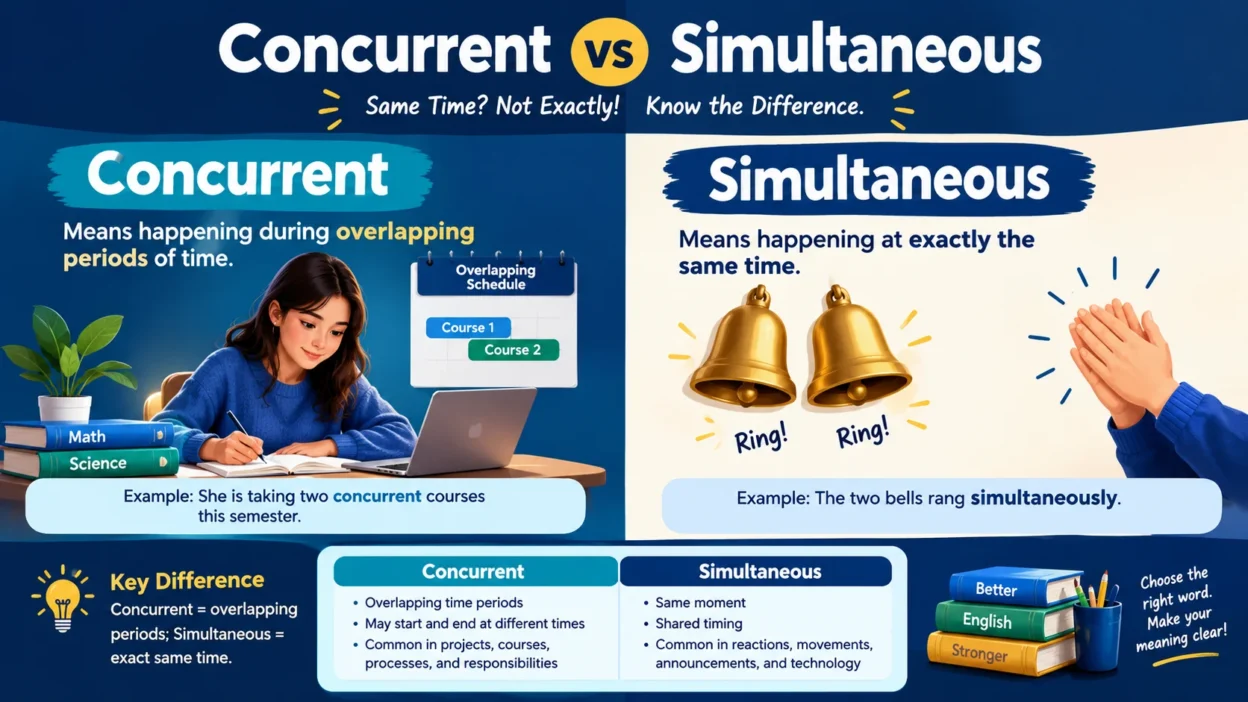
In simple terms, concurrent describes events, activities, or processes that overlap in time, while simultaneous usually describes events that happen at exactly the same time. For example, a student can take two concurrent courses if their schedules overlap during the same semester. Two people clapping at the exact same moment are clapping simultaneously. Although the words sometimes overlap in meaning, they are not always interchangeable. This guide explains the definitions of concurrent and simultaneous, their grammatical uses, and the differences between them, with practical examples, common mistakes, and easy memory tips to help you use both words confidently.
Quick Answer: Concurrent vs Simultaneous
Concurrent means happening or existing during the same period, often with some overlap. Simultaneous means happening at exactly the same time. For example, two projects can run concurrently over several weeks, while two alarms ringing at the same instant ring simultaneously. Both words describe time relationships, but simultaneous emphasizes exact timing.
Why Do People Confuse Concurrent and Simultaneous?
People confuse these words because both refer to events that occur in overlapping time periods. In some situations, they can even describe the same event.
The main difference is the emphasis:
- Concurrent: Focuses on activities or events that occur during overlapping periods.
- Simultaneous: Focuses on events that occur at the same moment.
For example, two employees may work on concurrent projects throughout a month. However, if both employees begin speaking at precisely the same moment, their actions are simultaneous.
Remember that concurrent events do not necessarily begin and end together. Simultaneous events share the same timing, although the word does not always require them to have identical durations.
What Does Concurrent Mean?
Concurrent is an adjective meaning occurring, existing, or happening during the same period as something else.
It is commonly used when two or more activities, responsibilities, events, or processes overlap in time.
Examples of Concurrent
- She is managing two concurrent projects.
- The university offers concurrent courses in mathematics and physics.
- The company is conducting concurrent investigations into two separate issues.
- He held two concurrent positions at the organization.
- Several processes can run concurrently on a computer.
In each example, the activities or situations coexist during overlapping periods. They do not necessarily start or finish at precisely the same moment.
Common Uses of Concurrent
The word concurrent is especially common in professional, academic, legal, and technical contexts.
- Education: Concurrent courses or programs.
- Business: Concurrent projects, responsibilities, or meetings.
- Technology: Concurrent processes or tasks.
- Law: Concurrent sentences, which are served at the same time rather than one after another.
- Research: Concurrent studies or investigations.
Related forms: concurrently (adverb), concurrency (noun).
Example: The two teams worked concurrently to complete the assignment.
What Does Simultaneous Mean?
Simultaneous is an adjective meaning happening or occurring at the same time as something else.
It emphasizes that two or more events share the same moment or timing.
Examples of Simultaneous
- The two bells rang simultaneously.
- Everyone stood up simultaneously.
- The audience gave a simultaneous response.
- The system allows simultaneous access by multiple users.
- Both cameras captured the event simultaneously.
In these examples, the focus is on events occurring at the same time rather than simply overlapping across a broader period.
Common Uses of Simultaneous
The word simultaneous is common in everyday conversation, science, communication, technology, and descriptions of coordinated events.
- Everyday life: Simultaneous movements or reactions.
- Communication: Simultaneous translation or interpretation.
- Science: Simultaneous measurements.
- Technology: Simultaneous access or operations.
- Events: Simultaneous announcements or celebrations.
Related forms: simultaneously (adverb), simultaneity (noun).
Example: The interpreter translated the speaker’s words simultaneously.
Concurrent vs Simultaneous: Comparison Table
| Feature | Concurrent | Simultaneous |
|---|---|---|
| Meaning | Happening during overlapping periods | Happening at the same time |
| Main emphasis | Overlap in time | Exact timing or shared moments |
| Start and end times | May differ | Events share the same timing, but durations may differ |
| Typical contexts | Projects, courses, processes, responsibilities | Reactions, movements, announcements, measurements |
| Example | She completed two concurrent courses. | The two alarms rang simultaneously. |
| Grammatical form | Adjective; also used as an adverb with -ly | Adjective; also used as an adverb with -ly |
Key distinction: Concurrent activities may overlap without happening at every moment together. Simultaneous events occur at the same time, even if they continue for different lengths of time.
When Should You Use Concurrent or Simultaneous?
Choose the word according to the timing you want to communicate.
Use Concurrent When Activities Overlap
Use concurrent when describing activities, processes, or situations that exist or happen during overlapping periods.
Examples:
- She is studying for two concurrent qualifications.
- The company launched three concurrent marketing campaigns.
- The software supports concurrent requests from different users.
- He managed concurrent responsibilities at work.
These examples focus on activities taking place within the same general period.
Use Simultaneous When Events Happen at the Same Time
Use simultaneous when the timing of events is the main point.
Examples:
- The audience applauded simultaneously.
- Two lights flashed simultaneously.
- The two speakers began talking simultaneously.
- The devices recorded simultaneous measurements.
These examples emphasize that the events occurred at the same moment or had matching timing.
Can Concurrent and Simultaneous Be Used Interchangeably?
Sometimes, yes. The choice depends on the context.
For example:
- The system supports concurrent requests.
- The system supports simultaneous requests.
Both sentences may be correct. However, concurrent emphasizes overlapping processing or activity, while simultaneous emphasizes requests occurring at the same time.
In computing, concurrent tasks can make progress during overlapping periods without necessarily executing at the exact same instant. Simultaneous execution, in the stricter technical sense, means tasks execute at the same time, such as on separate processor cores.
12 Examples of Concurrent vs Simultaneous in Sentences
These examples show how the two words work in everyday, academic, professional, and technical contexts.
Examples Using Concurrent
- Education: Maria enrolled in two concurrent courses this semester.
- Business: The manager is supervising three concurrent projects.
- Technology: The application can handle concurrent user requests.
- Research: Two concurrent studies examined the same problem.
- Employment: He held two concurrent positions at the company.
- Law: The judge ordered the sentences to run concurrently.
Examples Using Simultaneous
- Everyday life: The children shouted simultaneously when the game ended.
- Communication: The conference provided simultaneous translation into three languages.
- Science: The researchers took simultaneous measurements of temperature and pressure.
- Events: Two concerts began simultaneously in different venues.
- Technology: The platform permits simultaneous access from multiple devices.
- Sports: The runners crossed the finish line simultaneously.
Examples That Highlight the Difference
13. Concurrent: She worked on two reports throughout the afternoon, switching between them.
14. Simultaneous: She received two phone calls at exactly the same moment.
15. Concurrent: The construction and renovation projects continued during the same month.
16. Simultaneous: The lights in both buildings turned on at the same instant.
The first pair illustrates overlapping activities versus events occurring at the same moment. The second pair makes the distinction clear through the timing of the actions.
Common Mistakes When Using Concurrent and Simultaneous
Avoid these common errors to make your English clearer and more precise.
Mistake 1: Assuming Both Words Always Mean Exactly the Same Thing
Incorrect assumption: Concurrent and simultaneous are interchangeable in every sentence.
Correction: Concurrent emphasizes overlapping periods, whereas simultaneous emphasizes matching timing.
Mistake 2: Using Concurrent for Events That Must Occur at One Exact Moment
Less precise: The two bells rang concurrently at exactly noon.
More natural: The two bells rang simultaneously at exactly noon.
The first sentence is not necessarily grammatically wrong, but simultaneously communicates the exact timing more directly.
Mistake 3: Thinking Concurrent Means Consecutive
These words are different.
- Concurrent: Activities overlap in time.
- Consecutive: Events follow one another without interruption in a sequence.
- Simultaneous: Events happen at the same time.
For example, two concurrent meetings may overlap, while two consecutive meetings happen one after another.
Mistake 4: Confusing Concurrent With Parallel
In technical contexts, concurrent and parallel are related but distinct.
- Concurrent: Tasks make progress during overlapping periods.
- Parallel: Tasks execute at the same time, typically using multiple processing resources.
In everyday English, the meanings can overlap, but technical writing often distinguishes them.
Mistake 5: Using the Adjectives Instead of the Adverbs
Use concurrent and simultaneous to describe nouns. Use concurrently and simultaneously to describe actions.
- Adjective: The teams performed concurrent tasks.
- Adverb: The teams worked concurrently.
- Adjective: The alarms produced simultaneous sounds.
- Adverb: The alarms sounded simultaneously.
Memory Trick: How to Remember the Difference
Use this simple memory trick:
- Concurrent = Coexisting periods. Think of two projects continuing over the same weeks.
- Simultaneous = Same moment. Think of two bells ringing at the exact same instant.
Imagine two timelines. If the timelines overlap for a while, the activities are concurrent. If the events line up at the same moment, they are simultaneous.
A quick question can also help: Am I describing overlapping periods or matching timing?
If the focus is on overlapping periods, choose concurrent. If the focus is on the same moment, choose simultaneous.
Concurrent vs Simultaneous in American and British English
There is no major difference in the meanings of concurrent and simultaneous between American and British English.
Both varieties use the words in the same general way:
- American English: The two events occurred simultaneously.
- British English: The two events occurred simultaneously.
Similarly:
- American English: She managed concurrent projects.
- British English: She managed concurrent projects.
The main distinction is semantic, not regional. Both words are standard in American and British English, although the preferred choice may vary with the subject, context, and writing style.
Similar Words: Concurrent, Simultaneous, Parallel, Overlapping, and Consecutive
Several related words describe how events relate to one another in time.
| Word | Meaning | Example |
|---|---|---|
| Concurrent | Happening during overlapping periods | They managed concurrent projects. |
| Simultaneous | Happening at the same time | The alarms sounded simultaneously. |
| Parallel | Happening alongside another activity or following a comparable course | The teams conducted parallel investigations. |
| Overlapping | Sharing part of the same time period | Their work schedules are overlapping. |
| Consecutive | Following one after another in order | She attended three consecutive meetings. |
| Synchronous | Occurring in coordination or at corresponding times | The devices performed synchronous operations. |
Although these words are related, they are not exact synonyms in every context. Choose the one that best describes the relationship between the events.
Final Verdict: Concurrent vs Simultaneous
Concurrent is the better choice when two or more activities, processes, or situations occur during overlapping periods. They may start and finish at different times.
Simultaneous is the better choice when you want to emphasize that events happen at the same moment or share the same timing.
For example, managing two projects over the same month means managing concurrent projects. Two alarms ringing at precisely the same instant means they ring simultaneously.
Both words are correct in many overlapping contexts, but the distinction helps you communicate timing more precisely.
Frequently Asked Questions
1. What is the main difference between concurrent and simultaneous?
Concurrent describes activities or events that overlap in time. Simultaneous describes events that happen at the same time. The main difference is that concurrent emphasizes overlapping periods, while simultaneous emphasizes matching timing.
2. Does concurrent mean at the same time?
Yes, in a broad sense. Concurrent activities occur during overlapping periods, but they do not have to happen at exactly the same moment throughout their duration.
3. Does simultaneous mean exactly at the same time?
Yes. Simultaneous generally means happening at the same moment or with matching timing. For example, two people starting a race together start simultaneously.
4. Can concurrent and simultaneous be used interchangeably?
Sometimes. Both can describe activities occurring within the same period. However, concurrent is often more suitable for overlapping processes, projects, or responsibilities, while simultaneous is more suitable when exact timing matters.
5. What is the difference between concurrent and consecutive?
Concurrent activities overlap in time, whereas consecutive events occur one after another in a sequence. Two concurrent meetings may take place during overlapping periods; two consecutive meetings happen in succession.
6. What is the difference between concurrent and parallel?
Concurrent tasks make progress during overlapping periods. Parallel tasks execute at the same time, often using separate processing resources. The distinction is particularly important in computing, although the words may overlap in everyday usage.
7. What is the adverb form of concurrent and simultaneous?
The adverb forms are concurrently and simultaneously. For example, The teams worked concurrently and The bells rang simultaneously.
8. Which word is better for formal writing?
Both words are appropriate for formal writing. Use concurrent for overlapping projects, processes, or responsibilities, and simultaneous when emphasizing events that happen at the same time. The context determines the better choice.
Remember This
- Concurrent: Activities occur during overlapping periods.
- Simultaneous: Events happen at the same moment.
- Consecutive: Events happen one after another.
- Parallel: Activities proceed alongside one another or follow a comparable course.
The easiest way to choose is to ask if you mean overlapping time periods or the same moment.
Conclusion
The difference between concurrent and simultaneous is small but useful. Both words describe relationships in time, but concurrent focuses on activities that overlap, while simultaneous emphasizes events happening at the same time. Understanding this distinction helps you communicate more clearly in everyday English, academic writing, business communication, and technical discussions.
When describing projects, responsibilities, or processes that continue during the same period, choose concurrent. When describing events that happen at the same moment, choose simultaneous. With these meanings in mind and a few practical examples, you can use both words confidently and accurately.

David Henry is a language enthusiast and content writer specializing in synonyms, vocabulary, and word meanings. He creates clear, engaging resources that help readers improve their writing, communication, and English skills.