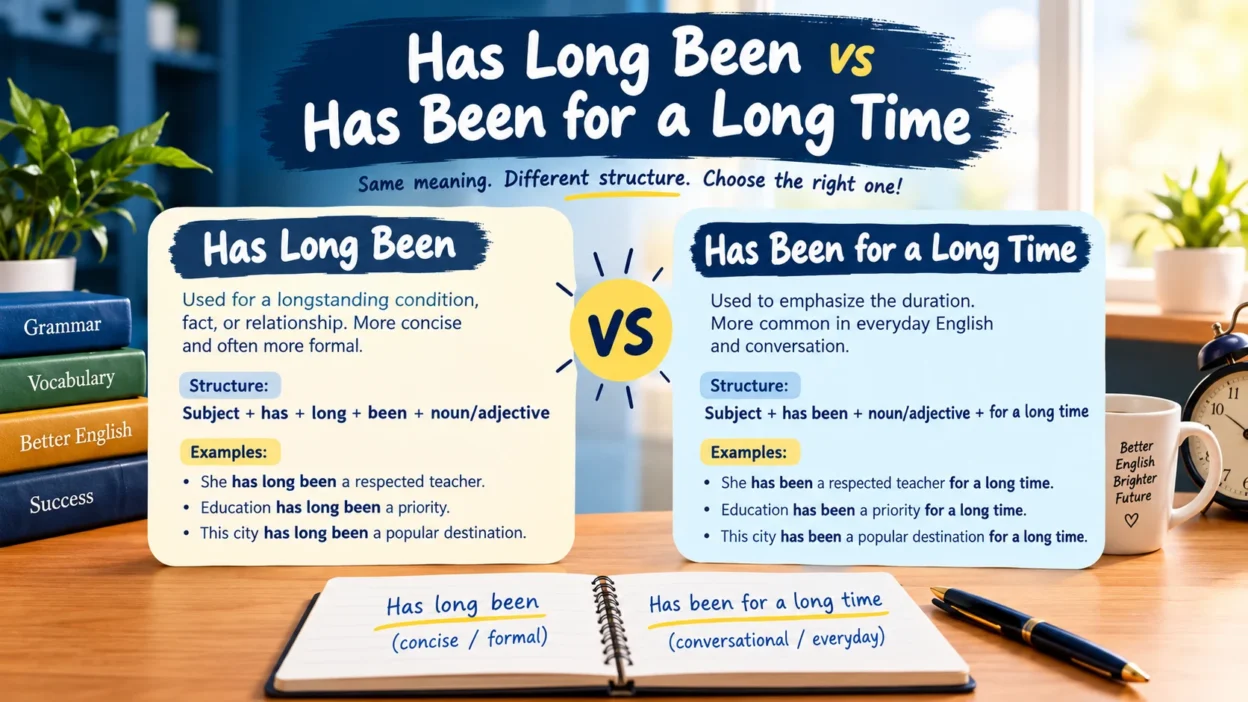
The phrases “has long been” and “has been for a long time” are both used to describe situations that started in the past and remain true in the present. They are closely related in meaning, but they differ in sentence structure, emphasis, and natural usage. Understanding the difference can help you write clearer sentences and speak more confidently in English.
For example, you might say, “She has long been a respected teacher” or “She has been a respected teacher for a long time.” Both sentences communicate that she has earned respect over an extended period. However, the first sounds more formal and concise, while the second is more conversational and emphasizes the length of time. Students, ESL learners, and anyone improving their English can benefit from learning when to use each expression.
Quick Answer
“Has long been” and “has been for a long time” can express the same general idea: something has been true for an extended period. “Has long been” is shorter and often more formal, while “has been … for a long time” is common in everyday English. Choose the structure that best fits your sentence and intended emphasis.
Why Do People Confuse “Has Long Been” and “Has Been for a Long Time”?
People often confuse these expressions because both refer to a situation that began in the past and continues to the present.
The main difference is their grammatical structure:
- Has long been: Places “long” between the auxiliary verb “has” and “been.”
- Has been … for a long time: Uses the present perfect form followed by a phrase describing duration.
Compare these examples:
- The city has long been a popular destination.
- The city has been a popular destination for a long time.
Both are grammatically correct. The first is more concise and may sound more formal, especially in articles, reports, and academic writing. The second is natural in conversation and everyday writing.
Remember that the position of “for a long time” depends on the sentence. It usually follows the verb phrase or the information describing the situation.
1. What Does “Has Long Been” Mean?
“Has long been” means that something has been true, existed, or remained in a particular state for a considerable period.
It uses the present perfect form of the verb be, with “long” placed between “has” and “been.”
Structure
Subject + has + long + been + noun/adjective/phrase
Examples:
- She has long been my closest friend.
- Education has long been a priority for the government.
- This building has long been an important landmark.
- He has long been interested in history.
In each example, the phrase indicates that the situation has existed for an extended period and is generally still relevant now.
When Is “Has Long Been” Used?
Use “has long been” when you want to express an established fact, longstanding condition, or enduring relationship in a concise way.
It is especially common in:
- Formal writing
- News articles and reports
- Academic discussions
- Historical or cultural descriptions
- Statements about established beliefs or traditions
Example: “Climate change has long been a subject of scientific research.”
This sentence presents the subject as something that scientists have studied over an extended period.
2. What Does “Has Been for a Long Time” Mean?
“Has been for a long time” is part of a longer sentence structure that expresses how long a situation has existed.
The words “for a long time” describe the duration of the situation.
Structure
Subject + has been + noun/adjective/phrase + for a long time
Examples:
- She has been my closest friend for a long time.
- Education has been a priority for the government for a long time.
- This building has been an important landmark for a long time.
- He has been interested in history for a long time.
These sentences express the same general idea as their “has long been” counterparts.
When Is “Has Been for a Long Time” Used?
Use this construction when you want to emphasize duration in a straightforward, conversational way.
It works well in:
- Everyday conversations
- Emails and informal messages
- Personal experiences
- General descriptions
- Spoken English
Example: “I have been interested in learning French for a long time.”
This sounds natural when talking about a personal interest that began in the past and continues today.
3. Comparison Table: Has Long Been vs. Has Been for a Long Time
| Feature | Has long been | Has been for a long time |
|---|---|---|
| Basic meaning | True for an extended period | True for an extended period |
| Grammar | Has + long + been | Has been + description + for a long time |
| Tone | Often formal or concise | Often conversational and direct |
| Emphasis | Longstanding condition or fact | Duration of the situation |
| Common use | Articles, reports, formal writing | Conversations and everyday writing |
| Example | It has long been a concern. | It has been a concern for a long time. |
| Correctness | Grammatically correct | Grammatically correct |
Important: The two expressions are often interchangeable, but not every sentence can be changed word for word without adjusting its structure.
4. When Should You Use Each Expression?
Use “Has Long Been” for Concise or Formal Statements
Choose this expression when discussing an established condition, belief, tradition, or fact.
Examples:
- Technology has long been essential to modern business.
- The region has long been known for its beautiful landscapes.
- Public health has long been a major concern.
This structure allows you to express duration without adding a separate phrase at the end.
Use “Has Been for a Long Time” in Everyday English
Choose this expression when speaking naturally or explaining how long something has continued.
Examples:
- My brother has been a doctor for a long time.
- This restaurant has been popular for a long time.
- I have been waiting for you for a long time.
The final example uses “have been waiting,” a present perfect continuous construction. It follows the same general principle of expressing duration, although it does not contain the exact phrase “has been.”
Can You Use Both in the Same Situation?
Yes. In many contexts, both structures communicate the same information.
- The issue has long been important to researchers.
- The issue has been important to researchers for a long time.
Both sentences are correct. The choice depends on your preferred style and the flow of the surrounding text.
5. Examples of “Has Long Been” vs. “Has Been for a Long Time”
Here are 12 examples showing how both expressions work in context.
Example 1: Friendship
- Has long been: Maria has long been a trusted friend.
- Has been for a long time: Maria has been a trusted friend for a long time.
Example 2: Education
- Has long been: Education has long been essential to social progress.
- Has been for a long time: Education has been essential to social progress for a long time.
Example 3: Business
- Has long been: Customer satisfaction has long been a priority for the company.
- Has been for a long time: Customer satisfaction has been a priority for the company for a long time.
Example 4: Science
- Has long been: Space exploration has long been a subject of public interest.
- Has been for a long time: Space exploration has been a subject of public interest for a long time.
Example 5: Culture
- Has long been: Music has long been an important part of the celebration.
- Has been for a long time: Music has been an important part of the celebration for a long time.
Example 6: Personal Interest
- Has long been: He has long been interested in photography.
- Has been for a long time: He has been interested in photography for a long time.
Example 7: Health
- Has long been: Regular exercise has long been associated with better health.
- Has been for a long time: Regular exercise has been associated with better health for a long time.
Example 8: Location
- Has long been: This town has long been famous for its historic buildings.
- Has been for a long time: This town has been famous for its historic buildings for a long time.
Example 9: Family
- Has long been: My aunt has long been a source of inspiration to me.
- Has been for a long time: My aunt has been a source of inspiration to me for a long time.
Example 10: Technology
- Has long been: Computers have long been useful tools for education.
- Has been for a long time: Computers have been useful tools for education for a long time.
Note: The plural subject “computers” requires “have,” not “has.”
Example 11: Public Debate
- Has long been: Environmental protection has long been a topic of debate.
- Has been for a long time: Environmental protection has been a topic of debate for a long time.
Example 12: Professional Experience
- Has long been: She has long been recognized as an expert in her field.
- Has been for a long time: She has been recognized as an expert in her field for a long time.
These examples show that the first expression is often more compact, while the second makes the duration explicit.
6. Common Mistakes to Avoid
Even though both expressions are straightforward, several mistakes are common.
Mistake 1: Using “Has Long Been” in the Wrong Order
Incorrect: She long has been a teacher.
Better: She has long been a teacher.
In standard contemporary English, “has long been” is the usual order for this meaning.
Mistake 2: Forgetting “For” in the Duration Phrase
Incorrect: He has been a manager a long time.
Better: He has been a manager for a long time.
The version without “for” can occur in informal speech, but including “for” is the safer choice for standard written English.
Mistake 3: Using “Has” With a Plural Subject
Incorrect: They has long been friends.
Correct: They have long been friends.
Use “has” with singular third-person subjects such as he, she, and it. Use “have” with I, you, we, and they.
Mistake 4: Assuming the Expressions Always Sound Identical
Although the meanings are similar, their styles can differ. “The tradition has long been respected” sounds more formal than “The tradition has been respected for a long time.”
Choose the version that fits your audience and writing style.
Mistake 5: Confusing Duration With a Finished Past Event
Incorrect for an ongoing situation: She was interested in art for a long time, and she still is.
Better: She has long been interested in art.
Alternatively: She has been interested in art for a long time.
The simple past usually describes a finished past situation, while the present perfect often connects a past situation to the present.
7. Memory Trick: How to Remember the Difference
Use this simple trick:
- Long goes inside: “Has long been.”
- For a long time goes at the end: “Has been … for a long time.”
Think of “has long been” as the compact version and “has been for a long time” as the expanded version.
For example:
- Compact: It has long been popular.
- Expanded: It has been popular for a long time.
Both are correct, and both express a longstanding situation.
8. American English vs. British English
There is no major difference in meaning between these expressions in American and British English. Both varieties use them naturally.
| Context | American English | British English |
|---|---|---|
| Formal writing | It has long been important. | It has long been important. |
| Everyday speech | It has been important for a long time. | It has been important for a long time. |
| Grammar | Present perfect | Present perfect |
The choice generally depends on tone, context, and sentence rhythm rather than nationality.
Both expressions are appropriate in academic writing, professional communication, and everyday English.
9. Similar Words and Expressions
Several other expressions can communicate a similar idea.
“Has Always Been”
This emphasizes that something has remained true throughout the relevant period.
Example: She has always been kind to others.
“Has Been for Years”
This specifies a long duration, often measured in years.
Example: The library has been open for years.
“Has Been for Ages”
This is an informal expression meaning for a very long time.
Example: I haven’t seen him for ages.
“Has Been Long Established”
This is a more formal expression that emphasizes that something has existed or been accepted for a substantial period.
Example: The tradition is long established in the region.
“Has Remained”
This emphasizes that something has continued in the same state.
Example: The issue has remained important to the community.
These expressions are related, but their meanings and grammatical structures are not always identical. Choose the one that conveys your intended meaning most accurately.
10. Frequently Asked Questions
1. Is “has long been” grammatically correct?
Yes. “Has long been” is grammatically correct and widely used in standard English. It describes a condition or fact that has existed for an extended period, as in “She has long been a respected leader.”
2. Is “has been for a long time” correct English?
Yes. It is correct when used in a complete sentence, such as “He has been a teacher for a long time.” The phrase “for a long time” describes the duration of the situation.
3. Are “has long been” and “has been for a long time” interchangeable?
They are interchangeable in many sentences because they express similar meanings. However, the sentence structure may need to change, and the tone can differ slightly. “Has long been” often sounds more formal and concise.
4. Which phrase is more formal?
“Has long been” often sounds more formal because it is concise and commonly used in reports, academic writing, and formal descriptions. “Has been for a long time” is also correct and is especially natural in everyday conversation.
5. Can I use “has long been” in academic writing?
Yes. It is suitable for academic writing when discussing longstanding facts, theories, concerns, or conditions. For example, “Language has long been a subject of scholarly research.”
6. Should I write “has been long” or “has long been”?
For the meaning discussed in this article, “has long been” is generally the more natural structure.
Example: “It has long been a concern.”
“Has been long” can occur in other constructions, but it is not the usual word order for expressing that something has been true for a long time.
7. Can I use “have long been” instead of “has long been”?
Yes. Use “have long been” with subjects such as I, you, we, and they, or with plural nouns.
Examples:
- I have long been interested in science.
- They have long been close friends.
Use “has long been” with singular third-person subjects, such as he, she, it, or the company.
11. Remember This
- Has long been is concise and often more formal.
- Has been for a long time is direct and conversational.
- Both usually describe a situation that began in the past and continues or remains relevant now.
- Use “has” with singular third-person subjects and “have” with plural subjects and the appropriate pronouns.
- Choose the construction that sounds most natural in your sentence.
Conclusion
The difference between “has long been” and “has been for a long time” is mainly one of style and sentence structure. Both expressions communicate that a condition, fact, relationship, or situation has existed for an extended period. The first is shorter and often suited to formal writing, while the second is straightforward and common in everyday conversation.
To use them confidently, focus on the meaning of your sentence, the subject, and the intended tone. With regular practice and attention to examples, you can use both expressions naturally in conversations, essays, reports, and professional communication.

David Henry is a language enthusiast and content writer specializing in synonyms, vocabulary, and word meanings. He creates clear, engaging resources that help readers improve their writing, communication, and English skills.