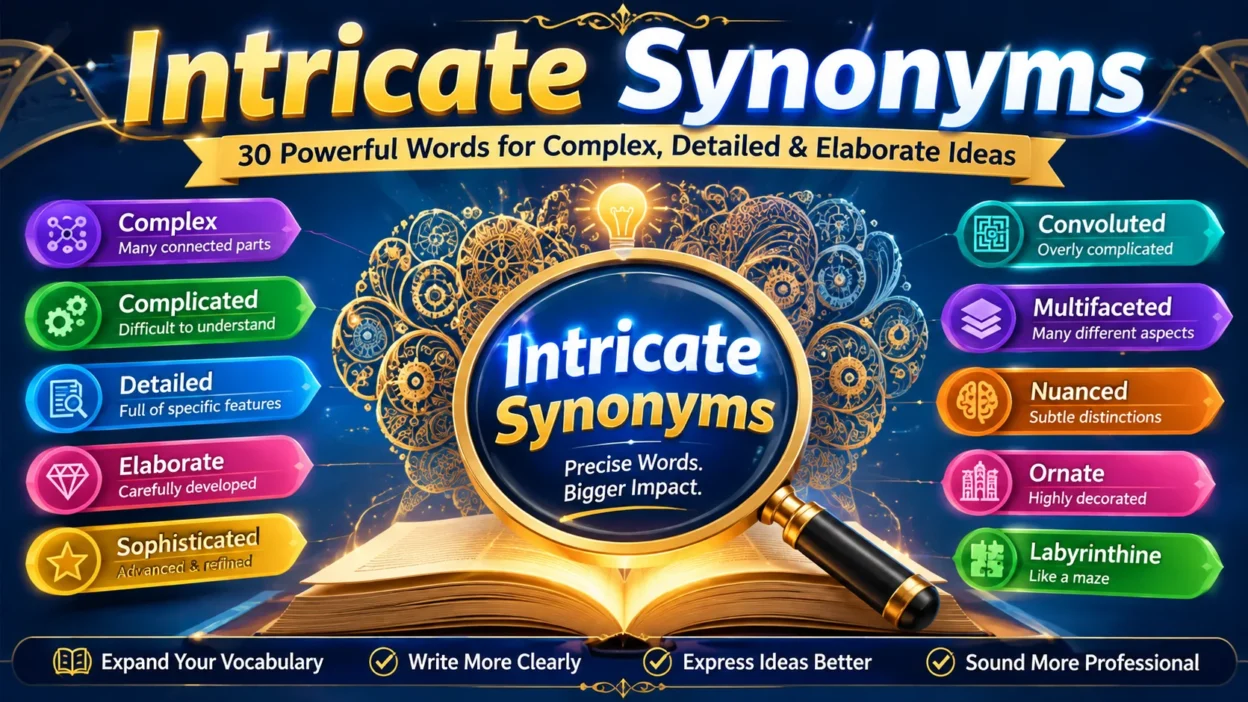
When you are looking for the right intricate synonyms, you are usually trying to describe something that has many connected parts, fine details, or a complicated design. The word intricate is useful when ordinary words such as “complex” or “detailed” do not fully express the idea.
Understanding synonyms for intricate can help students, ESL learners, writers, and content creators make their language more precise. Depending on the situation, you may want to emphasize complexity, detail, sophistication, difficulty, or careful craftsmanship.
What Does “Intricate” Mean?
Intricate is an adjective meaning very complicated, detailed, or made up of many small parts that fit together.
Simple meaning
If something is intricate, it has many details or parts that require careful attention to understand, create, or use.
Example:
The artist created an intricate pattern on the wall.
Here, “intricate” tells us that the pattern has many detailed and carefully arranged parts.
Tone and usage
“Intricate” often has a positive or neutral tone. It can describe beautiful designs, complicated systems, detailed artwork, plans, stories, machinery, or ideas.
For example:
- Intricate design — highly detailed and carefully made
- Intricate pattern — containing many small details
- Intricate system — complicated and interconnected
- Intricate plot — involving many connected events or details
30 Intricate Synonyms
Below are 30 useful synonyms and closely related alternatives to intricate, with simple meanings, examples, and usage guidance.
1. Complex
Meaning: Made of many connected or difficult parts.
Example:
The scientist explained the complex process to the students.
Best usage: General descriptions of systems, ideas, problems, or processes.
2. Complicated
Meaning: Difficult to understand, solve, or deal with.
Example:
The instructions were too complicated for a beginner.
Best usage: Problems, instructions, situations, and processes that are difficult.
3. Detailed
Meaning: Containing many specific pieces of information or small features.
Example:
She prepared a detailed report about the project.
Best usage: Reports, descriptions, plans, drawings, and explanations.
4. Elaborate
Meaning: Carefully developed with many details or features.
Example:
The wedding ceremony included an elaborate decoration scheme.
Best usage: Plans, decorations, designs, events, and explanations.
5. Sophisticated
Meaning: Highly developed, advanced, or refined.
Example:
The company uses a sophisticated computer system.
Best usage: Technology, systems, methods, designs, and advanced ideas.
6. Complexified
Meaning: Made more complicated or difficult.
Example:
The new rules complexified an already difficult process.
Best usage: Formal or analytical writing; less common in everyday English.
7. Convoluted
Meaning: Extremely complicated and difficult to follow.
Example:
The lawyer gave a convoluted explanation of the contract.
Best usage: Arguments, explanations, writing, and processes that are unnecessarily complicated.
8. Complicated
Meaning: Having many parts or factors that make something difficult.
Example:
The machine has a complicated internal structure.
Best usage: Technical, practical, or difficult situations.
9. Byzantine
Meaning: Extremely complicated, often in a confusing way.
Example:
The company had a Byzantine system of regulations.
Best usage: Formal writing about complicated systems, rules, or organizations.
10. Multifaceted
Meaning: Having many different aspects or sides.
Example:
Climate change is a multifaceted problem.
Best usage: Problems, people, subjects, and issues with several dimensions.
11. Nuanced
Meaning: Containing small but important differences or distinctions.
Example:
The author gives a nuanced analysis of the issue.
Best usage: Arguments, opinions, analysis, writing, and discussions.
12. Sophisticate
Meaning: A person who is experienced or knowledgeable; not normally a direct adjective synonym for intricate.
Example:
The museum attracts sophisticated visitors.
Best usage: This is better treated as a related word rather than a direct synonym for “intricate.”
13. Ornate
Meaning: Highly decorated with many elaborate details.
Example:
The palace has an ornate entrance.
Best usage: Architecture, furniture, clothing, art, and decoration.
14. Labyrinthine
Meaning: Extremely complicated, like a maze.
Example:
The city has a labyrinthine network of narrow streets.
Best usage: Places, systems, stories, and processes that are difficult to navigate.
15. Tangled
Meaning: Confused, mixed together, or difficult to separate.
Example:
The investigation uncovered a tangled web of relationships.
Best usage: Problems, relationships, situations, wires, and confusing circumstances.
16. Involved
Meaning: Complicated because many parts or factors are included.
Example:
Planning the international event was an involved process.
Best usage: Formal descriptions of complicated tasks or procedures.
17. Sophisticatedly Designed
Meaning: Designed with advanced thought, skill, or refinement.
Example:
The website is sophisticatedly designed for modern users.
Best usage: Design and technology contexts; use sparingly because it is a phrase rather than a single-word synonym.
18. Fine
Meaning: Made with very small, precise, or delicate details.
Example:
The jewelry features fine decorative work.
Best usage: Craftsmanship, art, jewelry, fabric, and physical details.
19. Detailed
Meaning: Including many individual facts or features.
Example:
He provided a detailed description of the painting.
Best usage: Descriptions, instructions, reports, plans, and visual work.
20. Elaborated
Meaning: Developed or explained in greater detail.
Example:
The researcher elaborated on the theory in her presentation.
Best usage: Ideas, explanations, theories, and discussions.
21. Intricately Designed
Meaning: Designed with many carefully arranged details.
Example:
The necklace was intricately designed by a skilled craftsman.
Best usage: Jewelry, artwork, architecture, graphics, and decorative objects.
22. Delicate
Meaning: Fine, detailed, or requiring careful handling.
Example:
The vase has delicate floral patterns.
Best usage: Art, crafts, decoration, patterns, and fragile objects.
23. Complexly Structured
Meaning: Organized with many interconnected parts.
Example:
The brain is a complexly structured organ.
Best usage: Science, technology, organizations, and systems.
24. Layered
Meaning: Having several levels, meanings, or parts.
Example:
The novel has a layered storyline with several themes.
Best usage: Literature, storytelling, ideas, arguments, and visual design.
25. Rich
Meaning: Containing many interesting, meaningful, or detailed elements.
Example:
The documentary offers a rich description of local culture.
Best usage: Writing, culture, stories, experiences, and artistic work.
26. Ornamental
Meaning: Designed with decorative details.
Example:
The building contains ornamental carvings.
Best usage: Architecture, furniture, art, and decoration.
27. Technical
Meaning: Involving specialized knowledge, methods, or details.
Example:
The manual contains technical information about the equipment.
Best usage: Science, engineering, technology, and professional subjects.
28. Arcane
Meaning: Known or understood by only a small number of people.
Example:
The book contains arcane information about medieval law.
Best usage: Specialized, obscure, or difficult knowledge.
29. Sophisticated
Meaning: Advanced, highly developed, or carefully designed.
Example:
The software uses a sophisticated security system.
Best usage: Technology, methods, systems, products, and intellectual ideas.
30. Intricate in Detail
Meaning: Containing numerous small and carefully arranged details.
Example:
The artist created an intricate-in-detail illustration of the ancient city.
Best usage: Descriptive writing when emphasizing visual or artistic complexity.
Intricate Synonyms Comparison Table
| Synonym | Main Meaning | Tone | Best Used For |
|---|---|---|---|
| Complex | Many connected parts | Neutral | Systems and ideas |
| Complicated | Difficult to understand | Neutral | Problems and processes |
| Detailed | Many specific features | Neutral/Positive | Reports and descriptions |
| Elaborate | Highly developed | Positive | Plans and designs |
| Sophisticated | Advanced and refined | Positive | Technology and systems |
| Convoluted | Overly complicated | Negative | Explanations and arguments |
| Multifaceted | Many different aspects | Neutral/Positive | Issues and subjects |
| Nuanced | Fine distinctions | Positive | Writing and analysis |
| Ornate | Highly decorated | Positive | Architecture and art |
| Labyrinthine | Like a maze | Usually negative | Systems and places |
| Delicate | Fine and detailed | Positive | Art and crafts |
| Layered | Several levels | Positive | Stories and ideas |
| Arcane | Difficult specialized knowledge | Neutral | Specialized subjects |
Intricate vs. Complex
These two words are closely related, but they are not always interchangeable.
Complex mainly emphasizes that something has many connected parts or factors.
Intricate often emphasizes fine details and careful arrangement.
Compare:
- The human brain is a complex organ.
- The artist created an intricate design.
The first sentence focuses on the many interconnected functions of the brain. The second focuses on the small, carefully arranged details of the design.
Intricate vs. Complicated
Complicated usually emphasizes difficulty.
Intricate can emphasize complexity while also suggesting skill, beauty, precision, or careful construction.
Compare:
- The instructions are complicated.
- The embroidery has an intricate pattern.
“Complicated” sounds more negative when something is difficult. “Intricate” can sound admiring when describing craftsmanship or design.
Intricate vs. Elaborate
Elaborate often suggests something has been developed or decorated extensively.
Intricate focuses more strongly on the complexity and fine details.
For example:
- An elaborate wedding suggests extensive planning and decoration.
- An intricate wedding invitation suggests a detailed and carefully designed invitation.
How to Choose the Right Synonym
Choosing the best synonym depends on exactly what you want to communicate.
When you mean “many parts”
Use:
- Complex
- Multifaceted
- Involved
- Layered
Example:
The problem is complex and requires careful analysis.
When you mean “difficult”
Use:
- Complicated
- Convoluted
- Labyrinthine
Example:
The application process is complicated.
When you mean “many details”
Use:
- Detailed
- Elaborate
- Intricate
- Fine
Example:
The artist painted an intricate pattern.
When you mean “advanced”
Use:
- Sophisticated
- Technical
- Advanced
Example:
The laboratory uses sophisticated equipment.
When you mean “beautifully decorated”
Use:
- Ornate
- Ornamental
- Elaborate
- Intricate
Example:
The palace has an ornate ceiling.
When you mean “subtle or intellectually detailed”
Use:
- Nuanced
- Multifaceted
- Layered
- Sophisticated
Example:
The author presents a nuanced argument.
Examples of Intricate in Different Contexts
Intricate Design
The designer created an intricate pattern inspired by nature.
Here, “intricate” highlights the many small visual details.
Intricate Story
The mystery has an intricate plot filled with unexpected connections.
In this example, the word describes a complicated storyline.
Intricate Machine
The watch contains an intricate mechanical system.
Here, “intricate” emphasizes the many small parts working together.
Intricate Argument
The professor presented an intricate argument about economic policy.
In this context, “intricate” describes an argument involving several connected ideas.
Intricate Artwork
The painting contains intricate details that are easy to miss.
Here, the word emphasizes precision and fine craftsmanship.
Common Mistakes When Using Intricate Synonyms
Using “complicated” for everything
Although “complicated” is a common synonym, it can sound negative. If you admire something because it is carefully designed, intricate, elaborate, or ornate may be better choices.
Using “ornate” for abstract ideas
“Ornate” usually describes decoration. It is natural to say:
The building has an ornate doorway.
It is less natural to use “ornate” for an ordinary technical process.
Using “sophisticated” when you only mean difficult
Sophisticated means advanced, refined, or highly developed. It does not simply mean “hard.”
Confusing detail with complexity
Something can be detailed without being complex.
For example, a simple list can contain many details but may not be intricate.
Why Learning Intricate Synonyms Matters
Learning different alternatives to “intricate” improves vocabulary and makes writing more precise.
For students, these words can make essays and assignments more descriptive. ESL learners can use them to express subtle differences in meaning. Writers can choose vocabulary that creates a particular mood, while content creators can avoid repetitive language.
Instead of repeatedly writing “complex,” you can choose a word that explains why something is complex.
For example:
- Complex → many connected parts
- Detailed → many specific features
- Elaborate → extensively developed
- Convoluted → unnecessarily difficult
- Sophisticated → advanced and refined
- Ornate → highly decorated
- Nuanced → containing subtle distinctions
This makes your writing clearer and more engaging.
Final Takeaway
The best intricate synonyms depend on the context. If you are describing a complicated system, complex may be the best choice. If you want to emphasize specific details, choose detailed. For advanced technology, sophisticated works well. For decoration, ornate is more precise, while nuanced is useful for subtle ideas and arguments.
Understanding these distinctions helps you choose words that communicate exactly what you mean. Rather than replacing “intricate” with any random synonym, consider the object, tone, and specific quality you want to emphasize.

David Henry is a language enthusiast and content writer specializing in synonyms, vocabulary, and word meanings. He creates clear, engaging resources that help readers improve their writing, communication, and English skills.