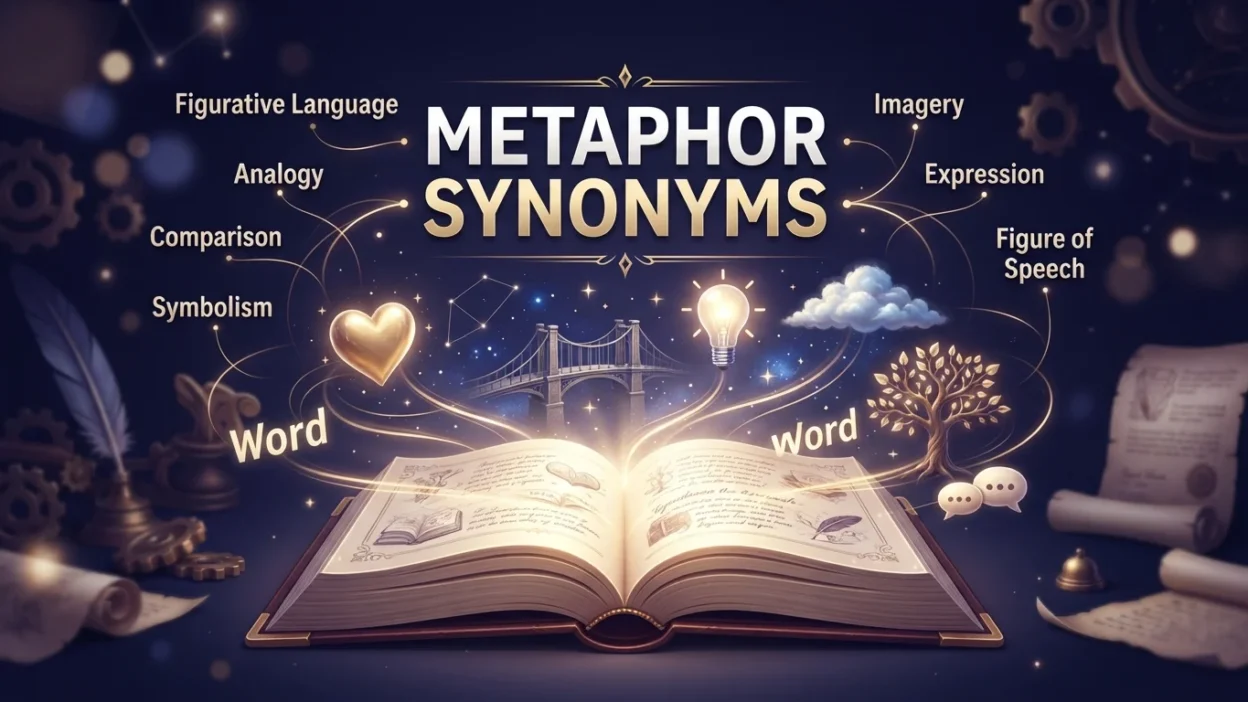
A metaphor is a figure of speech that describes one thing by saying it is another thing, even though the two are not literally the same. Metaphors help writers make ideas more vivid, emotional, and memorable. For example, saying “Time is a thief” does not mean time literally steals things; it suggests that time takes moments away from us.
Finding the right metaphor synonyms can help students, ESL learners, writers, and content creators express the idea of comparison more precisely. However, not every synonym has exactly the same meaning. Some words describe figurative language in general, while others refer specifically to comparisons, symbols, or imaginative expressions.
Important note: The original prompt mentions “demure” and asks for 30 synonyms of “demure,” but the target keyword is “metaphor synonyms.” To keep the article relevant to search intent and useful for readers, this guide focuses on metaphor and its appropriate synonyms and related terms rather than changing the topic to demure.
What Does “Metaphor” Mean?
A metaphor is an imaginative comparison in which one thing is described as another to communicate a deeper idea.
Simple definition
Metaphor: A figure of speech that compares two different things by treating one as if it were the other.
Examples
- “Her voice was music to my ears.”
- “The classroom was a zoo.”
- “He has a heart of stone.”
- “Life is a journey.”
- “The city never sleeps.”
These statements are not meant to be understood literally. They create an image or feeling in the reader’s mind.
Why Use Metaphor Synonyms?
Using the same word repeatedly can make writing feel dull. Learning related terms gives you more options and helps you describe figurative language accurately.
For example, depending on the context, you might use:
- Figurative expression for a broad description
- Analogy for an explanatory comparison
- Symbol when an object represents a deeper idea
- Comparison for a general act of showing similarities
- Figure of speech for a broad literary term
- Allegory for an extended symbolic story or narrative
The key is to choose a word that matches your intended meaning.
30 Metaphor Synonyms and Related Words
Below are 30 useful alternatives and closely related terms. Some are direct alternatives, while others describe specific forms or functions of metaphor.
1. Figure of Speech
Meaning: A creative use of language that goes beyond its literal meaning.
Example: “A metaphor is a common figure of speech in poetry.”
Best usage context: Use this when discussing literary or rhetorical language generally.
2. Figurative Expression
Meaning: Language used in a nonliteral way to create an idea, image, or feeling.
Example: “The phrase ‘broken heart’ can be a figurative expression.”
Best usage context: Useful in academic, educational, and ESL writing.
3. Comparison
Meaning: Showing how two things are similar in some way.
Example: “The writer makes a comparison between life and a winding road.”
Best usage context: Use when discussing similarities broadly rather than a specific literary device.
4. Analogy
Meaning: A comparison used to explain or clarify an idea.
Example: “The teacher used an analogy between the brain and a computer.”
Best usage context: Best for explanations, education, essays, and arguments.
5. Symbol
Meaning: Something that represents a larger or deeper idea.
Example: “The dove is often used as a symbol of peace.”
Best usage context: Use when an object, image, or action represents an abstract concept.
6. Symbolism
Meaning: The use of symbols to communicate deeper meanings.
Example: “The novel uses symbolism to explore freedom and loss.”
Best usage context: Especially useful in literary analysis.
7. Image
Meaning: A word or expression that creates a mental picture.
Example: “The poet creates a powerful image of a stormy sea.”
Best usage context: Good for discussing descriptive writing and poetry.
8. Imagery
Meaning: Descriptive language that appeals to the senses and creates mental pictures.
Example: “The author’s imagery makes the forest feel alive.”
Best usage context: Use when discussing vivid descriptive language.
9. Rhetorical Device
Meaning: A technique used to make communication more persuasive, memorable, or effective.
Example: “The writer uses metaphor as a rhetorical device.”
Best usage context: Appropriate for academic writing, speeches, and persuasive communication.
10. Literary Device
Meaning: A technique writers use to create meaning, style, or emotional impact.
Example: “Metaphor is an important literary device.”
Best usage context: Best for literature classes and literary analysis.
11. Rhetorical Figure
Meaning: A deliberate use of language that gives expression greater impact or style.
Example: “The speech contains several rhetorical figures.”
Best usage context: Useful in formal discussions of rhetoric and communication.
12. Trope
Meaning: A recurring figurative or conceptual use of language.
Example: “The journey is a common literary trope for personal growth.”
Best usage context: Useful in literary criticism, storytelling, and media analysis.
13. Comparison Figure
Meaning: A figure of speech that establishes a relationship between different ideas or objects.
Example: “The author uses a comparison figure to make the character’s emotions clearer.”
Best usage context: Suitable when discussing figurative comparisons in an educational context.
14. Figurative Comparison
Meaning: A nonliteral comparison between two different things.
Example: “Calling the child a little ray of sunshine is a figurative comparison.”
Best usage context: Helpful for explaining metaphors to beginners and ESL learners.
15. Representation
Meaning: Something that stands for or expresses another idea.
Example: “The river becomes a representation of change in the novel.”
Best usage context: Useful when analyzing how an image or object communicates an abstract concept.
16. Illustration
Meaning: Something that helps explain or demonstrate an idea.
Example: “The story provides an illustration of how fear can control people.”
Best usage context: Best when a metaphor or story is being used to explain an idea.
17. Emblem
Meaning: An object or image that represents a particular idea or quality.
Example: “The flag serves as an emblem of national identity.”
Best usage context: Useful when discussing recognizable symbolic representations.
18. Sign
Meaning: Something that communicates or points toward a particular meaning.
Example: “The broken window becomes a sign of conflict in the story.”
Best usage context: Appropriate for general symbolic or interpretive discussions.
19. Motif
Meaning: A recurring image, idea, object, or theme in a literary work.
Example: “Water is a recurring motif throughout the novel.”
Best usage context: Use in literary analysis when an image or idea appears repeatedly.
20. Allegory
Meaning: A story, character, or narrative in which deeper ideas are represented through symbolic elements.
Example: “The novel can be read as an allegory for the struggle between freedom and control.”
Best usage context: Use for extended symbolic stories rather than simple one-line metaphors.
21. Parable
Meaning: A short story that teaches a moral or practical lesson.
Example: “The teacher told a parable about honesty.”
Best usage context: Common in religious, moral, and educational contexts.
22. Comparison Device
Meaning: A language technique that connects two ideas to make meaning clearer or stronger.
Example: “The writer uses a comparison device to describe the character’s loneliness.”
Best usage context: Useful as a general educational term.
23. Figurative Language
Meaning: Language that communicates more than its literal meaning.
Example: “Figurative language makes the poem more emotional.”
Best usage context: Excellent for ESL learners and introductory language lessons.
24. Expression
Meaning: A particular way of communicating an idea, feeling, or thought.
Example: “The phrase ‘a sea of people’ is a vivid expression.”
Best usage context: Use when you want a broad and simple alternative.
25. Turn of Phrase
Meaning: A particular or creative way of expressing something.
Example: “The author’s unusual turn of phrase makes the description memorable.”
Best usage context: Useful when discussing creative writing style.
26. Idiomatic Expression
Meaning: A phrase whose meaning is different from the literal meaning of its individual words.
Example: “The phrase ‘break the ice’ is an idiomatic expression.”
Best usage context: Use for idioms, although an idiom is not automatically a metaphor.
27. Conceptual Comparison
Meaning: A comparison between ideas or concepts rather than physical objects.
Example: “The author makes a conceptual comparison between memory and a photograph.”
Best usage context: Useful in academic and analytical writing.
28. Extended Metaphor
Meaning: A metaphor that continues across several sentences, paragraphs, or an entire work.
Example: “The poem develops an extended metaphor comparing life to a voyage.”
Best usage context: Use specifically for metaphors developed over a longer passage.
29. Figurative Analogy
Meaning: An imaginative comparison used to explain or communicate an idea.
Example: “The speaker uses a figurative analogy to explain the effects of fear.”
Best usage context: Useful for creative explanations and educational writing.
30. Metaphorical Expression
Meaning: An expression that uses metaphorical rather than literal meaning.
Example: “Calling someone a ‘bright star’ is a metaphorical expression of admiration.”
Best usage context: Good for explaining individual metaphorical phrases.
Metaphor Synonyms: Quick Comparison Table
| Term | Main Meaning | Best Used For |
|---|---|---|
| Metaphor | Direct nonliteral comparison | Creative and literary writing |
| Figure of speech | Broad nonliteral language technique | General language study |
| Figurative expression | Nonliteral expression | ESL and general writing |
| Analogy | Comparison used to explain | Teaching and arguments |
| Symbol | Something representing an idea | Literature and art |
| Symbolism | Use of symbols | Literary analysis |
| Imagery | Sensory mental pictures | Poetry and descriptive writing |
| Rhetorical device | Communication technique | Speeches and persuasion |
| Literary device | Writing technique | Literature |
| Trope | Recurring figurative idea | Storytelling and criticism |
| Motif | Recurring element | Literary analysis |
| Allegory | Extended symbolic narrative | Fiction and philosophy |
| Parable | Story with a lesson | Moral or educational writing |
| Idiom | Fixed nonliteral phrase | Everyday language |
| Extended metaphor | Metaphor developed over time | Poetry and essays |
Metaphor vs. Analogy
These terms are related but are not interchangeable.
A metaphor usually creates a direct imaginative connection:
“The classroom was a zoo.”
An analogy usually explains how two things are similar:
“Learning a language is like building a house because both require a strong foundation.”
A metaphor often creates an image or emotional effect, while an analogy is commonly used to explain an idea.
Metaphor vs. Simile
A simile explicitly compares two things using words such as “like” or “as.”
Simile:
“Her smile was like sunshine.”
Metaphor:
“Her smile was sunshine.”
Both create comparisons, but their grammatical structures are different.
Therefore, simile can be a related term when discussing metaphor synonyms, but it should not always be treated as a direct synonym.
Metaphor vs. Symbol
A metaphor creates a comparison, while a symbol represents an idea.
For example:
“The child’s mind was a sponge.”
This is a metaphor comparing the child’s ability to learn with a sponge’s ability to absorb water.
A white dove, however, may function as a symbol of peace.
The two concepts can overlap, but they serve different purposes.
How to Choose the Right Metaphor Synonym
Choosing the best alternative depends on what you are trying to communicate.
For general language study
Choose:
- Figure of speech
- Figurative language
- Figurative expression
- Expression
These are easy choices for students and ESL learners.
For literary analysis
Choose:
- Literary device
- Imagery
- Symbolism
- Motif
- Trope
- Allegory
These terms are more precise when analyzing literature.
For explanations and teaching
Choose:
- Analogy
- Illustration
- Comparison
- Figurative analogy
- Conceptual comparison
These words work well when explaining complicated ideas.
For symbolic meaning
Choose:
- Symbol
- Symbolism
- Representation
- Emblem
- Motif
These terms are appropriate when something represents a deeper concept.
For creative writing
Choose:
- Metaphorical expression
- Figurative expression
- Imagery
- Extended metaphor
- Turn of phrase
These options help describe creative uses of language.
Common Metaphor Examples
Understanding examples can make the meaning of metaphor clearer.
“Time is money.”
This metaphor connects time with money to emphasize that time is valuable.
“She has a heart of stone.”
This suggests that someone is emotionally cold or unwilling to show compassion.
“The world is a stage.”
This famous metaphor presents life as if it were a theatrical performance.
“He is a walking encyclopedia.”
This means the person has a very large amount of knowledge.
“The news was a dagger to her heart.”
The statement does not mean an actual dagger was used. It emphasizes intense emotional pain.
Why Metaphors Matter in Writing
Metaphors make ordinary language more powerful.
Instead of saying:
“The man was very angry.”
A writer might say:
“Anger was a fire burning inside him.”
The second sentence creates a stronger mental image. Readers can imagine the heat, intensity, and uncontrollable nature of the emotion.
Metaphors can also make complex ideas easier to understand. Writers, teachers, speakers, journalists, and content creators often use them to connect unfamiliar concepts with familiar experiences.
Metaphor Synonyms for Different Writing Situations
| Writing Situation | Recommended Term |
|---|---|
| Beginner language lesson | Figurative language |
| School essay | Figure of speech |
| Literary analysis | Literary device |
| Explaining a difficult concept | Analogy |
| Discussing repeated imagery | Motif |
| Discussing symbolic meaning | Symbolism |
| Analyzing a symbolic story | Allegory |
| Describing sensory language | Imagery |
| Persuasive speech analysis | Rhetorical device |
| Creative writing | Metaphorical expression |
| Analyzing recurring themes | Trope or motif |
| Discussing a long metaphor | Extended metaphor |
Tips for Using Metaphors Effectively
1. Make the comparison understandable
A metaphor should help the reader understand or feel something.
Weak:
“His thoughts were a complicated refrigerator.”
Strong:
“His thoughts were a tangled web.”
The second comparison is easier to understand.
2. Avoid unnecessary metaphors
Too many metaphors can make writing confusing. Use them when they add meaning, emotion, or clarity.
3. Match the tone
A playful metaphor may work well in a social media post but not in a formal academic report.
4. Think about your audience
ESL learners and beginners benefit from familiar comparisons. Specialized audiences may understand more complex metaphors.
5. Avoid mixed metaphors
A mixed metaphor combines unrelated comparisons in a confusing way.
For example:
“We need to get the ball rolling and put all our cards on the table before the ship sails.”
Each expression can work independently, but combining several unrelated metaphors can weaken the sentence.
Frequently Asked Questions About Metaphor Synonyms
What is the closest synonym for metaphor?
There is no perfect synonym in every situation. Figurative expression, figure of speech, and figurative comparison are among the closest general alternatives.
Is analogy a synonym for metaphor?
Not exactly. An analogy compares two things to explain a relationship or concept, while a metaphor usually makes an imaginative, nonliteral comparison.
Is simile a synonym for metaphor?
Simile is closely related to metaphor, but it is a different figure of speech. Similes usually use “like” or “as” to make an explicit comparison.
Is symbolism the same as metaphor?
No. A metaphor creates a comparison, while symbolism involves using something to represent a deeper meaning. A metaphor can sometimes contribute to symbolism.
What is another word for figurative language?
Depending on the context, you can use nonliteral language, figurative expression, figure of speech, or rhetorical language.
Why are metaphor synonyms useful?
They allow writers to communicate more precisely and avoid repeating the same terminology. They also help students understand the differences between related literary concepts.
Final Thoughts on Metaphor Synonyms
Understanding metaphor synonyms is about more than memorizing a list of replacement words. The most useful approach is to understand the difference between related concepts such as metaphor, analogy, simile, symbolism, imagery, allegory, and figurative language.
For everyday explanations, figurative expression or figure of speech may be appropriate. For literary analysis, terms such as symbolism, motif, imagery, trope, and literary device can provide greater precision. When explaining a complex idea, analogy may be the better choice.
By choosing the right term for the context, students, ESL learners, writers, and content creators can make their vocabulary more accurate, their writing more natural, and their explanations easier to understand.

Alexander Eric is the Administrator of SynonymLot, dedicated to providing accurate synonyms, vocabulary resources, and language tools. He enjoys helping readers improve writing, communication, and English word knowledge daily.