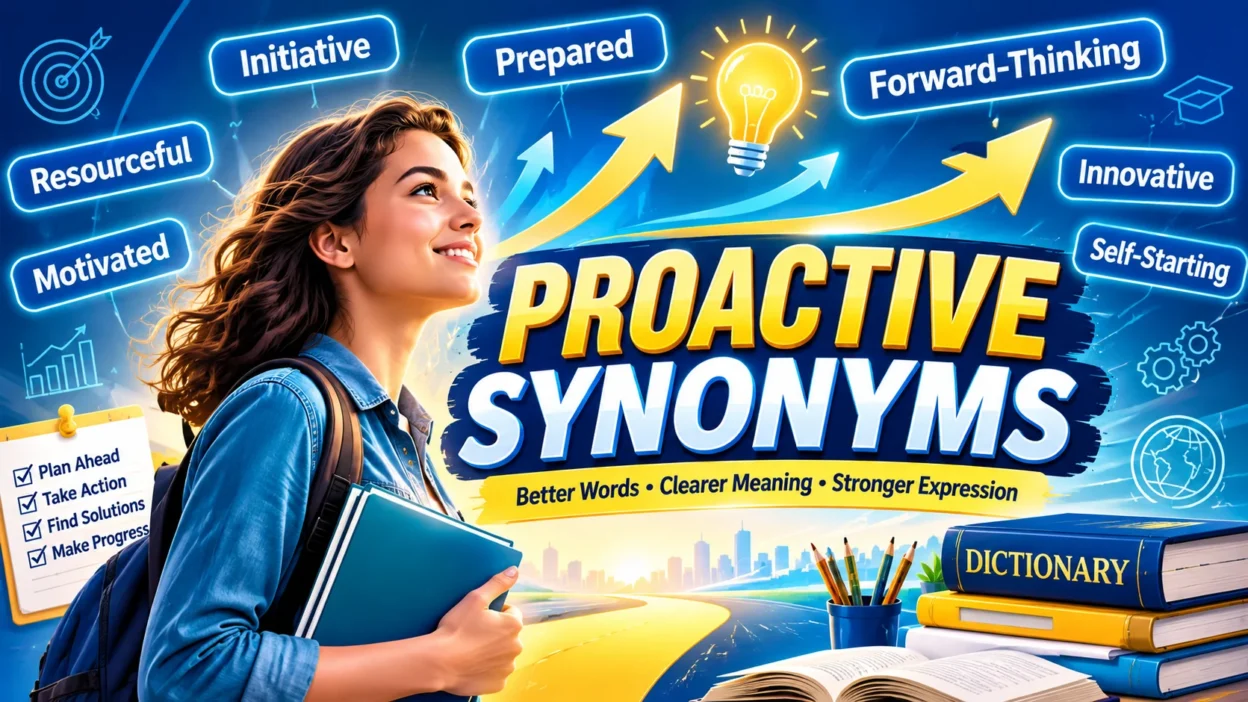
If you are looking for proactive synonyms, you are probably trying to find better ways to describe someone who takes action before problems happen. The word proactive is useful in everyday English, academic writing, business communication, resumes, and professional conversations. However, using the same word repeatedly can make your writing sound less varied.
Learning synonyms for proactive helps students, ESL learners, writers, and content creators choose words that match the exact meaning and tone they want. Some alternatives emphasize preparation, while others focus on initiative, responsibility, energy, or forward thinking.
What Does “Proactive” Mean?
Proactive is an adjective used to describe someone who takes action before a problem, need, or situation requires them to react.
In simple English, proactive means taking action in advance instead of waiting for something to happen.
For example:
- She is proactive about improving her English.
- The manager took a proactive approach to customer complaints.
- A proactive student prepares for exams weeks ahead.
The tone of proactive is usually positive. It suggests that someone is responsible, prepared, independent, and willing to take initiative.
Proactive: Simple Definition
Proactive: Taking action early or in advance to prevent problems or create a positive result.
Proactive in Different Contexts
The word can be used in several situations:
- Work: A proactive employee solves problems before they become serious.
- Education: A proactive student prepares before an exam.
- Business: A proactive company anticipates customer needs.
- Personal life: A proactive person plans ahead instead of waiting for difficulties.
- Writing: “Proactive” can describe forward-thinking behavior or an anticipatory strategy.
30 Proactive Synonyms With Meanings and Examples
Below are 30 useful proactive synonyms, with simple meanings, example sentences, and guidance on when to use each word.
1. Initiative-taking
Meaning: Willing to act without being told what to do.
Example:
Maria is initiative-taking and often suggests new solutions at work.
Best usage: Professional, academic, and workplace contexts.
2. Enterprising
Meaning: Good at finding opportunities and taking action.
Example:
The enterprising student created a small online business.
Best usage: Business, entrepreneurship, and professional writing.
3. Forward-thinking
Meaning: Thinking about future needs and possibilities.
Example:
The company has a forward-thinking approach to technology.
Best usage: Business, leadership, strategy, and formal writing.
4. Anticipatory
Meaning: Done in preparation for something that is expected to happen.
Example:
The hospital took anticipatory measures before the storm.
Best usage: Formal, academic, technical, and professional writing.
5. Preemptive
Meaning: Done before something happens to prevent a problem.
Example:
The team took preemptive action to avoid delays.
Best usage: Business, security, technology, and formal contexts.
6. Prepared
Meaning: Ready for something before it happens.
Example:
She was prepared for the difficult questions during the interview.
Best usage: Everyday English, education, work, and general writing.
7. Diligent
Meaning: Careful, hardworking, and consistent in doing something.
Example:
He is diligent about checking his work before submitting it.
Best usage: Academic and professional contexts.
8. Industrious
Meaning: Working hard and showing a strong desire to accomplish tasks.
Example:
The industrious employee completed the project ahead of schedule.
Best usage: Formal writing, professional descriptions, and academic English.
9. Energetic
Meaning: Having a lot of energy and enthusiasm for taking action.
Example:
She is an energetic team member who always gets projects moving.
Best usage: Informal and professional contexts.
10. Ambitious
Meaning: Having a strong desire to achieve something important.
Example:
He is ambitious and actively works toward his career goals.
Best usage: Careers, education, personal goals, and professional writing.
11. Resourceful
Meaning: Able to find clever ways to solve problems.
Example:
The resourceful employee found a solution when the original plan failed.
Best usage: Work, problem-solving, education, and resumes.
12. Assertive
Meaning: Confidently expressing ideas and taking appropriate action.
Example:
She was assertive when asking the team to address the problem.
Best usage: Communication, leadership, workplace, and personal development.
13. Industrious
Meaning: Hardworking and productive.
Example:
The industrious researcher spent months preparing the study.
Best usage: Formal and academic writing.
Note: Industrious overlaps with proactive, but it focuses more on hard work than acting in advance.
14. Dynamic
Meaning: Active, energetic, and willing to make things happen.
Example:
The dynamic manager introduced several improvements to the department.
Best usage: Business, leadership, marketing, and professional writing.
15. Vigorous
Meaning: Showing strong energy and effort.
Example:
The organization launched a vigorous campaign to improve safety.
Best usage: Formal writing and situations involving strong action.
16. Motivated
Meaning: Having a strong reason or desire to achieve something.
Example:
She is highly motivated to improve her professional skills.
Best usage: Education, employment, interviews, and resumes.
17. Driven
Meaning: Strongly motivated to achieve a goal.
Example:
He is a driven professional who constantly looks for ways to improve.
Best usage: Careers, leadership, resumes, and informal professional English.
18. Alert
Meaning: Paying close attention and ready to respond.
Example:
The security team remained alert to potential problems.
Best usage: Safety, security, workplace, and everyday contexts.
19. Attentive
Meaning: Carefully noticing what is happening or what may be needed.
Example:
The attentive teacher noticed that several students needed extra help.
Best usage: Education, customer service, relationships, and professional writing.
20. Responsible
Meaning: Reliable and willing to take care of duties.
Example:
She is responsible and always prepares for important meetings.
Best usage: General, academic, workplace, and personal contexts.
21. Conscientious
Meaning: Careful, responsible, and committed to doing things properly.
Example:
He is a conscientious worker who checks every detail before submitting a report.
Best usage: Formal English, resumes, recommendations, and professional writing.
22. Vigilant
Meaning: Carefully watching for possible problems or danger.
Example:
The staff remained vigilant during the security inspection.
Best usage: Security, safety, formal writing, and serious situations.
23. Pioneering
Meaning: Introducing new ideas or methods.
Example:
The company developed a pioneering approach to renewable energy.
Best usage: Innovation, science, technology, business, and formal writing.
24. Innovative
Meaning: Using new and creative ideas or methods.
Example:
The innovative team developed a faster way to process orders.
Best usage: Technology, business, education, marketing, and professional writing.
25. Foresighted
Meaning: Able to think about future consequences and prepare for them.
Example:
Her foresighted planning helped the organization avoid future difficulties.
Best usage: Formal writing, leadership, planning, and strategy.
26. Preventive
Meaning: Intended to stop a problem before it occurs.
Example:
The company introduced preventive measures to reduce workplace accidents.
Best usage: Health, safety, business, technical, and formal contexts.
27. Precautionary
Meaning: Done as a safety measure before a possible problem occurs.
Example:
The school took precautionary steps before the severe weather arrived.
Best usage: Safety, formal writing, announcements, and official communication.
28. Self-starting
Meaning: Able and willing to begin tasks without being told.
Example:
The company is looking for a self-starting employee who can work independently.
Best usage: Jobs, resumes, interviews, and workplace communication.
29. Go-ahead
Meaning: Active, confident, and willing to take action.
Example:
She has a go-ahead attitude toward new projects.
Best usage: Informal English and conversational contexts.
30. Forward-looking
Meaning: Focused on future possibilities, improvements, and goals.
Example:
The organization needs a forward-looking strategy for long-term growth.
Best usage: Business, leadership, strategy, and formal writing.
Quick Comparison of Proactive Synonyms
| Synonym | Main Idea | Tone | Best Context |
|---|---|---|---|
| Initiative-taking | Acts independently | Professional | Work |
| Enterprising | Finds opportunities | Positive | Business |
| Forward-thinking | Plans for the future | Professional | Strategy |
| Anticipatory | Prepares in advance | Formal | Academic/business |
| Preemptive | Prevents a problem | Formal | Security/business |
| Prepared | Ready in advance | Neutral | Everyday use |
| Diligent | Works carefully | Positive | School/work |
| Resourceful | Solves problems creatively | Positive | Work/problem-solving |
| Assertive | Acts confidently | Strong | Communication |
| Ambitious | Wants to achieve goals | Positive | Careers |
| Dynamic | Energetic and active | Positive | Leadership |
| Motivated | Has strong drive | Positive | Education/work |
| Driven | Strongly goal-oriented | Positive | Careers |
| Vigilant | Watches for danger | Serious | Security/safety |
| Innovative | Creates new solutions | Positive | Technology/business |
| Preventive | Stops problems early | Formal | Health/safety |
| Self-starting | Acts without instructions | Professional | Employment |
| Foresighted | Understands future needs | Formal | Planning |
| Forward-looking | Focuses on future growth | Professional | Strategy |
Proactive vs. Reactive: What Is the Difference?
Understanding the opposite of proactive can make the meaning clearer.
Proactive
A proactive person acts before a problem happens.
Example:
The manager regularly checks equipment to prevent breakdowns.
Reactive
A reactive person acts after a problem happens.
Example:
The manager repairs the equipment only after it breaks.
In simple terms:
Proactive = act first.
Reactive = respond afterward.
Neither word is automatically appropriate in every situation, but proactive often carries a more positive meaning when describing planning, responsibility, and initiative.
How to Choose the Right Proactive Synonym
Not every synonym has exactly the same meaning. Choose your word according to the specific quality you want to emphasize.
For Future Planning
Use:
- Forward-thinking
- Forward-looking
- Foresighted
- Anticipatory
These words work well when someone thinks about future needs or consequences.
Example:
The organization needs a forward-thinking leader.
For Preventing Problems
Use:
- Preemptive
- Preventive
- Precautionary
- Anticipatory
These are especially useful when action is taken to stop something negative from happening.
Example:
The company introduced preventive measures to reduce accidents.
For Independent Action
Use:
- Initiative-taking
- Self-starting
- Enterprising
- Resourceful
These words describe people who do not always wait for instructions.
Example:
We need a self-starting employee who can manage projects independently.
For Hard Work and Commitment
Use:
- Diligent
- Industrious
- Conscientious
- Motivated
- Driven
These words are useful when you want to emphasize effort, dedication, or responsibility.
Example:
She is a conscientious and motivated student.
For Innovation and New Ideas
Use:
- Innovative
- Pioneering
- Dynamic
- Forward-thinking
These alternatives work well when proactive behavior involves creating new ideas or improving existing systems.
Example:
The company needs an innovative approach to customer service.
Proactive Synonyms for Resumes
If you are writing a resume or CV, some alternatives sound particularly natural in professional descriptions.
Instead of:
I am a proactive employee.
You could write:
- I am a self-starting professional who works independently.
- I am a resourceful employee who identifies solutions quickly.
- I am a motivated professional who takes initiative.
- I am a forward-thinking team member focused on continuous improvement.
- I am an enterprising professional who identifies new opportunities.
For resumes, self-starting, resourceful, motivated, initiative-taking, and forward-thinking can be especially useful because they describe specific professional qualities.
Proactive Synonyms for Students
Students can use these words when describing themselves or their study habits:
- Prepared
- Diligent
- Motivated
- Responsible
- Conscientious
- Self-starting
- Ambitious
- Resourceful
For example:
She is a proactive student who prepares for exams early.
Could become:
She is a diligent student who prepares for exams early.
Or:
She is a self-starting student who independently seeks additional learning resources.
Proactive Synonyms for Professional Writing
In business and professional writing, the best choice depends on your intended meaning.
If you mean planning ahead, use forward-thinking.
If you mean preventing problems, use preventive or preemptive.
If you mean taking initiative, use initiative-taking or self-starting.
If you mean finding solutions, use resourceful.
If you mean creating new approaches, use innovative.
Choosing a precise synonym makes professional writing clearer and more persuasive.
Common Mistakes When Using Proactive Synonyms
1. Treating Every Synonym as Identical
Words such as diligent, innovative, and vigilant can overlap with proactive, but they emphasize different qualities.
For example, diligent mainly means hardworking and careful, while proactive emphasizes taking action before it becomes necessary.
2. Using Formal Words in Casual Conversation
Words such as anticipatory and foresighted may sound overly formal in everyday speech.
In casual English, prepared, ready, or forward-thinking may sound more natural.
3. Confusing Ambition With Proactivity
An ambitious person wants to achieve something, but that does not necessarily mean they take action in advance.
Someone can be ambitious without being proactive.
4. Using “Preemptive” Everywhere
Preemptive usually suggests preventing a specific expected problem or threat. It is more specialized than proactive.
Frequently Asked Questions About Proactive Synonyms
What is the best synonym for proactive?
There is no single best synonym. Initiative-taking, forward-thinking, self-starting, resourceful, and anticipatory are strong choices depending on the context.
What is a simple synonym for proactive?
Simple alternatives include prepared, active, ready, motivated, and responsible. However, each word has a slightly different meaning.
What is the opposite of proactive?
The most common opposite is reactive. A proactive person acts in advance, while a reactive person responds after something happens.
What is a professional synonym for proactive?
For professional writing, consider initiative-taking, forward-thinking, self-starting, resourceful, or enterprising.
What is a synonym for proactive on a resume?
Good resume-friendly choices include self-starting, motivated, resourceful, initiative-taking, forward-thinking, and driven.
Is “preventive” the same as “proactive”?
Not exactly. Preventive specifically describes action intended to stop a problem, while proactive has a broader meaning and can include planning, improvement, initiative, and preparation.
Final Thoughts on Proactive Synonyms
Learning proactive synonyms can make your English more precise, natural, and flexible. Although these words share the general idea of taking action or preparing ahead, each one highlights a different quality.
Use forward-thinking when emphasizing future planning, preemptive when preventing a specific problem, self-starting when describing independence, resourceful when focusing on problem-solving, and innovative when emphasizing new ideas.
For students, ESL learners, writers, and content creators, understanding these small differences is more valuable than simply memorizing a long list of synonyms. The right word should match your meaning, audience, and tone.

Daniel Jack is a language enthusiast and content writer who specializes in synonyms, vocabulary, and word meanings. He creates clear, engaging resources that help readers improve communication and expand their English skills.