
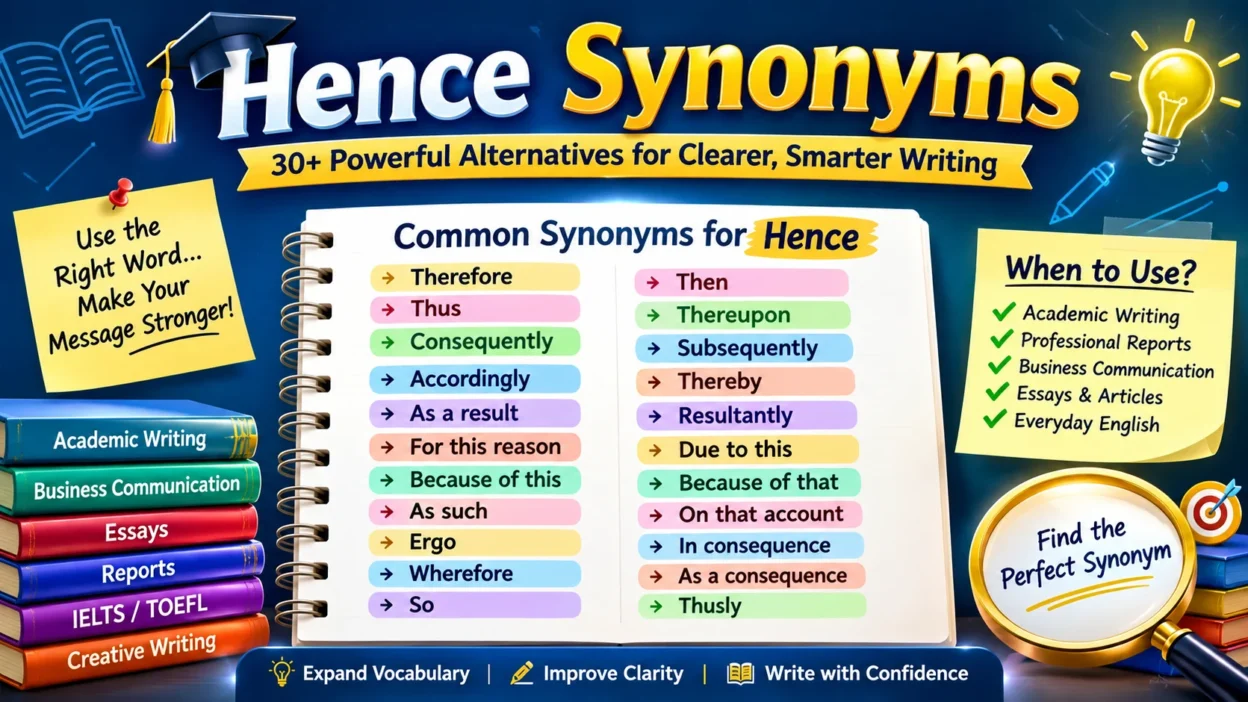
If you are looking for hence synonyms, you may want alternatives that make your writing clearer, more natural, or more sophisticated. The word hence is common in formal English, academic writing, essays, reports, and professional communication, but its exact meaning can change slightly depending on context.
In simple English, hence usually means “therefore,” “for this reason,” “as a result,” or sometimes “from now.” Choosing the right synonym depends on what you want to express. For example, therefore works well when showing a logical result, while thus is often preferred in formal or academic writing.
This guide explains 30 useful hence synonyms with simple meanings, example sentences, and usage notes. It is designed for students, ESL learners, writers, and content creators who want to use alternatives accurately.
Note: Your requested instructions mention “demure” and synonyms of “demure,” but the target keyword is “hence synonyms.” To keep the article relevant to your stated SEO keyword and search intent, this article focuses on hence and its synonyms rather than demure.
What Does “Hence” Mean?
Hence is an adverb used mainly to show a result, consequence, reason, or conclusion.
Simple definition
Hence = therefore, for this reason, or as a result.
Example:
The road was flooded; hence, we decided to stay home.
Here, hence means “therefore” or “because of this.”
Another meaning of “hence”
Hence can also refer to a point in the future.
Example:
The project will be completed two weeks hence.
In this sentence, hence means “two weeks from now.”
This second meaning is less common in everyday conversation and sounds more formal or literary.
30 Useful Hence Synonyms
1. Therefore
Meaning: For that reason; because of what was just mentioned.
Example:
The evidence was incomplete; therefore, the case required further investigation.
Best usage: Formal writing, academic essays, logical arguments, and professional reports.
2. Thus
Meaning: In this way or as a result.
Example:
She studied consistently and thus achieved excellent results.
Best usage: Academic, technical, and formal writing.
3. Consequently
Meaning: As a result of something.
Example:
The company lost several major clients and consequently reduced its expenses.
Best usage: Formal writing when emphasizing a consequence.
4. Accordingly
Meaning: In a way that is suitable because of a particular situation.
Example:
The weather changed suddenly, so we adjusted our plans accordingly.
Best usage: Formal and professional contexts.
5. As a result
Meaning: Because of something that happened previously.
Example:
The team trained every day. As a result, its performance improved significantly.
Best usage: Everyday writing, essays, reports, and explanations.
6. For this reason
Meaning: Because of the reason just mentioned.
Example:
The instructions were unclear. For this reason, several students made mistakes.
Best usage: Clear explanations and educational writing.
7. Because of this
Meaning: As a consequence of this situation.
Example:
The store closed early. Because of this, we had to return the next day.
Best usage: Conversational and simple English.
8. As such
Meaning: Because of the nature or situation just described.
Example:
He is the team leader and, as such, is responsible for making the final decision.
Best usage: Formal and professional writing.
9. Ergo
Meaning: Therefore; consequently.
Example:
The experiment produced inconsistent results; ergo, the hypothesis needed revision.
Best usage: Formal, humorous, philosophical, or deliberately sophisticated writing.
10. Wherefore
Meaning: For what reason; therefore, in some older or literary uses.
Example:
Wherefore should we abandon a plan that has already shown promise?
Best usage: Literary, archaic, or dramatic contexts.
11. So
Meaning: For that reason or as a result.
Example:
It was getting late, so we decided to leave.
Best usage: Everyday conversation and informal writing.
12. Then
Meaning: In that case or as a result.
Example:
If the information is incorrect, then we need to revise the report.
Best usage: Everyday English and logical explanations.
13. Thereupon
Meaning: Immediately after that event or as a result of it.
Example:
The judge announced the decision, and thereupon the audience became silent.
Best usage: Formal or literary writing.
14. Subsequently
Meaning: After something happened.
Example:
The company initially rejected the proposal and subsequently accepted a revised version.
Best usage: Formal writing when focusing on sequence rather than direct cause.
15. Thereby
Meaning: By that action or as a result of that action.
Example:
She improved the process, thereby reducing the amount of wasted time.
Best usage: Formal, technical, and academic writing.
16. Resultantly
Meaning: As a result.
Example:
The system experienced repeated failures and resultantly required major repairs.
Best usage: Very formal writing; use sparingly because consequently or as a result is usually more natural.
17. For that reason
Meaning: Because of the specific reason previously stated.
Example:
The evidence was unreliable. For that reason, the conclusion was reconsidered.
Best usage: Essays, explanations, and persuasive writing.
18. Due to this
Meaning: Because of this situation or event.
Example:
The flight was delayed due to this unexpected technical problem.
Best usage: Formal or semi-formal writing when the cause is clear.
19. Because of that
Meaning: As a consequence of something already mentioned.
Example:
He missed the deadline. Because of that, his application was not considered.
Best usage: Conversational and straightforward English.
20. On that account
Meaning: For that reason.
Example:
The proposal lacked sufficient evidence, and on that account, it was rejected.
Best usage: Formal or literary writing.
21. In consequence
Meaning: As a result.
Example:
The factory ignored the safety regulations and, in consequence, faced serious penalties.
Best usage: Formal writing, especially British English.
22. As a consequence
Meaning: As a result of something.
Example:
The river overflowed. As a consequence, several roads were closed.
Best usage: Formal writing and explanations involving consequences.
23. Thusly
Meaning: In this way or therefore.
Example:
The instructions were followed thusly, producing the desired outcome.
Best usage: Rare or stylistic writing. Thus is generally more natural.
24. Henceforth
Meaning: From this time forward.
Example:
Henceforth, all employees must submit their reports electronically.
Best usage: Formal announcements, legal language, and official statements.
Important: Henceforth is related to hence but is not a direct synonym for “therefore.”
25. From this point onward
Meaning: Starting from this moment or stage.
Example:
From this point onward, students must complete the assignments independently.
Best usage: Rules, instructions, policies, and explanations of future actions.
26. From now on
Meaning: Starting at the present time.
Example:
From now on, we will check every document carefully.
Best usage: Everyday English and informal communication.
27. From then on
Meaning: Starting from a particular past moment.
Example:
He learned from the mistake, and from then on, he planned more carefully.
Best usage: Narratives and explanations about past events.
28. Thereafter
Meaning: After that time or event.
Example:
The contract was signed, and thereafter, construction began.
Best usage: Formal, legal, historical, and professional writing.
29. Accordingly, then
Meaning: Therefore, based on the circumstances.
Example:
The original plan was no longer practical, and we acted accordingly.
Best usage: Formal explanations where an action follows a situation.
30. In view of this
Meaning: Considering the information or situation just mentioned.
Example:
The costs had increased significantly. In view of this, the committee postponed the project.
Best usage: Formal reports, business writing, academic arguments, and official communication.
Hence Synonyms Comparison Table
| Synonym | Main Meaning | Tone | Best Use |
|---|---|---|---|
| Therefore | For that reason | Formal | Essays, arguments |
| Thus | As a result | Formal | Academic writing |
| Consequently | As a consequence | Formal | Reports |
| Accordingly | In response to a situation | Formal | Professional writing |
| As a result | Because of this | Neutral | General writing |
| For this reason | Because of this reason | Neutral | Explanations |
| Because of this | As a consequence | Informal/Neutral | Everyday English |
| As such | Because of that role/nature | Formal | Professional writing |
| Ergo | Therefore | Very formal/stylized | Philosophical or playful writing |
| So | Therefore | Informal | Conversation |
| Thereby | By that action | Formal | Academic/technical writing |
| Subsequently | Afterward | Formal | Chronological writing |
| Thereafter | After that | Formal | Legal/historical writing |
| Henceforth | From now onward | Formal | Official statements |
| From now on | Starting now | Informal | Conversation |
| In consequence | As a result | Formal | Formal prose |
| As a consequence | As a result | Formal | Essays and reports |
| In view of this | Considering this | Formal | Business/academic writing |
“Hence” vs. “Therefore”
These two words are often interchangeable when they mean “for that reason.”
Hence:
The evidence was insufficient; hence, the investigation continued.
Therefore:
The evidence was insufficient; therefore, the investigation continued.
Both sentences express a logical result.
However, therefore is generally more common in modern academic and professional writing, while hence can sound slightly more formal, concise, or literary.
“Hence” vs. “Thus”
Hence and thus can both introduce a result, but thus has another important meaning: “in this way.”
Hence:
The roads were blocked; hence, we arrived late.
Thus:
She explained the process clearly, thus helping everyone understand it.
In the second example, thus means “in this way” rather than simply “therefore.”
“Hence” vs. “As a Result”
The phrase as a result is usually easier for ESL learners and works naturally in both speaking and writing.
Formal:
The temperature dropped significantly; hence, the water froze.
Clear and natural:
The temperature dropped significantly. As a result, the water froze.
If your audience includes beginners, as a result can be a clearer alternative.
“Hence” vs. “Consequently”
Both words can show a consequence.
The company failed to meet its targets; hence, profits declined.
The company failed to meet its targets; consequently, profits declined.
Consequently strongly emphasizes the result and is especially common in formal reports, essays, and analytical writing.
How to Choose the Right Hence Synonym
Choosing a synonym is not simply about finding another word with the same dictionary definition. You should consider meaning, tone, audience, and context.
For academic writing
Choose:
- Therefore
- Thus
- Consequently
- Accordingly
- As a consequence
Example:
The sample size was too small; therefore, the results cannot be generalized.
For simple English
Choose:
- So
- As a result
- Because of this
- For this reason
- Because of that
These alternatives are easier for ESL learners and general readers.
For professional writing
Choose:
- Therefore
- Accordingly
- Consequently
- As such
- In view of this
Example:
The deadline has changed. Accordingly, all teams must update their schedules.
For technical writing
Choose:
- Thus
- Therefore
- Thereby
- Consequently
- As a result
These words can help explain relationships between processes and outcomes.
For legal or official writing
Choose:
- Henceforth
- Thereafter
- Accordingly
- In consequence
- Thereby
These terms create a formal and precise tone.
For everyday conversation
Choose:
- So
- Because of this
- Because of that
- From now on
- From then on
Avoid overly formal words such as ergo or thereupon unless you intentionally want a formal or humorous effect.
Common Mistakes When Using “Hence”
1. Using “hence” when you mean “afterward”
Hence does not normally mean simply “afterward.”
Incorrect:
I finished dinner, hence I watched television.
Better:
I finished dinner, and then I watched television.
If you mean a result, you can write:
I was tired; hence, I went to bed.
2. Confusing “henceforth” with “hence”
Henceforth means “from now on.”
Henceforth, all applications must be submitted online.
It does not simply mean “therefore.”
3. Using overly formal synonyms in casual conversation
Words such as ergo, thereupon, and in consequence can sound unnatural in everyday speech.
Instead of:
The restaurant was closed; ergo, we departed.
A natural sentence is:
The restaurant was closed, so we left.
4. Forgetting the relationship between ideas
Hence normally connects an idea with its consequence or result.
The weather was severe; hence, the event was canceled.
The second idea is a consequence of the first.
Frequently Asked Questions
What is the best synonym for hence?
Therefore is one of the closest and most widely useful synonyms for hence when hence means “for that reason” or “as a result.”
What is a simple synonym for hence?
So and as a result are simple alternatives that are easy for ESL learners to understand.
Is “thus” a synonym for “hence”?
Yes. Thus can be a synonym for hence when both mean “therefore” or “as a result.” However, thus can also mean “in this way.”
Is “therefore” more common than “hence”?
In many forms of modern English, therefore is more common and natural, especially in academic and professional writing.
Is “hence” formal?
Yes. Hence generally has a formal, academic, or literary tone. It is less common in casual conversation.
Can “hence” mean “from now”?
Yes, especially in expressions such as “two years hence,” meaning two years from now.
What is the difference between “hence” and “henceforth”?
Hence can mean “therefore” or “from now/from this point,” depending on context. Henceforth specifically means “from this time forward.”
Quick Synonym Guide
If you need a replacement for hence, use this quick guide:
- Therefore → best general formal alternative
- Thus → academic and concise
- Consequently → emphasizes a consequence
- As a result → clear and natural
- So → simple and conversational
- For this reason → excellent for explanations
- Accordingly → formal response to circumstances
- Thereby → result produced by an action
- Thereafter → means after that, not therefore
- Henceforth → means from now onward
- Ergo → highly formal or stylistic
Final Thoughts on Hence Synonyms
Understanding hence synonyms can make your English more flexible and precise. Although hence, therefore, thus, consequently, and as a result can all express a result, they do not always create exactly the same tone or meaning.
For everyday communication, so, because of this, and as a result are usually natural choices. For academic and professional writing, therefore, thus, consequently, and accordingly are strong alternatives. For formal or specialized contexts, words such as thereby, thereafter, and henceforth may be appropriate—but their meanings should not be confused.
The best synonym is always the one that matches your intended meaning, audience, and tone. By learning these distinctions, students, ESL learners, writers, and content creators can communicate ideas more clearly and confidently.

Daniel Jack is a language enthusiast and content writer who specializes in synonyms, vocabulary, and word meanings. He creates clear, engaging resources that help readers improve communication and expand their English skills.