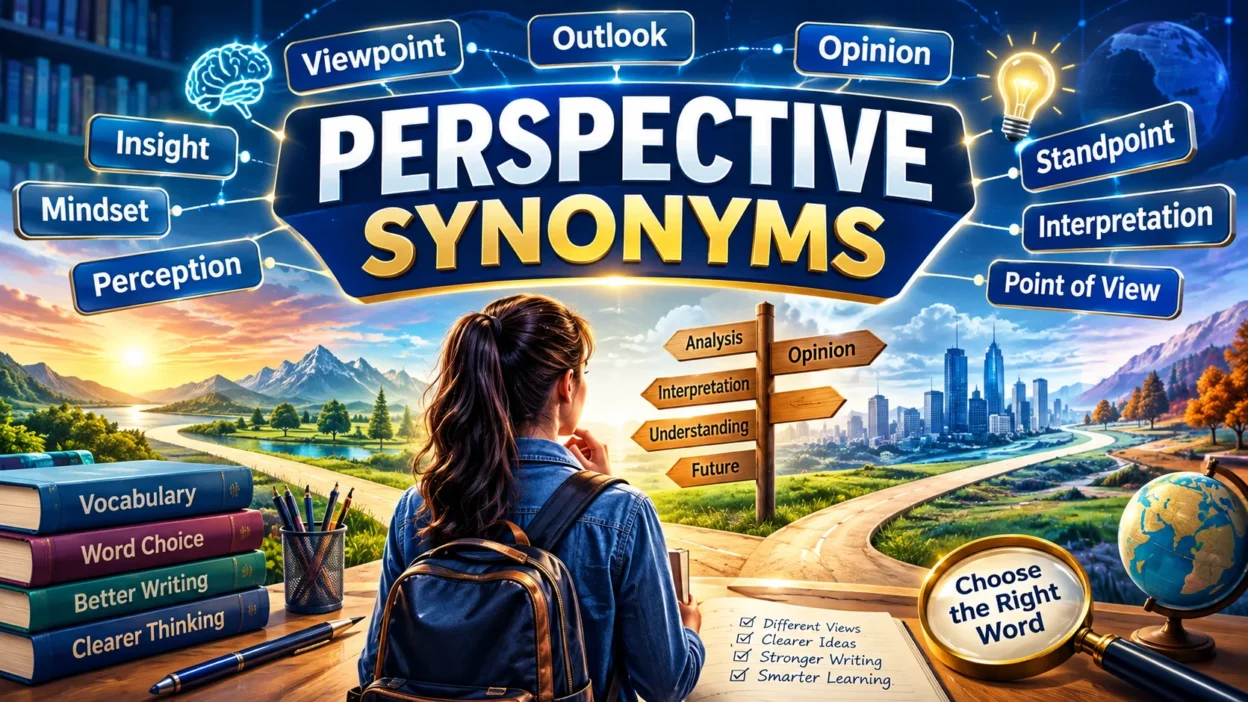
Finding the right perspective synonyms can make your writing more precise, engaging, and natural. if you are a student writing an essay, an ESL learner building vocabulary, or a content creator looking for better word choices, understanding related words helps you communicate ideas with greater clarity.
The word perspective can describe a particular way of seeing, understanding, or thinking about something. Depending on the context, you might mean a viewpoint, opinion, outlook, attitude, interpretation, or point of view. Choosing the right synonym depends on the meaning and tone you want to express.
This guide focuses specifically on useful alternatives to perspective. Each word includes a simple meaning, an example sentence, and a recommended usage context so you can confidently choose the best word for your writing.
What Does “Perspective” Mean?
Perspective means a particular way of looking at, thinking about, or understanding something.
Simple definition
Perspective: A way of seeing or understanding a person, situation, issue, or idea.
For example:
- From my perspective, the decision was reasonable.
- Traveling can give you a new perspective on life.
- The book presents the story from a child’s perspective.
The word can refer to a person’s opinion, a particular viewpoint, or a broader way of understanding a situation.
30 Perspective Synonyms
Here are 30 useful alternatives to perspective, with simple explanations and examples.
1. Viewpoint
Meaning: A particular way of thinking about or understanding something.
Example: From her viewpoint, the project was a success.
Best usage: Excellent for essays, discussions, and formal writing.
2. Point of View
Meaning: The position or opinion from which someone considers something.
Example: The novel is written from the child’s point of view.
Best usage: Common in literature, storytelling, and everyday conversation.
3. Outlook
Meaning: A person’s general attitude or way of thinking about life or the future.
Example: Her positive outlook helped her overcome the challenge.
Best usage: Best when discussing attitudes, expectations, or future possibilities.
4. View
Meaning: An opinion, belief, or way of considering something.
Example: He expressed his view during the meeting.
Best usage: Simple and natural for everyday and professional writing.
5. Opinion
Meaning: A belief or judgment about something.
Example: In my opinion, the proposal needs more research.
Best usage: Use when perspective specifically means a personal belief.
6. Standpoint
Meaning: A particular position or way of considering an issue.
Example: From a financial standpoint, the plan makes sense.
Best usage: Useful in analytical, academic, and professional writing.
7. Position
Meaning: A person’s attitude, opinion, or stance on an issue.
Example: The organization explained its position on climate policy.
Best usage: Particularly useful for debates and formal discussions.
8. Stance
Meaning: A clearly expressed attitude or opinion about an issue.
Example: The journalist took a strong stance on the matter.
Best usage: Best for arguments, debates, politics, and formal discussions.
9. Attitude
Meaning: The way someone thinks or feels about something.
Example: His attitude toward failure changed over time.
Best usage: Use when perspective involves feelings or behavior.
10. Mindset
Meaning: A person’s established way of thinking.
Example: A growth mindset can help students learn from mistakes.
Best usage: Excellent for education, psychology, business, and personal development.
11. Interpretation
Meaning: The way someone understands or explains something.
Example: Her interpretation of the poem was very different from mine.
Best usage: Ideal for literature, art, information, and ambiguous situations.
12. Understanding
Meaning: The way someone comprehends or makes sense of something.
Example: The discussion improved my understanding of the issue.
Best usage: Useful when perspective refers to comprehension.
13. Perception
Meaning: The way something is noticed, understood, or viewed by someone.
Example: The campaign changed public perception of the company.
Best usage: Strong choice for psychology, society, marketing, and public opinion.
14. Insight
Meaning: A deep or clear understanding of something.
Example: The interview provided valuable insight into the problem.
Best usage: Best when the perspective offers meaningful understanding.
15. Angle
Meaning: A particular way of approaching or considering a subject.
Example: The reporter examined the story from a different angle.
Best usage: Useful in journalism, writing, problem-solving, and discussion.
16. Lens
Meaning: A particular way of viewing or analyzing something.
Example: The author examines history through a cultural lens.
Best usage: Excellent for academic, cultural, literary, and analytical writing.
17. Approach
Meaning: A particular method or way of dealing with something.
Example: We need a different approach to solving this problem.
Best usage: Use when perspective involves a method rather than simply an opinion.
18. Frame of Reference
Meaning: The experiences, beliefs, or ideas that influence how someone understands something.
Example: Our different cultural backgrounds gave us different frames of reference.
Best usage: Useful in academic, scientific, cultural, and social contexts.
19. Worldview
Meaning: A person’s overall beliefs about life, society, and the world.
Example: Travel changed his worldview.
Best usage: Best for broad philosophical, cultural, or personal perspectives.
20. Belief
Meaning: Something a person accepts as true or considers important.
Example: Her belief in equality influenced her decisions.
Best usage: Use when perspective is based on personal convictions.
21. Judgment
Meaning: An opinion or conclusion formed after thinking about something.
Example: His judgment of the situation was based on years of experience.
Best usage: Appropriate for decisions, evaluations, and assessments.
22. Assessment
Meaning: A careful evaluation or judgment of something.
Example: The manager’s assessment of the situation was accurate.
Best usage: Best for professional, academic, and analytical contexts.
23. Evaluation
Meaning: A detailed judgment about the quality, value, or importance of something.
Example: The evaluation offered a fresh perspective on the program.
Best usage: Useful for research, education, business, and formal analysis.
24. Impression
Meaning: An idea or feeling formed about someone or something.
Example: My first impression of the city was extremely positive.
Best usage: Best when perspective comes from personal experience or observation.
25. Thought
Meaning: An idea, opinion, or consideration about something.
Example: She shared her thoughts on the new policy.
Best usage: Natural in everyday and informal writing.
26. Idea
Meaning: A thought, belief, or understanding about something.
Example: He offered an interesting idea about how the problem could be solved.
Best usage: Use when perspective refers to a particular thought or concept.
27. Concept
Meaning: A general idea or understanding of something.
Example: The concept of perspective is important in social research.
Best usage: Suitable for academic and educational contexts.
28. Vision
Meaning: A particular idea about what something could or should become.
Example: The founder shared her vision for the company’s future.
Best usage: Strong choice for goals, leadership, creativity, and future plans.
29. Viewpoint
Meaning: A specific position or way of looking at an issue.
Example: Listening to another viewpoint helped me understand the debate.
Best usage: Particularly useful when comparing different opinions.
30. Take
Meaning: A person’s particular opinion or interpretation of a subject.
Example: What’s your take on the new design?
Best usage: Informal conversations, blogs, social media, and casual writing.
Perspective Synonyms Comparison Table
| Synonym | Main Meaning | Tone | Best Context |
|---|---|---|---|
| Viewpoint | Way of seeing something | Neutral | General/academic |
| Point of view | Position or opinion | Neutral | Literature/general |
| Outlook | General attitude | Neutral | Life/future |
| Opinion | Personal belief | Neutral | Everyday/formal |
| Standpoint | Position for analysis | Formal | Academic/professional |
| Stance | Firm opinion | Formal | Debate/issues |
| Attitude | Feelings or approach | Neutral | Behavior/emotions |
| Mindset | Established way of thinking | Modern | Education/business |
| Interpretation | Explanation or understanding | Formal | Literature/analysis |
| Perception | How something is viewed | Formal | Psychology/society |
| Insight | Deep understanding | Positive | Analysis/research |
| Angle | Particular approach | Neutral | Journalism/writing |
| Lens | Analytical way of viewing | Academic | Research/culture |
| Worldview | Overall beliefs | Formal | Philosophy/culture |
| Vision | Idea of the future | Positive | Leadership/goals |
Perspective vs. Viewpoint
Perspective and viewpoint are very close in meaning, but they can have slightly different uses.
Perspective often suggests a broader way of understanding something, influenced by experience or background.
Viewpoint usually emphasizes a particular position or opinion.
For example:
- Travel gave her a new perspective on life.
- He explained his viewpoint during the debate.
Both are correct, but perspective can sound broader and more reflective.
Perspective vs. Opinion
An opinion is a belief or judgment about something.
A perspective can include an opinion but may also describe the broader way someone understands a situation.
Compare:
- My opinion is that the plan will fail.
- My perspective changed after I learned more about the problem.
The second sentence suggests a broader understanding rather than simply a single belief.
Perspective vs. Perception
These words are related but not identical.
Perception often refers to how something is noticed or understood.
Perspective refers more broadly to a way of looking at or thinking about something.
Example:
The company’s public perception improved.
Here, perception focuses on how people see the company.
The manager’s perspective was influenced by years of experience.
Here, perspective focuses on the manager’s broader way of understanding the situation.
Perspective Synonyms for Academic Writing
When writing an essay, report, or research paper, some synonyms are more appropriate than others.
Consider these choices:
- Standpoint — for a particular analytical position
- Viewpoint — for a specific opinion
- Perspective — for a broader way of understanding
- Interpretation — for explaining meaning
- Perception — for how something is viewed
- Lens — for a particular analytical framework
- Assessment — for careful evaluation
- Insight — for deeper understanding
Example:
The study provides insight into how students perceive online education.
This sounds more precise than simply repeating the word perspective.
Perspective Synonyms for Everyday English
For casual conversations, simple words usually sound more natural.
Good choices include:
- View
- Opinion
- Point of view
- Take
- Thought
- Idea
- Outlook
For example:
What’s your take on this movie?
This sounds more conversational than:
What is your standpoint on this movie?
The meaning is similar, but the tone is different.
Perspective Synonyms for Positive Writing
When you want to emphasize understanding or personal growth, choose words such as:
- Insight
- Outlook
- Vision
- Understanding
- Mindset
Example:
The experience gave me valuable insight into different cultures.
These words can make your writing sound thoughtful and constructive.
How to Choose the Right Perspective Synonym
The best synonym depends on what kind of perspective you mean.
For a Personal Opinion
Use:
- Opinion
- View
- Take
- Viewpoint
- Point of view
Example:
What is your view of the situation?
For a Firm Position
Use:
- Stance
- Position
- Standpoint
Example:
The organization clearly stated its position.
For a Way of Thinking
Use:
- Mindset
- Attitude
- Outlook
- Worldview
Example:
Her optimistic outlook helped her deal with uncertainty.
For Analysis
Use:
- Lens
- Angle
- Interpretation
- Assessment
- Evaluation
Example:
The researcher examined the issue through a historical lens.
For Deep Understanding
Use:
- Insight
- Understanding
- Perception
Example:
The conversation gave me a new insight into the problem.
For Future Goals
Use:
- Vision
- Outlook
Example:
The leader presented a clear vision for the organization.
Common Mistakes When Using Perspective Synonyms
Not every synonym can replace perspective in every sentence.
For example, vision is not usually a direct replacement when talking about someone’s opinion. Similarly, stance normally suggests a firm position, while insight suggests deeper understanding.
Always consider three things:
- Meaning — Does the synonym express the same idea?
- Tone — Is it formal, informal, academic, or conversational?
- Context — Does it fit the subject being discussed?
Choosing a synonym simply because it looks similar can make your writing sound unnatural.
Why Learning Perspective Synonyms Matters
Learning alternatives to common words can improve both vocabulary and writing quality.
For students, these words can make essays more precise and reduce repetition. ESL learners can use them to understand subtle differences in English vocabulary.
Writers and content creators can also use perspective synonyms to create more varied and engaging content. Instead of repeating perspective several times, you can select a more precise word based on your intended meaning.
For example:
The article explores the issue from a different perspective.
Could become:
The article examines the issue from a different viewpoint.
Or:
The article examines the issue through a different lens.
Each version has a slightly different tone and emphasis.
Final Thoughts on Perspective Synonyms
The best perspective synonyms are not simply words that have similar dictionary definitions. They are words that communicate the exact shade of meaning you need.
Use viewpoint or point of view for a particular way of seeing something, opinion for a personal belief, stance for a firm position, mindset for a way of thinking, perception for how something is viewed, and insight for deeper understanding.
By learning these distinctions, you can make your English more accurate, flexible, and natural. Whether you are writing an academic essay, creating online content, or improving your everyday vocabulary, choosing the right synonym can make a noticeable difference.

Alexander Eric is the Administrator of SynonymLot, dedicated to providing accurate synonyms, vocabulary resources, and language tools. He enjoys helping readers improve writing, communication, and English word knowledge daily.