
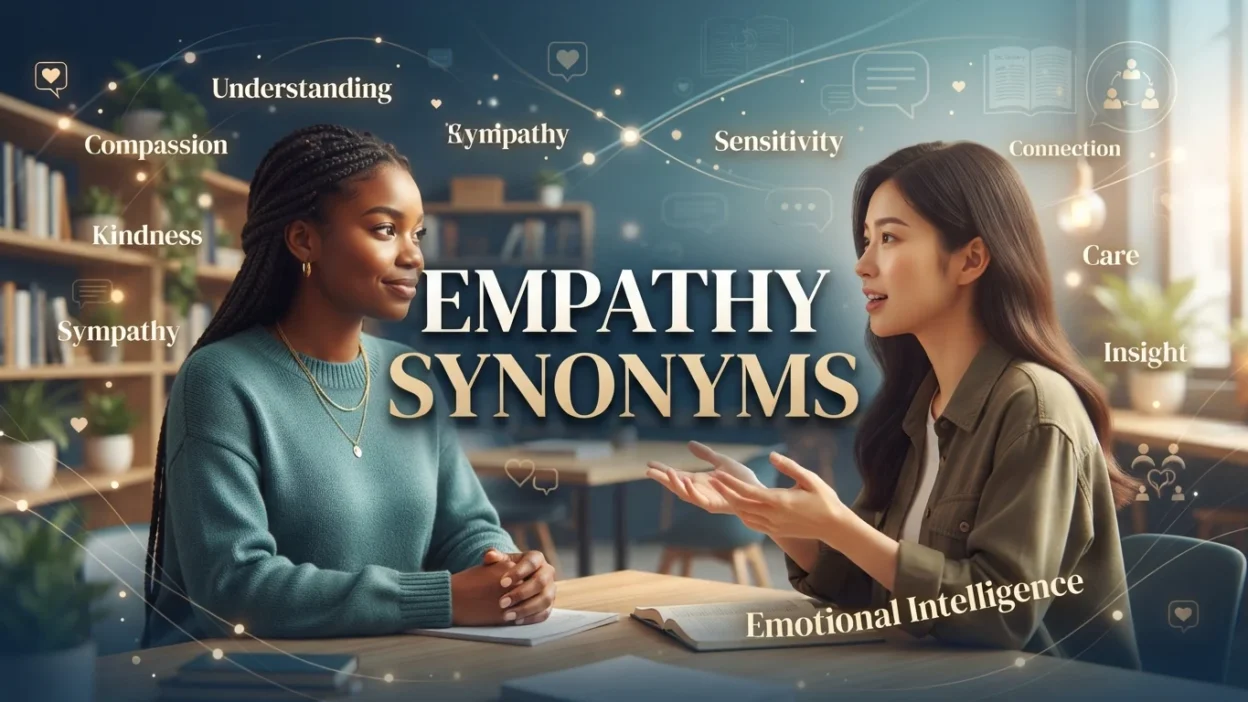
Empathy is the ability to understand another person’s feelings, experiences, or point of view. It helps us connect with others, communicate thoughtfully, and respond with kindness. Whether you are writing an essay, speaking with someone, or creating meaningful content, choosing the right word can make your message more precise.
Learning empathy synonyms can also improve your vocabulary. While words such as compassion, understanding, and sympathy are related to empathy, they do not always mean exactly the same thing. Some emphasize emotional connection, while others focus on kindness, sensitivity, or the ability to understand another person’s perspective.
What Does “Empathy” Mean?
Empathy means the ability to understand and share, or thoughtfully recognize, another person’s feelings and experiences.
In simple English, empathy is putting yourself in someone else’s situation and trying to understand how they feel.
Examples of Empathy
- A friend listens carefully when you are upset instead of immediately giving advice.
- A teacher understands that a struggling student may need extra support.
- A manager considers an employee’s concerns before making a decision.
- A writer describes a character’s emotions in a way readers can understand.
Empathy can be emotional, intellectual, or practical. You may understand what someone feels without experiencing exactly the same emotion yourself.
30 Empathy Synonyms
Here are 30 useful words and phrases related to empathy, with simple meanings, examples, and usage contexts.
1. Understanding
Meaning: The ability to recognize and appreciate another person’s feelings or situation.
Example: Her understanding helped me feel comfortable sharing my concerns.
Best usage: Everyday conversations, relationships, education, and professional communication.
2. Compassion
Meaning: Concern for someone who is suffering, often accompanied by a desire to help.
Example: The nurse treated every patient with compassion.
Best usage: Situations involving hardship, suffering, or a need for support.
3. Sympathy
Meaning: Feelings of concern or sadness for someone experiencing difficulty.
Example: We expressed our sympathy after hearing about his loss.
Best usage: Condolences, difficult situations, and emotional support.
4. Sensitivity
Meaning: Awareness of other people’s feelings and the ability to respond carefully.
Example: She handled the sensitive subject with great sensitivity.
Best usage: Emotional, cultural, social, and workplace situations.
5. Kindness
Meaning: The quality of being caring, helpful, and considerate toward others.
Example: His kindness made the new student feel welcome.
Best usage: General communication and everyday acts of care.
6. Consideration
Meaning: Thoughtful attention to another person’s feelings or needs.
Example: She showed consideration by asking whether everyone was comfortable.
Best usage: Polite, professional, and interpersonal situations.
7. Emotional Intelligence
Meaning: The ability to recognize, understand, and manage emotions in yourself and others.
Example: Strong emotional intelligence helped the manager resolve the disagreement.
Best usage: Business, leadership, education, psychology, and personal development.
8. Insight
Meaning: A deep understanding of someone’s thoughts, feelings, or situation.
Example: His insight into her concerns helped solve the problem.
Best usage: Analytical writing, psychology, literature, and thoughtful discussions.
9. Awareness
Meaning: Knowledge or recognition of another person’s feelings, needs, or experiences.
Example: Greater awareness of others can improve communication.
Best usage: Educational, social, professional, and academic writing.
10. Attentiveness
Meaning: Giving careful attention to someone or something.
Example: The counselor’s attentiveness made the student feel heard.
Best usage: Counseling, customer service, relationships, and professional settings.
11. Care
Meaning: Concern for someone’s well-being.
Example: She showed genuine care for her people neighbor.
Best usage: Personal relationships and supportive situations.
12. Concern
Meaning: A feeling that someone’s well-being or situation matters to you.
Example: His concern for his colleague was obvious.
Best usage: Formal and informal communication.
13. Thoughtfulness
Meaning: The quality of considering other people’s feelings and needs.
Example: Her thoughtfulness made everyone feel included.
Best usage: Personal relationships, writing, and social situations.
14. Humanity
Meaning: Kindness, understanding, and concern for other people.
Example: The story reminds us of our shared humanity.
Best usage: Literature, speeches, essays, and philosophical discussions.
15. Altruism
Meaning: Caring about and helping others without expecting a personal reward.
Example: His altruism inspired others to volunteer.
Best usage: Psychology, social science, charity, and academic writing.
16. Generosity
Meaning: A willingness to give time, help, resources, or support to others.
Example: Her generosity helped the community recover.
Best usage: Charity, relationships, community service, and positive descriptions.
17. Pity
Meaning: A feeling of sadness or concern for someone who is suffering.
Example: He felt pity for the injured animal.
Best usage: Situations involving suffering; use carefully because pity can sometimes sound condescending.
18. Fellow Feeling
Meaning: A shared emotional response or sense of connection with another person.
Example: Her fellow feeling helped her understand what her friend was experiencing.
Best usage: Formal, literary, and philosophical writing.
19. Rapport
Meaning: A comfortable and positive relationship in which people understand and communicate well with one another.
Example: The therapist quickly developed rapport with her client.
Best usage: Workplace communication, counseling, teaching, and relationships.
20. Solidarity
Meaning: Unity with others based on shared feelings, experiences, or goals.
Example: The workers showed solidarity with their colleagues.
Best usage: Social issues, communities, activism, and group situations.
21. Sympathy and Understanding
Meaning: A combination of concern for someone and an effort to understand their situation.
Example: She responded with sympathy and understanding.
Best usage: Supportive conversations and sensitive writing.
22. Perspective-Taking
Meaning: The ability to imagine or understand a situation from another person’s point of view.
Example: Perspective-taking helped the students resolve their disagreement.
Best usage: Psychology, education, communication, and academic writing.
23. Identification
Meaning: A feeling of connection with another person because you recognize yourself or your experiences in them.
Example: Readers often develop identification with the novel’s main character.
Best usage: Literature, psychology, and analytical writing.
24. Responsiveness
Meaning: The ability to notice another person’s needs and respond appropriately.
Example: The teacher’s responsiveness encouraged students to ask questions.
Best usage: Education, leadership, healthcare, and customer service.
25. Receptiveness
Meaning: Being open and willing to listen to another person’s thoughts or feelings.
Example: Her receptiveness made honest communication easier.
Best usage: Professional communication, relationships, and conflict resolution.
26. Validation
Meaning: Recognizing that another person’s feelings or experiences are understandable and meaningful.
Example: The counselor offered validation instead of dismissing his concerns.
Best usage: Emotional communication, counseling, relationships, and mental-health-related discussions.
27. Supportiveness
Meaning: Providing emotional or practical encouragement to someone.
Example: Her supportiveness helped the team remain confident during the difficult project.
Best usage: Friendships, workplaces, education, and teamwork.
28. Listening
Meaning: Paying close attention to what another person says and trying to understand their message.
Example: Active listening is an important part of empathetic communication.
Best usage: Communication skills, relationships, education, and leadership.
29. Understandingness
Meaning: A willingness to understand another person’s difficulties or feelings.
Example: His understandingness made it easier for employees to discuss their problems.
Best usage: Less common usage; alternatives such as understanding or compassion are usually more natural.
30. Empathic Insight
Meaning: A deep understanding of another person’s emotional experience.
Example: The writer used empathic insight to create a realistic character.
Best usage: Psychology, literature, counseling, and creative writing.
Empathy Synonyms Comparison Table
| Synonym | Main Idea | Tone | Best Context |
|---|---|---|---|
| Understanding | Recognizing another person’s situation | Neutral | Everyday use |
| Compassion | Caring about suffering and wanting to help | Warm | Healthcare, hardship |
| Sympathy | Feeling concern for someone | Caring | Loss and difficult events |
| Sensitivity | Being aware of feelings | Thoughtful | Social situations |
| Kindness | Acting in a caring way | Warm | Everyday life |
| Consideration | Thinking about others’ needs | Polite | Professional settings |
| Emotional intelligence | Understanding emotions | Professional | Leadership |
| Insight | Deep understanding | Intellectual | Academic writing |
| Awareness | Recognizing feelings or needs | Neutral | Education |
| Thoughtfulness | Considering others carefully | Warm | Relationships |
| Altruism | Helping without expecting reward | Formal | Psychology |
| Rapport | Positive interpersonal connection | Professional | Counseling and business |
| Solidarity | Unity with others | Strong | Social issues |
| Perspective-taking | Seeing another viewpoint | Academic | Education and psychology |
| Validation | Recognizing someone’s feelings | Supportive | Emotional communication |
Empathy vs. Sympathy: What Is the Difference?
Empathy and sympathy are closely related, but they are not identical.
Empathy focuses on understanding another person’s feelings or perspective.
“I can imagine how difficult that must have been for you.”
Sympathy focuses more on feeling concern or sadness for someone.
“I’m sorry you had to go through that.”
A simple way to remember the distinction is:
Empathy = understanding the experience.
Sympathy = feeling concern about the experience.
Empathy vs. Compassion
Compassion goes beyond recognizing someone’s feelings. It often includes a desire to reduce their suffering or provide help.
For example:
- Empathy: “I understand that you are frightened.”
- Compassion: “I understand that you are frightened, and I want to help.”
Both words are positive, but compassion often suggests action.
How to Choose the Right Empathy Synonym
The best synonym depends on what you want to communicate.
For Everyday Conversations
Use:
- Understanding
- Kindness
- Care
- Consideration
- Sensitivity
These words sound natural and are easy to understand.
For Emotional Support
Use:
- Compassion
- Sympathy
- Validation
- Supportiveness
- Concern
These choices work well when someone is experiencing sadness, stress, loss, or difficulty.
For Academic Writing
Use:
- Perspective-taking
- Emotional intelligence
- Insight
- Awareness
- Identification
These terms are particularly useful in psychology, education, communication, and literary analysis.
For Professional Communication
Use:
- Consideration
- Responsiveness
- Emotional intelligence
- Receptiveness
- Rapport
These words can describe effective communication and positive workplace relationships.
For Literature and Creative Writing
Use:
- Insight
- Identification
- Humanity
- Empathic insight
- Perspective-taking
These terms can help explain how writers create believable characters and emotional connections with readers.
Why Learning Empathy Synonyms Matters
Having a wider vocabulary allows you to express emotional ideas more precisely.
For example, saying someone is kind tells us they behave in a caring way. Calling someone compassionate suggests that they care about suffering and may want to help. Saying someone has emotional intelligence highlights their ability to recognize and manage emotions.
This distinction is especially useful for students and ESL learners because similar words can have different tones and contexts.
Writers can also use these alternatives to avoid repetition. Instead of repeatedly using empathy, a writer might choose understanding, compassion, perspective-taking, or sensitivity, depending on the exact meaning.
Common Mistakes When Using Empathy Synonyms
1. Treating Every Synonym as Identical
Related words often have slightly different meanings. Sympathy, for example, is not exactly the same as empathy.
2. Using “Pity” as a Perfect Replacement
Pity can suggest looking down on someone, while empathy usually implies emotional understanding and respect. Therefore, they are not interchangeable in every sentence.
3. Using Formal Words in Casual Situations
Words such as altruism and perspective-taking can sound academic. In everyday conversation, understanding or care may sound more natural.
4. Ignoring Context
Always consider the situation, audience, and tone before choosing a synonym.
Frequently Asked Questions About Empathy Synonyms
What is the best synonym for empathy?
Understanding is one of the closest everyday alternatives, while compassion, sympathy, and perspective-taking may be better depending on the context.
What is a stronger word for empathy?
Compassion can be stronger when you want to emphasize both emotional understanding and a desire to help.
What is a simple word for empathy?
A simple word is understanding. It is easy for ESL learners and works in many everyday situations.
Is sympathy the same as empathy?
No. Sympathy generally means feeling concern for someone, while empathy involves understanding or sharing their emotional perspective.
What is the opposite of empathy?
Depending on the context, possible opposites include indifference, insensitivity, apathy, and lack of understanding.
What is empathy in simple English?
Empathy means trying to understand how another person feels or sees a situation.
Final Thoughts on Empathy Synonyms
Understanding empathy synonyms can make your vocabulary more accurate, expressive, and flexible. Words such as understanding, compassion, sympathy, sensitivity, kindness, emotional intelligence, and perspective-taking all connect to empathy, but each carries its own shade of meaning.
The key is to choose a word that matches your intended tone and context. For everyday communication, understanding and kindness are natural choices. For emotional support, compassion and validation may work better. In academic or professional writing, terms such as emotional intelligence, perspective-taking, and rapport can provide greater precision.
By learning these distinctions, students, ESL learners, writers, and content creators can communicate emotions and human relationships more clearly and effectively.

Daniel Jack is a language enthusiast and content writer who specializes in synonyms, vocabulary, and word meanings. He creates clear, engaging resources that help readers improve communication and expand their English skills.