
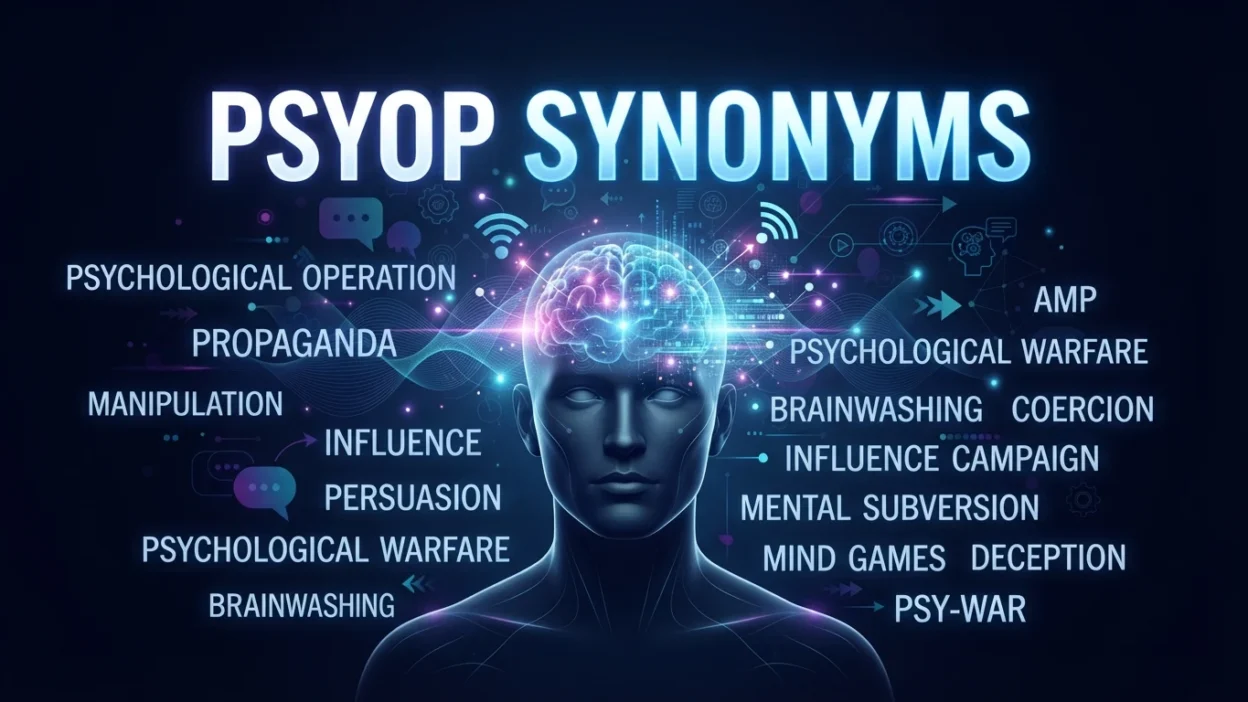
The term psyop is often used in military discussions, politics, media, online communities, and everyday conversations. But what does it actually mean, and what words can be used instead of “psyop”? Understanding psyop synonyms can help you communicate more clearly and choose vocabulary that matches the exact situation.
A psyop is short for psychological operation. In simple terms, it refers to a planned effort to influence how people think, feel, or behave. Depending on the context, a psyop may involve communication, information, persuasion, propaganda, or other techniques designed to affect an audience.
This guide explains the meaning of psyop, provides 30 useful synonyms and related terms, and shows how their meanings differ. These alternatives are not always perfect replacements because some are broader, more negative, or more specific than “psyop.”
What Does Psyop Mean?
Psyop is an informal shortened form of psychological operation. It generally describes an organized attempt to influence a target audience’s emotions, beliefs, attitudes, decisions, or behavior.
The word is especially associated with military and intelligence contexts, where psychological operations may be designed to influence an opposing force or civilian population.
In modern informal English, however, psyop is also frequently used online to describe something that people believe is deliberately designed to manipulate public opinion.
Simple Definition of Psyop
Psyop: A planned action or communication intended to influence people’s thoughts, feelings, beliefs, or behavior.
Example Sentence
“Some people believed the confusing social media campaign was a psyop designed to influence public opinion.”
The word can be neutral in a technical context, but in everyday online language, psyop often has a suspicious or negative tone.
30 Psyop Synonyms and Related Words
Not every word below is an exact synonym. Some are close alternatives, while others describe specific methods or broader concepts associated with psychological operations.
1. Psychological operation
Meaning: An organized effort to influence people’s thoughts, feelings, or behavior.
Example: “The military conducted a psychological operation to influence enemy morale.”
Best usage: Formal, military, academic, or professional writing.
2. Psychological warfare
Meaning: The use of psychological methods to weaken or influence an opponent.
Example: “The campaign was described as a form of psychological warfare.”
Best usage: Military and conflict-related contexts.
3. Propaganda
Meaning: Information or ideas spread to influence people’s opinions or beliefs, often for a political purpose.
Example: “The government was accused of spreading propaganda.”
Best usage: Political, historical, media, and social discussions.
4. Manipulation
Meaning: An attempt to control someone’s thoughts, feelings, or actions, often unfairly.
Example: “The advertisement relied on emotional manipulation.”
Best usage: General situations where influence feels deceptive or unfair.
5. Influence campaign
Meaning: An organized effort to affect public opinion or behavior.
Example: “Researchers discovered an online influence campaign.”
Best usage: Politics, social media, public relations, and journalism.
6. Information operation
Meaning: A planned effort involving information to influence an audience or situation.
Example: “The report examined a large-scale information operation.”
Best usage: Military, government, cybersecurity, and academic contexts.
7. Persuasion campaign
Meaning: An organized attempt to convince people to accept an idea or take an action.
Example: “The organization launched a persuasion campaign to increase public support.”
Best usage: Neutral and general communication.
8. Disinformation campaign
Meaning: A coordinated effort to spread false or misleading information deliberately.
Example: “Officials investigated a suspected disinformation campaign.”
Best usage: News, politics, social media, and information security.
9. Misinformation campaign
Meaning: A campaign involving false or inaccurate information, although the intent to deceive may not always be established.
Example: “The false claims spread quickly during the misinformation campaign.”
Best usage: Media literacy and online information discussions.
10. Mind games
Meaning: Actions intended to confuse, pressure, or psychologically influence someone.
Example: “The negotiations included several psychological mind games.”
Best usage: Informal conversations and casual writing.
11. Psychological manipulation
Meaning: Using psychological techniques to control or influence another person’s thinking or behavior.
Example: “The article described several forms of psychological manipulation.”
Best usage: Psychology, relationships, media, and general discussions.
12. Deception
Meaning: The act of deliberately making someone believe something that is not true.
Example: “The strategy depended heavily on deception.”
Best usage: Situations involving misleading information or behavior.
13. Persuasion
Meaning: The process of convincing someone to believe or do something.
Example: “Effective persuasion can change how people view an issue.”
Best usage: Neutral contexts, education, advertising, and communication.
14. Coercion
Meaning: Forcing someone to act through threats, pressure, or intimidation.
Example: “The agreement was criticized because of alleged coercion.”
Best usage: Situations involving force or severe pressure.
15. Psychological strategy
Meaning: A planned approach that uses psychological principles to influence people.
Example: “The team developed a psychological strategy for the negotiation.”
Best usage: Neutral and professional contexts.
16. Influence operation
Meaning: An organized effort intended to affect people’s opinions or behavior.
Example: “The investigation focused on a foreign influence operation.”
Best usage: Politics, intelligence, journalism, and international affairs.
17. Influence tactic
Meaning: A specific method used to influence someone’s thoughts or actions.
Example: “Creating urgency is a common influence tactic in advertising.”
Best usage: Marketing, psychology, communication, and business.
18. Psychological tactic
Meaning: A deliberate technique designed to produce a psychological effect.
Example: “The negotiator used a psychological tactic to gain attention.”
Best usage: Negotiations, communication, games, and strategy.
19. Persuasive messaging
Meaning: Communication specifically designed to convince an audience.
Example: “The campaign used persuasive messaging to attract younger voters.”
Best usage: Marketing, politics, public relations, and media.
20. Strategic communication
Meaning: Planned communication designed to achieve a particular goal.
Example: “The organization used strategic communication during the crisis.”
Best usage: Professional, corporate, government, and academic writing.
21. Propaganda campaign
Meaning: An organized effort to spread persuasive information or ideas, usually to shape public opinion.
Example: “The historical documentary examined a wartime propaganda campaign.”
Best usage: History, politics, war, and media analysis.
22. Public opinion campaign
Meaning: An organized effort to change or strengthen people’s views about an issue.
Example: “The group began a public opinion campaign before the election.”
Best usage: Politics, advocacy, public relations, and social issues.
23. Psychological influence
Meaning: The effect that something has on a person’s thoughts, emotions, or behavior.
Example: “The study explored the psychological influence of advertising.”
Best usage: Academic and general discussions.
24. Social manipulation
Meaning: Influencing people or groups in a deceptive or unfair way.
Example: “The researchers studied social manipulation on online platforms.”
Best usage: Social media, psychology, and online communities.
25. Narrative manipulation
Meaning: Deliberately shaping a story or interpretation to influence how people understand an issue.
Example: “Critics accused the organization of narrative manipulation.”
Best usage: Journalism, politics, social media, and cultural analysis.
26. Perception management
Meaning: An organized effort to influence how people perceive a person, organization, event, or issue.
Example: “The company used perception management during the public relations crisis.”
Best usage: Public relations, politics, business, and communications.
27. Brainwashing
Meaning: An informal term for extreme attempts to change someone’s beliefs or attitudes through psychological pressure.
Example: “The movie portrayed the character as a victim of brainwashing.”
Best usage: Informal or dramatic contexts; avoid using it as a precise technical synonym.
28. Mind manipulation
Meaning: An informal expression for attempts to control or strongly influence someone’s thinking.
Example: “The story focuses on mind manipulation and psychological control.”
Best usage: Informal writing, fiction, entertainment, and general discussions.
29. Psychological influence campaign
Meaning: A coordinated campaign designed to affect how an audience thinks or behaves.
Example: “The researchers investigated a psychological influence campaign online.”
Best usage: Formal explanations when you want to emphasize psychological influence.
30. Information warfare
Meaning: Strategic use of information and communication to gain an advantage over an opponent.
Example: “The report discussed the role of information warfare in modern conflicts.”
Best usage: Military, geopolitical, cybersecurity, and academic contexts.
Psyop Synonyms Comparison Guide
Choosing the right synonym depends on what you mean by psyop. Some alternatives are neutral, while others strongly suggest deception or wrongdoing.
| Term | Main Idea | Tone | Best Context |
|---|---|---|---|
| Psyop | Planned psychological influence | Informal/neutral | Military, online discussions |
| Psychological operation | Organized psychological influence | Formal | Military, academic |
| Propaganda | Persuasive information | Often negative | Politics, history |
| Manipulation | Unfair psychological influence | Negative | General use |
| Persuasion | Convincing someone | Neutral | Communication, marketing |
| Disinformation | Deliberately false information | Negative | Politics, media |
| Influence campaign | Organized influence | Neutral | Politics, social media |
| Psychological warfare | Psychological conflict | Serious | Military |
| Deception | Deliberately misleading someone | Negative | Strategy, conflict |
| Information warfare | Strategic use of information | Serious | Military, geopolitical |
Psyop vs. Propaganda
Psyop and propaganda are closely related, but they are not always interchangeable.
A psyop generally refers to a planned psychological operation intended to influence a target audience. Propaganda focuses more specifically on information, messages, images, or ideas used to shape opinions.
For example, a military psychological operation might use propaganda as one of its communication methods.
Simple difference:
- Psyop: The broader psychological operation or strategy.
- Propaganda: Persuasive information used to influence beliefs or opinions.
Psyop vs. Manipulation
The word manipulation usually has a more negative meaning.
If someone says, “This is a psyop,” they may be suggesting that an event or message was deliberately created to influence people. If they say, “This is manipulation,” they are more directly suggesting that the influence is deceptive or unfair.
Use manipulation when the negative or deceptive aspect is important.
Psyop vs. Disinformation
Disinformation specifically involves false or misleading information that is deliberately spread.
A psyop does not necessarily have to contain false information. It can involve truthful information, selective messaging, emotional appeals, or other forms of communication.
Therefore, disinformation campaign is more specific than psyop.
Psyop vs. Persuasion
Persuasion is usually neutral. It means trying to convince someone to think or do something.
For example, a teacher persuading students to study harder is not normally described as a psyop.
A psyop generally suggests a more deliberate, strategic, or organized attempt to influence a target audience.
How to Choose the Right Psyop Synonym
For Formal or Academic Writing
Choose:
- Psychological operation
- Information operation
- Strategic communication
- Psychological influence
- Influence operation
These terms sound more precise and professional.
For Military Contexts
Choose:
- Psychological warfare
- Psychological operation
- Information warfare
- Information operation
- Influence operation
These terms work well when discussing military strategy or conflict.
For Political Contexts
Choose:
- Propaganda
- Influence campaign
- Disinformation campaign
- Public opinion campaign
- Perception management
The best choice depends on whether the focus is persuasion, false information, or public perception.
For Negative or Critical Situations
Choose:
- Manipulation
- Psychological manipulation
- Deception
- Social manipulation
- Narrative manipulation
These terms make the critical or suspicious meaning clearer.
For Neutral Situations
Choose:
- Persuasion
- Influence
- Influence campaign
- Strategic communication
- Psychological strategy
These words do not automatically imply dishonest behavior.
For Casual or Online Language
Choose:
- Psyop
- Mind games
- Mind manipulation
- Manipulation
- Psychological tactic
These expressions are more natural in informal conversations and online discussions.
What Is the Best Synonym for Psyop?
There is no single perfect synonym because the best word depends on the context.
If you need a formal synonym, use psychological operation.
If you mean organized attempts to influence public opinion, influence campaign may be better.
If false information is deliberately being spread, disinformation campaign is more precise.
If the situation involves deceptive psychological control, manipulation or psychological manipulation may be appropriate.
If the context involves military conflict, psychological warfare can be a strong alternative.
Common Questions About Psyop Synonyms
What is the simplest synonym for psyop?
A simple synonym for psyop is psychological operation. In less formal language, words such as manipulation, influence, or mind games may describe related ideas.
Is propaganda a synonym for psyop?
Propaganda can be part of a psyop, but the two terms are not always identical. A psyop is a broader psychological strategy, while propaganda generally refers to persuasive information used to influence opinions.
Is manipulation the same as a psyop?
Not exactly. Manipulation describes influencing someone, usually in a deceptive or unfair way. A psyop can involve manipulation but may also use other forms of psychological influence.
What is another word for psychological operation?
Possible alternatives include psychological warfare, information operation, influence operation, psychological strategy, and influence campaign, depending on the context.
Is psyop a formal word?
“Psyop” is widely used as an informal abbreviation of “psychological operation.” For formal academic or professional writing, psychological operation is usually the clearer choice.
What does psyop mean in social media?
On social media, psyop is often used informally to suggest that a post, trend, story, campaign, or event was deliberately created or promoted to influence people’s opinions or behavior. Online usage can be broader and more speculative than the formal military meaning.
Final Thoughts
Understanding psyop synonyms is useful because the word can have different meanings depending on context. A military document, academic article, political discussion, and social media post may all use different vocabulary to describe psychological influence.
The most important alternatives include psychological operation, psychological warfare, propaganda, manipulation, influence campaign, information operation, disinformation campaign, persuasion, and perception management.
When choosing a synonym, think about the exact idea you want to communicate. Use psychological operation for formal precision, propaganda for persuasive messaging, disinformation for deliberate false information, manipulation for deceptive influence, and persuasion when the meaning is neutral.
Using the right synonym makes your writing clearer, more accurate, and easier for readers to understand.

David Henry is a language enthusiast and content writer specializing in synonyms, vocabulary, and word meanings. He creates clear, engaging resources that help readers improve their writing, communication, and English skills.