Dopamine is a word we often hear in conversations about happiness, motivation, rewards, focus, and the brain. But what does dopamine actually mean, and what words can you use instead when writing or explaining the concept?
If you are a student, ESL learner, writer, blogger, or content creator, understanding dopamine synonyms can help you describe this important brain chemical more naturally. However, it is important to know that dopamine does not have many exact synonyms because it is the scientific name of a specific neurotransmitter.
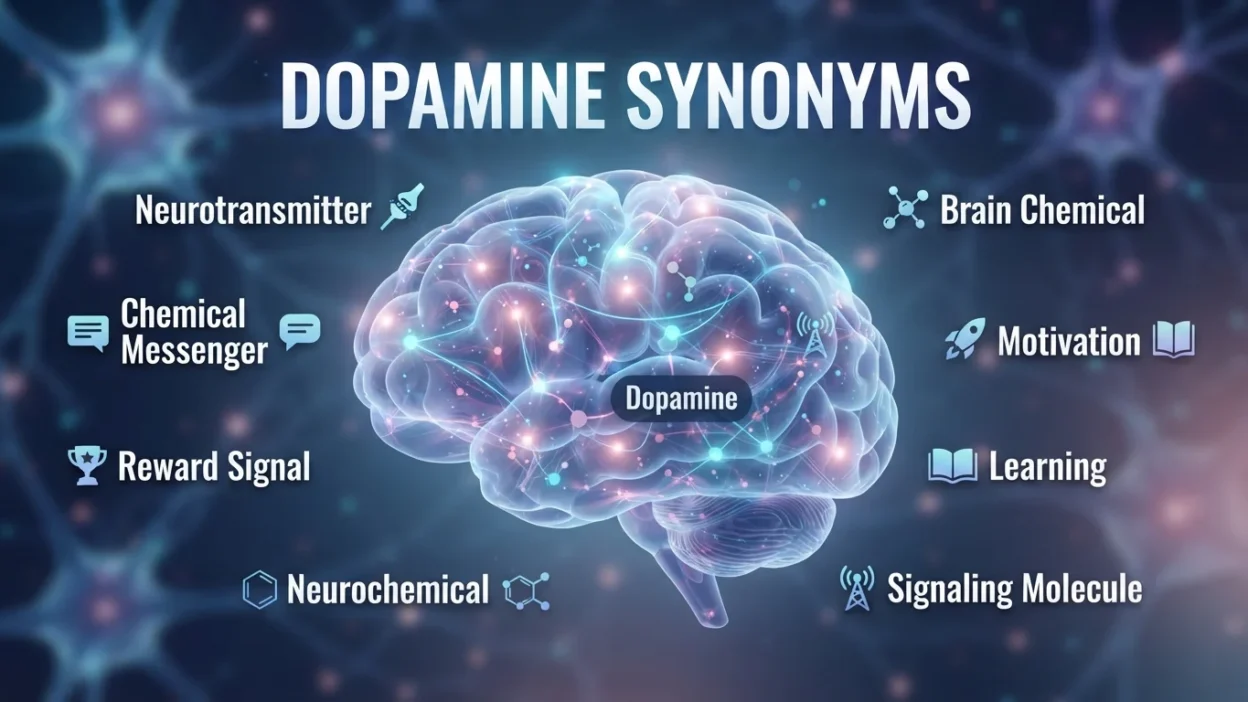
Instead, writers often use related words and phrases such as neurotransmitter, brain chemical, reward chemical, motivation chemical, pleasure-related chemical, and signaling molecule. Each term highlights a slightly different aspect of dopamine.
What Is Dopamine?
Dopamine is a chemical messenger called a neurotransmitter. It helps nerve cells communicate with each other and plays important roles in motivation, learning, movement, attention, mood, and the brain’s reward system.
In simple English, dopamine can be described as a brain chemical involved in motivation, reward, learning, and movement.
Dopamine is not simply the “happiness chemical,” as it is sometimes described online. Its functions are much broader and more complex. For example, dopamine can be involved when you expect a reward, work toward a goal, learn something new, or respond to an important experience.
Quick Answer: What Are Dopamine Synonyms?
There is no perfect everyday synonym for dopamine because it is the specific name of a neurotransmitter. However, depending on context, useful related terms include:
- Neurotransmitter
- Brain chemical
- Chemical messenger
- Signaling molecule
- Neural messenger
- Reward-related chemical
- Motivation-related chemical
- Reward signal
- Brain signaling chemical
- Neuromodulator
- Catecholamine
- Monoamine
- Neurochemical
- Chemical signal
- Neural signal
- Brain messenger
- Motivational signal
- Reward messenger
- Learning signal
- Reinforcement signal
- Pleasure-related chemical
- Attention-related chemical
- Movement-related neurotransmitter
- Behavioral signal
- Neural signaling molecule
- Brain reward signal
- Motivation messenger
- Dopaminergic signal
- Dopaminergic neurotransmitter
- Dopamine signaling
30 Dopamine Synonyms and Related Terms
1. Neurotransmitter
Meaning: A chemical that carries messages between nerve cells.
Example: Dopamine is an important neurotransmitter involved in several brain functions.
Best usage: Use this in scientific, educational, and medical writing.
2. Brain Chemical
Meaning: A simple, informal term for a chemical substance that works in the brain.
Example: Dopamine is often described as an important brain chemical.
Best usage: Good for general audiences and beginner-friendly content.
3. Chemical Messenger
Meaning: A chemical that carries information from one cell to another.
Example: Dopamine acts as a chemical messenger in the nervous system.
Best usage: Useful when explaining dopamine to students or ESL learners.
4. Signaling Molecule
Meaning: A molecule that helps cells communicate and respond to information.
Example: Dopamine functions as a signaling molecule in the brain.
Best usage: Best for biology, science, and academic contexts.
5. Neural Messenger
Meaning: A substance that helps nerve cells communicate.
Example: Dopamine is a neural messenger that influences several brain processes.
Best usage: Useful in educational explanations.
6. Neurochemical
Meaning: A chemical involved in the activity or communication of the nervous system.
Example: Dopamine is a well-known neurochemical.
Best usage: Appropriate for scientific and health-related writing.
7. Neuromodulator
Meaning: A chemical that changes how nerve cells communicate and respond.
Example: Dopamine can act as a neuromodulator in different brain pathways.
Best usage: Best for advanced scientific or academic writing.
8. Catecholamine
Meaning: A type of chemical messenger that includes dopamine, norepinephrine, and epinephrine.
Example: Dopamine belongs to a group of chemicals called catecholamines.
Best usage: Use this in biology, neuroscience, and medical contexts.
9. Monoamine
Meaning: A class of neurotransmitters that contain a particular chemical structure.
Example: Dopamine is a monoamine neurotransmitter.
Best usage: Suitable for scientific and university-level writing.
10. Chemical Signal
Meaning: A chemical message used by cells to communicate.
Example: Dopamine can serve as a chemical signal between neurons.
Best usage: Good for simple science explanations.
11. Neural Signal
Meaning: Information transmitted through the nervous system.
Example: Dopamine signaling can influence how the brain responds to important experiences.
Best usage: Useful when discussing brain communication.
12. Brain Messenger
Meaning: An informal way to describe a chemical that carries information in the brain.
Example: Dopamine works as a brain messenger involved in motivation and learning.
Best usage: Best for blogs, educational articles, and general audiences.
13. Reward Signal
Meaning: A signal associated with recognizing or responding to rewarding experiences.
Example: Dopamine signaling can help the brain learn from rewarding experiences.
Best usage: Useful in discussions about motivation and reward.
14. Reward-Related Chemical
Meaning: A simple phrase describing dopamine’s involvement in reward-related brain processes.
Example: Dopamine is often discussed as a reward-related chemical.
Best usage: Use carefully in popular writing because dopamine has many functions beyond reward.
15. Motivation-Related Chemical
Meaning: A phrase emphasizing dopamine’s role in motivation and goal-directed behavior.
Example: Dopamine is involved in motivation-related brain processes.
Best usage: Useful for articles about motivation, goals, habits, and behavior.
16. Motivational Signal
Meaning: A signal that contributes to motivation or goal-directed behavior.
Example: Dopamine signaling can influence motivational behavior.
Best usage: Good for psychology and neuroscience discussions.
17. Motivation Messenger
Meaning: An informal phrase highlighting dopamine’s connection with motivation.
Example: Some popular articles call dopamine a motivation messenger.
Best usage: Suitable for simple, nontechnical explanations.
18. Reward Messenger
Meaning: An informal phrase emphasizing dopamine’s role in reward-related signaling.
Example: Dopamine can act as part of the brain’s reward messenger system.
Best usage: Good for beginner-level explanations, but not an exact scientific synonym.
19. Learning Signal
Meaning: A signal that helps the brain respond to experiences and update behavior.
Example: Dopamine signaling can contribute to learning from rewards and mistakes.
Best usage: Useful in psychology, neuroscience, and educational writing.
20. Reinforcement Signal
Meaning: A signal associated with learning whether a behavior should become more or less likely.
Example: Dopamine is involved in neural processes related to reinforcement learning.
Best usage: Best for psychology and neuroscience contexts.
21. Pleasure-Related Chemical
Meaning: An informal phrase connecting dopamine with pleasure-related experiences.
Example: Dopamine is sometimes called a pleasure-related chemical.
Best usage: Use for general audiences, but avoid presenting it as a complete definition.
22. Attention-Related Chemical
Meaning: A phrase highlighting dopamine’s involvement in attention and cognitive processes.
Example: Dopamine plays a role in brain systems involved in attention.
Best usage: Useful when discussing concentration, attention, or cognition.
23. Movement-Related Neurotransmitter
Meaning: A term emphasizing dopamine’s important role in movement.
Example: Dopamine is a movement-related neurotransmitter involved in motor control.
Best usage: Appropriate for neuroscience and medical explanations.
24. Behavioral Signal
Meaning: A signal associated with processes that influence behavior.
Example: Dopamine signaling can affect behavioral responses to rewards.
Best usage: Useful in psychology and behavioral science.
25. Neural Signaling Molecule
Meaning: A molecule involved in communication between nerve cells.
Example: Dopamine is a neural signaling molecule with many functions in the nervous system.
Best usage: Good for scientific and educational writing.
26. Brain Reward Signal
Meaning: An informal phrase referring to dopamine’s involvement in reward-related brain activity.
Example: Dopamine contributes to brain reward signaling.
Best usage: Useful for articles about habits, motivation, and behavioral science.
27. Dopaminergic Signal
Meaning: A signal involving dopamine or dopamine-producing neurons.
Example: Dopaminergic signals can influence motivation and learning.
Best usage: Best for advanced neuroscience writing.
28. Dopaminergic Neurotransmitter
Meaning: A phrase identifying dopamine as the neurotransmitter involved in dopaminergic signaling.
Example: Dopamine is the primary dopaminergic neurotransmitter in the brain.
Best usage: Suitable for technical scientific contexts.
29. Dopamine Signaling
Meaning: The process through which dopamine communicates information in the nervous system.
Example: Dopamine signaling plays an important role in learning and movement.
Best usage: Excellent for neuroscience, biology, and research-based writing.
30. Dopamine Messenger
Meaning: A simple phrase describing dopamine as a chemical messenger.
Example: Dopamine acts as a dopamine messenger between neurons and brain regions.
Best usage: Better as an explanatory phrase than as a formal scientific synonym.
Dopamine Synonyms: Comparison Guide
Not every synonym or related term works in every situation. The best choice depends on what you want to emphasize.
| Term | Main Focus | Tone | Best Context |
|---|---|---|---|
| Neurotransmitter | Brain communication | Scientific | Biology |
| Brain chemical | General meaning | Simple | Blogs, ESL |
| Chemical messenger | Cell communication | Neutral | Education |
| Signaling molecule | Cellular signaling | Scientific | Academic writing |
| Neurochemical | Nervous system chemistry | Scientific | Health/science |
| Neuromodulator | Regulation of neural activity | Advanced | Neuroscience |
| Catecholamine | Chemical classification | Technical | Biology |
| Monoamine | Chemical classification | Technical | Science |
| Reward signal | Reward processing | Accessible | Psychology |
| Motivation-related chemical | Motivation | Informal | General content |
| Learning signal | Learning | Educational | Psychology |
| Reinforcement signal | Behavioral learning | Technical | Neuroscience |
| Pleasure-related chemical | Pleasure | Popular | General audiences |
| Dopaminergic signal | Dopamine pathways | Advanced | Neuroscience |
| Dopamine signaling | Dopamine communication | Scientific | Research |
How to Choose the Right Dopamine Synonym
Choosing the right term depends on your audience and your purpose. A scientific paper needs different vocabulary from a casual blog post.
For Students
Use simple terms such as:
- Brain chemical
- Neurotransmitter
- Chemical messenger
- Neurochemical
- Signaling molecule
These words make scientific explanations easier to understand without losing the main idea.
For ESL Learners
If English is not your first language, start with brain chemical or chemical messenger. These phrases are easier to understand than technical terms such as neuromodulator or catecholamine.
For example:
Dopamine is a chemical messenger that helps brain cells communicate.
This sentence is simple, natural, and easy to remember.
For Academic Writing
Academic and scientific writing benefits from precise terminology. Consider:
- Neurotransmitter
- Neuromodulator
- Catecholamine
- Monoamine
- Signaling molecule
- Dopamine signaling
- Dopaminergic signal
These terms provide greater scientific accuracy than informal expressions such as “pleasure chemical.”
For Blog Posts
Blog writers can use accessible phrases such as:
- Brain chemical
- Chemical messenger
- Reward signal
- Motivation-related chemical
- Learning signal
- Brain reward signal
These terms are easier for general readers while still explaining the subject clearly.
For Content About Motivation
When discussing goals, habits, or motivation, terms such as motivation-related chemical, motivational signal, and reward signal may fit naturally.
However, avoid suggesting that dopamine is simply a “motivation chemical.” Dopamine has multiple functions in the nervous system.
For Content About Pleasure
The phrase pleasure-related chemical may be familiar to general readers, but it should be used carefully.
Dopamine is often associated with pleasure in popular discussions, but its biological role is more complicated than simply creating happiness or pleasure.
Are “Dopamine” and “Neurotransmitter” Synonyms?
Not exactly.
Dopamine is the name of a specific chemical. Neurotransmitter is a category describing chemicals that transmit signals between nerve cells.
Therefore, dopamine is a neurotransmitter, but not every neurotransmitter is dopamine.
For example, serotonin and dopamine are both neurotransmitters, but they are different chemicals with different functions.
Is “Brain Chemical” a Synonym for Dopamine?
“Brain chemical” can be used as a simple descriptive phrase for dopamine, but it is not an exact scientific synonym.
The phrase is useful because it helps beginners understand the basic idea. However, in scientific writing, neurotransmitter or neurochemical is usually more precise.
Is Dopamine the “Happiness Chemical”?
This is a common popular description, but it is an oversimplification.
Dopamine is involved in several brain functions, including motivation, reward processing, learning, attention, and movement. It should not be treated as a chemical that simply produces happiness.
For accurate writing, phrases such as neurotransmitter, chemical messenger, or dopamine signaling are generally better choices.
Dopamine Synonyms by Tone
Simple and Beginner-Friendly
- Brain chemical
- Brain messenger
- Chemical messenger
- Chemical signal
- Neural messenger
Scientific and Academic
- Neurotransmitter
- Neurochemical
- Neuromodulator
- Catecholamine
- Monoamine
- Signaling molecule
- Neural signaling molecule
Motivation and Reward
- Reward signal
- Motivational signal
- Motivation-related chemical
- Reward messenger
- Brain reward signal
- Reinforcement signal
Learning and Behavior
- Learning signal
- Behavioral signal
- Reinforcement signal
- Dopaminergic signal
- Dopamine signaling
Popular or Informal
- Pleasure-related chemical
- Brain chemical
- Motivation messenger
- Reward-related chemical
Why Understanding Dopamine Vocabulary Matters
Learning different terms for dopamine can improve your vocabulary and make your writing more precise.
For example, repeating “dopamine” in every sentence can make an article sound repetitive. Using related terms can improve readability while allowing you to explain different aspects of the concept.
Compare these sentences:
Repetitive:
Dopamine is a neurotransmitter. Dopamine affects motivation. Dopamine also affects learning.
More varied:
Dopamine is an important neurotransmitter. This chemical messenger is involved in motivation and learning, while dopamine signaling also contributes to other brain processes.
The second version sounds more natural while maintaining the central meaning.
Common Mistakes When Using Dopamine Synonyms
Mistake 1: Treating Every Related Term as an Exact Synonym
Terms such as neurotransmitter, catecholamine, and monoamine describe categories or characteristics rather than replacing the word dopamine in every sentence.
Mistake 2: Calling Dopamine Only a Pleasure Chemical
Dopamine has many functions. Describing it only in terms of pleasure can give readers an incomplete understanding.
Mistake 3: Using Technical Terms in Simple Content
Words such as neuromodulator and dopaminergic may confuse beginners. Use simpler language when your audience does not have a scientific background.
Mistake 4: Overusing “Brain Chemical”
Although “brain chemical” is easy to understand, repeating it too often can make writing sound vague. Mix simple terms with more precise vocabulary when appropriate.
Frequently Asked Questions About Dopamine Synonyms
What is the closest synonym for dopamine?
There is no perfect synonym for dopamine because it is the specific name of a chemical. Neurotransmitter, neurochemical, and chemical messenger are useful related terms.
What is another word for dopamine?
Depending on the context, you can use phrases such as neurotransmitter, brain chemical, chemical messenger, neurochemical, or signaling molecule. These are related descriptions rather than exact synonyms.
What is dopamine in simple English?
Dopamine is a chemical messenger in the nervous system that helps nerve cells communicate and is involved in motivation, learning, movement, attention, and reward-related processes.
Is dopamine a neurotransmitter?
Yes. Dopamine is a neurotransmitter, meaning it is a chemical messenger used by nerve cells to communicate.
What is a simple synonym for dopamine?
For a beginner-friendly explanation, brain chemical or chemical messenger can be used as simple descriptive alternatives.
Is dopamine the same as serotonin?
No. Dopamine and serotonin are different neurotransmitters. Both are involved in brain function, but they have different biological roles and pathways.
Can I use “reward chemical” instead of dopamine?
You can use “reward-related chemical” in popular or explanatory writing, but it is not an exact synonym. Dopamine has functions beyond reward processing.
Final Thoughts on Dopamine Synonyms
Understanding dopamine synonyms requires a little more care than learning ordinary vocabulary synonyms. Dopamine is the specific name of a neurotransmitter, so most alternatives are actually related scientific terms or descriptive phrases.
For simple writing, brain chemical, chemical messenger, and neurochemical are useful choices. For academic writing, neurotransmitter, neuromodulator, catecholamine, monoamine, and dopamine signaling provide greater precision.
The key is to choose vocabulary based on your audience and meaning. When you use the right term, your writing becomes clearer, more natural, and more scientifically accurate.

David Henry is a language enthusiast and content writer specializing in synonyms, vocabulary, and word meanings. He creates clear, engaging resources that help readers improve their writing, communication, and English skills.