If you have ever paused while writing a sentence like “If it rains, I will stay home” or “If I had more time, I would travel,” you are not alone. The choice between will and would inside an if clause confuses many English learners, and even native speakers sometimes stop to think about it. The good news is that the rule is simpler than it looks once you understand what each word is doing.
This article explains exactly when to use will and when to use would in if clauses. You will learn the difference between real and unreal situations, see more than ten practical examples, and pick up a memory trick that makes the choice almost automatic. Whether you are a beginner, an ESL student, or someone who simply wants cleaner grammar, this guide will help you use if clauses with confidence in everyday speaking and writing.
Quick Answer
Use will in an if clause for real, possible future situations: “If you study, you will pass.” Use would for unreal, imaginary, or hypothetical situations: “If I had a car, I would drive.” The if clause describes the condition, and the main clause shows the result.
Why People Confuse Will and Would in If Clauses
The confusion comes from a simple fact: both words talk about the future in some way. Will points to a real future possibility, while would points to an imagined or unreal result. Because they look similar and both express something ahead of us, learners often mix them up.
There is also a common myth that “you can never use will after if.” That advice is only half true. You cannot use will in certain unreal conditionals, but you absolutely can use it in real future conditions. Understanding the difference between real and unreal is the key that unlocks everything.
Another reason for confusion is that would appears in polite requests, habits from the past, and imaginary situations. Its flexibility makes it harder to pin down. Once you separate these jobs clearly, the if clause rule becomes much easier to apply.
What Does Will Mean in an If Clause?
Will in an if clause signals a real, possible condition. The speaker believes the situation could genuinely happen. The if clause sets the condition, and the main clause states what will follow if that condition is met.
Think of it as a promise, a prediction, or a plan that depends on something real. For example, “If she calls, I will answer” means there is a real chance she will call, and answering is the natural result. The condition is open and possible, not imaginary.
Key points about will in if clauses:
- It shows a real future possibility.
- It appears in first conditional sentences.
- The condition is likely or at least genuinely possible.
- The main clause usually uses will as well.
- It answers the question “What will happen if this really occurs?”
What Does Would Mean in an If Clause?
Would in an if clause or its main clause signals an unreal, imaginary, or hypothetical situation. The speaker is not describing something likely to happen. They are imagining, dreaming, or speculating about a different reality.
For example, “If I won the lottery, I would buy a house” does not mean winning is likely. It is a fantasy. The past-tense “won” plus would tells the listener this is imaginary. Similarly, “If I were you, I would apologize” gives advice about an unreal situation, since you cannot actually be the other person.
Key points about would in if clauses:
- It shows an unreal or imaginary condition.
- It appears in second and third conditional sentences.
- The condition is contrary to fact or highly unlikely.
- The main clause usually uses would plus a base verb.
- It answers the question “What would happen if things were different?”
Will vs Would in If Clauses: Comparison Table
| Feature | Will in if clause | Would in if clause |
|---|---|---|
| Type of situation | Real, possible future | Unreal, imaginary, hypothetical |
| Conditional type | First conditional | Second or third conditional |
| Likelihood | Genuinely possible | Unlikely or impossible |
| Example | If it rains, I will stay home. | If it rained, I would stay home. |
| Time reference | Real future | Imaginary present or past |
| Meaning | A real result depends on a condition | An imagined result depends on a condition |
| Tone | Practical, factual | Dreamy, speculative, polite |
When to Use Each One
Use Will When the Situation Is Real and Possible
Choose will when you are talking about a genuine future possibility. The condition could actually happen, and you are describing the likely result. This is the first conditional pattern: if plus present simple, then will plus base verb.
Examples include making plans, giving warnings, and stating predictions. “If you heat ice, it will melt” describes a real, reliable outcome. “If the train is late, we will miss the movie” describes a real risk.
Use Would When the Situation Is Unreal or Imaginary
Choose would when you are imagining a different reality. The condition is not true now, was not true in the past, or is very unlikely. This covers second and third conditionals, plus polite requests.
“If I had a million dollars, I would travel the world” imagines a reality that is not currently true. “If I had studied harder, I would have passed” imagines a different past. In both cases, would fits because the situation is unreal.
10+ Examples of Will and Would in If Clauses
Real situations with will:
- If you finish your homework, you will get dessert.
- If the weather is nice tomorrow, we will go to the beach.
- If she invites me, I will attend the party.
- If you press this button, the machine will start.
- If he does not hurry, he will miss the bus.
Unreal situations with would:
- If I had a car, I would drive you to the airport.
- If I were taller, I would play basketball.
- If she knew the answer, she would tell us.
- If we lived closer, we would visit more often.
- If I had seen the sign, I would have turned left.
- If he were more careful, he would not make so many mistakes.
- If they had left earlier, they would have caught the train.
Notice the pattern. The will examples describe real possibilities. The would examples describe imagined realities or different pasts.
Common Mistakes to Avoid
Many learners make small errors that change the meaning of a sentence. Here are the most frequent mistakes and how to fix them.
- Using would for real future possibilities. “If it would rain, I would stay home” sounds wrong when rain is genuinely possible. Say “If it rains, I will stay home.”
- Mixing will with unreal conditions. “If I had money, I will buy a car” is incorrect. Use “If I had money, I would buy a car.”
- Forgetting the past tense in second conditionals. “If I win the lottery, I would buy a house” mixes real and unreal. Say “If I won the lottery, I would buy a house.”
- Overusing will after if. Not every if clause needs will. In unreal conditionals, would or the past tense is correct.
- Confusing would with used to. “Would” can describe past habits, but that is a different use from unreal conditionals.
A Simple Memory Trick
Remember this short phrase: Real future, will. Unreal now, would.
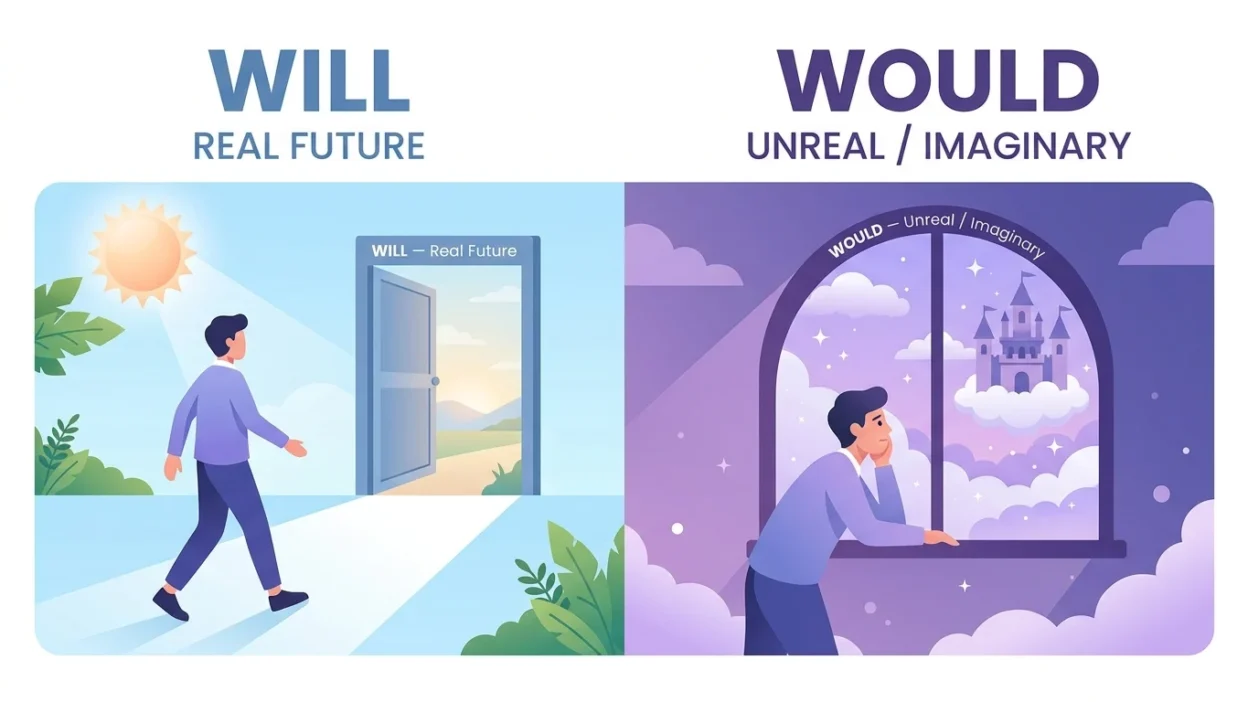
If the situation can truly happen, use will. If you are imagining, dreaming, or describing something contrary to fact, use would. Another helpful image: will is a door that can open; would is a window you look through but cannot walk past.
You can also test yourself with one question: “Am I describing something real or something imaginary?” Your answer tells you which word to choose.
American vs British English
The rule for will and would in if clauses is the same in American and British English. Both varieties use will for real future conditions and would for unreal or hypothetical ones.
There are small differences in related areas. British English sometimes uses shall with I and we in formal offers, while American English prefers will. British speakers may also use should in certain formal if clauses, as in “If you should need help, call me.” American English usually says “If you need help, call me.”
Spelling differences like “realize” versus “realise” do not affect if clause grammar. The core rule stays identical on both sides of the Atlantic.
Similar Words Worth Knowing
Several words behave like will and would and are worth learning alongside them.
- Can and could: “If I can help, I will” versus “If I could help, I would.” Can shows real ability; could shows unreal or polite possibility.
- May and might: “If it may rain, take an umbrella” is rare, but “If it might rain, take an umbrella” shows weaker possibility. Might often replaces would in softer speculation.
- Shall: Used mainly in British English for offers and suggestions, as in “If I shall see him, I will tell him.”
- Should: In formal if clauses, “If you should arrive early, wait for me” adds politeness or formality.
- Were to: “If I were to move, I would choose Canada” adds a dreamy, unlikely tone to unreal conditions.
Final Verdict
The choice between will and would in an if clause comes down to one question: is the situation real or unreal? Use will for genuine future possibilities. Use would for imagined, hypothetical, or contrary-to-fact situations. This single distinction explains almost every correct and incorrect sentence you will meet.
Master this rule and your English will sound more precise and natural. You will stop guessing and start choosing with confidence.
FAQs
Can I use will after if?
Yes, you can use will after if when the situation is a real future possibility, as in “If you study, you will pass.” The old rule that says never use will after if is only about unreal conditionals.
What is the difference between if it rains and if it rained?
“If it rains” describes a real future possibility and pairs with will. “If it rained” describes an imaginary present situation and pairs with would.
Is it wrong to say if I would have known?
In standard English, yes. Say “If I had known” instead. “If I would have known” is common in casual speech but considered incorrect in formal writing.
When do I use would in the if clause itself?
Would can appear in an if clause in polite requests or in sentences like “If you would help me, I would be grateful.” It is less common than would in the main clause.
Can will and would appear in the same sentence?
Yes. “If you will wait a moment, I would be happy to help” mixes a real condition with a polite result. This is more advanced but completely natural.
Does the rule change for past situations?
For unreal past situations, use the past perfect in the if clause and would have in the main clause: “If I had left earlier, I would have arrived on time.”
Is would always about the past?
No. Would often talks about an imaginary present or future, as in “If I were rich, I would travel.” It only refers to the past in third conditional sentences.
What is the safest rule for beginners?
Use will for real future possibilities and would for imaginary ones. Practice with clear examples until the pattern feels natural.
Remember This
Will equals real possibility. Would equals unreal imagination. One question, “Is this real or imaginary?”, solves the whole puzzle.
Conclusion
Choosing between will and would in an if clause does not require memorizing dozens of rules. It requires understanding one core idea: real situations take will, and unreal situations take would. When the condition can genuinely happen, you are in first conditional territory with will. When the condition is imaginary, contrary to fact, or purely hypothetical, you are in second or third conditional territory with would.
Practice with the examples in this guide, ask yourself the real-or-imaginary question each time, and the correct choice will soon feel automatic. Clear if clauses make your English sharper, more precise, and easier for others to understand.

David Henry is a language enthusiast and content writer specializing in synonyms, vocabulary, and word meanings. He creates clear, engaging resources that help readers improve their writing, communication, and English skills.