
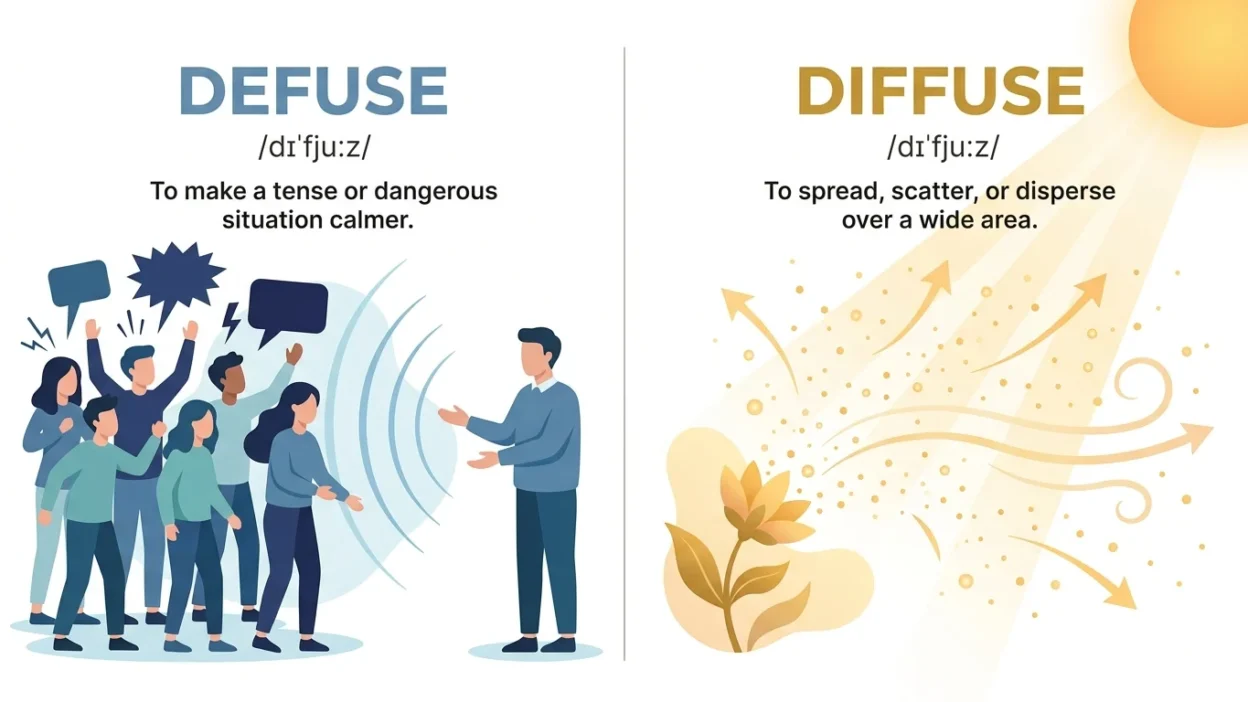
Defuse vs diffuse are two words that sound almost identical but mean completely different things. This tiny difference causes big confusion, even for native English speakers. If you have ever paused mid-sentence wondering whether you should “defuse the situation” or “diffuse the situation,” you are not alone.
The good news is that once you understand the core meanings, you will never mix them up again. One word is about calming things down. The other is about spreading things out. That is the entire distinction in a nutshell.
This guide will explain both words in plain English, give you plenty of examples, and share a simple memory trick that makes the choice automatic. By the end, you will use these words with confidence.
Quick Answer
Defuse means to make a situation less tense or dangerous, or to remove a bomb’s fuse. Diffuse means to spread something out over a wide area, like light, gas, or ideas. Use defuse for calming tension and diffuse for spreading or scattering.
Why People Confuse Defuse and Diffuse
These two words are homophones (or near-homophones). They sound almost the same when spoken, especially in fast conversation. Both have the same rhythm and very similar pronunciation.
The confusion gets worse because both words can appear in similar contexts. You might read about efforts to “defuse tensions” in one article and how “tensions diffused throughout the region” in another. The topics overlap, but the meanings are opposite.
Spelling adds another layer of difficulty. Defuse has one “f.” Diffuse has two. That single letter changes everything.
What Does Defuse Mean?
Defuse is always a verb. It comes from the prefix “de-” (meaning to undo or reverse) plus “fuse” (the part of a bomb that triggers an explosion). The word entered English around 1943, during World War II.
Defuse has two main meanings:
- To make a bomb safe by removing or disabling its fuse
- To make a tense or dangerous situation calmer and less likely to explode into conflict
The second meaning is a metaphor. Think of an argument or crisis as a bomb. When you defuse it, you remove the danger before it goes off.
Defuse in Action
- Bomb context: The bomb squad worked carefully to defuse the device before it could explode.
- Situation context: She told a joke to defuse the tension in the room.
- Diplomatic context: Negotiators are trying to defuse the crisis between the two countries.
- Everyday context: His calm response helped defuse what could have become a serious argument.
What Does Diffuse Mean?
Diffuse is more flexible. It can be a verb or an adjective. It comes from the Latin word “diffundere,” which means “to pour out or scatter”.
As a verb, diffuse means:
- To spread something out over a wide area
- To scatter or disperse something, like light, gas, heat, or information
As an adjective, diffuse means:
- Spread out and not concentrated in one place (like “diffuse light”)
- Wordy and unfocused (like “a diffuse explanation”)
The adjective form is pronounced slightly differently: “dih-FYOOS” (adjective) versus “dih-FYOOZ” (verb).
Diffuse in Action
- Light context: The curtains diffuse the sunlight, making the room feel softer and warmer.
- Gas or scent context: The smell of freshly baked bread diffused through the entire house.
- Information context: New ideas diffused rapidly across Europe as agriculture developed.
- Adjective context: The pain was diffuse, spread across his whole back rather than in one spot.
Defuse vs Diffuse Comparison Table
| Feature | Defuse | Diffuse |
|---|---|---|
| Part of speech | Verb only | Verb AND adjective |
| Core meaning | Make safe, calm, or less tense | Spread out, scatter, disperse |
| Bomb connection | Removing the fuse | Not related to bombs |
| Common objects | Situations, tensions, crises, bombs | Light, gas, heat, ideas, information |
| Spelling | One “f” | Two “f”s |
| Memory hook | Defuse deactivates danger | Diffuse disperses outward |
When to Use Each Word
Use Defuse When…
You are talking about reducing danger, tension, or conflict. If the situation involves anger, stress, or something that could “blow up,” defuse is your word.
Signals to use defuse:
- You want to say “calm down”
- The topic is arguments, crises, or bombs
- The goal is to make something safe or peaceful
Use Diffuse When…
You are talking about spreading or scattering something. If the situation involves light, smells, gases, heat, or information moving through space or among people, diffuse is your word.
Signals to use diffuse:
- You want to say “spread out”
- The topic is science, light, smells, or the spread of ideas
- The goal is to describe something becoming less concentrated
10+ Clear Examples
Defuse Examples
- The teacher defused the argument between two students by changing the subject.
- Police called a specialist to defuse the suspicious package found at the station.
- A sincere apology can defuse even the most heated disagreements.
- The president’s speech was designed to defuse public anger over the new law.
- Humor is often the fastest way to defuse an awkward moment.
- The negotiator successfully defused the hostage situation.
- She tried to defuse her father’s anger by explaining the misunderstanding calmly.
Diffuse Examples
- The morning fog diffused the sunlight into a soft, gray glow.
- The scent of jasmine diffused through the open window.
- The teacher used a screen to diffuse the projector light so students could see clearly.
- News of the discovery diffused quickly through the scientific community.
- Heat from the fireplace diffused evenly throughout the cabin.
- The company’s new technology gradually diffused across the industry.
- A lampshade helps diffuse the bulb’s harsh brightness.
- His writing was criticized for being too diffuse and hard to follow.
Common Mistakes to Avoid
Mistake 1: Saying “diffuse the situation.”
This is the single most common error. You cannot “diffuse” a tense situation unless you are literally spreading it out across a larger area. You defuse a situation by calming it down.
Mistake 2: Saying “defuse the light.”
Light does not need to be made safe. It needs to be spread out. So you diffuse light, not defuse it.
Mistake 3: Forgetting that diffuse is also an adjective.
Many learners only learn diffuse as a verb. But “diffuse pain” or “diffuse lighting” are common and correct uses.
Mistake 4: Mixing up the pronunciation.
The verb diffuse and the noun defuse sound almost identical. The adjective diffuse has a different ending sound (“-fyoos” instead of “-fyooz”).
A Simple Memory Trick
Defuse starts with “de-” like “deactivate.” When you defuse something, you deactivate the danger.
Diffuse has two “f”s — think of the two “f”s as spreading out, just like the meaning of the word. The “f” is diffused across the word.
Another trick: Bombs get defused. Light gets diffused. Remember that pair, and you will be right almost every time.
American vs British English
Both words follow the same spelling and usage patterns in American and British English. There is no meaningful difference between how these words are used across English-speaking regions.
The only small variation is pronunciation. The verb diffuse is pronounced “dih-FYOOZ” in both varieties. The adjective diffuse is “dih-FYOOS.” Defuse is “dee-FYOOZ” in American English and “dee-FYOOZ” or “dih-FYOOZ” in British English.
Similar Words to Know
Defuse is related to:
- Disarm — to remove weapons or make harmless
- De-escalate — to reduce the intensity of a conflict
- Calm — to make peaceful
- Neutralize — to make something ineffective
Diffuse is related to:
- Disperse — to scatter in different directions
- Disseminate — to spread information widely
- Spread — the simplest synonym
- Scatter — to throw or distribute loosely
Final Verdict
Defuse and diffuse are not interchangeable. Defuse is about making things safe and calm. Diffuse is about spreading things out.
If you remember nothing else, remember this: You defuse a crisis. You diffuse a scent. Danger gets defused. Particles and ideas get diffused.
The spelling difference — one “f” versus two — is a helpful visual cue. Use it to train your brain until the correct choice becomes automatic.
Frequently Asked Questions
What is the difference between defuse and diffuse?
Defuse means to make a situation less dangerous or tense, or to remove a bomb’s fuse. Diffuse means to spread something out over a wide area. Defuse is about calming or neutralizing danger. Diffuse is about spreading or scattering.
Is it “defuse the situation” or “diffuse the situation”?
The correct phrase is “defuse the situation.” You are calming the tension and reducing the danger. “Diffuse the situation” is a common mistake because the words sound alike, but it is incorrect.
Can diffuse be an adjective?
Yes. Diffuse is both a verb and an adjective. As an adjective, it means “spread out” or “not concentrated.” For example, “diffuse light” is soft and scattered light. “Diffuse pain” is pain spread across a large area rather than in one spot.
How do you pronounce defuse and diffuse?
Defuse is pronounced “dee-FYOOZ.” The verb diffuse is also “dih-FYOOZ.” The adjective diffuse is pronounced “dih-FYOOS,” with a soft “s” sound at the end. The difference is subtle but important in careful speech.
What is an example of defuse in a sentence?
“The manager’s calm apology helped defuse the customer’s anger.” Another example: “Bomb disposal experts were called to defuse the device.”
What is an example of diffuse in a sentence?
“The sheer curtains diffuse the harsh afternoon sunlight.” Another example: “The scent of lavender diffused slowly through the bedroom.”
Does defuse only relate to bombs?
No. The bomb meaning is the original and literal one. But the most common use today is figurative: defusing tensions, defusing a crisis, defusing an argument. Any time you reduce tension or danger, you are defusing.
What is the noun form of diffuse?
The noun is diffusion. It refers to the process of spreading out. In science, diffusion describes how particles move from areas of high concentration to low concentration. In sociology, it describes how ideas or technologies spread through a population.
Remember This
Defuse = Deactivate danger. One “f.” Calm the bomb, calm the room.
Diffuse = Disperse outward. Two “f”s. Spread the light, spread the scent.
Conclusion
Defuse and diffuse look and sound almost identical, but they live in different worlds. Defuse belongs to danger, tension, and bombs. Diffuse belongs to light, gases, scents, and the spread of ideas.
The next time you write or speak, ask yourself one simple question: Am I trying to calm something down or spread something out? If it is calming, choose defuse. If it is spreading, choose diffuse.
With a little practice, this distinction will become second nature. Your writing will be clearer, and you will never again “diffuse” a crisis or “defuse” a scent by mistake.

David Henry is a language enthusiast and content writer specializing in synonyms, vocabulary, and word meanings. He creates clear, engaging resources that help readers improve their writing, communication, and English skills.