Hopping and hoping are two different words that sound similar but mean very different things. Many English learners mix them up because they differ by only one letter. Hopping means jumping on one foot or making small jumps. Hoping means wanting something to happen and feeling that it might. If you write “I am hoping to see you,” you express a wish. If you write “I am hopping to see you,” you describe jumping while going to see someone. The meaning changes completely.
This mix-up is very common among students, ESL learners, and even native speakers who type quickly. The good news is that the difference is easy to remember once you know the rule. In this article, you will learn the exact meanings, see clear examples, and get a simple memory trick. By the end, you will never confuse hopping and hoping again.
Quick Answer
Hopping means jumping on one foot or making small jumps. Hoping means wanting something to happen and feeling it is possible. Hopping has a double “p” and comes from “hop.” Hoping has one “p” and comes from “hope.” The spelling change signals a different meaning and a different vowel sound.
Why People Confuse Hopping and Hoping
These two words look almost the same. Only one letter separates them. That single letter changes both the pronunciation and the meaning. When people write fast or rely on sound alone, they often choose the wrong one. Also, both words are common in daily English, so the mistake appears everywhere from text messages to school essays.
The confusion grows because English spelling does not always match pronunciation. In “hoping,” the “o” sounds like the “o” in “open.” In “hopping,” the “o” sounds short, like the “o” in “stop.” The double “p” in “hopping” keeps the vowel short. The single “p” in “hoping” lets the vowel sound long. This is a key spelling rule in English.
What Does Hopping Mean?
Hopping is the present participle of the verb “hop.” It means jumping on one foot, moving with small jumps, or jumping over something. It can also describe animals that jump, like rabbits and frogs. In informal English, “hopping” can mean moving quickly from place to place, as in “bar hopping” or “job hopping.”
Key meanings of hopping
- Jumping on one foot: “The child was hopping across the playground.”
- Small quick jumps: “The bird was hopping on the branch.”
- Moving between places: “They went bar hopping on Friday night.”
- Changing frequently: “Job hopping is common among young workers.”
Examples of hopping
- The rabbit is hopping through the garden.
- She hurt her ankle, so she was hopping to the door.
- The frog kept hopping away from me.
- We spent the evening club hopping downtown.
- He is hopping from one task to another.
What Does Hoping Mean?
Hoping is the present participle of the verb “hope.” It means wanting something to happen and believing it is possible. It expresses a wish, a desire, or an expectation. People use “hoping” when they talk about the future, about outcomes, or about things they cannot control.
Key meanings of hoping
- Wanting something to happen: “I am hoping for good weather.”
- Expecting a positive result: “She is hoping to pass the exam.”
- Expressing a wish: “We are hoping you can come.”
- Feeling optimistic: “He is hoping for the best.”
Examples of hoping
- I am hoping to visit my family next month.
- She is hoping that the train is not late.
- We are hoping for a quiet weekend.
- They are hoping to buy a new house.
- He is hoping the meeting goes well.
Hopping vs Hoping: Comparison Table
| Feature | Hopping | Hoping |
|---|---|---|
| Verb base | Hop | Hope |
| Meaning | Jumping on one foot or making small jumps | Wanting something to happen |
| Spelling | Double “p” | Single “p” |
| Vowel sound | Short “o” (like “stop”) | Long “o” (like “open”) |
| Part of speech | Present participle of “hop” | Present participle of “hope” |
| Common context | Movement, animals, bar hopping, job hopping | Wishes, expectations, future plans |
| Example | The bird is hopping on the grass. | I am hoping for a good result. |
When to Use Each Word
Use hopping when you talk about physical movement. If someone is jumping, bouncing, or moving quickly between places, hopping is the right word. Think of action and motion. If you can picture a rabbit, a frog, or a child jumping, use hopping.
Use hoping when you talk about feelings, wishes, or expectations. If someone wants something to happen, hoping is correct. Think of emotion and desire. If you can picture someone wishing or waiting for good news, use hoping.
Quick rule
- Hopping = action (jumping)
- Hoping = feeling (wishing)
10+ Examples in Sentences
- The frog is hopping across the pond.
- I am hoping to see you soon.
- She was hopping on one foot after the injury.
- We are hoping for a sunny day.
- The rabbit kept hopping toward the fence.
- He is hoping to get a promotion.
- They were hopping from one store to another.
- I am hoping that you understand.
- The kids were hopping like kangaroos.
- She is hoping to study abroad next year.
- The bird was hopping along the sidewalk.
- We are hoping the package arrives today.
Common Mistakes
Many people write “hopping” when they mean “hoping.” This is the most common error. For example, “I am hopping you feel better” is wrong. It should be “I am hoping you feel better.” The double “p” turns a wish into a jump.
Another mistake is mixing up the pronunciation. Some learners say “hoping” with a short “o” sound. That makes it sound like “hopping.” Practice the long “o” sound in “hoping” and the short “o” sound in “hopping.”
A third mistake is using “hoping” for physical movement. If you say “The rabbit is hoping in the garden,” it sounds like the rabbit is wishing for something. That is not what you mean. Use hopping for the rabbit.
Common error list
- Wrong: I am hopping you are well. Right: I am hoping you are well.
- Wrong: The frog is hoping on the rock. Right: The frog is hopping on the rock.
- Wrong: She is hoping on one foot. Right: She is hopping on one foot.
Memory Trick
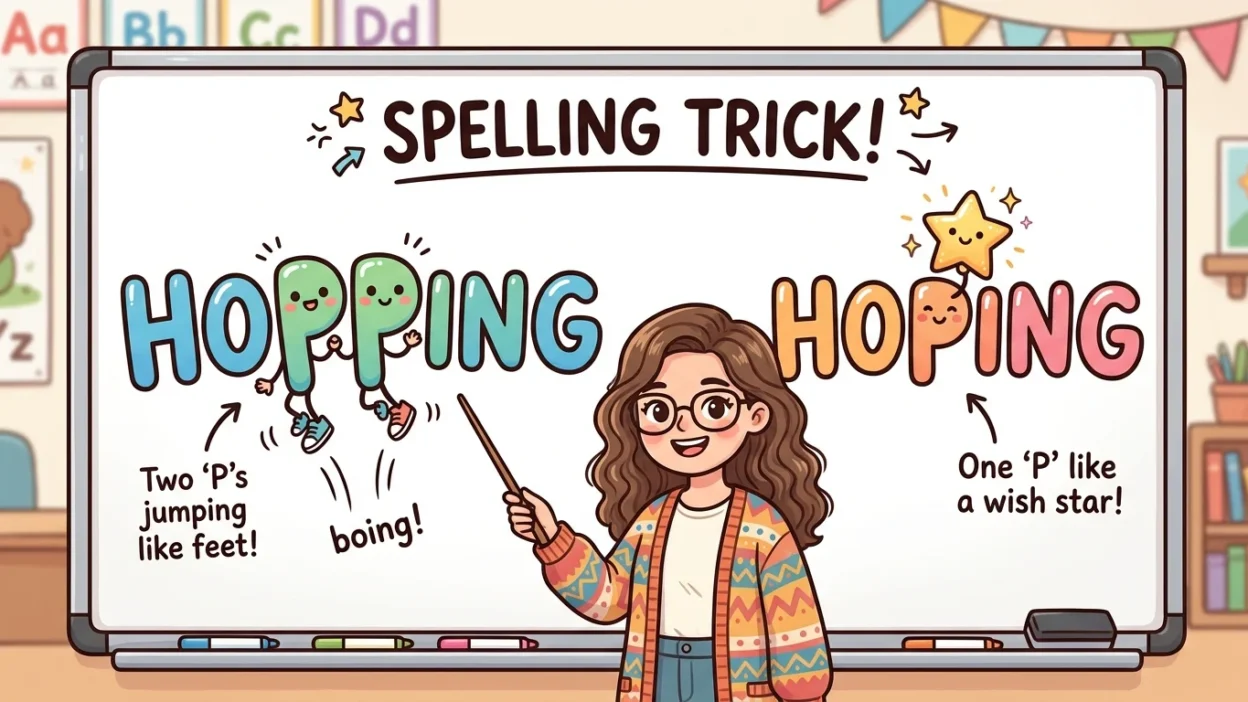
Here is a simple trick. “Hoping” has one “p.” One “p” means one wish. “Hopping” has two “p”s. Two “p”s mean two feet jumping. You can also remember that “hop” has a short sound and “hope” has a long sound. The extra “p” in “hopping” keeps the vowel short, just like in “stopping” and “shopping.”
Another trick: “Hope” contains the word “ope,” which sounds like “open.” You open your heart to hope. “Hop” sounds like “top,” which is a short, quick word. Short word, short jump.
American vs British English
Both American and British English use hopping and hoping the same way. The meanings do not change. The spelling rules are also the same. The only difference is pronunciation accent, but the vowel difference between the two words remains clear in both varieties. So you can use the same rule no matter where you are.
Similar Words That Cause Confusion
Several other word pairs follow the same pattern. Learning them together can help you avoid mistakes.
| Short vowel (double consonant) | Long vowel (single consonant) |
|---|---|
| hopping | hoping |
| stopping | stoning |
| shopping | shaping |
| sitting | siting |
| running | runing (not a word) |
The rule is simple. When a short vowel comes before a final consonant, the consonant often doubles. When the vowel is long, the consonant stays single. This pattern appears in many English words.
Other similar confusing pairs include:
- Losing vs loosing
- Then vs than
- Your vs you’re
- Its vs it’s
Final Verdict
Hopping and hoping are not interchangeable. Hopping is about jumping and movement. Hoping is about wishing and expecting. The double “p” in hopping keeps the vowel short. The single “p” in hoping keeps the vowel long. If you remember this one spelling rule, you will choose the right word every time. Use hopping for actions and hoping for feelings.
FAQs
What is the difference between hopping and hoping?
Hopping means jumping on one foot or making small jumps. Hoping means wanting something to happen. They differ by one letter and have different meanings and pronunciations.
Is it “I am hoping” or “I am hopping”?
It depends on your meaning. If you want something, say “I am hoping.” If you are jumping, say “I am hopping.” Most people mean “hoping” in daily conversation.
Why does hopping have two p’s?
The double “p” keeps the vowel sound short. In English, a short vowel before a final consonant often causes the consonant to double. This rule appears in words like stopping and shopping.
How do you pronounce hoping and hopping?
Hoping has a long “o” sound, like in “open.” Hopping has a short “o” sound, like in “stop.” The double “p” signals the short sound.
Can hopping mean moving between places?
Yes. In informal English, hopping can mean moving quickly from one place to another. Examples include bar hopping, job hopping, and club hopping.
Is hoping a verb?
Yes. Hoping is the present participle of the verb “hope.” It is used in continuous tenses, such as “I am hoping” or “she was hoping.”
What is a good memory trick for hopping vs hoping?
One “p” means one wish (hoping). Two “p”s mean two feet jumping (hopping). This simple trick helps you remember the difference.
Are hopping and hoping used the same in British and American English?
Yes. Both varieties use the same meanings and spelling rules. Only the accent changes, not the usage.
Remember This
Hopping = jumping. Hoping = wishing. One “p” for a wish. Two “p”s for two feet. Keep this in mind, and you will never mix them up again.
Conclusion
Hopping and hoping are easy to confuse because they look and sound similar. But their meanings are completely different. Hopping is about physical movement, like a rabbit jumping or a child bouncing on one foot. Hoping is about emotion and expectation, like wishing for good news or waiting for a positive result.
The next time you write a sentence, pause and ask yourself: am I talking about jumping or wishing? If it is jumping, use hopping with two “p”s. If it is wishing, use hoping with one “p.” This small check will make your writing clear and correct. Practice with the examples above, and the difference will become natural.

David Henry is a language enthusiast and content writer specializing in synonyms, vocabulary, and word meanings. He creates clear, engaging resources that help readers improve their writing, communication, and English skills.