
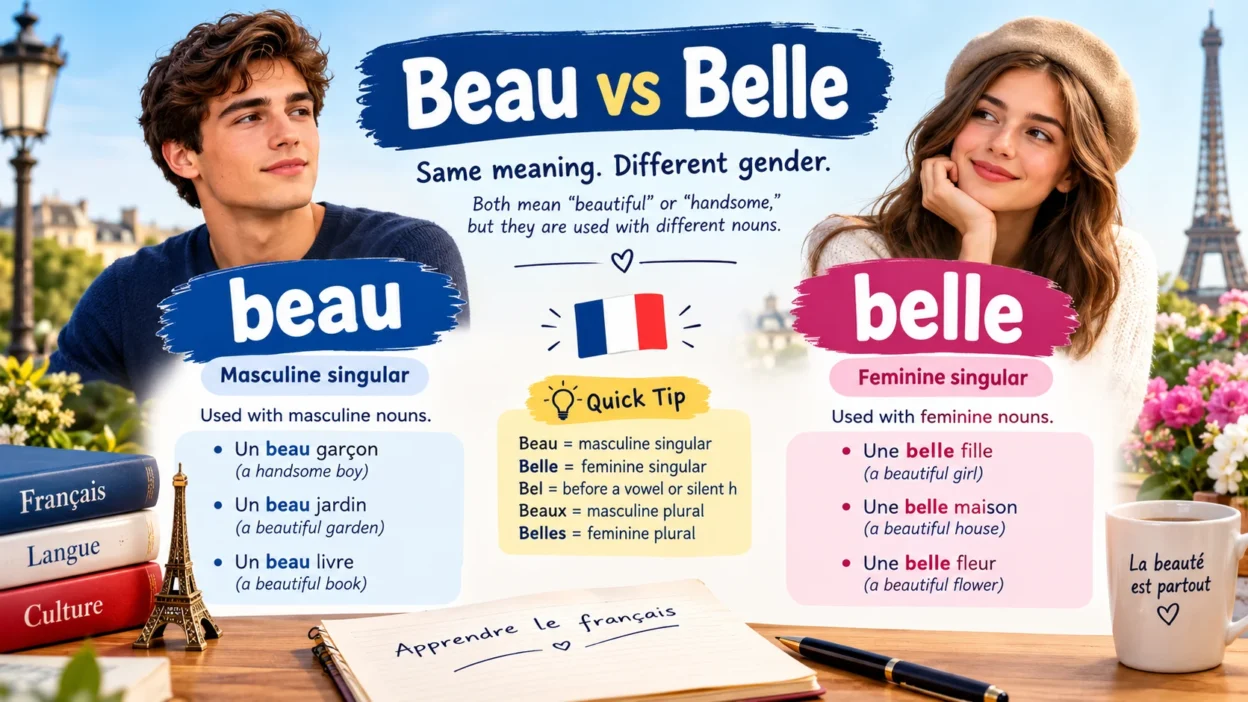
The French words beau and belle both mean “beautiful” or “handsome,” but they are used differently depending on the gender and number of the noun they describe. If you are learning French, understanding the difference between beau vs belle will help you describe people, places, and things more naturally. Although these words share a similar meaning, they are not interchangeable in every sentence.
French adjectives usually agree with the nouns they describe in gender and number. Beau is the masculine singular form, generally used with masculine nouns, while belle is the feminine singular form, used with feminine nouns. For example, un beau garçon means “a handsome boy,” whereas une belle fille means “a beautiful girl.” Both adjectives can also describe objects, places, and abstract ideas, not just people. Learning when to use each form will make your French more accurate and help you avoid common grammar mistakes.
Quick Answer: Beau vs Belle
Beau is the masculine singular form of the French adjective meaning “beautiful” or “handsome.” Belle is its feminine singular form. Use beau with masculine singular nouns and belle with feminine singular nouns. For example, un beau jardin means “a beautiful garden,” while une belle maison means “a beautiful house.”
Why Do People Confuse Beau and Belle?
People often confuse beau and belle because both words express beauty and have the same basic meaning in English. English adjectives generally do not change according to the gender of a noun, but French adjectives frequently do.
For example:
- Un beau livre — A beautiful book.
- Une belle fleur — A beautiful flower.
The difference is grammatical rather than a difference in the degree of beauty. Neither word is inherently more beautiful, romantic, or formal than the other.
Another source of confusion is pronunciation. Beau is generally pronounced /boʊ/ in English-style phonetic notation, while belle sounds approximately like the English word “bell.” Their spelling and pronunciation differ, even though they belong to the same adjective family.
What Does Beau Mean?
Beau is the masculine singular form of the French adjective beau, meaning “beautiful,” “handsome,” “lovely,” or “fine,” depending on context.
It commonly describes masculine singular nouns, including people, places, and objects.
Examples:
- Un beau garçon — A handsome boy.
- Un beau paysage — A beautiful landscape.
- Un beau livre — A beautiful book.
- Un beau jour — A beautiful day.
When Is Beau Used?
Use beau when the noun is masculine and singular, provided the adjective follows the normal masculine form rules.
For example:
- C’est un beau bâtiment. — It is a beautiful building.
- Il est beau. — He is handsome.
- Quel beau jardin ! — What a beautiful garden!
There is one important spelling rule: before a masculine singular noun beginning with a vowel or a silent h, beau usually changes to bel.
For example:
- Un bel homme — A handsome man.
- Un bel arbre — A beautiful tree.
The form bel is another form of the same adjective, not a separate word with a different meaning.
What Does Belle Mean?
Belle is the feminine singular form of the French adjective beau. It means “beautiful,” “lovely,” or “fine,” depending on the noun and context.
It is used with feminine singular nouns, including people, places, and objects.
Examples:
- Une belle femme — A beautiful woman.
- Une belle maison — A beautiful house.
- Une belle journée — A beautiful day.
- Une belle histoire — A beautiful story.
When Is Belle Used?
Use belle when describing a feminine singular noun.
For example:
- Elle est belle. — She is beautiful.
- C’est une belle ville. — It is a beautiful city.
- Quelle belle robe ! — What a beautiful dress!
Remember that grammatical gender does not always match a person’s gender or an object’s physical characteristics. The adjective agrees with the grammatical gender of the French noun.
Beau vs Belle: Comparison Table
| Feature | Beau | Belle |
|---|---|---|
| Grammatical form | Masculine singular | Feminine singular |
| Basic meaning | Beautiful, handsome, lovely | Beautiful, lovely, fine |
| Used with | Masculine singular nouns | Feminine singular nouns |
| Example | Un beau garçon | Une belle fille |
| Pronunciation | Approximately “boh” | Approximately “bell” |
| Before a vowel or silent h | Usually bel before a masculine singular noun | Remains belle |
| Plural form | Beaux | Belles |
When Should You Use Beau or Belle?
Choose the form according to the grammatical gender and number of the noun you are describing.
Use Beau for Masculine Singular Nouns
Examples:
- Un beau chien — A beautiful dog.
- Un beau château — A beautiful castle.
- Un beau film — A beautiful or excellent film.
Use Belle for Feminine Singular Nouns
Examples:
- Une belle chanson — A beautiful song.
- Une belle plage — A beautiful beach.
- Une belle idée — A beautiful or wonderful idea.
What About Plural Nouns?
The adjective changes when the noun is plural.
- Beaux: masculine plural — De beaux jardins (beautiful gardens).
- Belles: feminine plural — De belles fleurs (beautiful flowers).
What About Masculine Nouns Beginning With a Vowel?
Use bel before a masculine singular noun beginning with a vowel or silent h in the relevant adjective position.
- Un bel appartement — A beautiful apartment.
- Un bel hôtel — A beautiful hotel.
12 Examples of Beau vs Belle in Sentences
Here are practical examples to help you understand the difference.
- Il est beau. — He is handsome.
- Elle est belle. — She is beautiful.
- C’est un beau jardin. — It is a beautiful garden.
- C’est une belle maison. — It is a beautiful house.
- J’ai vu un beau film. — I watched a beautiful or excellent film.
- Elle porte une belle robe. — She is wearing a beautiful dress.
- Nous avons un beau chien. — We have a beautiful dog.
- C’est une belle journée. — It is a beautiful day.
- Il habite dans un bel appartement. — He lives in a beautiful apartment.
- Ils visitent de beaux châteaux. — They are visiting beautiful castles.
- Elle a de belles fleurs. — She has beautiful flowers.
- Quelle belle histoire ! — What a beautiful story!
These examples show that beau, bel, and belle are forms of the same adjective. The correct choice depends on the noun and the grammatical context.
Common Mistakes When Using Beau and Belle
1. Using Beau With Every Noun
Incorrect: Une beau maison.
Correct: Une belle maison.
Why? Maison is feminine, so the adjective must be belle.
2. Using Belle With Masculine Singular Nouns
Incorrect: Un belle garçon.
Correct: Un beau garçon.
Why? Garçon is masculine singular, so use beau.
3. Forgetting the Form Bel
Incorrect: Un beau homme.
Correct: Un bel homme.
Why? Before a masculine singular noun beginning with a vowel or silent h, the adjective normally takes the form bel.
4. Forgetting Plural Agreement
Incorrect: Des beau jardins.
Correct: De beaux jardins.
Why? Jardins is masculine plural, so the adjective becomes beaux. In this construction, des commonly changes to de before the adjective.
5. Thinking Beau Always Means Handsome
Beau can describe people, but it also describes things, places, experiences, and abstract concepts.
For example, un beau paysage means “a beautiful landscape,” not “a handsome landscape” in ordinary English.
What Is an Easy Memory Trick for Beau and Belle?
Use this simple rule:
- Beau = masculine singular
- Bel = masculine singular before a vowel or silent h
- Belle = feminine singular
- Beaux = masculine plural
- Belles = feminine plural
A useful memory trick is to connect belle with “beautiful girl” and beau with “handsome boy.” These are simplified examples, but they help you remember the basic distinction. Always check the noun’s grammatical gender rather than relying on the person or object’s appearance.
Beau vs Belle in American and British English
There is no difference between American and British English in the basic meaning of beau and belle, because both words come from French.
In English, beau can also refer to a male romantic companion or boyfriend, especially in literary or somewhat old-fashioned contexts. Belle may refer to a beautiful or admired woman, as in the expression “the belle of the ball.”
Examples:
- She arrived at the party with her beau. — Her male romantic companion accompanied her.
- She was the belle of the ball. — She was the most admired woman at the event.
These English uses are different from the ordinary French adjective rules. In French, beau and belle are primarily adjective forms that agree with nouns.
Similar Words Related to Beau and Belle
Several French words and forms are useful to learn alongside beau and belle.
| Word | Meaning | Example |
|---|---|---|
| Bel | Masculine singular form before a vowel or silent h | Un bel homme |
| Beaux | Masculine plural | De beaux arbres |
| Belles | Feminine plural | De belles maisons |
| Joli | Pretty, attractive; masculine singular | Un joli jardin |
| Jolie | Pretty, attractive; feminine singular | Une jolie robe |
| Magnifique | Magnificent or gorgeous; same form for masculine and feminine singular | Une magnifique vue |
| Beau-frère | Brother-in-law | Mon beau-frère |
| Belle-sœur | Sister-in-law | Ma belle-sœur |
Although joli and beau can both describe something attractive, they are not always interchangeable. Joli often emphasizes prettiness, while beau can express broader beauty, quality, or grandeur.
Final Verdict: Beau vs Belle
The main difference between beau and belle is grammatical gender. Use beau with masculine singular nouns and belle with feminine singular nouns. Use bel before a masculine singular noun beginning with a vowel or silent h, and use beaux or belles for the respective plural forms.
Both words can mean “beautiful,” “handsome,” or “lovely,” depending on context. The right choice depends on the French noun, not on if the person or object is considered masculine or feminine in everyday life.
Frequently Asked Questions
1. Is beau masculine or feminine?
Beau is masculine singular. It is used with masculine singular nouns, such as un beau garçon (a handsome boy) and un beau jardin (a beautiful garden).
2. Is belle the feminine version of beau?
Yes. Belle is the feminine singular form of beau. For example, un beau livre means “a beautiful book,” while une belle histoire means “a beautiful story.”
3. Does beau mean handsome or beautiful?
It can mean either. When describing a man, beau often means “handsome.” When describing an object, place, or experience, it commonly means “beautiful,” “lovely,” or “fine.”
4. Why do French speakers say bel homme instead of beau homme?
French uses bel before a masculine singular noun that begins with a vowel or silent h in this construction. Therefore, un bel homme is correct, while un beau homme is not the standard form.
5. What is the plural of beau?
The masculine plural form is beaux. For example, de beaux jardins means “beautiful gardens.” The feminine plural form is belles, as in de belles fleurs (beautiful flowers).
6. Can beau and belle describe objects?
Yes. They describe people, objects, places, experiences, and abstract ideas. For example, un beau livre means “a beautiful book,” and une belle idée means “a wonderful idea.”
7. Is belle used differently in American and British English?
The basic French meaning is the same in both varieties of English. In English, belle can also mean an admired or beautiful woman, particularly in expressions such as “the belle of the ball.”
Remember This
- Beau: masculine singular — un beau garçon.
- Bel: masculine singular before a vowel or silent h — un bel homme.
- Belle: feminine singular — une belle maison.
- Beaux: masculine plural — de beaux jardins.
- Belles: feminine plural — de belles fleurs.
Conclusion
Understanding beau vs belle is an important step in learning French adjectives. Both words express beauty, attractiveness, or loveliness, but their forms depend on grammatical gender. Use beau for masculine singular nouns and belle for feminine singular nouns, while remembering the related forms bel, beaux, and belles.
With regular practice, you will recognize the correct form more easily in French conversations, books, and everyday writing. Pay attention to the noun you are describing, learn its grammatical gender, and use the matching adjective form to create accurate, natural French sentences.

Alexander Eric is the Administrator of SynonymLot, dedicated to providing accurate synonyms, vocabulary resources, and language tools. He enjoys helping readers improve writing, communication, and English word knowledge daily.