
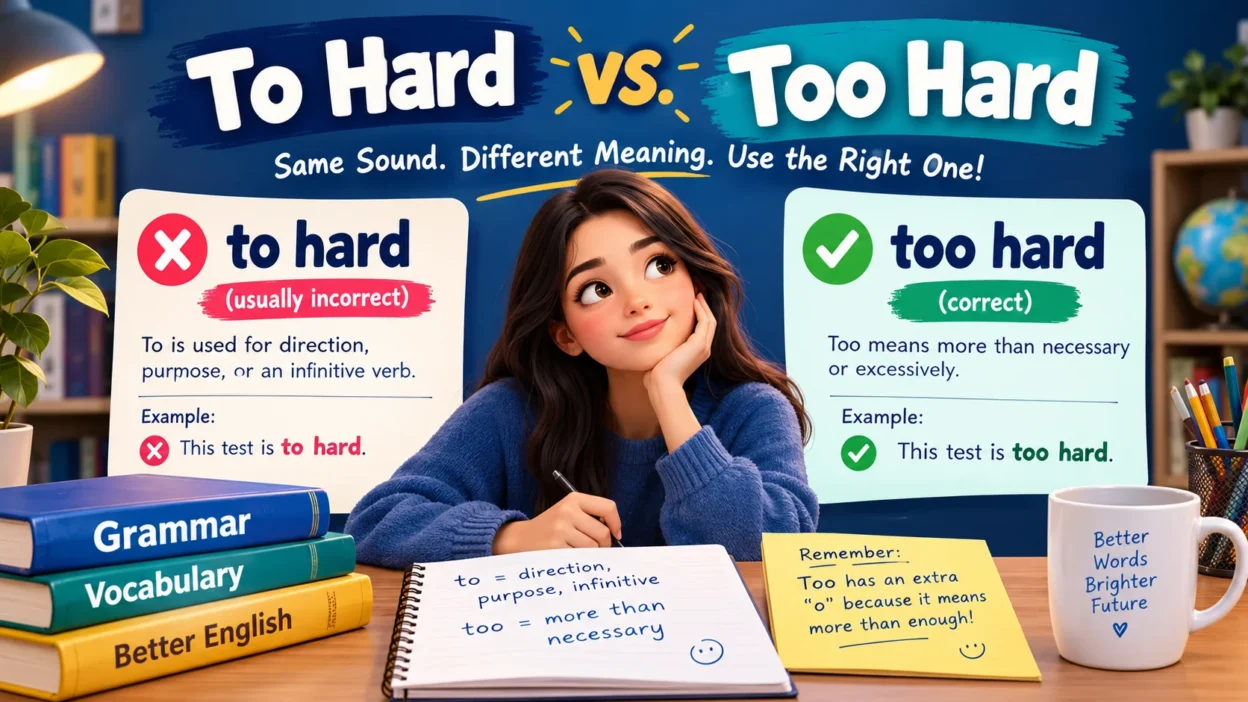
When deciding between “to hard” and “too hard,” the correct phrase is usually “too hard.” It means something is excessively difficult, requires too much effort, or is harder than necessary. The phrase “to hard” is generally incorrect when you want to describe difficulty because to and too have different grammatical functions.
English learners often confuse these words because they sound exactly alike. However, they are used differently in sentences. For example, you should write “This question is too hard,” not “This question is to hard.”
Understanding the difference between to and too will help you avoid common spelling mistakes in schoolwork, emails, social media posts, and everyday writing. The good news is that the rule is simple once you know what each word means. In this guide, you will learn when to use “too hard,” why “to hard” is usually incorrect, and how to recognize the right phrase through practical examples.
Quick Answer: To Hard or Too Hard?
“Too hard” is correct when you mean excessively difficult, forceful, or intense. For example, “The exam was too hard for me.” The word too means more than necessary or more than is acceptable. By contrast, to usually expresses direction, purpose, or an infinitive verb. Therefore, “to hard” is generally incorrect when describing something as excessively difficult.
Why Do People Confuse “To Hard” and “Too Hard”?
People confuse these phrases because to and too have the same pronunciation but different meanings and uses. They are examples of homophones—words that sound alike but have different spellings and meanings.
Here is the main difference:
- To: Often indicates direction, purpose, or an infinitive verb.
- Too: Means “also” or “more than necessary.”
- Hard: Can mean difficult, requiring effort, or forcefully.
When you want to say that something is excessively difficult, use too hard.
Example:
- Correct: This exercise is too hard.
- Incorrect: This exercise is to hard.
1. What Does “To” Mean?
The word to is commonly used as a preposition or as part of an infinitive verb. It can indicate movement toward a place, a recipient, a purpose, or an intended action.
Examples of “To”
- I am going to school.
- She gave the book to her friend.
- I want to learn English.
- He needs to work harder.
- We went to the library.
In these examples, to does not mean “excessively” or “more than necessary.”
Can You Use “To” Before “Hard”?
Yes, but the surrounding sentence must make grammatical sense. For example:
- I need to work hard to pass the exam.
- She tried to hit the ball hard.
- It is difficult to know how hard to push.
In these sentences, to introduces a verb or forms part of a grammatical construction. It does not replace too in the phrase “too hard.”
2. What Does “Too” Mean?
The word too is an adverb with two common meanings: “more than necessary” and “also.”
When used with hard, it usually means that something is excessively difficult or that an action is performed with excessive force.
Examples of “Too Hard”
- This test is too hard for beginners.
- You are working too hard.
- The music is playing too hard for my liking.
- He hit the ball too hard.
- The chair is too hard to sit on comfortably.
The exact meaning depends on the context. “Too hard” can describe difficulty, physical force, excessive effort, or an uncomfortable level of firmness.
To Hard vs. Too Hard: Comparison Table
| Feature | To Hard | Too Hard |
|---|---|---|
| Main meaning | Usually a spelling or grammar error in this context | Excessively difficult, forceful, or intense |
| Grammar | To introduces an infinitive or expresses a relationship | Too modifies an adjective or adverb |
| Correctness | Usually incorrect when describing excessive difficulty | Correct when expressing excess |
| Example | “This test is to hard.” | “This test is too hard.” |
| Common use | Other constructions involving to and hard | Everyday speech and writing |
Remember: If you mean “more difficult than necessary,” write too hard.
When Should You Use Each Phrase?
Use “Too Hard” When Something Is Excessive
Use too hard when something is more difficult, forceful, or intense than is suitable.
Examples:
- The homework is too hard for me.
- Don’t press the button too hard.
- You are trying too hard to impress everyone.
- This mattress is too hard to sleep on.
Use “To” When the Sentence Requires It
Use to when introducing an infinitive verb or indicating direction or purpose.
Examples:
- I want to work hard.
- She went to the gym.
- He studied hard to pass his exam.
- I don’t know how hard to push.
Notice the difference between these two sentences:
- “I want to work hard.” — To introduces the verb work.
- “I work too hard.” — Too means excessively.
12 Examples of “To Hard” vs. “Too Hard”
The following examples show how to use the correct phrase in everyday English.
| Incorrect or contrasting phrase | Correct example |
|---|---|
| The question is to hard. | The question is too hard. |
| This game is to hard for me. | This game is too hard for me. |
| You are working to hard. | You are working too hard. |
| Don’t push to hard. | Don’t push too hard. |
| The exam was to hard. | The exam was too hard. |
| She tried to hard. | She tried too hard. |
| The box is to hard to open. | The box is too hard to open. |
| He hit the ball to hard. | He hit the ball too hard. |
| The lesson is to hard for beginners. | The lesson is too hard for beginners. |
| I studied to hard last night. | I studied too hard last night. |
Here are two additional examples showing the correct use of to:
11. I need to work hard if I want to succeed.
12. She learned how hard to press the keys by practicing.
These last two sentences are grammatically correct because to serves a different purpose.
Common Mistakes to Avoid
Even experienced English speakers sometimes confuse to, too, and two. Here are some mistakes to watch for.
Mistake 1: Writing “To Hard” Instead of “Too Hard”
Incorrect: This assignment is to hard.
Correct: This assignment is too hard.
Explanation: Use too because the assignment is excessively difficult.
Mistake 2: Confusing “Too Hard” With “Very Hard”
Both expressions are grammatical, but they have slightly different meanings.
- Very hard: Extremely difficult.
- Too hard: So difficult that it creates a problem or exceeds what is acceptable.
For example:
- The test was very hard, but I passed.
- The test was too hard for most students to finish.
Mistake 3: Confusing “Too” With “Two”
Incorrect: The exam was two hard.
Correct: The exam was too hard.
Two refers to the number 2, while too expresses excess or means “also.”
Mistake 4: Thinking “To” Is Always Wrong Before “Hard”
The word to is correct in sentences such as “I want to work hard.” The mistake occurs when to is used instead of too to express excess.
Memory Trick: How to Remember “Too Hard”
Use this simple trick:
Too has an extra “o” because it means “more than enough.”
Think of these examples:
- Too hard = more difficult than acceptable.
- Too expensive = more expensive than acceptable.
- Too hot = hotter than comfortable.
- To learn = an action you want to perform.
You can also ask yourself: “Can I replace too with excessively?”
If the sentence still makes sense, too is probably the correct choice.
Example: “The exam is excessively hard.” This makes sense, so “The exam is too hard” is correct.
American vs. British English
There is no difference between American and British English in the basic usage of to hard and too hard. Both varieties use too hard when describing something excessively difficult or forceful.
Examples in both varieties:
- This exercise is too hard.
- You are working too hard.
- Don’t hit the ball too hard.
Spelling conventions may differ for other words, such as color in American English and colour in British English, but the distinction between to and too remains the same.
Similar Words and Expressions
Understanding related expressions can help you communicate more precisely.
| Expression | Meaning | Example |
|---|---|---|
| Too difficult | More difficult than acceptable | The task is too difficult for me. |
| Very hard | Extremely difficult | The final exam was very hard. |
| Extremely hard | Difficult to a high degree | Learning a language can be extremely hard. |
| Too tough | Excessively difficult or challenging | This question is too tough for beginners. |
| Too intense | Excessively strong or demanding | The workout was too intense. |
| Hard to do | Difficult to complete | This exercise is hard to do. |
| Work hard | Make a great effort | You must work hard to improve. |
These expressions are related, but they are not always interchangeable. Choose the one that best matches your intended meaning.
Frequently Asked Questions (FAQs)
1. Is it “to hard” or “too hard”?
“Too hard” is correct when you mean something is excessively difficult or forceful. For example, “This question is too hard.” Use to in other grammatical constructions, such as “I want to work hard.”
2. Why is “too hard” correct?
Too is an adverb that expresses excess. In “too hard,” it indicates that something is more difficult, forceful, or intense than is appropriate or necessary.
3. Can I say “This is very hard” instead of “This is too hard”?
Yes. Both are correct, but their meanings differ. “Very hard” emphasizes a high degree of difficulty, while “too hard” suggests that the difficulty is excessive or creates a problem.
4. Is “trying too hard” grammatically correct?
Yes. “Trying too hard” means making more effort than necessary, often in an attempt to achieve something or impress someone. For example, “He is trying too hard to impress his classmates.”
5. Is “work to hard” correct?
No, not when you mean working excessively. The correct expression is “work too hard.” However, “to work hard” is correct in a sentence such as “I want to work hard.”
6. What is the difference between “too hard” and “hard too”?
“Too hard” is the normal word order when too modifies hard. “Hard too” may occur in a different sentence structure where too means “also,” but it does not replace the standard phrase. For example, “She works hard too” means she also works hard.
7. Is “too hard for me” correct?
Yes. The expression “too hard for me” means that something is excessively difficult for you. For example, “This puzzle is too hard for me to solve.”
Remember This
- Too hard: Correct when something is excessively difficult, forceful, or intense.
- To hard: Generally incorrect when used to express excessive difficulty.
- To work hard: Correct because to introduces the verb work.
- Very hard: Means extremely difficult, without necessarily implying excess.
- Too: Means “more than necessary” or “also.”
- To: Often expresses direction, purpose, or an infinitive verb.
Conclusion
The difference between “to hard” and “too hard” is simple once you understand how to and too function in English. When you want to describe something as excessively difficult, intense, or forceful, use “too hard.” For example, “The exam was too hard for me” is correct, while “The exam was to hard for me” is not.
However, to is still correct in sentences such as “I want to work hard” and “She studied hard to pass.” The key is to consider the meaning of the sentence before choosing the word. With a little practice, you can avoid this common mistake and write more clearly and confidently.

David Henry is a language enthusiast and content writer specializing in synonyms, vocabulary, and word meanings. He creates clear, engaging resources that help readers improve their writing, communication, and English skills.