
The words definite and definitive look similar, and both can describe something clear or certain. However, they have different meanings and are used in different situations. Understanding the difference between definite and definitive can help you choose the right word in everyday conversations, academic writing, professional communication, and formal documents.
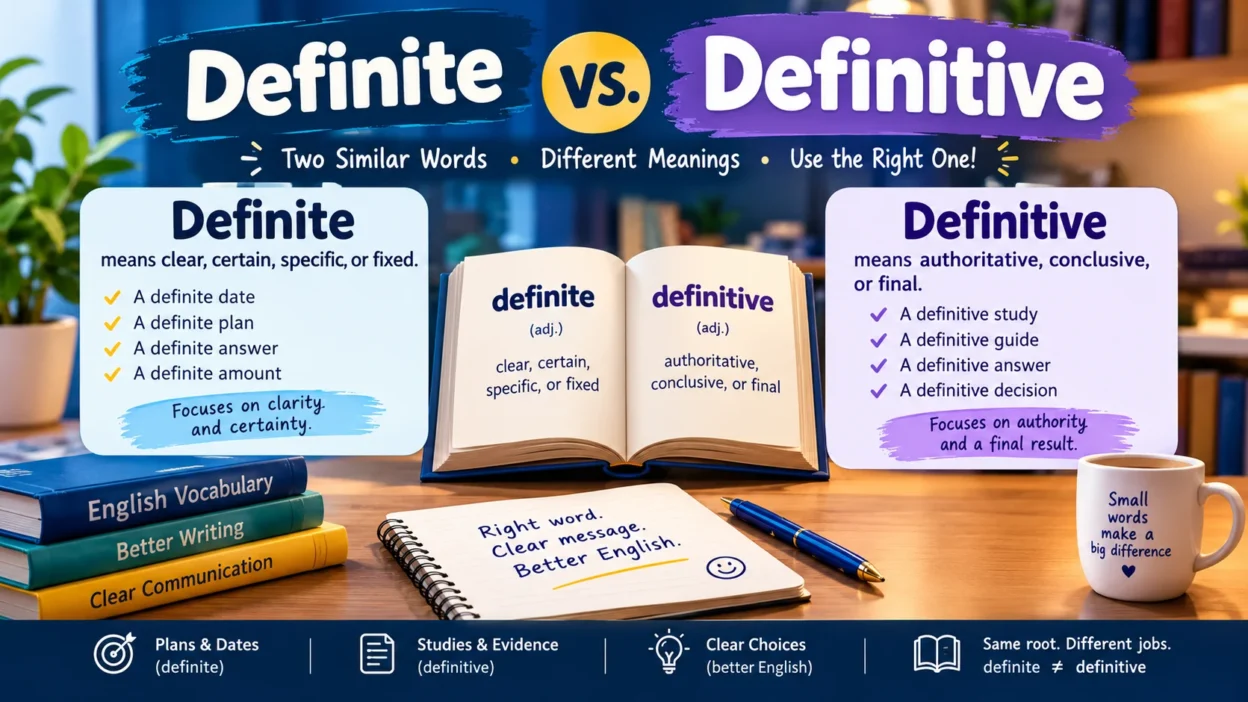
Definite means clear, certain, or fixed. It suggests that something is specific, settled, or not doubtful. For example, “We have a definite plan for the weekend” means the plan is clear and decided. Definitive, on the other hand, means authoritative, conclusive, or final. It often describes something that provides the most reliable answer or settles a question. For example, “The report provides a definitive explanation” means the report gives an authoritative and conclusive explanation.
Although these adjectives sometimes overlap, they are not always interchangeable. The key is to consider whether you mean something is clearly established or whether it provides a final, authoritative answer.
Quick Answer: Definite vs. Definitive
Definite means clear, certain, specific, or fixed. Definitive means final, authoritative, or conclusive. Use definite when something is settled or clearly identified, such as a definite date. Use definitive when something provides a conclusive answer or an authoritative result, such as a definitive study or decision.
Why Do People Confuse Definite and Definitive?
People often confuse these words because they share the root define and can both suggest certainty. Their meanings, however, emphasize different things.
- Definite focuses on clarity, certainty, or something being fixed.
- Definitive focuses on authority, conclusiveness, or providing the final answer.
For example:
- “We have a definite answer.” — The answer is clear and certain.
- “We have a definitive answer.” — The answer is conclusive and settles the question.
Both sentences can be correct, but definitive places more emphasis on settling the issue conclusively.
What Does Definite Mean?
Definite is an adjective meaning clear, certain, specific, or precisely determined. It describes something that is established enough to be understood or relied upon rather than left vague or uncertain.
Examples of Definite in Sentences
- We need a definite date for the meeting.
- She gave me a definite answer.
- There is a definite improvement in his writing.
- I have no definite plans for tomorrow.
- The company has set a definite deadline.
When Should You Use Definite?
Use definite when you want to communicate that something is:
- Certain: There is a definite possibility of rain.
- Specific: We need a definite amount of money.
- Fixed: They agreed on a definite schedule.
- Clearly noticeable: There is a definite difference between the two designs.
- Settled or decided: He made a definite decision to leave.
In everyday English, definite is especially common when discussing plans, dates, amounts, decisions, and noticeable changes.
What Does Definitive Mean?
Definitive is an adjective meaning authoritative, conclusive, or serving as the final and most reliable version or explanation of something. It is often used when a result, decision, study, or source settles a question or establishes an accepted conclusion.
Examples of Definitive in Sentences
- The researchers published a definitive study on the subject.
- The test provided a definitive diagnosis.
- This book is considered the definitive guide to the topic.
- The court issued a definitive ruling.
- We still need definitive proof of the claim.
When Should You Use Definitive?
Use definitive when something is:
- Conclusive: The evidence provides a definitive answer.
- Authoritative: She wrote the definitive biography of the artist.
- Final: The committee reached a definitive decision.
- Reliable and comprehensive: This manual is the definitive reference for the equipment.
- Settling a question: The investigation produced definitive findings.
In scientific, legal, medical, academic, and professional contexts, definitive often suggests a conclusion supported by strong evidence or recognized authority. However, whether a result is genuinely definitive depends on the evidence and context.
Definite vs. Definitive: Comparison Table
| Feature | Definite | Definitive |
|---|---|---|
| Main meaning | Clear, certain, or fixed | Conclusive, authoritative, or final |
| Main emphasis | Clarity and certainty | Settling a question or establishing authority |
| Common uses | Plans, dates, amounts, decisions | Studies, evidence, guides, rulings |
| Everyday example | A definite appointment | A definitive answer |
| Academic example | A definite improvement | A definitive study |
| Professional example | A definite deadline | A definitive report |
| Common synonyms | Certain, specific, clear, fixed | Conclusive, authoritative, final |
| Part of speech | Adjective | Adjective |
The main difference: Something definite is clearly established or specified. Something definitive provides an authoritative or conclusive result.
When to Use Definite vs. Definitive
Choosing the correct word depends on what you want to emphasize.
Use Definite for Certainty or Specificity
Choose definite when discussing something clearly identified, decided, or fixed.
Examples:
- We need a definite time for the interview.
- There is a definite risk of delays.
- She noticed a definite change in his attitude.
- They have a definite plan for the project.
- I cannot give you a definite answer yet.
Use Definitive for Authority or a Conclusive Result
Choose definitive when referring to something that settles a question or serves as an authoritative source.
Examples:
- The investigation reached a definitive conclusion.
- The study offers definitive evidence.
- This is the definitive edition of the novel.
- The judge made a definitive ruling.
- The guide is a definitive resource for beginners.
Can Both Words Be Correct in the Same Situation?
Yes. Some nouns work naturally with both adjectives, but the meaning changes slightly.
Consider the word answer:
- A definite answer: A clear, certain answer rather than a vague or uncertain one.
- A definitive answer: An answer that conclusively settles the question.
The same distinction can apply to decision, result, and conclusion, depending on the context.
12 Examples of Definite vs. Definitive in Sentences
These examples show how the two words work in everyday and formal English.
1. Definite: We have a definite date for the wedding. Definitive: The official announcement gave the definitive date for the event.
2. Definite: She gave me a definite answer about her availability. Definitive: The investigation provided a definitive answer to the question.
3. Definite: There is a definite improvement in your pronunciation. Definitive: The study offers a definitive explanation of the observed results.
4. Definite: The manager set a definite deadline for the report. Definitive: The committee issued a definitive ruling on the dispute.
5. Definite: We need a definite amount before preparing the budget. Definitive: The audit produced definitive evidence of the error.
6. Definite: He has a definite interest in learning English. Definitive: Her book became the definitive reference on English grammar.
7. Definite: There is a definite possibility that the event will be delayed. Definitive: The latest results are not definitive enough to settle the debate.
8. Definite: They made a definite plan for their holiday. Definitive: The travel guide is considered the definitive account of the region.
9. Definite: I noticed a definite difference between the two versions. Definitive: The experiment provided a definitive comparison of the treatments.
10. Definite: The company has a definite goal for the coming year. Definitive: The final report offered a definitive assessment of the company’s performance.
11. Definite: We need a definite response before Friday. Definitive: The court’s ruling provided a definitive resolution of the legal question.
12. Definite: There was a definite sound coming from the next room. Definitive: Investigators have not yet found definitive proof of what caused the sound.
Common Mistakes When Using Definite and Definitive
Mistake 1: Treating the Words as Perfect Synonyms
Although both words can express certainty, they emphasize different ideas.
Incorrect assumption: Definite and definitive always mean exactly the same thing.
Better understanding:
- A definite date is a date that has been specified or fixed.
- A definitive explanation is one that conclusively settles an issue.
Mistake 2: Using Definitive When You Mean Specific
Less natural: “Please provide a definitive meeting time.”
More natural: “Please provide a definite meeting time.”
Use definite when you simply need a specific, confirmed time. Definitive may work if you mean the final, authoritative time after uncertainty or competing proposals have been resolved.
Mistake 3: Assuming Definitive Always Means Permanent
A definitive decision is conclusive in a particular context, but it is not necessarily impossible to review or change.
For example: “The committee made a definitive decision.”
This means the decision settles the matter at that stage; it does not guarantee that circumstances or policies can never change.
Mistake 4: Confusing Definitive With Definite Proof
Both expressions are possible, but they emphasize different things.
- Definite proof: Proof that is clear or certain.
- Definitive proof: Proof that conclusively settles the issue.
The best choice depends on the strength and role of the evidence.
Mistake 5: Using Definitive for Every Final Decision
Definitive is appropriate when a decision is conclusive or authoritative. For ordinary plans and arrangements, definite is often more natural.
For example, “We have a definite plan for lunch” is more natural than “We have a definitive plan for lunch” in most everyday conversations.
Memory Trick: How to Remember the Difference
Use this simple memory trick:
- Definite = Decided or clearly defined.
- Definitive = Decisive and conclusive.
Think of a definite date as a date you know, and a definitive answer as an answer that settles the question.
Another quick test is to ask yourself:
- Do I mean specific, fixed, or certain? Use definite.
- Do I mean authoritative, final, or conclusive? Use definitive.
American vs. British English: Definite and Definitive
There is no major difference between American and British English in the meanings or standard spelling of definite and definitive.
Both varieties use:
- Definite for something clear, certain, or fixed.
- Definitive for something authoritative, conclusive, or final.
Examples in American English:
- We need a definite date for the meeting.
- The report provides a definitive answer.
Examples in British English:
- We need a definite date for the meeting.
- The report provides a definitive answer.
Both spellings are standard in the United States and the United Kingdom. The choice between these words depends on meaning, not regional spelling conventions.
Similar Words: Definite, Definitive, Certain, and Conclusive
Several related adjectives express certainty, but each has its own emphasis.
| Word | Meaning | Example |
|---|---|---|
| Definite | Clear, specific, or fixed | We have a definite appointment. |
| Definitive | Authoritative or conclusive | The study provides a definitive answer. |
| Certain | Known or believed to be true; also used to mean particular | I am certain that she called. |
| Conclusive | Providing enough evidence to settle a question | The evidence was conclusive. |
| Specific | Clearly identified rather than general | Please give me a specific example. |
| Final | Coming at the end or intended to settle a matter | This is the final version of the report. |
| Decisive | Settling an issue or determining an outcome | The team scored a decisive goal. |
Definite vs. certain: Definite often describes a specific or settled thing, while certain commonly expresses confidence or lack of doubt.
Definitive vs. conclusive: These words are close in meaning. Definitive can emphasize authority or status as the accepted reference, while conclusive emphasizes evidence or reasoning that settles a question.
Definitive vs. final: Final means last or settled, while definitive often adds the idea of authority or conclusiveness.
Frequently Asked Questions
1. What is the main difference between definite and definitive?
Definite means clear, certain, specific, or fixed. Definitive means authoritative, conclusive, or final. A definite date is a confirmed date, while a definitive answer settles a question conclusively.
2. Is definite the same as definitive?
No. They are related but not identical. Definite emphasizes clarity or certainty, whereas definitive emphasizes authority or conclusiveness. Depending on the sentence, substituting one for the other may change the intended meaning.
3. Is it a definite answer or a definitive answer?
Both expressions are correct. Use a definite answer when the answer is clear or certain. Use a definitive answer when the answer conclusively settles the question.
4. What does definitive mean in simple words?
Definitive means final, authoritative, or conclusive. For example, a definitive report provides an authoritative account of a subject or settles a particular question.
5. What is an example of definite in a sentence?
“We have a definite plan for the weekend.” Here, definite means that the plan is clear or settled rather than vague or uncertain.
6. What is an example of definitive in a sentence?
“The researchers found definitive evidence to support their conclusion.” Here, definitive means the evidence is conclusive enough to settle the issue in question.
7. Can a decision be definite and definitive?
Yes. A decision can be definite because it is clearly established and definitive because it conclusively settles an issue. The two words describe different aspects of the decision.
8. What is the opposite of definite and definitive?
Opposites depend on the context. For definite, possible opposites include uncertain, vague, and indefinite. For definitive, possible opposites include inconclusive, tentative, and provisional.
Remember This
- Definite = clear, certain, specific, or fixed.
- Definitive = authoritative, conclusive, or final.
- Use definite for dates, plans, amounts, and clearly established details.
- Use definitive for authoritative studies, conclusive evidence, reference works, and decisions that settle questions.
- Both words can describe answers and decisions, but they emphasize different qualities.
Conclusion
Understanding the difference between definite and definitive makes your English clearer and more precise. Although both words relate to certainty, definite focuses on something being clear, specific, or settled, while definitive emphasizes authority, conclusiveness, or a final resolution. Recognizing this distinction helps you avoid awkward word choices in everyday conversations, academic assignments, and professional writing.
When choosing between the two, consider what you want to communicate. If you are talking about a confirmed appointment, a specific amount, or a clear plan, choose definite. If you are describing an authoritative guide, conclusive evidence, or a result that settles a question, choose definitive. With practice, you will find it easier to use both words naturally and confidently.

David Henry is a language enthusiast and content writer specializing in synonyms, vocabulary, and word meanings. He creates clear, engaging resources that help readers improve their writing, communication, and English skills.