
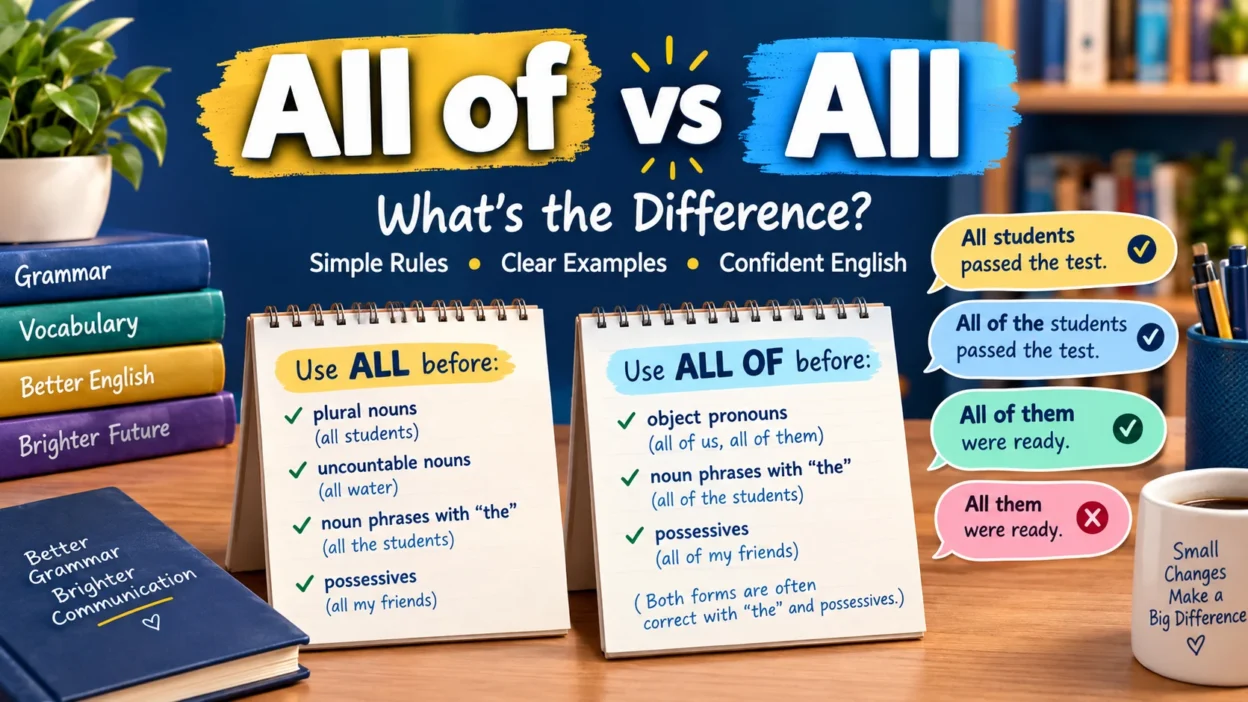
If you are unsure if to say “all of the students” or “all the students,” you are not alone. The expressions all of and all often have the same basic meaning, but they are not always used in exactly the same way. The choice depends mainly on what comes after them.
All means the whole amount or every member of a group. All of is commonly used before pronouns, such as all of them, and before noun phrases with words like the, my, these, or those. In many cases, all of the students and all the students are both correct, although all of can sound slightly more explicit or emphatic.
Understanding this small grammar difference can make your English sound more natural. This guide explains when to use all and all of, with simple rules and practical examples for everyday, academic, and professional English.
Quick Answer
All and all of can both mean “the entire amount” or “every member of a group.” Use all of before object pronouns such as all of them. Before noun phrases, all the students and all of the students are both usually correct. Before a noun without a determiner, use all, not all of.
Why Do People Confuse “All of” and “All”?
The confusion happens because all and all of often have nearly identical meanings.
For example:
- All the children were happy.
- All of the children were happy.
Both sentences mean that the entire group of children was happy.
The important difference is grammatical structure. All of is especially useful when the following word is a pronoun or a noun phrase introduced by a determiner.
Compare:
- All students need practice. ✓
- All of the students need practice. ✓
- All of students need practice. ✗
The third sentence is incorrect because students appears without a determiner such as the, these, those, my, or their.
First Word: “All”
All refers to the complete number or amount of something.
It can be used before plural countable nouns and uncountable nouns.
Before plural nouns
- All students should attend the class.
- All cars need regular maintenance.
- All children deserve support.
Here, all means every member of the group.
Before uncountable nouns
- All the water is gone.
- All information must be checked.
- All available evidence supports the conclusion.
With uncountable nouns, all refers to the entire amount.
“All” as a pronoun
Sometimes all can stand alone.
- All were invited.
- I gave my all.
- All is well.
In these cases, another noun does not immediately follow all.
Second Word: “All of”
All of also means the whole amount or every member of a group.
It is especially common before:
- object pronouns
- noun phrases beginning with the
- possessive determiners
- demonstratives such as these and those
With object pronouns
Use all of before pronouns such as us, you, them, and it.
- All of us agreed.
- All of them arrived early.
- All of you did a great job.
- All of it was useful.
Do not normally say:
- All us agreed. ✗
- All them arrived. ✗
With “the”
Both forms are possible:
- All the students passed.
- All of the students passed.
The word of is optional in this structure.
With possessives
Both forms can also occur with possessive determiners:
- All my friends came.
- All of my friends came.
Similarly:
- All their money was spent.
- All of their money was spent.
All of vs All: Comparison Table
| Structure | Correct? | Example |
|---|---|---|
| all + plural noun | ✓ | All students attended. |
| all + uncountable noun | ✓ | All information was useful. |
| all + the + noun | ✓ | All the students attended. |
| all of + the + noun | ✓ | All of the students attended. |
| all + my/your/their + noun | ✓ | All my friends agreed. |
| all of + my/your/their + noun | ✓ | All of my friends agreed. |
| all of + object pronoun | ✓ | All of them agreed. |
| all + object pronoun | ✗ | All them agreed. |
| all of + noun without determiner | Usually ✗ | All of students agreed. |
| all + noun without determiner | ✓ | All students agreed. |
When Should You Use Each?
Use “all” before a noun without a determiner
When a plural or uncountable noun is used generally, all is the natural choice.
- All employees must follow the rules.
- All animals need water.
- All information should be accurate.
Use “all” or “all of” before “the”
Both are correct:
- All the books are new.
- All of the books are new.
The shorter version is very common in everyday English.
Use “all” or “all of” with possessives
Both are possible:
- All my family members attended.
- All of my family members attended.
The same applies to your, his, her, our, their, and other possessive determiners.
Use “all of” before object pronouns
This is an important rule.
Say:
- All of us
- All of you
- All of them
- All of it
Not:
- All us ✗
- All them ✗
12 Examples of “All of” and “All”
Here are practical examples showing the difference.
1. General plural noun
All students need regular practice.
Here, students is a general plural noun, so all is used directly.
2. Noun with “the”
All the students passed the test.
You can also say:
All of the students passed the test.
Both are correct.
3. Object pronoun
All of them were ready.
Because them is an object pronoun, of is required.
4. Uncountable noun
All the water has disappeared.
This refers to the entire amount of water.
5. Possessive determiner
All of my friends live nearby.
You can also say:
All my friends live nearby.
6. “Us”
All of us enjoyed the trip.
Not “all us.”
7. “You”
All of you should complete the assignment.
This refers to the entire group being addressed.
8. General noun
All employees must wear identification badges.
The noun employees is being discussed generally.
9. “The”
All of the money was spent.
Here, all of refers to the entire amount of a particular sum.
10. Possessive
All their plans changed unexpectedly.
This can also be written:
All of their plans changed unexpectedly.
11. Demonstrative
All of these examples are useful.
You can also say:
All these examples are useful.
12. Another pronoun
All of it was necessary.
Here, it is an object pronoun, so all of it is the standard construction.
Common Mistakes
Mistake 1: “All of students”
❌ All of students attended the lecture.
✓ All students attended the lecture.
✓ All of the students attended the lecture.
Add the if you want to use all of before students.
Mistake 2: “All them”
❌ I invited all them.
✓ I invited all of them.
The pronoun them requires of after all in this construction.
Mistake 3: Thinking “all of” is always wrong
Some learners avoid all of because they have learned that all is enough.
But this is correct:
✓ All of us were excited.
✓ All of the students passed.
Mistake 4: Thinking “all of” is always required
You do not need of before every noun phrase.
Both are correct:
✓ All the books are interesting.
✓ All of the books are interesting.
Mistake 5: Confusing “all” with “every”
All and every are related but have different grammar.
Say:
- All students
- Every student
Do not say:
- All student ✗
- Every students ✗
All normally works with plural or uncountable nouns, while every takes a singular countable noun.
Memory Trick
Use this simple rule:
ALL + noun
ALL OF + pronoun
For example:
- All students ✓
- All of the students ✓
- All of them ✓
Think:
Noun → all
Pronoun → all of
When the, my, these, those, or another determiner comes before the noun, both forms are often possible:
- all the books
- all of the books
American vs British English
There is no major difference between American and British English in the basic grammar of all and all of.
Both varieties commonly use:
- all students
- all the students
- all of the students
- all of them
- all my friends
- all of my friends
The choice between all the and all of the is often influenced by style, rhythm, and emphasis rather than by a strict American-versus-British rule.
In both varieties, all of them is standard, while all them is not standard in formal English.
Similar Words
Several expressions are closely related to all.
Every
Every refers to each individual member of a group.
- Every student received a certificate.
Compare:
- All students received certificates.
- Every student received a certificate.
Entire
Entire means complete or whole.
- I read the entire book.
- She spent the entire day studying.
Whole
Whole also emphasizes completeness.
- He ate the whole cake.
- We spent the whole afternoon there.
Both
Both means the two members or things in a pair.
- Both students passed.
You would not normally use all for exactly two items when both is the more precise choice.
Final Verdict
The difference between all and all of is mainly about what follows them.
Use all directly before a plural or uncountable noun:
- all students
- all information
- all water
Use all of before object pronouns:
- all of us
- all of them
- all of it
Before noun phrases beginning with the, my, your, these, those, and similar determiners, both forms are generally possible:
- all the students
- all of the students
So, neither expression is simply “more correct.” The right choice depends on the grammatical structure that follows it.
Frequently Asked Questions
Is “all of the” grammatically correct?
Yes. All of the is completely correct.
For example:
All of the students completed the assignment.
You can also say all the students completed the assignment.
Is “all of” or “all” more correct?
Neither is universally more correct. All and all of are both correct in different structures. Before object pronouns, use all of, while before many noun phrases, either form may work.
Can I say “all of them”?
Yes. All of them is the standard form.
Example:
I checked all of them before submitting the report.
Can I say “all them”?
No, not in standard formal English.
Use:
all of them
Is “all of the students” correct?
Yes. All of the students is grammatically correct.
All the students is also correct and is often more concise.
Is “all of students” correct?
Usually no. When students is a general plural noun, say all students.
If you mean a particular group, say all of the students.
Can I say “all of my friends”?
Yes. This is correct.
You can also say:
all my friends
Both are grammatical.
What is the easiest way to remember the difference?
Remember:
All + noun: all students
All of + pronoun: all of them
When a determiner such as the, my, these, or those appears before the noun, both all and all of can often be used.
Remember This
The simplest rule is:
Use “all” directly with a noun. Use “all of” before object pronouns.
- All students passed. ✓
- All of the students passed. ✓
- All of them passed. ✓
- All of students passed. ✗
- All them passed. ✗
When you see the, my, your, these, those, remember that both all and all of may be possible.
Conclusion
All of and all usually express the idea of a complete group or amount, but their grammatical patterns are slightly different. All can come directly before plural and uncountable nouns, while all of is especially important before object pronouns such as us, you, them, and it.
Before phrases such as the students, my friends, or these books, both forms are generally correct. Once you remember the basic patterns—all students, all of the students, and all of them—choosing between the two becomes much easier.

Daniel Jack is a language enthusiast and content writer who specializes in synonyms, vocabulary, and word meanings. He creates clear, engaging resources that help readers improve communication and expand their English skills.