
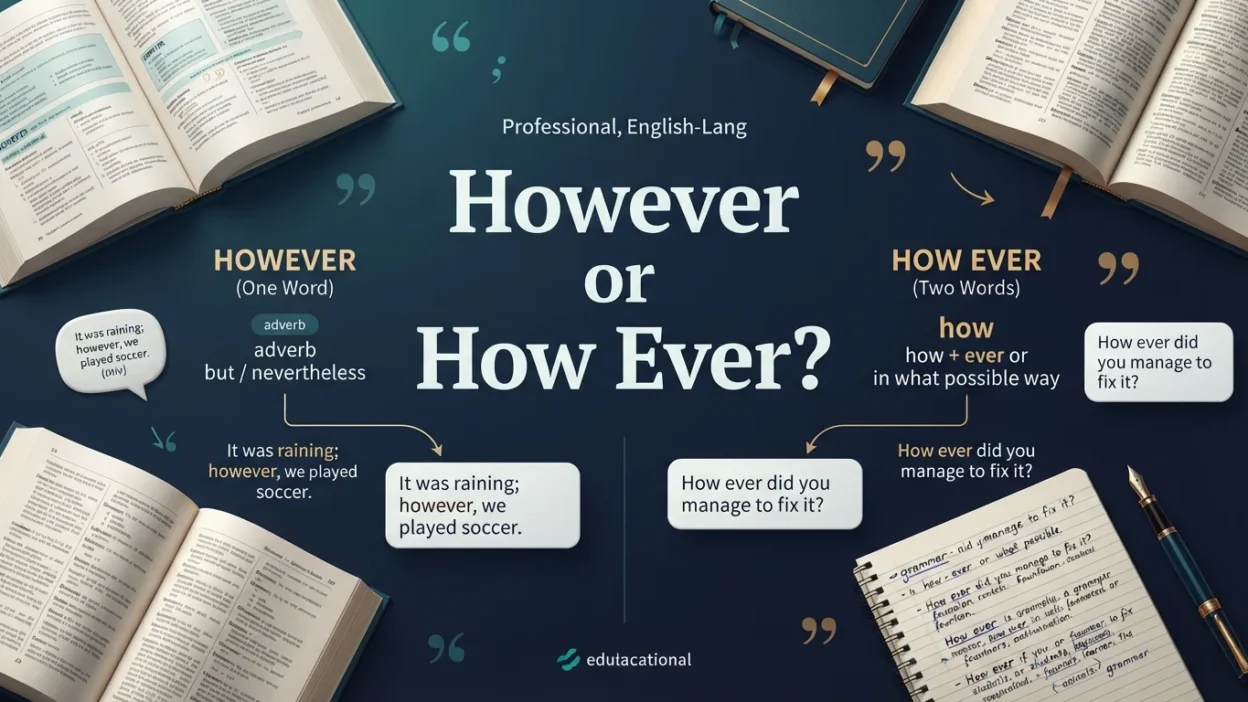
If you are wondering if to write “however” or “how ever,” the correct choice depends on what you mean. However is normally written as one word when it means “but,” “nevertheless,” or “in spite of that.” For example: I wanted to go; however, I was too tired. How ever is written as two words when how and ever have separate grammatical roles, usually when asking about the method or degree of something: How ever did you manage to finish so quickly?
Although these forms look almost identical, they do not always have the same meaning or function. Understanding the difference will help you write more naturally and avoid a common spelling mistake. This guide explains however vs. how ever with simple rules, examples, comparisons, and practical tips for students, ESL learners, writers, and everyday English users.
Quick Answer
However is usually correct when it means “but,” “nevertheless,” or “in contrast.” How ever is used when how and ever function separately, often to express surprise or emphasis in a question. In most ordinary contrast sentences, use however as one word.
Why Do People Confuse “However” and “How Ever”?
The confusion comes from the fact that however can be divided visually into how + ever. However, modern English does not treat the two forms as interchangeable.
The word however has its own established meanings and grammatical functions. It can introduce a contrast, qualify a statement, or mean “to whatever degree.”
On the other hand, how ever occurs when how is the main question word and ever adds emphasis.
Compare these sentences:
- I was tired; however, I continued working.
- How ever did you solve that difficult problem?
In the first sentence, however means nevertheless. In the second, how asks about the manner or method, while ever adds emphasis or surprise.
What Does “However” Mean?
However is most commonly an adverb meaning “but,” “nevertheless,” or “in spite of that.”
It is used to show a contrast between two ideas.
Example:
The weather was cold. However, we went for a walk.
Here, however tells us that going for a walk contrasts with the cold weather.
“However” Can Also Mean “To Whatever Degree”
In some sentences, however means “no matter how” or “to whatever extent.”
For example:
However difficult the test is, I will try my best.
This means:
No matter how difficult the test is, I will try my best.
Another example:
However carefully you plan, unexpected problems can happen.
This means that unexpected problems can happen regardless of how carefully you plan.
What Does “How Ever” Mean?
How ever consists of two separate words: how and ever.
It is generally used when how asks about the manner, method, degree, or circumstances of something, while ever adds emphasis.
For example:
How ever did you find that tiny restaurant?
The speaker is expressing surprise and asking how the person managed to find it.
Another example:
How ever could she afford such an expensive car?
Here, ever makes the question more emphatic. The speaker is surprised and wants to know how it was possible.
Is “How Ever” Common?
How ever is much less common than however. It usually appears in questions or emphatic expressions.
You should not automatically separate however simply because it contains the letters how and ever.
However vs. How Ever: Comparison Table
| Feature | However | How ever |
|---|---|---|
| Spelling | One word | Two words |
| Main function | Shows contrast or degree | Emphasizes “how” |
| Common meaning | But, nevertheless | In what way/how, with emphasis |
| Common use | Statements and clauses | Questions and emphatic expressions |
| Example | It was expensive; however, I bought it. | How ever did you afford it? |
| Frequency | Very common | Less common |
| Can mean “nevertheless”? | Yes | No |
When Should You Use “However”?
Use however when you want to introduce a contrast.
1. To Mean “But”
I wanted to buy the laptop. However, it was too expensive.
2. To Mean “Nevertheless”
She was nervous. However, she gave an excellent presentation.
3. To Connect Contrasting Ideas
The restaurant was crowded; however, we found a table.
4. To Mean “No Matter How”
However busy he becomes, he always calls his parents.
In this meaning, however is still one word.
When Should You Use “How Ever”?
Use how ever when how retains its question function and ever emphasizes it.
For example:
How ever did you know that?
The question is essentially:
How did you know that?
The word ever adds surprise or emphasis.
Another example:
How ever can we finish all this work today?
This expresses strong doubt or surprise about how something could be accomplished.
12 Examples of “However” and “How Ever”
Examples With “However”
- I was tired; however, I finished my homework.
- The plan sounds good. However, it may be difficult to implement.
- He studied hard; however, he did not pass the exam.
- The hotel was expensive. However, the service was excellent.
- I understand your point; however, I disagree with your conclusion.
- However carefully you drive, accidents can sometimes happen.
Examples With “How Ever”
- How ever did you manage to solve that puzzle?
- How ever could they afford such a large house?
- How ever will we finish this project by tomorrow?
- How ever did you find my old photograph?
- How ever can anyone remember all those details?
- How ever were you able to carry all those boxes?
Notice the difference: however commonly connects or contrasts ideas, while how ever emphasizes a question about how something happened or could happen.
Common Mistakes With “However” and “How Ever”
Mistake 1: Writing “How Ever” Instead of “However”
Incorrect:
I wanted to attend. How ever, I was busy.
Correct:
I wanted to attend. However, I was busy.
When the meaning is “but” or “nevertheless,” use however.
Mistake 2: Always Writing “However” as One Word
Sometimes how ever is intentionally written as two words.
How ever did you discover that?
Here, separating the words is appropriate because how is functioning as the question word.
Mistake 3: Confusing “However” With “But”
However and but can both express contrast, but their punctuation and position can differ.
I wanted to go, but I was busy.
I wanted to go. However, I was busy.
Mistake 4: Forgetting Punctuation Around “However”
When however is used as a sentence adverb to introduce a contrasting statement, it is commonly followed by a comma.
However, the results were different.
When it appears in the middle of a clause, commas may be used around it:
The results, however, were different.
Punctuation can vary depending on the exact grammatical structure, so the key is to consider how however functions in the sentence.
A Simple Memory Trick
Use this easy test:
Can you replace the word with “but” or “nevertheless”?
If yes, use however.
I wanted to leave. However, I stayed.
You could say:
I wanted to leave. Nevertheless, I stayed.
So however is correct.
If how is asking about a method or manner and ever adds emphasis, use how ever.
How ever did you do that?
Think:
However = contrast
How ever = emphatic “how”
American vs. British English
The distinction between however and how ever is generally the same in both American and British English.
Both varieties commonly use however as a contrast marker:
The journey was long. However, it was enjoyable.
Both can also use how ever in emphatic questions:
How ever did you manage that?
There is no major American-versus-British spelling difference that changes the basic rule. The important issue is meaning and grammatical function, not regional English.
Similar Words and Expressions
Several words and phrases can overlap with however, especially when it means “but” or “nevertheless.”
But
But is a very common way to introduce a contrast.
I wanted to help, but I was busy.
Nevertheless
Nevertheless means “despite that” or “even so.”
The task was difficult. Nevertheless, we completed it.
Nonetheless
Nonetheless is similar to nevertheless and is often used in formal writing.
The evidence was limited. Nonetheless, the researchers continued.
Yet
Yet can introduce an unexpected contrast.
She is young, yet she is very experienced.
Still
Still can show that something remains true despite another fact.
It was expensive. Still, I decided to buy it.
These alternatives are useful, but they are not always grammatically interchangeable with however.
Final Verdict: However or How Ever?
For most everyday sentences involving contrast, however is the correct form.
Use however when it means:
- but
- nevertheless
- in spite of that
- to whatever degree / no matter how
Use how ever when how is functioning separately as a question word and ever adds emphasis.
The easiest rule is:
If you mean “but,” choose “however.” If you are emphasizing a question beginning with “how,” “how ever” may be appropriate.
Frequently Asked Questions
Is “however” one word or two?
However is normally one word. It is commonly used to mean “but,” “nevertheless,” or “in spite of that.”
Is “how ever” grammatically correct?
Yes. How ever can be grammatically correct when how and ever have separate functions, especially in an emphatic question such as How ever did you do that?
Is “however” the same as “but”?
They can have similar meanings when expressing contrast, but they do not always have identical grammar or punctuation. However is often used as a sentence adverb, while but commonly joins two clauses.
Should I write “however” or “how ever” in a formal essay?
In most cases, use however if you mean “but” or “nevertheless.” Use how ever only when the sentence genuinely requires the separate words.
Can “however” start a sentence?
Yes. However can begin a sentence when it introduces a contrasting idea.
The evidence seemed convincing. However, further research revealed problems.
Does “however” always show contrast?
No. However can also mean “no matter how” or “to whatever degree.”
However hard she tries, she cannot solve the problem.
What is an easy way to remember the difference?
Remember:
However = but/nevertheless
How ever = emphasized how
Remember This
- However is one word.
- Use however when you mean “but” or “nevertheless.”
- However can also mean “no matter how.”
- How ever is two words when how and ever function separately.
- How ever is especially common in emphatic questions.
- The difference is based on meaning and grammar, not American versus British spelling.
Conclusion
Choosing between however and how ever becomes easy once you look at the meaning of the sentence. In ordinary contrast statements, however is the correct one-word form. It can mean “but,” “nevertheless,” or “in spite of that,” and it can also introduce expressions such as however difficult.
How ever is different because the words perform separate grammatical roles. It is typically used to add emphasis to a question beginning with how, as in How ever did you manage that? When you remember “however = contrast” and “how ever = emphatic how,” you can usually choose the correct form confidently.

Daniel Jack is a language enthusiast and content writer who specializes in synonyms, vocabulary, and word meanings. He creates clear, engaging resources that help readers improve communication and expand their English skills.