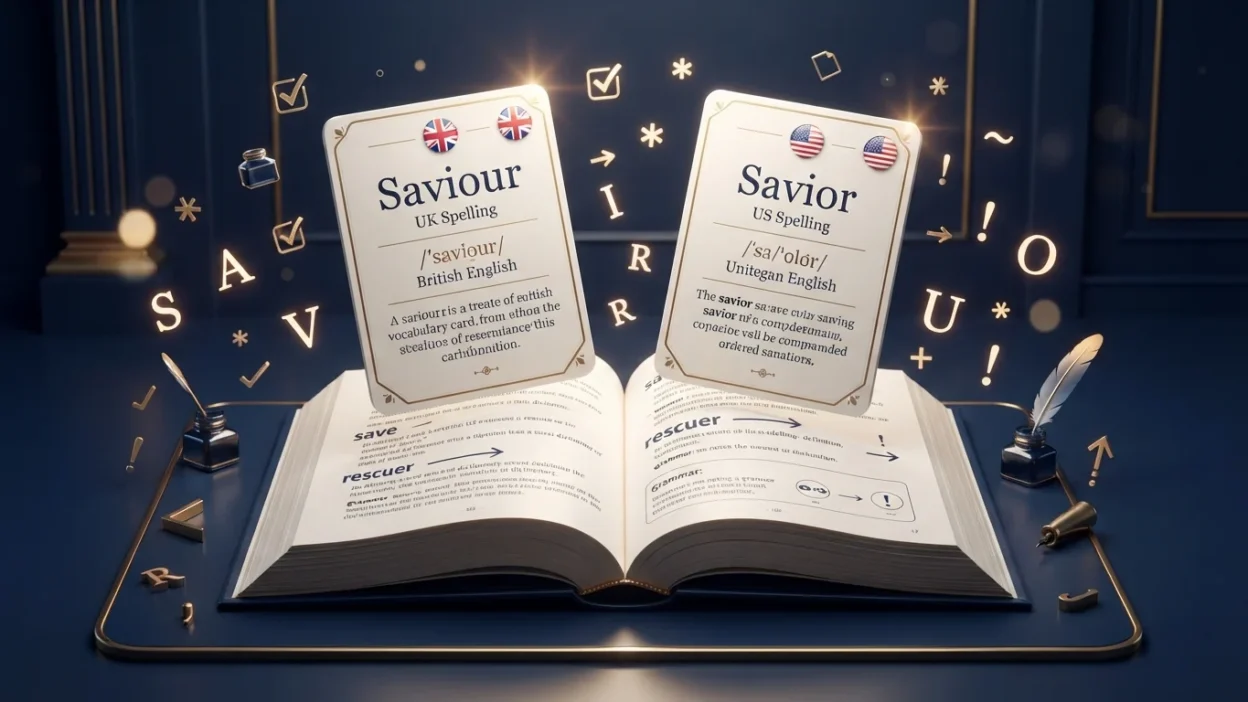
If you are wondering if “saviour” or “savior” is correct, both spellings are correct. The difference is mainly British vs. American English. Saviour is the standard spelling in British English, while savior is the standard spelling in American English. Both words have the same meaning: a person who saves someone from danger, difficulty, or harm. The word can also refer to a religious figure, especially Jesus Christ, who is called the Savior or Saviour in Christianity.
Choosing the right spelling depends on the variety of English you are using. If you are writing for a British, Australian, or other Commonwealth audience, saviour is usually preferred. For an American audience, use savior. Understanding this small spelling difference can help you write consistently and avoid unnecessary confusion.
Quick Answer: Saviour or Savior?
Saviour and savior are both correct spellings of the same word. Saviour is preferred in British English, while savior is preferred in American English. Both mean someone who saves another person from danger, trouble, or harm, and both can have religious meanings.
Why Do People Confuse “Saviour” and “Savior”?
The confusion comes from differences between British and American spelling conventions.
Many English words have slightly different spellings depending on the variety of English being used. Words ending in -our in British English often end in -or in American English.
For example:
- British: saviour
- American: savior
- British: colour
- American: color
- British: favour
- American: favor
- British: honour
- American: honor
So, the extra u in saviour does not change its meaning or pronunciation.
First Word: Saviour
Saviour is the traditional British English spelling.
It means a person who saves someone from danger, difficulty, suffering, or failure. It can also be used as a religious title.
Examples
- The firefighter was hailed as a saviour after rescuing the family.
- Many Christians refer to Jesus Christ as their Saviour.
- The new policy was seen as a saviour for the struggling industry.
In British English, saviour is generally the preferred spelling in formal writing.
Second Word: Savior
Savior is the standard American English spelling.
It has exactly the same meaning as saviour. The only difference is the spelling.
Examples
- The firefighter was hailed as a savior after rescuing the family.
- Christians often refer to Jesus Christ as their Savior.
- The new treatment became a savior for many patients.
If you are writing according to American English conventions, savior is the natural choice.
Saviour vs Savior: Comparison Table
| Feature | Saviour | Savior |
|---|---|---|
| Meaning | A person who saves someone | A person who saves someone |
| Spelling | British English | American English |
| Pronunciation | Same | Same |
| Number of syllables | 2 | 2 |
| Religious use | Yes | Yes |
| Common in the UK | Yes | Less common |
| Common in the US | Less common | Yes |
| Meaning difference | None | None |
When Should You Use Saviour?
Use saviour when writing in British English or for audiences that generally follow British spelling.
This spelling is especially appropriate in:
- UK English
- Many Commonwealth English contexts
- British-style academic writing
- British newspapers and publications
- Religious writing following British spelling conventions
Example:
The doctor was considered a saviour by the local community.
When Should You Use Savior?
Use savior when writing in American English.
It is appropriate for:
- US English
- American academic writing
- American publications
- US-based websites and businesses
- Audiences accustomed to American spelling
Example:
The doctor was considered a savior by the local community.
Saviour or Savior: 10+ Examples
The meaning remains unchanged regardless of which spelling you choose.
- British: The lifeguard became a saviour after rescuing the swimmer.
American: The lifeguard became a savior after rescuing the swimmer. - British: She saw her mentor as a saviour during a difficult period.
American: She saw her mentor as a savior during a difficult period. - British: The charity was a saviour for many families.
American: The charity was a savior for many families. - British: The firefighter was praised as a saviour.
American: The firefighter was praised as a savior. - British: The new invention could be a saviour for the industry.
American: The new invention could be a savior for the industry. - British: He described his teacher as his saviour.
American: He described his teacher as his savior. - British: In Christian belief, Jesus is the Saviour.
American: In Christian belief, Jesus is the Savior. - British: The rescue team acted as saviours during the emergency.
American: The rescue team acted as saviors during the emergency. - British: The medicine was described as a potential saviour for the patient.
American: The medicine was described as a potential savior for the patient. - British: The organization became a saviour to people affected by the disaster.
American: The organization became a savior to people affected by the disaster. - British: Many people considered the leader a saviour of the nation.
American: Many people considered the leader a savior of the nation.
Common Mistakes
Mistake 1: Thinking one spelling is incorrect
Neither spelling is wrong.
Saviour is standard British spelling, while savior is standard American spelling.
Mistake 2: Mixing spelling styles
Try to remain consistent within the same piece of writing.
For example, if your text uses:
- colour
- favour
- honour
then saviour fits the same British spelling pattern.
If your text uses:
- color
- favor
- honor
then savior is the appropriate American form.
Mistake 3: Assuming the pronunciation changes
The spelling changes, but the pronunciation and meaning are essentially the same.
Memory Trick
A simple way to remember the difference is:
British English = Saviour with “U”
American English = Savior without “U”
Think of the British forms colour, favour, honour, saviour as keeping the U.
American English commonly removes that U:
color, favor, honor, savior
American vs British English
The difference between saviour and savior is a spelling difference based on regional English conventions.
British English generally retains the -our ending:
saviour
American English generally uses -or:
savior
The same pattern appears in several related words, including colour/color, favour/favor, and honour/honor.
Other English-speaking countries may follow either British or American conventions, or have their own established style preferences. When writing for a particular audience, it is best to follow that audience’s standard consistently.
Similar Words
Depending on the context, several words can express an idea similar to saviour/savior:
- Rescuer — someone who saves another person from immediate danger.
- Lifesaver — someone or something that prevents serious trouble or saves a life.
- Hero — a person admired for brave or noble actions.
- Protector — someone who keeps another person safe.
- Deliverer — someone who frees another person from danger or difficulty.
- Helper — someone who provides assistance.
- Guardian — someone who protects or watches over another person.
- Redeemer — someone who saves, restores, or frees; often used in religious contexts.
These words are related but are not always interchangeable. Saviour/savior specifically emphasizes the idea of saving someone from danger, difficulty, or suffering.
Final Verdict
Saviour and savior are both correct.
- Choose saviour for British English.
- Choose savior for American English.
- Both have the same meaning.
- Both can be used in religious and non-religious contexts.
- The difference is primarily spelling, not pronunciation or meaning.
The most important thing is to match your spelling to the variety of English you are using.
Frequently Asked Questions
Is “saviour” or “savior” correct?
Both are correct. Saviour is the standard British English spelling, while savior is the standard American English spelling.
Is “saviour” British or American?
Saviour is primarily the British English spelling. It is also used in other varieties of English influenced by British spelling conventions.
Is “savior” American English?
Yes. Savior is the standard spelling in American English.
Do “saviour” and “savior” have the same meaning?
Yes. They have the same meaning and refer to a person who saves someone from danger, difficulty, harm, or suffering.
Is Jesus called “Saviour” or “Savior”?
Both spellings are used. Saviour is common in British English religious writing, while Savior is common in American English religious writing.
How do you pronounce “saviour” and “savior”?
They are generally pronounced the same way. The spelling difference does not normally create a difference in pronunciation.
Can I use “saviour” in American English?
You can, but savior is the standard American spelling. If you are following American English style, savior is usually the better choice.
What is the plural of “saviour” and “savior”?
The British plural is saviours, while the American plural is saviors.
Remember This
Saviour = British English
Savior = American English
Same meaning. Same basic pronunciation. Different spelling.
Conclusion
The choice between saviour and savior is simple once you know the difference between British and American spelling. Saviour is the preferred British form, while savior is the preferred American form. Neither spelling changes the word’s basic meaning.
When writing, focus on consistency. If you are using British English, choose saviour. If you are using American English, choose savior. Once you remember the -our versus -or pattern, this spelling difference becomes much easier to recognize.

David Henry is a language enthusiast and content writer specializing in synonyms, vocabulary, and word meanings. He creates clear, engaging resources that help readers improve their writing, communication, and English skills.