
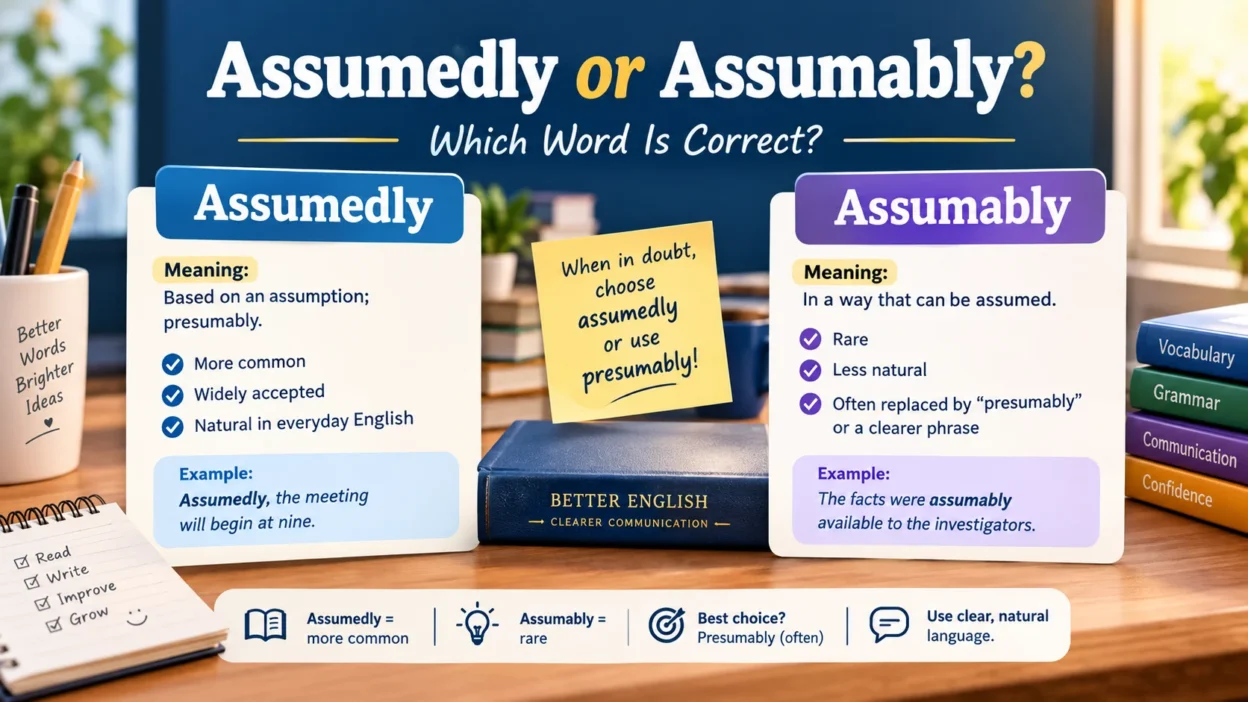
When you want to say that something is accepted as true based on available information, assumedly and assumably may both appear possible. However, they are not equally common or natural in modern English. Assumedly is the more established and widely used choice when you mean “presumably” or “as can be assumed.” Assumably is a real word, but it is uncommon and can sound awkward in everyday writing.
Understanding the difference matters because these adverbs can look almost identical while having different levels of natural usage. For students, ESL learners, writers, and professionals, choosing the more familiar form can make your English clearer and more idiomatic. In most ordinary sentences, assumedly is the safer choice, although presumably, apparently, or supposedly may sometimes express the intended meaning better.
Quick Answer
Assumedly is generally the better and more common choice when you mean “presumably,” “by assumption,” or “as one can reasonably assume.” Assumably exists but is rare and less natural in everyday English. When in doubt, use assumedly or choose a clearer alternative such as presumably.
Why Do People Confuse “Assumedly” and “Assumably”?
The confusion comes from the verb assume.
Both words appear to be formed from the same root:
- assume → to accept something as true without complete proof
- assumedly → based on an assumption; presumably
- assumably → in a manner that can be assumed
Because -ly and -ably are common adverb-forming patterns, it is easy to think that both forms are equally common.
In practice, however, assumedly is much more familiar and useful in general English.
What Does “Assumedly” Mean?
Assumedly is an adverb meaning “presumably,” “as is assumed,” or “based on what is believed to be true.”
It is used when you are making a statement based on an assumption rather than definite knowledge.
Examples
- Assumedly, the meeting will begin at nine.
- She is assumedly responsible for the decision.
- He was assumedly unaware of the changes.
In many situations, presumably sounds more natural:
Presumably, the meeting will begin at nine.
This is especially true in everyday conversation.
What Does “Assumably” Mean?
Assumably is an adverb derived from assumable, meaning something that can be assumed.
It can mean “in a way that can be assumed” or “as something that may reasonably be assumed.”
However, it is uncommon in modern general English.
For example:
The facts were assumably available to the investigators.
Although this construction can be understood, many readers would find this more natural:
The facts were presumably available to the investigators.
Or:
The facts could reasonably be assumed to be available to the investigators.
Assumedly vs. Assumably: Comparison Table
| Feature | Assumedly | Assumably |
|---|---|---|
| Part of speech | Adverb | Adverb |
| Basic idea | Based on an assumption | In a way that can be assumed |
| Commonness | More common | Rare |
| Natural in general writing | Yes, though “presumably” is often better | Usually less natural |
| Best alternative | Presumably | Presumably / reasonably |
| Suitable for learners | Yes | Usually avoid unless context requires it |
When Should You Use Each?
Use “Assumedly” When You Mean “Presumably”
Use assumedly when you are making a statement based on an assumption.
Assumedly, they already know about the change.
However, presumably is often smoother:
Presumably, they already know about the change.
Use “Assumably” When You Specifically Mean “In a Way That Can Be Assumed”
Assumably can be used when the focus is on something being capable of being assumed.
Still, because the word is uncommon, rewriting the sentence is often preferable.
Instead of:
The result is assumably correct.
Consider:
The result can reasonably be assumed to be correct.
12 Examples of “Assumedly” and “Assumably”
- Assumedly, the manager has already approved the request.
- Assumedly, everyone received the email.
- She was assumedly responsible for organizing the event.
- Assumedly, the documents were checked before publication.
- He had assumedly left before the storm began.
- Assumedly, the company will announce its decision soon.
- The information was assumedly accurate at the time.
- Assumedly, they knew about the problem beforehand.
- The figures were assumably based on the latest report.
- The conclusion was assumably reached from the available evidence.
- The information could reasonably be assumed to be correct.
- The outcome was presumably expected by the organizers.
Notice that examples 9 and 10 are grammatically understandable, but many writers would naturally replace assumably with a clearer construction.
Common Mistakes
Mistake 1: Assuming Both Words Are Equally Common
They are not equally common in ordinary English.
Assumedly is the more familiar form.
Mistake 2: Using “Assumably” Simply Because It Sounds More Formal
A longer word is not automatically more sophisticated.
Assumably, he knew the answer.
is not necessarily better than:
Presumably, he knew the answer.
Mistake 3: Using “Assumedly” When “Apparently” Is Intended
These words can express different ideas.
- Assumedly = based on an assumption
- Apparently = according to what appears to be true
Compare:
Assumedly, John is at home.
This means you are assuming he is at home.
Apparently, John is at home.
This means available evidence suggests that he is at home.
Mistake 4: Using an Adverb When a Clearer Construction Is Better
Instead of forcing assumedly or assumably into a sentence, you can often write:
It can reasonably be assumed that…
This is especially useful in formal or academic writing.
Memory Trick
Remember:
Assumedly = assumption → presumably
If you are tempted to use assumably, ask yourself:
“Do I simply mean ‘presumably’?”
If the answer is yes, presumably is usually the clearest choice.
American vs. British English
There is no major American-versus-British distinction that makes assumedly correct in one variety and assumably correct in the other.
Both varieties can encounter these forms, but assumably remains relatively uncommon. Assumedly is more recognizable, while presumably is generally a more natural and widely useful alternative in both American and British English.
Similar Words
Several words can express ideas related to assumedly, but their meanings are not identical.
Presumably
Means probably or based on what is reasonably believed.
Presumably, she has already left.
This is often the best everyday alternative to assumedly.
Apparently
Means according to what seems or appears to be true.
Apparently, the store is closed today.
Supposedly
Means according to what people say or what is believed, sometimes with doubt.
Supposedly, the project will finish this month.
Probably
Means very likely.
He will probably arrive soon.
Certainly
Means definitely or without reasonable doubt.
She will certainly arrive soon.
Unlike assumedly, certainly expresses a much higher level of confidence.
Final Verdict: Assumedly or Assumably?
Assumedly is generally the better choice between the two when you want an adverb related to making an assumption.
Assumably is not simply a spelling mistake, but it is uncommon and often sounds less natural. In most everyday, academic, and professional situations, presumably will be clearer and more idiomatic.
Best choices
- Assumedly → acceptable and established
- Assumably → uncommon; use cautiously
- Presumably → usually the most natural alternative
FAQs
Is “assumedly” a correct word?
Yes. Assumedly is a correct English adverb meaning roughly “presumably” or “based on an assumption.”
Is “assumably” a real word?
Yes. Assumably is a real but uncommon adverb related to something that can be assumed. It is much less familiar than assumedly.
Which is more common, assumedly or assumably?
Assumedly is generally more common and recognizable. Assumably is relatively rare in ordinary English.
Is “assumedly” the same as “presumably”?
They are closely related, but presumably is usually more natural. Both can indicate that something is being accepted as likely based on an assumption.
Should I use “assumably” in academic writing?
Usually, it is better to choose a clearer alternative. Depending on the meaning, presumably, apparently, or “can reasonably be assumed” may be more appropriate.
What is the opposite of “assumedly”?
There is no single direct opposite in every context. Depending on the intended meaning, expressions such as certainly, definitely, or provenly may contrast with an assumption.
Is “presumably” better than “assumedly”?
Often, yes. Presumably is widely used and sounds natural in both everyday and formal English.
Remember This
Assumedly is the safer word when choosing between assumedly and assumably. But if you want the most natural everyday expression, presumably is often the best choice.
Conclusion
The difference between assumedly and assumably is mainly one of usage and naturalness. Assumedly is an established adverb that means something like “presumably” or “based on an assumption.” Assumably also exists, but it is uncommon and may sound awkward to many readers.
For clear English, especially when writing for a broad audience, choose assumedly when appropriate and consider presumably when it expresses your meaning. If you specifically need to say that something can be assumed, a phrase such as “can reasonably be assumed” is often clearer than assumably.

David Henry is a language enthusiast and content writer specializing in synonyms, vocabulary, and word meanings. He creates clear, engaging resources that help readers improve their writing, communication, and English skills.