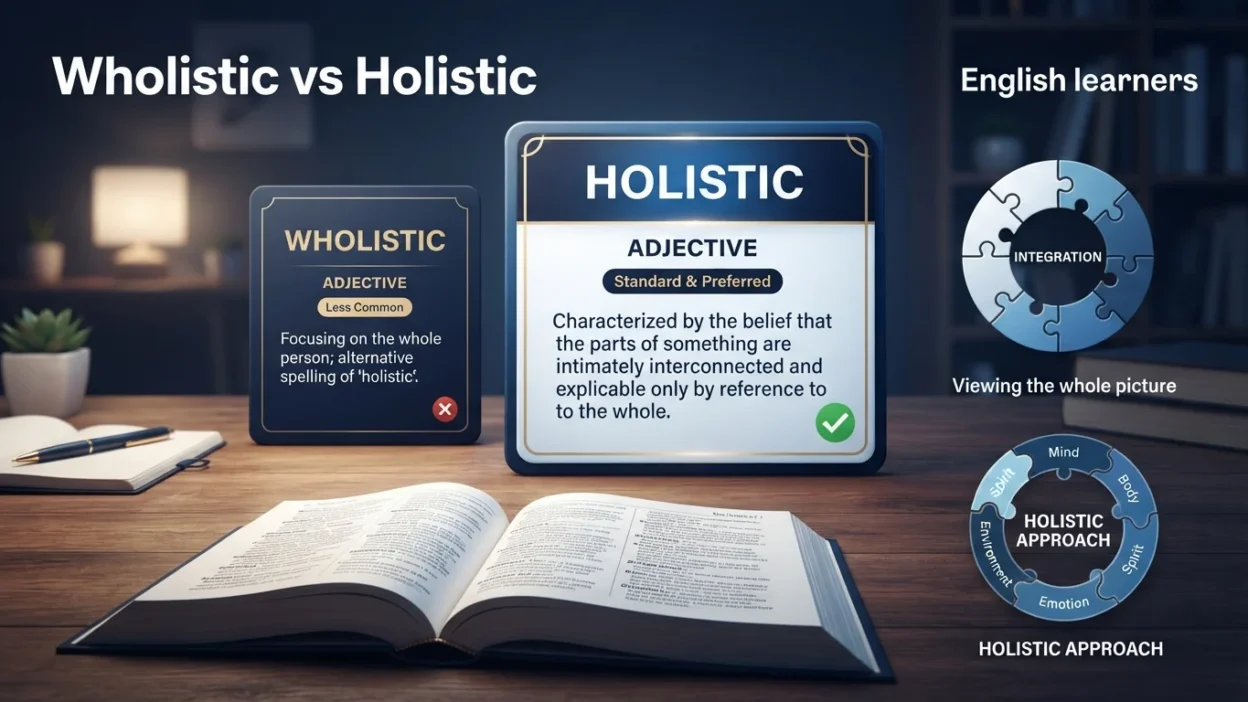
If you are wondering if “wholistic” or “holistic” is the correct word, the standard choice is holistic. It means considering a person, situation, or system as a complete whole rather than focusing only on individual parts. Wholistic does appear in some English writing, often because people connect the word with “whole,” but it is much less common and is generally not the preferred form in standard modern English.
This distinction matters because both forms can look logical at first glance. If you are writing an essay, report, academic paper, website, or professional message, holistic is usually the safest and most widely accepted choice. Understanding the difference can also help you recognize why “holistic” is used in education, healthcare, business, psychology, and many other fields.
Quick Answer: Wholistic or Holistic?
Holistic is the standard and widely accepted spelling. It describes an approach that considers something as a complete system rather than examining only separate parts. Wholistic is an alternative form found in some usage, but it is uncommon and usually unnecessary. For formal, academic, and professional writing, choose holistic.
Why Do People Confuse “Wholistic” and “Holistic”?
The confusion is easy to understand because holistic is closely related in meaning to the word whole.
When people hear “holistic,” they may naturally think:
- whole
- complete
- entire
- all parts together
This can lead someone to spell the word wholistic, especially when they are writing it from pronunciation.
However, holistic is the established standard form. The spelling does not need a “w” to express the idea of looking at something as a whole.
For example:
- Correct: The doctor takes a holistic approach to patient care.
- Less common: The doctor takes a wholistic approach to patient care.
In most situations, holistic is the better choice.
What Does “Holistic” Mean?
Holistic is an adjective meaning considering the whole of something, including how its different parts work together.
It is often used when an approach does not focus on just one factor.
For example:
The school uses a holistic approach to student development.
This means the school considers more than academic grades. It may also consider a student’s emotional, social, physical, and personal development.
Common contexts for “holistic”
You may see holistic used in:
- healthcare
- education
- psychology
- personal development
- business
- environmental studies
- nutrition
- social work
- wellness
- management
The exact meaning depends on the context, but the central idea remains the same: look at the whole rather than only one part.
What Does “Wholistic” Mean?
Wholistic is a less common variant of holistic. It is generally intended to express the same basic idea: considering something as a whole.
The word may appear because writers want to make the connection with whole more obvious.
For example:
The program takes a wholistic approach to wellness.
The intended meaning is clear, but holistic is the more established choice:
The program takes a holistic approach to wellness.
Because “wholistic” is relatively uncommon, using it can make your writing look unusual or nonstandard to some readers.
Wholistic vs Holistic: Comparison Table
| Feature | Holistic | Wholistic |
|---|---|---|
| Meaning | Considering something as a whole | Generally the same meaning |
| Standard usage | Yes | Less common |
| Frequency | Very common | Uncommon |
| Formal writing | Recommended | Usually avoid |
| Academic writing | Preferred | Not usually preferred |
| Professional writing | Preferred | May look unusual |
| Connection with “whole” | Meaning is related | Spelling directly suggests “whole” |
| Best choice | Yes | Usually no |
When Should You Use “Holistic”?
Use holistic when you want to describe an approach that considers multiple connected aspects of something.
1. Healthcare
The clinic provides holistic care that considers the patient’s physical and emotional needs.
2. Education
Teachers should take a holistic approach to student development.
3. Business
The company needs a holistic strategy for improving customer satisfaction.
4. Personal development
She takes a holistic approach to improving her lifestyle.
5. Environmental studies
A holistic view of the environment considers relationships between different ecosystems.
In all these examples, holistic communicates the idea of looking beyond a single component.
When Should You Use “Wholistic”?
In most ordinary writing, there is little reason to choose wholistic instead of holistic.
You may encounter “wholistic” in:
- personal writing
- alternative or wellness-related materials
- older or less standardized texts
- writing where the author intentionally emphasizes the word “whole”
Even when it is understandable, holistic is generally the safer choice for readers who expect standard English.
If you are unsure, use holistic.
10+ Examples of “Holistic” in Sentences
Here are practical examples showing how holistic works in different contexts.
- The teacher uses a holistic approach to assess student progress.
- The doctor believes in holistic patient care.
- We need a holistic understanding of the problem before making a decision.
- The program focuses on holistic child development.
- She follows a holistic approach to maintaining her well-being.
- The company adopted a holistic strategy for improving workplace culture.
- A holistic education develops both academic and social skills.
- The environmental project takes a holistic view of the local ecosystem.
- The therapist considers the client’s situation from a holistic perspective.
- Good leadership requires a holistic understanding of an organization.
- The course offers a holistic approach to language learning.
- The researcher examined the issue from a holistic perspective rather than studying one factor alone.
Notice that holistic can describe an approach, strategy, view, understanding, perspective, or method.
Common Mistakes With “Wholistic” and “Holistic”
Mistake 1: Assuming “wholistic” must be correct because of “whole”
It is natural to connect the word with “whole,” but English spelling does not always work that way.
Better:
We need a holistic approach.
Mistake 2: Treating both forms as equally common
Although “wholistic” can be found in English, it is much less common than holistic.
For general writing, there is no advantage in choosing the unusual form.
Mistake 3: Using “holistic” when you only mean “complete”
“Holistic” has a more specific sense than simply “complete.” It often suggests that different parts are considered together as a connected whole.
For example:
The doctor took a holistic approach.
This suggests that the doctor considered several aspects of the patient’s situation, not merely that the doctor provided “complete” care.
Mistake 4: Thinking “holistic” only belongs to healthcare
Although healthcare is a common context, the word is much broader.
You can have:
- a holistic education
- a holistic strategy
- a holistic analysis
- a holistic approach
- a holistic perspective
- a holistic understanding
Memory Trick: Think “Holistic = Whole Approach”
A simple way to remember the standard spelling is:
HOLISTIC → WHOLE IDEA
You do not need to put a w into the spelling just because the meaning is connected to “whole.”
Remember:
Holistic = looking at the whole.
If you are choosing between wholistic and holistic, remember that holistic is the standard form.
American vs British English
There is no major American-versus-British spelling difference that makes wholistic the British version and holistic the American version.
Holistic is the standard and widely recognized form in both American and British English.
You may encounter wholistic in different types of English writing, but its appearance should not be interpreted simply as a regional spelling difference.
For international readers, students, and professional writers, holistic is the clearest choice.
Similar Words to “Holistic”
Depending on the context, several words can express related ideas.
Comprehensive
Means including many or all important aspects.
We need a comprehensive plan.
Whole
Refers to something complete or undivided.
We studied the whole system.
Integrated
Emphasizes that different parts are combined or work together.
The hospital provides integrated healthcare services.
All-encompassing
Means covering a very wide range of things.
The report provides an all-encompassing review.
Complete
Means having all necessary parts.
We need a complete picture of the situation.
Systemic
Often refers to something involving an entire system rather than an isolated part.
The organization needs systemic change.
These words are related to holistic, but they are not always interchangeable. Choose the word that best matches the specific meaning you want to communicate.
Final Verdict: Wholistic or Holistic?
Holistic is the best choice in standard English.
Use holistic when you mean an approach that considers a person, problem, system, or situation as a whole and takes the relationships between its parts into account.
Wholistic is a less common variant that some writers use, but it is generally unnecessary. In academic, professional, educational, and general-purpose writing, holistic is the safer and more widely accepted form.
Quick rule:
Choose “holistic.”
Frequently Asked Questions
Is “wholistic” a correct word?
“Wholistic” is found in English and is generally used with the same meaning as “holistic,” but it is much less common. Holistic is the standard form and is usually the better choice.
Is “holistic” or “wholistic” correct?
Holistic is the preferred standard form. Although “wholistic” appears in some writing, most writers should choose holistic, especially in formal and professional contexts.
Why is holistic spelled without a “w”?
The established word is holistic, even though its meaning is related to the idea of a “whole.” English words do not always follow the spelling we might expect from related words.
Can I use “wholistic” in academic writing?
It is better to use holistic in academic writing. Since “holistic” is more common and widely recognized, it reduces the possibility that readers will view your word choice as unusual.
Does holistic mean complete?
Not exactly. Holistic means considering something as a whole, especially by taking multiple connected parts or factors into account. “Complete” can mean having all necessary parts but does not necessarily carry the same idea of interconnectedness.
Is holistic only used in healthcare?
No. Holistic is used in healthcare, education, business, psychology, environmental studies, personal development, and many other areas.
What is the opposite of a holistic approach?
Depending on the context, possible contrasts include a narrow, fragmented, isolated, or reductionist approach. The exact opposite depends on what is being discussed.
Remember This
- Holistic is the standard and preferred form.
- Wholistic is much less common.
- Both forms generally communicate the idea of considering something as a whole.
- Use holistic in academic, professional, and general writing.
- Holistic can describe approaches in healthcare, education, business, psychology, and many other fields.
- Think: Holistic = consider the whole.
Conclusion
The choice between wholistic vs holistic is usually straightforward: choose holistic. While “wholistic” can be found in some English usage, it is uncommon compared with the established form. Holistic describes an approach that considers the whole and recognizes how different parts can relate to one another.
If you are writing an essay, professional document, website, report, or everyday message, holistic is the clearest and safest option. Remember the simple rule: holistic is standard; wholistic is an uncommon variant.

David Henry is a language enthusiast and content writer specializing in synonyms, vocabulary, and word meanings. He creates clear, engaging resources that help readers improve their writing, communication, and English skills.