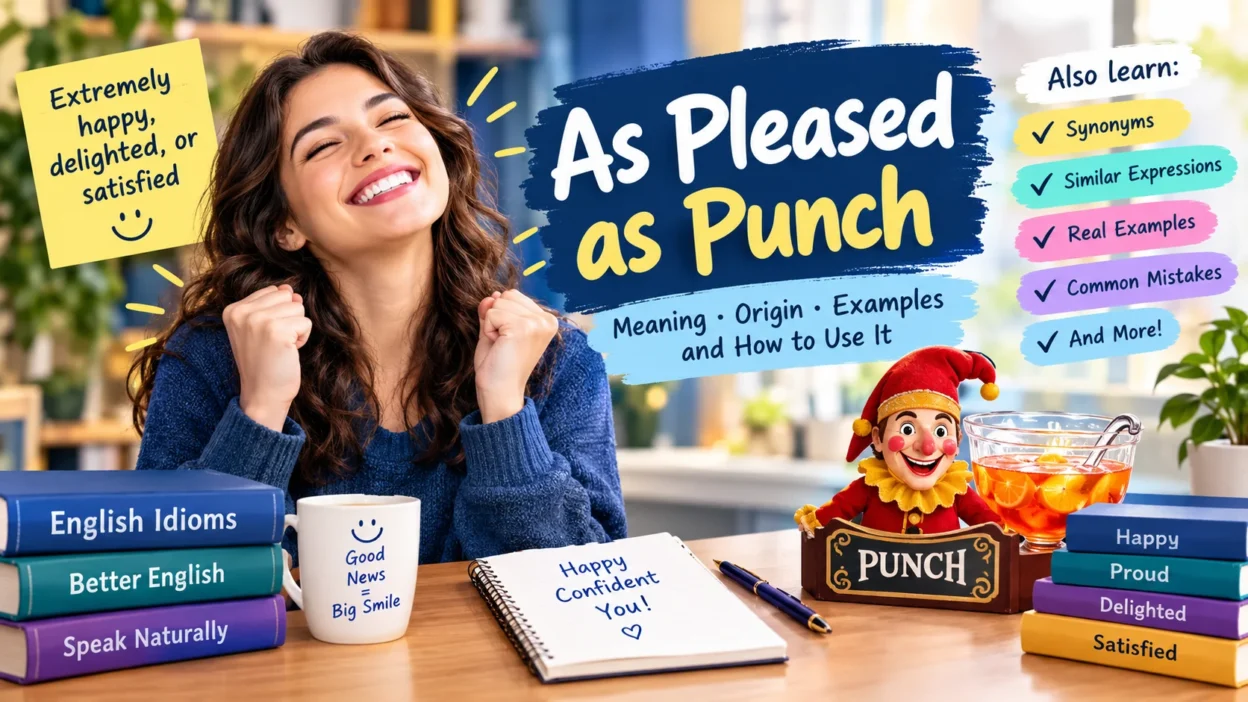
The phrase “as pleased as punch” is an English idiom that means extremely happy, delighted, or satisfied with something. People use it when someone feels especially pleased about an achievement, good news, a personal success, or a situation that brings them joy. For example, “She was as pleased as punch when she received her promotion.” This means she was very happy about the promotion.
Learning idioms like “as pleased as punch” helps students, ESL learners, and English speakers express emotions more naturally. Instead of simply saying “very happy,” you can use this colorful expression to make your conversations and writing more lively. It is commonly used in everyday conversation, storytelling, and informal writing. Although the phrase may sound unusual to learners because punch is also the name of a drink, its meaning is figurative rather than literal. Understanding when and how to use it will help you communicate happiness and satisfaction with greater confidence.
Quick Answer: What Does “As Pleased as Punch” Mean?
“As pleased as punch” means extremely happy, delighted, or satisfied. It is an informal English idiom used when someone feels proud or joyful about something that has happened. For example, “He was as pleased as punch with his exam results” means he was very happy and satisfied with his performance.
Why Do People Confuse “As Pleased as Punch”?
People sometimes find this idiom confusing because the word punch usually refers to a drink or a physical action. However, in this expression, it does not refer to either meaning directly.
The phrase is a fixed expression whose meaning cannot be understood by interpreting each word separately. The word pleased communicates happiness or satisfaction, while the complete expression adds emphasis.
Another reason for confusion is that learners may mistake it for a formal expression. In reality, it is generally conversational and informal, making it especially suitable for friendly discussions and everyday storytelling.
What Does “As Pleased as Punch” Mean?
The expression “as pleased as punch” describes someone who is extremely happy or satisfied, often because something has gone well.
It can communicate several related feelings:
- Happiness: Feeling joyful about good news.
- Satisfaction: Being happy with a result or decision.
- Pride: Feeling pleased about an achievement.
- Delight: Experiencing great pleasure because of something positive.
For example:
- “My parents were as pleased as punch with my graduation results.”
- “She looked as pleased as punch after winning the competition.”
- “The little boy was as pleased as punch with his new bicycle.”
In each example, the phrase emphasizes a strong positive feeling.
What Is the Meaning of “Pleased”?
The word pleased is an adjective that describes feeling happy, satisfied, or glad about something.
It can be used in both casual and formal situations.
Examples:
- “I am pleased with your progress.”
- “She was pleased to hear the good news.”
- “We are pleased with the final results.”
Unlike the complete idiom, pleased does not automatically mean extremely happy. The degree of happiness depends on the context and any words used to modify it.
For example, “slightly pleased” suggests mild satisfaction, while “extremely pleased” indicates a stronger feeling.
What Does “Punch” Mean in This Idiom?
The word punch has several meanings in English, including a mixed drink, a physical blow, and the force or impact of something.
However, in “as pleased as punch,” it is part of a traditional idiomatic expression. The phrase is often associated with Mr. Punch, the cheerful, boastful puppet character from the traditional Punch and Judy shows.
That historical association is commonly given as an explanation for the expression, although the exact development of the idiom is not completely certain. In modern English, speakers generally use the phrase without thinking about its historical background.
The important point is that “as pleased as punch” means very happy or satisfied, not happy because of a drink or a physical punch.
“As Pleased as Punch” vs. Similar Expressions
These expressions can communicate happiness, but they differ slightly in tone and emphasis.
| Expression | Meaning | Typical use |
|---|---|---|
| As pleased as punch | Extremely happy or satisfied | Informal conversation |
| Very pleased | Happy or satisfied | Formal and informal situations |
| Over the moon | Extremely happy | Informal conversation |
| Thrilled | Very excited and happy | Personal news and achievements |
| Delighted | Very pleased | Both formal and informal situations |
| Proud as a peacock | Feeling very proud | Achievements or accomplishments |
| On cloud nine | Extremely happy | Informal conversation |
Although these expressions are related, they are not always interchangeable. For example, thrilled often suggests excitement, while pleased can emphasize satisfaction. “As pleased as punch” can express both happiness and pride.
When Should You Use “As Pleased as Punch”?
Use this idiom when you want to describe someone who is visibly or strongly happy about a positive event, achievement, or result.
1. To describe personal achievements
The phrase works well when someone has accomplished something important.
Example: “She was as pleased as punch after passing her driving test.”
2. To express satisfaction with results
You can use it when someone is happy with the outcome of a task or project.
Example: “The teacher was as pleased as punch with the students’ improvement.”
3. To describe receiving good news
The idiom is suitable for happy reactions to unexpected or welcome news.
Example: “He was as pleased as punch when he learned that he had been accepted into university.”
4. To make storytelling more expressive
Writers use the expression to give a character a lively, cheerful personality.
Example: “Grandma was as pleased as punch when the whole family arrived for dinner.”
When Should You Avoid It?
Because the expression is informal and somewhat traditional, it may sound out of place in highly technical or formal writing.
Instead of writing, “The board was as pleased as punch with the financial report,” in a formal business document, you could write, “The board was highly satisfied with the financial report.”
12 Examples of “As Pleased as Punch” in Sentences
Here are practical examples showing how the idiom works in different situations.
1. School: “Mia was as pleased as punch when she received the highest score in her class.”
2. Work: “Daniel was as pleased as punch after his manager praised his presentation.”
3. Family: “My mother was as pleased as punch when I visited her after a long time.”
4. Sports: “The coach was as pleased as punch with the team’s performance.”
5. Gifts: “The little girl was as pleased as punch with her birthday present.”
6. Travel: “We were as pleased as punch when we found a beautiful hotel near the beach.”
7. Cooking: “Dad was as pleased as punch when everyone enjoyed his homemade pizza.”
8. Education: “The student was as pleased as punch after completing the difficult assignment.”
9. Business: “The shop owner was as pleased as punch with the weekend sales.”
10. Friendship: “Emma was as pleased as punch when her friends organized a surprise party for her.”
11. Personal goals: “He was as pleased as punch when he finally finished writing his first book.”
12. Everyday life: “I was as pleased as punch to hear that my missing keys had been found.”
These examples show that the expression can describe happiness about both major achievements and small everyday pleasures.
Common Mistakes When Using “As Pleased as Punch”
Avoid these common errors to use the idiom naturally.
Mistake 1: Taking the phrase literally
Incorrect understanding: The person is happy because of a drink called punch.
Correct understanding: The person is extremely happy or satisfied.
Mistake 2: Using the wrong preposition
The usual expression is “as pleased as punch.”
Example: “She was as pleased as punch with her new job.”
Avoid changing it to “as pleased than punch” or “as pleased like punch.”
Mistake 3: Assuming it always means pride
The idiom can express pride, but it can also describe simple happiness or satisfaction.
Example: “He was as pleased as punch to see his old friends again.”
Here, the feeling is happiness rather than pride in an accomplishment.
Mistake 4: Using it in every formal situation
The expression is perfectly understandable in many contexts, but it may be too conversational for some professional reports or academic papers.
For formal writing, consider very satisfied, delighted, or highly pleased, depending on the intended meaning.
Mistake 5: Forgetting the verb tense
The idiom itself does not change, but the verb should agree with the subject and tense.
- Present: “She is as pleased as punch.”
- Past: “She was as pleased as punch.”
- Plural: “They were as pleased as punch.”
Memory Trick: How to Remember “As Pleased as Punch”
Use this simple memory trick:
Pleased = happy; as pleased as punch = very happy.
Imagine someone smiling proudly after receiving a wonderful surprise. That person is “as pleased as punch.”
You can also remember it through this example:
“Ali passed his exam, and he was as pleased as punch.”
Whenever someone feels delighted or satisfied about something positive, this idiom may be appropriate.
Is “As Pleased as Punch” American or British English?
“As pleased as punch” is used in both American and British English. It is not restricted to one country.
The expression is understandable to English speakers in both varieties, although how frequently people use it may vary by age, region, and personal speaking style.
| Feature | American English | British English |
|---|---|---|
| Meaning | Extremely happy or satisfied | Extremely happy or satisfied |
| Grammar | “As pleased as punch” | “As pleased as punch” |
| Spelling | Same | Same |
| Formality | Generally informal | Generally informal |
| Example | “He was as pleased as punch with the result.” | “She was as pleased as punch with her new garden.” |
There is no spelling difference between American and British English for this expression.
Similar Words and Expressions
If you want to express happiness in different ways, these alternatives can help.
- Delighted: Very happy about something.
- Thrilled: Extremely excited and happy.
- Overjoyed: Experiencing great happiness.
- Ecstatic: Feeling overwhelming happiness or excitement.
- Satisfied: Feeling that something is good enough or meets expectations.
- Proud: Feeling pleasure about an achievement or someone’s success.
- Over the moon: An informal expression meaning extremely happy.
- On cloud nine: An informal idiom for feeling exceptionally happy.
- Walking on air: Feeling extremely happy, often after good news.
- Tickled pink: An informal idiom meaning very pleased or amused.
Choose the expression that best matches the feeling you want to communicate. For example, satisfied is useful for a neutral or professional tone, while ecstatic conveys a more intense emotional reaction.
Final Verdict: What Does “As Pleased as Punch” Mean?
“As pleased as punch” is a correct and established English idiom meaning extremely happy, delighted, or satisfied.
Use it in everyday conversations, stories, and informal writing when describing someone’s positive reaction to good news, a successful result, a gift, or a personal achievement.
For example, “She was as pleased as punch when she got the job” is a natural sentence that communicates both happiness and satisfaction.
If you need a more formal alternative, use very pleased, highly satisfied, or delighted, depending on the context.
Frequently Asked Questions
1. What does “as pleased as punch” mean in simple words?
It means very happy, delighted, or satisfied. Someone who is as pleased as punch feels especially good about something that has happened.
Example: “He was as pleased as punch with his birthday gift.”
2. Is “as pleased as punch” an idiom?
Yes. It is an idiom because its overall meaning is figurative. The phrase means extremely happy or satisfied rather than referring to the literal meanings of pleased and punch separately.
3. Is “as pleased as punch” positive or negative?
It is positive. The phrase describes happiness, delight, satisfaction, or pride. It is generally used to communicate a pleasant emotional reaction.
4. Can I use “as pleased as punch” in formal writing?
You can, but it is generally more suitable for informal or conversational writing. In formal reports or academic work, very satisfied, highly pleased, or delighted may be more appropriate.
5. What is another way to say “as pleased as punch”?
Common alternatives include over the moon, delighted, thrilled, overjoyed, and on cloud nine. The best choice depends on if you want to emphasize satisfaction, excitement, or intense happiness.
6. Where did the expression “as pleased as punch” come from?
The expression is commonly associated with Mr. Punch, a cheerful and self-satisfied character from traditional Punch and Judy puppet shows. The precise history of the phrase is not entirely certain, but its modern meaning is well established.
7. Can I say “I am as pleased as punch”?
Yes. It is grammatically correct and natural in casual conversation.
Example: “I am as pleased as punch with my final exam results.”
You can also use past or plural forms, such as “I was as pleased as punch” and “They were as pleased as punch.”
Remember This
- Meaning: Extremely happy, delighted, or satisfied.
- Type: English idiom.
- Tone: Generally informal and conversational.
- Correct form: As pleased as punch.
- Example: “She was as pleased as punch when she won the award.”
- Formal alternatives: Very pleased, delighted, or highly satisfied.
The key is to remember that the complete phrase communicates a strong feeling of happiness rather than a literal meaning involving punch.
Conclusion
“As pleased as punch” is a colorful English idiom that makes descriptions of happiness more expressive. It is useful when talking about achievements, good news, gifts, family moments, or any situation that makes someone feel delighted and satisfied. Its meaning is straightforward once you understand that the phrase is figurative.
To use it correctly, keep the expression in its standard form and match the verb to the subject and tense. Although it is suitable for everyday conversation and informal writing, more direct alternatives may work better in formal contexts. With a little practice, you can use “as pleased as punch” naturally and confidently in your English conversations.

David Henry is a language enthusiast and content writer specializing in synonyms, vocabulary, and word meanings. He creates clear, engaging resources that help readers improve their writing, communication, and English skills.