
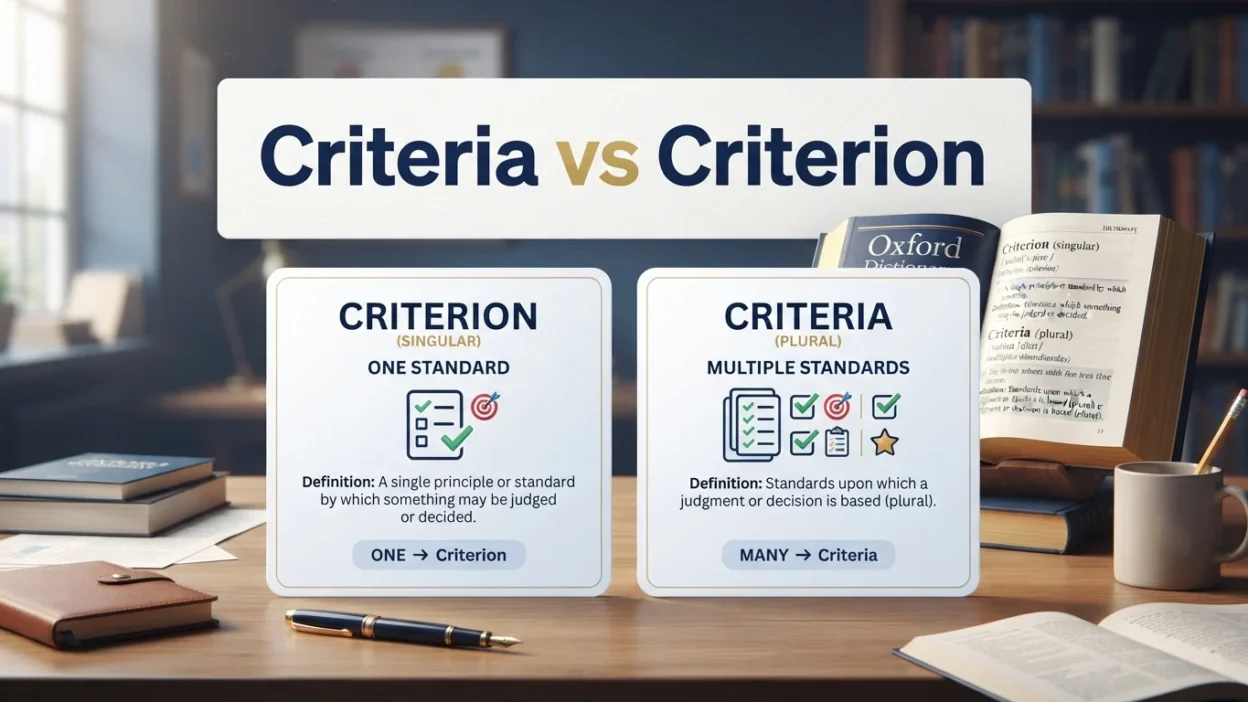
Criteria and criterion are closely related words, so it is easy to confuse them. The main difference is simple: criterion is singular, while criteria is plural. In other words, one standard is a criterion, while two or more standards are criteria. For example, you might say, “Price is an important criterion,” but “Price and quality are important criteria.”
Understanding this difference can help you write and speak more accurately in academic, professional, and everyday situations. These words are especially common when discussing requirements, standards, rules, qualifications, or factors used to make a decision. Once you remember the singular-versus-plural rule, choosing between criterion and criteria becomes much easier. This guide explains their meanings, correct usage, common mistakes, examples, and the differences between American and British English.
Quick Answer
Criterion is the singular form, meaning one standard or requirement used to judge something. Criteria is the plural form, meaning two or more standards or requirements. Say “one criterion,” but “several criteria.” For example: “Cost is one criterion,” and “Cost and quality are two criteria.”
Why Do People Confuse Criteria and Criterion?
People often confuse these words because criteria looks and sounds like a singular English noun, even though it is traditionally plural.
The words come from Greek, where their original forms were different from typical English singular and plural patterns:
- Criterion = singular
- Criteria = plural
The easiest way to avoid confusion is to connect criterion with one and criteria with more than one.
For example:
- One criterion → The most important criterion is safety.
- Two criteria → Safety and price are important criteria.
- Several criteria → The judges considered several criteria.
What Does “Criterion” Mean?
Criterion is a noun that means a standard, rule, or requirement used to judge, evaluate, or decide something.
It refers to one individual standard.
Examples
- Accuracy is an important criterion for this test.
- Experience is the main criterion for the position.
- The school has one basic criterion for admission.
- Price was an important criterion when choosing a laptop.
When Should You Use “Criterion”?
Use criterion when you are talking about one standard, condition, or factor.
A useful pattern is:
one + criterion
For example:
“Reliability is one important criterion for selecting a supplier.”
What Does “Criteria” Mean?
Criteria is the plural form of criterion. It means two or more standards, conditions, or requirements used to evaluate something.
Examples
- The job has several criteria for applicants.
- The judges used three criteria to select the winner.
- Price, quality, and durability are important criteria.
- The research project must meet specific criteria.
When Should You Use “Criteria”?
Use criteria when referring to multiple standards or requirements.
A useful pattern is:
two or more + criteria
For example:
“The university uses several criteria when evaluating applications.”
Criteria vs Criterion: Comparison Table
| Feature | Criterion | Criteria |
|---|---|---|
| Number | Singular | Plural |
| Meaning | One standard or requirement | Two or more standards or requirements |
| Example | “Cost is a criterion.” | “Cost and quality are criteria.” |
| Common phrase | “one criterion” | “several criteria” |
| Part of speech | Noun | Noun |
| Pronunciation | kry-TEER-ee-un | kry-TEER-ee-uh |
| Use | One factor for evaluation | Multiple factors for evaluation |
When Should You Use Each?
Use “Criterion” for One
Choose criterion when there is only one standard.
- “Safety is the most important criterion.”
- “There is one main criterion for acceptance.”
- “Age is a selection criterion.”
Use “Criteria” for More Than One
Choose criteria when there are multiple standards.
- “The committee considered several criteria.”
- “Price and performance are important criteria.”
- “Applicants must meet all the required criteria.”
A Simple Test
Ask yourself:
Am I talking about one standard or several?
If it is one → criterion
If it is two or more → criteria
10+ Examples of Criterion and Criteria
Examples with “Criterion”
- Quality is our most important criterion.
- Experience is a key criterion for this position.
- Safety should be the first criterion when choosing equipment.
- Cost was the deciding criterion.
- The teacher used accuracy as one criterion for grading.
- Availability is another criterion we need to consider.
Examples with “Criteria”
- The company has strict criteria for hiring new employees.
- Price and durability are important criteria when buying furniture.
- The students must meet all the admission criteria.
- The judges evaluated the competitors using several criteria.
- The product meets our quality criteria.
- We established clear criteria for measuring success.
Singular and Plural Together
You can also use both words in the same sentence:
“Price is one criterion, but the final decision depends on several criteria.”
This makes the difference particularly clear.
Common Mistakes
Mistake 1: Using “Criteria” as Singular
❌ “One criteria is important.”
✅ “One criterion is important.”
Because you are talking about one standard, use criterion.
Mistake 2: Using “Criterion” for Several Standards
“The company has several criterion.”
“The company has several criteria.”
Because “several” indicates more than one, use criteria.
Mistake 3: Adding an Incorrect Plural Ending
“Criterions”
In standard English, the normal plural of criterion is criteria.
Mistake 4: Confusing “Criteria” with “Requirement”
Although they can sometimes be similar, criteria refers specifically to standards used to judge or evaluate something.
For example:
“The candidate must meet three criteria.”
Those criteria could include education, experience, and language ability.
Memory Trick: Criterion = One, Criteria = Many
Here is an easy way to remember the difference:
Criterion → One
Criteria → Many
You can think of the -on ending in criterion as pointing to a single item.
Then remember:
Try saying this sentence:
“One criterion, two criteria, three criteria.”
Repeating this pattern can make the distinction much easier to remember.
American vs British English
The singular and plural distinction between criterion and criteria is used in both American and British English.
- American English: criterion = singular; criteria = plural
- British English: criterion = singular; criteria = plural
However, in informal speech, you may sometimes hear criteria being treated as a singular noun. This usage is generally considered nonstandard or informal in careful writing.
For formal academic, professional, and business writing, it is best to maintain the traditional distinction:
Similar Words
Several words are related to criterion and criteria, although they are not always interchangeable.
Standard
A standard is a level or rule used to judge quality or performance.
“The product meets the required standard.”
Requirement
A requirement is something that must be satisfied or provided.
“A degree is a requirement for the position.”
Condition
A condition is something that must be true or fulfilled.
“Applicants must meet certain conditions.”
Factor
A factor is something that influences a decision or result.
“Cost was an important factor in our decision.”
Benchmark
A benchmark is a reference point used for comparison or measurement.
“The company established a benchmark for performance.”
These words can overlap with criterion, but their meanings are not exactly identical.
Final Verdict
The difference between criteria and criterion is mainly a matter of number.
- Criterion = singular
- Criteria = plural
Use criterion when discussing one standard, requirement, or factor used to judge something. Use criteria when discussing two or more standards.
The most useful rule to remember is:
Once you learn this pattern, you can confidently use these words in essays, reports, applications, business communication, academic writing, and everyday English.
Frequently Asked Questions
Is “criteria” singular or plural?
Criteria is traditionally plural. The singular form is criterion. For example, “one criterion” and “three criteria.”
What is the singular of criteria?
The singular form of criteria is criterion.
What is the plural of criterion?
The plural form of criterion is criteria.
Can I say “a criteria”?
In standard formal English, no. Say “a criterion” because a refers to one item.
Is “criterions” correct?
Criterions is generally not used as the standard plural of criterion. The standard plural is criteria.
What is an example of criterion and criteria?
“Price is one criterion for choosing a car. Price, safety, and reliability are three criteria.”
Is “criteria” commonly used incorrectly as singular?
Yes, you may encounter criteria used as a singular noun, especially in informal communication. In careful formal writing, however, criterion should be used for one standard.
Which is correct: “selection criterion” or “selection criteria”?
Both can be correct. Selection criterion means one standard, while selection criteria means multiple standards.
Remember This
Criterion = one
Criteria = more than one
Think:
That simple rule will help you avoid one of the most common mistakes involving these two words.
Conclusion
Understanding criteria vs criterion is easier once you focus on the singular and plural forms. Criterion refers to one standard, rule, or factor used for evaluation, while criteria refers to multiple standards or factors. Both words are common in academic writing, business communication, hiring, research, education, and decision-making.
When in doubt, check the number of standards you are discussing. If there is only one, choose criterion. If there are several, choose criteria. Remember the simple formula—one criterion, several criteria—and you will be able to use these words accurately and naturally.

David Henry is a language enthusiast and content writer specializing in synonyms, vocabulary, and word meanings. He creates clear, engaging resources that help readers improve their writing, communication, and English skills.