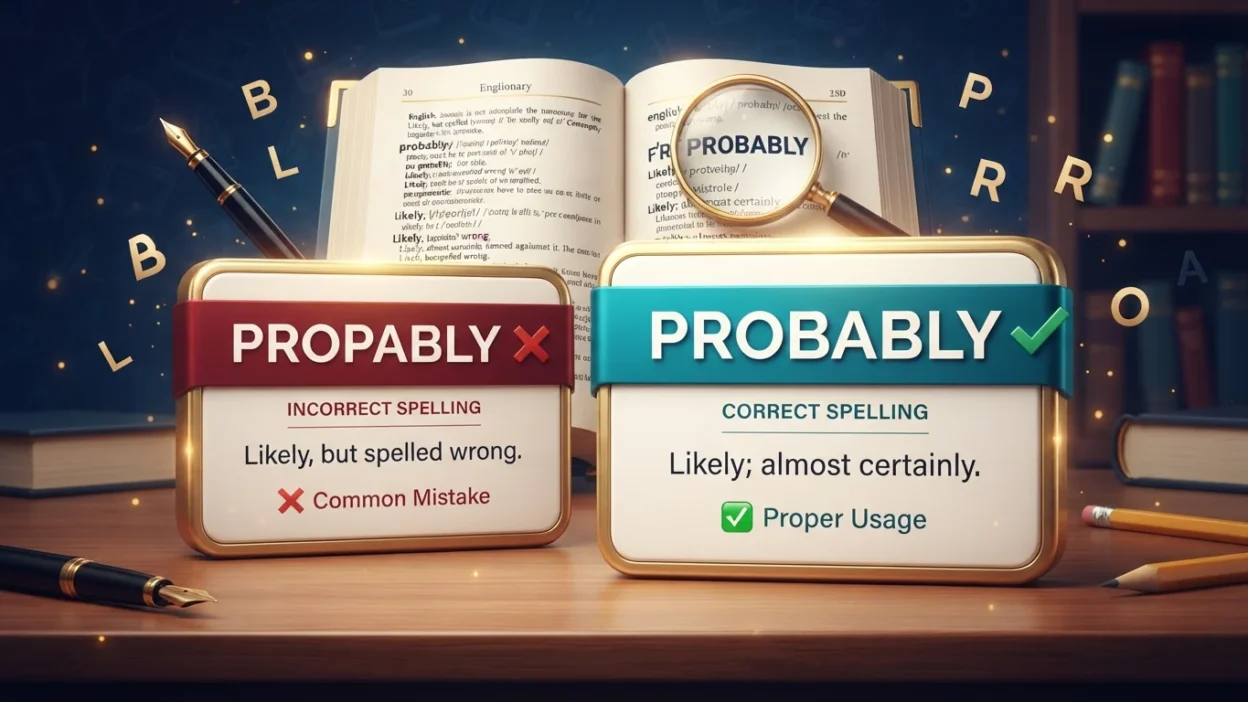
Have you ever typed “propably” and wondered whether it is correct? You are not alone. This is a common spelling mistake because the word is pronounced quickly, and the letters can be easy to mix up. The correct spelling is “probably.” The spelling “propably” is incorrect in standard English.
Probably is an adverb that means “very likely” or “most likely.” We use it when we believe something is likely to happen or be true, but we are not completely certain. Learning the correct spelling is useful for students, ESL learners, writers, and anyone who wants to communicate clearly in English. In this guide, you will learn the difference between propably and probably, how to pronounce and use probably, common mistakes, examples, and an easy memory trick.
Quick Answer
Probably is the correct spelling. Propably is a common misspelling and should not be used in standard English. Probably means “very likely” or “most likely.” For example: “She will probably arrive soon.” Remember: probable → probably, with “b” before the “l.”
Why Do People Confuse It?
People often confuse propably and probably because of pronunciation and the order of letters.
The word probably comes from probable, meaning likely to happen or be true. When the ending changes from -able to -ably, the spelling becomes:
probable → probably
A common mistake is to remove the e and accidentally write propably instead of probably.
Another reason is pronunciation. In everyday speech, probably may sound like “prob-lee” or even “prolly.” Because some sounds become weaker in casual speech, learners may spell the word according to how they hear it.
First Word: Propably
Propably is incorrect.
It is a common spelling error for probably, but it is not the standard spelling of the word.
Incorrect Example
She will propably come tomorrow.
The sentence should be:
She will probably come tomorrow.
If you are writing an email, essay, assignment, article, or formal message, always use probably.
Second Word: Probably
Probably is the correct word.
It is an adverb meaning very likely, most likely, or in all likelihood.
Examples
- I will probably go to the library later.
- It will probably rain tonight.
- She is probably busy right now.
- They will probably finish the project tomorrow.
The word shows that something is likely, but not completely certain.
Word Family
A useful way to remember the spelling is to connect probably with probable:
- probable = likely
- probably = most likely / very likely
Example:
It is probable that he will win.
He will probably win.
Comparison Table
| Word | Correct? | Meaning | Example |
|---|---|---|---|
| Propably | ❌ No | Common misspelling | She will propably call. |
| Probably | ✅ Yes | Very likely or most likely | She will probably call. |
| Probable | ✅ Yes | Likely to happen or be true | A delay is probable. |
| Probability | ✅ Yes | The likelihood of something happening | There is a high probability of rain. |
When to Use Each
Use “Probably”
Use probably when you want to say that something is likely but not certain.
I will probably study tonight.
This means studying tonight is likely, but the speaker is not making a definite promise.
Do Not Use “Propably”
Do not use propably in standard English writing.
❌ He is propably at home.
✅ He is probably at home.
Use “Probable” When an Adjective Is Needed
Use probable to describe something that is likely.
A change in the schedule is probable.
Use probably when modifying a verb, adjective, or whole statement.
The schedule will probably change.
10+ Examples of “Probably”
Here are practical examples showing how probably works in everyday English.
- I will probably call you tonight.
The speaker thinks calling is very likely. - She is probably at work.
The speaker believes she is likely at work. - It will probably snow tomorrow.
Snow is considered likely, but it is not certain. - They probably forgot the meeting.
The speaker thinks forgetting is the most likely explanation. - We will probably arrive before noon.
The speakers expect to arrive before noon. - He probably knows the answer.
The speaker believes he is likely to know it. - You should probably take an umbrella.
The speaker thinks taking an umbrella is a good idea because rain is likely. - This is probably the best option.
The speaker believes this option is most likely the best one. - My brother will probably join us later.
Joining later is considered likely. - The store is probably closed by now.
The speaker believes the store is likely to be closed. - She probably won’t agree with the plan.
The speaker thinks disagreement is likely. - They are probably waiting outside.
The speaker believes they are likely to be outside.
Common Mistakes
1. Writing “Propably”
The most common mistake is simply reversing the spelling pattern.
❌ propably
✅ probably
2. Forgetting the “b”
Because the word may sound different in fast speech, some learners forget the second b.
Remember:
pro-ba-bly
3. Confusing “Probably” With “Probable”
These words are related but have different grammatical roles.
- Probable is an adjective.
- Probably is an adverb.
Compare:
A delay is probable.
The train will probably be late.
4. Assuming Pronunciation Shows the Exact Spelling
English spelling does not always match pronunciation perfectly. Even if you hear something like “prolly” in casual conversation, the standard written form is probably.
Memory Trick
Use this simple trick:
PROBABLE → PROBABLY
Just remember that probably keeps the “b” from probable.
Think:
Another easy reminder is:
“Probably has a B because it comes from probable.”
Whenever you are unsure, think of the adjective probable first. Then change -e to -y:
probable → probably
American vs. British English
There is no spelling difference between American and British English for this word.
Both varieties use:
The pronunciation may vary slightly depending on accent and speaking style, but the standard spelling remains the same.
In casual speech, native speakers may pronounce probably very quickly, sometimes making it sound like “probly” or “prolly.” These informal pronunciations do not change the correct written spelling.
Similar Words
Several words are related to probably and can help you understand its meaning.
Likely
Means that something has a good chance of happening.
She is likely to arrive soon.
Perhaps
Means “maybe” or “possibly.”
Perhaps we should leave early.
Possibly
Means that something may happen or be true.
He could possibly be right.
Maybe
A common, informal way to express uncertainty.
Maybe I will go later.
Probable
An adjective meaning likely.
A quick recovery is probable.
Probability
A noun referring to how likely something is.
There is a high probability that prices will increase.
Final Verdict
The correct spelling is probably.
Propably is a misspelling and should be avoided in standard English writing.
Remember the connection:
probable → probably
When you want to say that something is very likely but not completely certain, use probably.
Frequently Asked Questions
Is “propably” a correct word?
No. Propably is a common misspelling of probably. The correct standard English spelling is probably.
What is the correct spelling: propably or probably?
The correct spelling is probably. The word contains “b” before “l.”
What does probably mean?
Probably means “very likely” or “most likely.” It indicates that something is expected to be true or happen, but it is not completely certain.
Why do people spell probably as propably?
The mistake often happens because of pronunciation. In fast or casual speech, probably may sound less clear, causing people to remember or write the letters incorrectly.
Is probably formal or informal?
Probably is suitable in both everyday and formal English. It can be used in conversations, emails, essays, reports, and professional writing.
Is there a difference between probably and probable?
Yes. Probable is an adjective, while probably is an adverb.
A delay is probable.
The train will probably be delayed.
How can I remember the spelling of probably?
Connect it to probable:
PROBABLE → PROBABLY
Remember that the b stays in the word.
How do you pronounce probably?
In careful speech, it is commonly pronounced approximately “PROB-uh-blee.” In casual speech, some speakers reduce it to something closer to “PROB-lee” or “prolly.” The spelling is still probably.
Remember This
PROBABLY = CORRECT ✅
PROPABLY = INCORRECT ❌
The easiest memory rule is:
If you remember probable, you can remember the correct spelling of probably.
Conclusion
Choosing between propably and probably is easy once you recognize that only probably is correct in standard English. Probably means “very likely” or “most likely,” and it is used when something is expected but not completely certain. The incorrect spelling propably usually comes from confusing the order of letters or from the way the word sounds in fast speech.
Whenever you are unsure, remember the word family probable → probably. Keep the b before l, and you will have the correct spelling every time. Whether you are writing a school assignment, professional email, blog post, or everyday message, probably is the form you should use.

David Henry is a language enthusiast and content writer specializing in synonyms, vocabulary, and word meanings. He creates clear, engaging resources that help readers improve their writing, communication, and English skills.