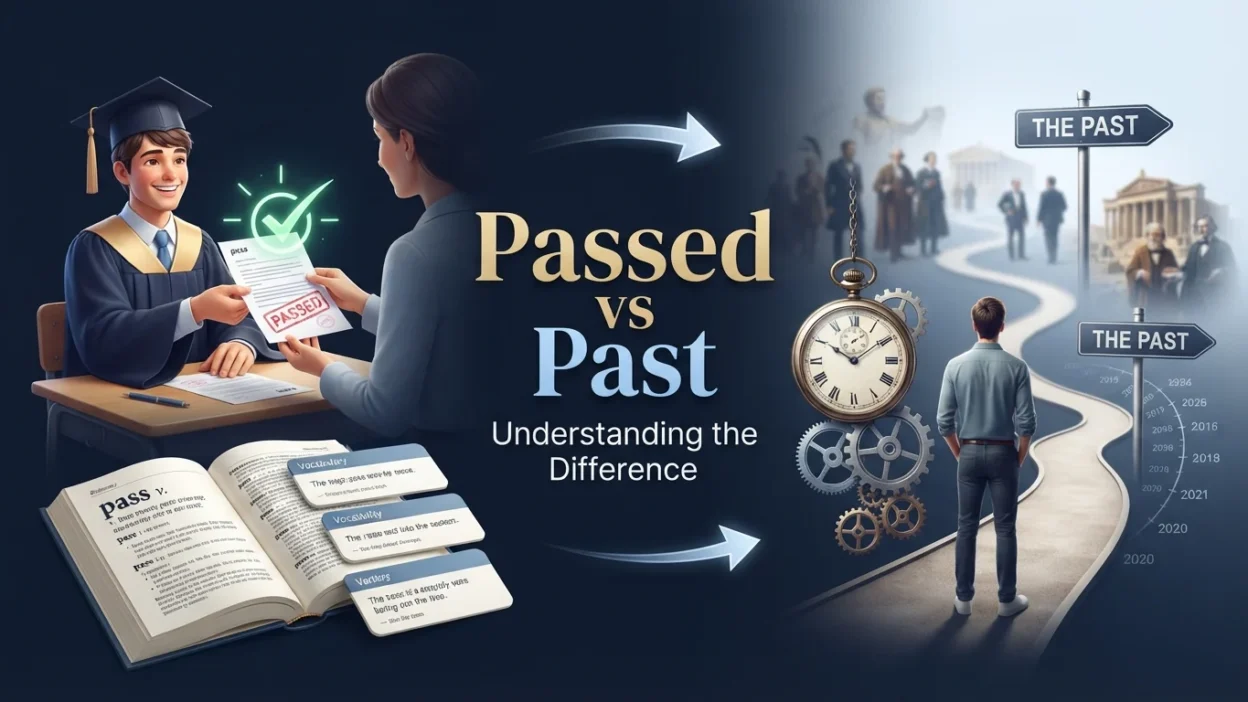
“Passed” and “past” sound very similar, but they have different meanings and grammatical jobs. This makes them easy to confuse, especially when speaking or writing quickly. Passed is usually the past tense or past participle of the verb pass, while past can be a noun, adjective, adverb, or preposition related to an earlier time, position, or point.
For example, you might say, “She passed the exam,” because she successfully completed it. But you would say, “She walked past the school,” because she moved beyond the school. Understanding this small difference can make your English more accurate and help you avoid a very common spelling mistake. The easiest way to remember it is to think of passed as an action and past as a time, place, or position.
Quick Answer
Passed is the past tense of pass and describes an action, such as successfully completing something or moving by something. Past usually refers to an earlier time, a previous period, or something beyond a particular point or place. If you can replace the word with “went by” as an action, “passed” may be correct.
Why Do People Confuse Passed and Past?
The confusion happens mainly because passed and past are pronounced similarly in many varieties of English.
However, they are not interchangeable.
- Passed comes from the verb pass.
- Past refers to an earlier time or something beyond a point.
- Passed normally describes an action.
- Past can describe time, location, direction, or a previous state.
Compare:
- The car passed my house. → The car moved beyond my house.
- The car went past my house. → “Past” describes the location or direction.
The first sentence focuses on the action of passing. The second uses past as a preposition describing where the car went.
What Does “Passed” Mean?
Passed is the past tense and past participle of the verb pass.
It can have several meanings depending on the context.
1. Successfully completed something
When someone passes a test, exam, course, or requirement, they achieve the required result.
- Maya passed her driving test.
- I passed my English exam.
- He passed the final interview.
2. Moved beyond someone or something
“Passed” can describe movement from one position to another.
- The runner passed me near the finish line.
- We passed the library on our way home.
- A bus passed our car.
3. Gave something to another person
“Passed” can also mean handed or transferred something.
- She passed me the salt.
- Please pass the message to your teacher.
- He passed the ball to his teammate.
4. Time went by
“Passed” can describe time moving forward.
- Three hours passed quickly.
- Several weeks passed before she replied.
- As the years passed, his interests changed.
What Does “Past” Mean?
Past usually refers to a time that has already happened, but it can also describe position, direction, or something beyond a particular point.
1. An earlier time
As a noun or adjective, past refers to something that happened before now.
- We learned from our past.
- She has a difficult past.
- His past experiences helped him succeed.
- In the past, people wrote more letters.
2. Beyond a particular place or point
“Past” can work as a preposition or adverb to describe movement beyond something.
- Walk past the bank and turn left.
- The train went past the station.
- I saw him past the entrance.
3. A previous period of time
“Past” is also commonly used with time expressions.
- It happened in the past.
- We met sometime in the past.
- She has changed a lot over the past year.
Passed vs Past: Comparison Table
| Word | Main Function | Meaning | Example |
|---|---|---|---|
| Passed | Verb | Moved beyond, succeeded, handed, or time went by | She passed the exam. |
| Past | Noun | Earlier time or previous experiences | He learned from his past. |
| Past | Adjective | Related to an earlier time | Her past mistakes taught her a lesson. |
| Past | Preposition | Beyond a place or point | Walk past the store. |
| Past | Adverb | Beyond a particular point | The car drove past. |
When Should You Use “Passed”?
Use passed when you need the past form of the verb pass.
Ask yourself: “Is this describing an action?”
If yes, passed may be the right choice.
Common uses of “passed”
- Passed an exam: She passed her exam.
- Passed someone: The cyclist passed me.
- Passed a place: We passed the museum.
- Passed something to someone: He passed me the book.
- Time passed: The afternoon passed quickly.
- Passed a law: Parliament passed the new law.
When Should You Use “Past”?
Use past when you are talking about an earlier time, something previous, or movement beyond a place or point.
Common uses of “past”
- Past experiences
- Past mistakes
- Past events
- In the past
- Over the past year
- Walk past the building
- Drive past the house
- Half past five
A useful test is to ask whether the sentence involves earlier time or beyond a point. If it does, past is often the correct word.
10+ Examples of Passed vs Past
Examples with “Passed”
- I passed my driving test yesterday.
- The teacher passed the papers to the students.
- The blue car passed us on the highway.
- She passed the restaurant without stopping.
- Two weeks passed before he called.
- The new law was passed last month.
Examples with “Past”
- I often think about my past.
- We walked past the old church.
- The children ran past me.
- She has learned from her past mistakes.
- It is half past seven.
- He has worked here for the past five years.
Examples Using Both
- The train passed the station and continued into the past?
This combination is unusual, so it is better to use each word in a natural context. - We passed the school and walked past the library.
Here, passed emphasizes the action of moving by the school, while past describes the direction beyond the library.
Common Mistakes
Mistake 1: “I past my exam.”
Incorrect:
- I past my exam.
Correct:
- I passed my exam.
Because passing an exam is an action, use passed.
Mistake 2: “I walked passed the shop.”
Incorrect:
- I walked passed the shop.
Correct:
- I walked past the shop.
Here, “past” tells us where you walked.
Mistake 3: “In the passed”
Incorrect:
- In the passed, people used different technology.
Correct:
- In the past, people used different technology.
“In the past” is a fixed expression referring to an earlier time.
Mistake 4: “The years past quickly.”
Incorrect:
- The years past quickly.
Correct:
- The years passed quickly.
Here, passed is the verb describing time moving forward.
A Simple Memory Trick
Think:
Passed = Pass + action
If someone passed an exam, passed a person, or passed something to someone, an action is taking place.
Past = Previous or beyond
If you are talking about a previous time, use past.
A quick memory sentence is:
You pass something, but you walk past something.
For example:
- I passed the test.
- I walked past the school.
American vs British English
The distinction between passed and past is essentially the same in American and British English.
Both varieties use:
- passed as the past form of pass
- past for previous time or position beyond something
For example:
- American English: I walked past the store.
- British English: I walked past the shop.
The vocabulary may differ in some contexts, but the basic grammar distinction between passed and past remains the same.
Similar Words
Understanding a few related words can make the distinction easier.
Pass
Pass is the base verb.
- I hope I pass the exam.
- Please pass me the pen.
Passed
Passed is the past tense and past participle of pass.
- She passed the exam.
- The car passed us.
Past
Past refers to an earlier time or something beyond a point.
- Think about the past.
- Walk past the door.
Previous
Previous means earlier or occurring before something else.
- Read the previous chapter.
- Her previous job was in London.
Former
Former refers to something or someone that held a position or status before.
- He is a former teacher.
- My former manager moved abroad.
Beyond
Beyond means farther than or on the other side of something.
- The village lies beyond the mountain.
- Don’t go beyond the marked area.
Final Verdict
The simplest distinction is this:
Passed is an action. It is the past form of pass.
Past refers to an earlier time, a previous situation, or a position beyond something.
Compare these two sentences:
- She passed the shop.
- She walked past the shop.
In the first sentence, passed is the verb. In the second, past shows the direction or position of her movement.
If you remember “passed = action” and “past = previous or beyond,” you will avoid most common mistakes.
FAQs
Is “passed” the past tense of “pass”?
Yes. Passed is the simple past and past participle form of the verb pass.
Example:
I passed the exam.
Is it “walked past” or “walked passed”?
The correct expression is “walked past.”
Example:
We walked past the library.
“Past” describes the direction or position beyond the library.
Is it “in the past” or “in the passed”?
The correct phrase is “in the past.”
Example:
People communicated differently in the past.
What is the difference between “passed” and “past” in a sentence?
Passed is generally a verb describing an action, while past refers to an earlier time or something beyond a particular point.
Is “time passed” correct?
Yes.
Time passed quickly.
Here, passed is the verb meaning that time went by.
Is “past” always about time?
No. Past can also describe movement or position.
Example:
The dog ran past me.
Here, “past” means beyond me, not an earlier time.
How can I remember passed vs past?
Remember:
Passed = an action
Past = previous or beyond
For example, “I passed the test” but “I walked past the school.”
Remember This
Passed = the past form of pass and usually describes an action.
Past = an earlier time, previous experience, or something beyond a point.
The easiest rule
Passed = did something
Past = before or beyond
- I passed the exam.
- I walked past the exam room.
- The years passed quickly.
- I learned from my past.
Conclusion
Although passed and past sound similar, their meanings and grammatical roles are different. Passed comes from the verb pass and is used for actions such as succeeding in an exam, moving beyond something, handing something over, or describing time going by. Past, on the other hand, usually refers to an earlier time, previous experiences, or something located beyond a particular point.
When you are unsure, look at what the sentence is doing. If you need an action or the past form of pass, choose passed. If you mean an earlier time or something beyond a location or point, choose past. With the simple memory trick “passed = action; past = previous or beyond,” the difference becomes much easier to remember and use correctly.

David Henry is a language enthusiast and content writer specializing in synonyms, vocabulary, and word meanings. He creates clear, engaging resources that help readers improve their writing, communication, and English skills.