
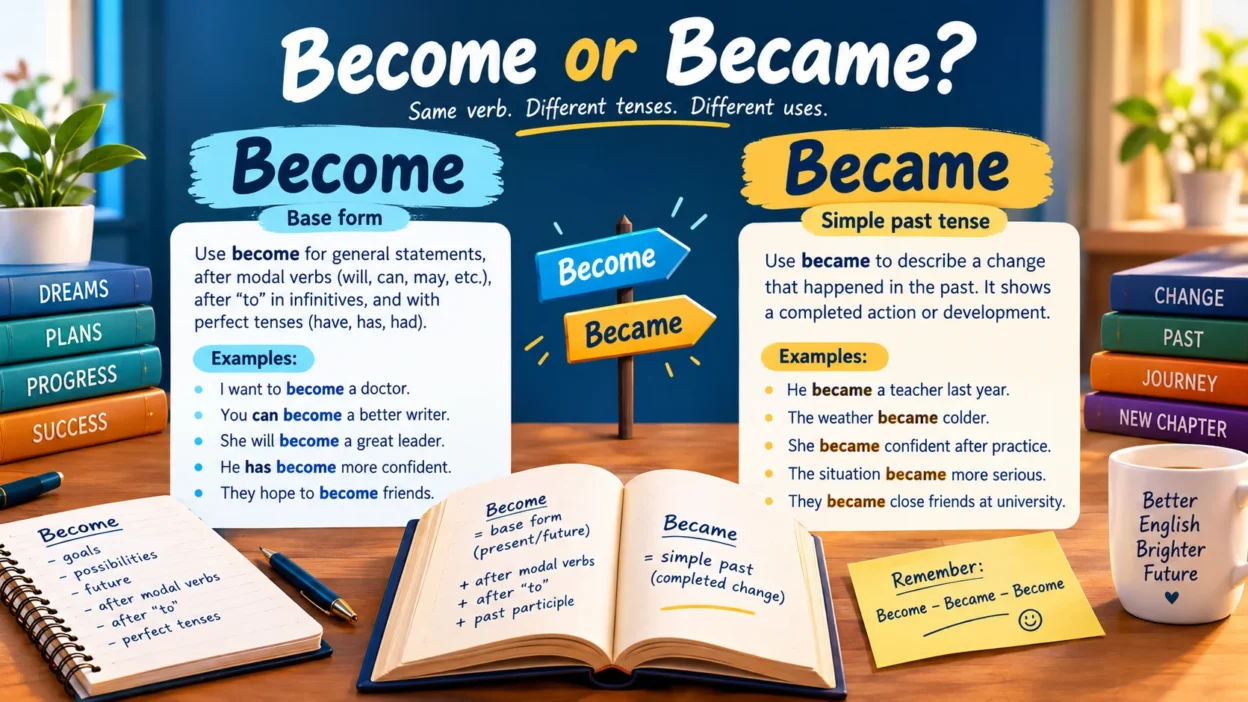
Choosing between become and became can be confusing for English learners because both words describe a change in someone or something. The main difference is their tense: become is the base form of the verb and is used in the present, after certain helping verbs, and in other grammatical structures, while became is the simple past tense of become.
For example, you can say, “I want to become a teacher” when talking about your future goal. However, if you are describing a change that happened in the past, you would say, “She became a teacher last year.” Both sentences are correct, but they refer to different grammatical situations. Understanding when to use each word will help you write clearer sentences, speak more naturally, and avoid common tense mistakes. This guide explains their meanings, grammatical rules, differences, and everyday uses with simple examples.
Quick Answer: Become vs. Became
Become is the base form of the verb, while became is its simple past tense. Use become for general statements, after modal verbs such as will and can, and after to. Use became to describe a change that happened in the past. For example: “I want to become a doctor” and “He became a doctor last year.”
Why Do People Confuse Become and Became?
People often confuse these words because they are different forms of the same irregular verb. Both describe a transition from one state, condition, or role to another.
Unlike regular verbs, become does not form its past tense by adding -ed. Its three main forms are:
- Base form: become
- Simple past: became
- Past participle: become
For example:
- Present: I become nervous before exams.
- Past: I became nervous before the exam.
- Present perfect: I have become more confident.
The key is to consider the tense and the helping verbs used in the sentence.
1. What Does Become Mean?
Become means to begin to be something or to change into a different state, condition, role, or identity.
It is the base form of an irregular verb. It appears in several grammatical structures, including the present tense, infinitives, and sentences with modal verbs.
When Should You Use Become?
Use become in these situations:
1. To describe a general fact or repeated situation
- People become tired after working for long hours.
- Some plants become dormant during winter.
- Children become more independent as they grow.
2. After modal verbs
- You can become a better writer with practice.
- She will become a great leader.
- They may become friends.
3. After “to” in an infinitive
- I hope to become a doctor.
- He wants to become famous.
- She plans to become a teacher.
4. With the present perfect or past perfect when the auxiliary verb requires a past participle
- I have become more patient.
- She has become interested in science.
- They had become close friends before moving away.
Notice that become is not limited to present-time meaning. It also appears in perfect tenses and other grammatical structures.
2. What Does Became Mean?
Became means started to be or changed into something at a particular time in the past. It is the simple past tense of become.
Use became when describing a completed change or development that occurred in the past.
When Should You Use Became?
1. To describe a past change
- He became angry after hearing the news.
- The weather became colder last night.
- She became confident after practicing.
2. To describe a change in someone’s role or status
- My brother became a doctor in 2022.
- She became the team captain last season.
- He became the company’s manager.
3. To describe a past transformation
- The small village became a busy town.
- The situation became more complicated.
- Their friendship became stronger over time.
4. To tell a story about past events
- At first, I was nervous, but I became comfortable later.
- The sky became dark before the storm arrived.
- He became interested in music when he was a child.
Remember that became is used for the simple past, not with has, have, or had as a past participle.
Become vs. Became: Comparison Table
| Feature | Become | Became |
|---|---|---|
| Verb form | Base form | Simple past |
| Main use | General statements and grammatical structures requiring the base form | Completed changes in the past |
| Present-tense example | I become nervous easily. | Not used for ordinary present tense |
| Past-tense example | Not the simple past form | She became nervous yesterday. |
| After “will” | I will become successful. | Incorrect: I will became successful. |
| After “to” | I want to become a pilot. | Incorrect: I want to became a pilot. |
| With “have” | I have become stronger. | Incorrect: I have became stronger. |
| Past participle | Become | Not the past participle |
When Should You Use Each Word?
The easiest way to choose between become and became is to identify the grammatical structure and the time being described.
Use Become When:
- You are describing a general fact: “People become wiser with experience.”
- You use a modal verb: “You can become successful.”
- You use an infinitive: “She hopes to become a scientist.”
- You use a perfect tense: “He has become more responsible.”
- You describe a future change with will: “It will become easier.”
Use Became When:
- You describe a completed change in the past: “He became famous.”
- You mention a past time: “She became a teacher in 2024.”
- You narrate a past event: “The room became silent.”
- You describe a past emotional change: “I became worried after the call.”
Important rule: A past-time expression does not automatically mean you should use became. For example, “I have become more confident over the past year” is correct because it uses the present perfect tense.
12 Examples of Become and Became in Sentences
Here are practical examples showing how both forms work.
Examples With Become
- I want to become a successful entrepreneur.
- You can become fluent in English through regular practice.
- She hopes to become a nurse.
- The days become shorter in winter.
- He will become a father next month.
- They have become good friends.
Examples With Became
- She became a nurse after completing her training.
- The sky became cloudy in the afternoon.
- He became interested in photography last year.
- My little brother became taller than me.
- The meeting became more serious after the announcement.
- Their small business became successful over time.
Paired Examples for Better Understanding
- Correct: I want to become a teacher.
- Correct: I became a teacher in 2023.
- Correct: She will become famous.
- Correct: She became famous after her first film.
- Correct: They have become close friends.
- Correct: They became close friends at university.
These pairs demonstrate how the verb form changes according to the sentence’s grammatical structure.
Common Mistakes With Become and Became
English learners sometimes use these forms interchangeably. Here are frequent mistakes and their corrections.
| Incorrect sentence | Correct sentence | Reason |
|---|---|---|
| I want to became a doctor. | I want to become a doctor. | Use the base form after to. |
| She will became famous. | She will become famous. | Use the base form after will. |
| He has became stronger. | He has become stronger. | Use the past participle after has. |
| They became friends tomorrow. | They will become friends tomorrow. | Use a suitable future construction. |
| I become tired yesterday. | I became tired yesterday. | Use the simple past for a completed past event. |
| She had became a manager. | She had become a manager. | Use the past participle after had. |
A Special Note About Present Tense
For third-person singular subjects such as he, she, and it, the simple present form is becomes, not become.
- Correct: She becomes nervous before interviews.
- Incorrect: She become nervous before interviews.
This is another form of the same verb, so it is useful to learn all three forms together: become, becomes, became, followed by the past participle become.
Memory Trick: How to Remember Become vs. Became
Use this simple memory trick:
- Become = base form. Think about goals, possibilities, and grammatical structures that require the base form.
- Became = past change. Think about something that already happened.
- Become = past participle, too. Use it after has, have, and had.
For example:
- Future goal: I want to become a pilot.
- Past event: I became a pilot last year.
- Present perfect: I have become a pilot.
Remember this pattern: become – became – become.
American vs. British English
There is no difference between American and British English in the standard forms of this verb.
Both varieties use:
- Become as the base form.
- Became as the simple past tense.
- Become as the past participle.
Examples in both varieties:
- She wants to become a doctor.
- She became a doctor last year.
- She has become a respected doctor.
Spelling differences between American and British English do not affect these verb forms. The same rules apply in both varieties.
Similar Words and Related Verb Forms
Learning related forms can help you understand become and became more easily.
| Verb form | Meaning or use | Example |
|---|---|---|
| Become | Base form | I want to become a writer. |
| Becomes | Simple present for he, she, or it | He becomes nervous easily. |
| Became | Simple past | She became a writer. |
| Become | Past participle | She has become a writer. |
| Becoming | Present participle or gerund | He is becoming more confident. |
Other verbs follow similar irregular patterns:
- Begin – began – begun: The class began at nine.
- Come – came – come: She came home early.
- Grow – grew – grown: The plant has grown taller.
- Write – wrote – written: He has written a letter.
These examples show why memorizing all three principal forms of irregular verbs is helpful.
Final Verdict: Become or Became?
Both words are correct, but they serve different grammatical purposes.
Use become when you need the base form, such as after will, can, or to. It is also the past participle used with has, have, and had. Use became when describing a completed change in the simple past.
Compare these sentences:
- “I hope to become a lawyer.” — A goal.
- “I became a lawyer last year.” — A completed past event.
- “I have become a lawyer.” — A change expressed in the present perfect.
The correct choice depends on the tense and grammatical structure, not simply on whether the event involves change.
Frequently Asked Questions
1. Is become present tense or past tense?
Become is the base form of the verb. It is used in the simple present with subjects such as I, you, we, and they, as well as after modal verbs and in infinitives. Its third-person singular simple present form is becomes.
2. Is became the past tense of become?
Yes. Became is the simple past tense of become. For example, “She became a doctor in 2025” describes a change that happened in the past.
3. Should I say “I have become” or “I have became”?
Say “I have become.” The present perfect tense requires the past participle, and the past participle of become is become, not became.
4. Is it correct to say “will became”?
No. The correct phrase is “will become.” Modal verbs such as will, can, may, and should are followed by the base form of the verb.
5. What is the past participle of become?
The past participle is become. The three principal forms are become – became – become. For example, “They have become good friends.”
6. Can I use became with yesterday?
Yes. Became is appropriate when describing a completed past change that happened yesterday. For example, “The weather became colder yesterday.”
7. What is the difference between became and has become?
Became is the simple past tense, usually describing a completed past event. Has become is the present perfect tense, which connects a past change to the present. For example, “He became famous in 2020” and “He has become famous” emphasize different aspects of the change.
Remember This
- Become: Base form — “I want to become a teacher.”
- Becomes: Simple present with he, she, or it — “She becomes nervous.”
- Became: Simple past — “She became a teacher last year.”
- Become: Past participle — “She has become a teacher.”
The most important rule is to use became for the simple past and become after modal verbs, infinitive to, and perfect-tense auxiliaries.
Conclusion
Understanding the difference between become and became is easier when you remember their grammatical roles. Become is the base form of the verb, while became describes a change that occurred in the past. The past participle is also become, which is why “has become” and “had become” are correct.
To improve your English, practice using these forms in sentences about your goals, experiences, and everyday life. Say “I want to become more confident,” “I became more confident last year,” and “I have become more confident.” With regular practice, you will learn to choose the correct form naturally.

David Henry is a language enthusiast and content writer specializing in synonyms, vocabulary, and word meanings. He creates clear, engaging resources that help readers improve their writing, communication, and English skills.