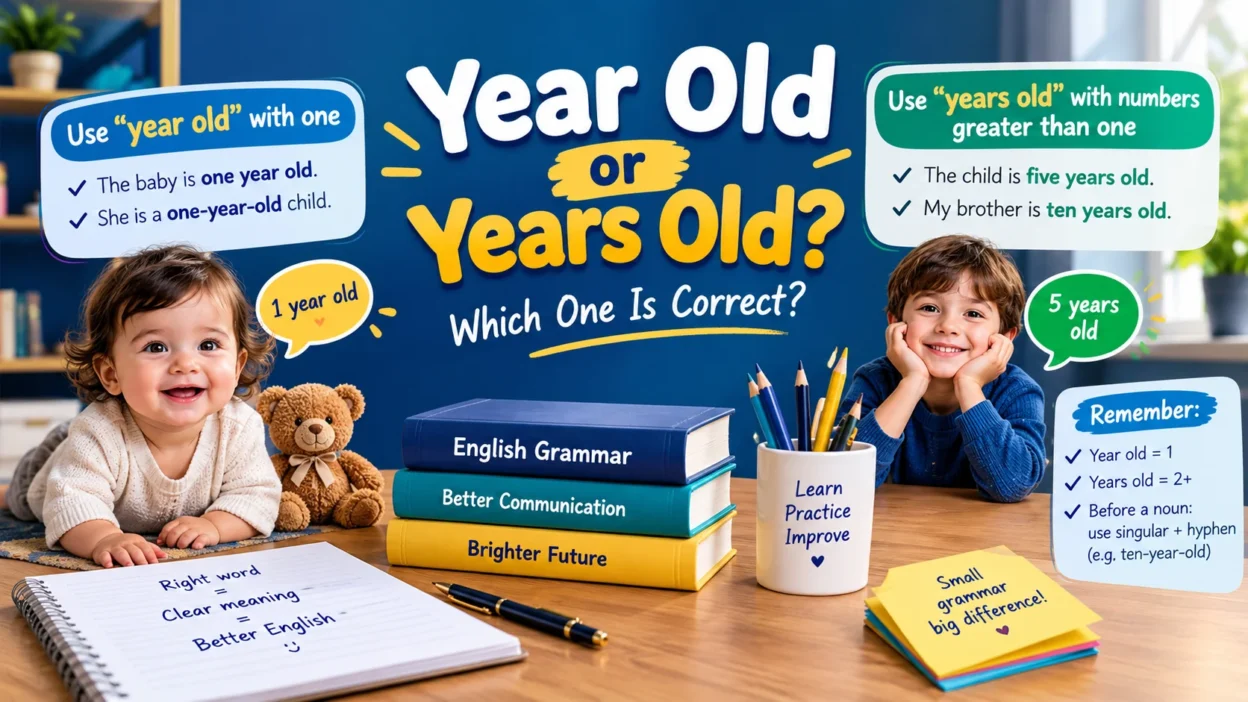
If you are talking about someone’s age, both “year old” and “years old” can be correct. The choice depends on the number. Use “year old” after the number one: “She is one year old.” Use “years old” after numbers greater than one: “She is five years old.” However, when the age comes before a noun as a compound adjective, use the singular form: “a five-year-old child.” This small grammar difference often confuses English learners because the word year changes depending on how the age expression is used.
Understanding year old vs. years old is useful in everyday conversations, school writing, forms, biographies, and descriptions of people or things. The key is to notice whether the age is being used as a normal age expression or as an adjective directly before a noun.
Quick Answer
Use “year old” with one: “He is one year old.” Use “years old” with numbers above one: “He is ten years old.” But before a noun, use a singular hyphenated form: “He is a ten-year-old boy.” The number does not change the word year in this compound structure.
Why Do People Confuse “Year Old” and “Years Old”?
The confusion happens because English uses year differently in two common structures:
- She is three years old. → normal age expression
- She is a three-year-old girl. → age used as an adjective
In the first sentence, years is plural because the person is three years in age.
In the second sentence, year remains singular because three-year-old functions as a compound adjective.
A useful rule is:
After a number, use plural “years” when stating age normally. Before a noun, use singular “year” in a compound adjective.
What Does “Year Old” Mean?
“Year old” is used when the age is exactly one year or when year is part of a compound adjective.
Examples:
- The baby is one year old.
- We adopted a one-year-old puppy.
- She has a one-year-old daughter.
Notice that year is singular in each example.
What Does “Years Old” Mean?
“Years old” is normally used when stating an age greater than one.
Examples:
- I am twenty years old.
- My brother is six years old.
- The building is 100 years old.
Here, years is plural because the number is greater than one.
Year Old vs. Years Old: Comparison Table
| Expression | Correct Example | Main Use |
|---|---|---|
| one year old | The baby is one year old. | Stating an age of one |
| two years old | The child is two years old. | Stating an age above one |
| ten years old | She is ten years old. | Stating age normally |
| a one-year-old child | He has a one-year-old child. | Age before a noun |
| a ten-year-old child | She has a ten-year-old child. | Age before a noun |
| ten-year-old | A ten-year-old student answered. | Compound adjective |
| ten years old | The student is ten years old. | Predicate age expression |
When Should You Use “Year Old”?
Use “year old” when:
- The age is exactly one.
- Year is part of a compound adjective before a noun.
Examples
- The puppy is one year old.
- She is one year old today.
- He has a one-year-old son.
- We bought a one-year-old car.
When Should You Use “Years Old”?
Use “years old” when you are simply stating someone’s or something’s age and the number is greater than one.
Examples:
- She is seven years old.
- My house is twenty years old.
- The museum is 200 years old.
- How many years old is your son?
10+ Examples of “Year Old” and “Years Old”
Examples with “year old”
- The baby is one year old.
- My daughter is one year old today.
- He owns a one-year-old car.
- They adopted a one-year-old dog.
- She has a one-year-old son.
- The company has a one-year-old website.
Examples with “years old”
- My brother is five years old.
- The building is fifty years old.
- How many years old is your sister?
- The tree is more than 100 years old.
- Their son is twelve years old.
- This computer is three years old.
Compare the structures
- The boy is ten years old.
- The ten-year-old boy is playing outside.
Both sentences describe the same age, but the grammar is different.
Common Mistakes
Mistake 1: Using “years” with one
❌ She is one years old.
✅ She is one year old.
Mistake 2: Using “years” in a compound adjective
❌ He is a five-years-old boy.
✅ He is a five-year-old boy.
Mistake 3: Forgetting the hyphens
❌ She is a ten year old girl.
✅ She is a ten-year-old girl.
Hyphens help show that the words work together as one adjective.
Mistake 4: Adding “old” unnecessarily
❌ My son is five years old old.
✅ My son is five years old.
Mistake 5: Confusing “age” with “years old”
Both can be correct:
- What is your age?
- How old are you?
But we normally say:
- I am twenty years old.
- I am twenty.
Memory Trick
Remember this simple rule:
Age after “is/am/are” → plural for numbers above one
She is six years old.
Age before a noun → singular + hyphens
She is a six-year-old girl.
Think:
Six years old → six-year-old child
The word year becomes singular when the whole phrase acts as an adjective before a noun.
American vs. British English
The basic grammar is the same in American English and British English.
Both varieties use:
- He is ten years old.
- He is a ten-year-old boy.
- She is one year old.
There is no major American-versus-British difference in this particular rule.
Similar Words and Expressions
Several expressions can describe age:
- one year old — age of exactly one year
- five years old — age of five years
- five-year-old — adjective describing someone or something aged five
- aged five — another way to state someone’s age, common in British English
- at the age of five — more formal age expression
- in his twenties — somewhere between ages 20 and 29
- under five — younger than five
- over 18 — older than 18
For example:
- She is eight years old.
- She is aged eight.
- She started school at the age of five.
Final Verdict
Both “year old” and “years old” are correct, but they are used in different grammatical situations.
- Use one year old for an age of one.
- Use two years old, ten years old, and 50 years old for ages greater than one.
- Use one-year-old, ten-year-old, and 50-year-old when the age phrase comes before a noun.
- Use hyphens in compound adjectives: a ten-year-old child.
The easiest rule is: “years old” for normal ages above one; “year-old” before a noun.
Frequently Asked Questions
Is “year old” grammatically correct?
Yes. “Year old” is correct when the age is one, as in “She is one year old.” It is also used in compound adjectives such as “a three-year-old child.”
Is it “2 year old” or “2 years old”?
When stating age normally, write “2 years old.” For example: “The child is 2 years old.” Before a noun, write “a 2-year-old child.”
Is it “1 year old” or “1 years old”?
The correct form is “1 year old.” Because one is singular, use year, not years.
Is “five year old” correct?
When it comes directly before a noun, write “five-year-old” with a singular year and hyphens. For example: “a five-year-old boy.”
Should “year old” have hyphens?
Use hyphens when the age phrase works as a compound adjective before a noun: a ten-year-old student. Usually, no hyphens are needed when stating age after a verb: The student is ten years old.
Can I say “She is five”?
Yes. In everyday English, “She is five” can mean “She is five years old.” The longer form is useful when you want to state the age explicitly.
Is “years old” used for things too?
Yes. “Years old” can describe people, animals, objects, buildings, traditions, and other things with an age.
For example: “The castle is 500 years old.”
Remember This
One → one year old
More than one → two/three/ten years old
Before a noun → one-year-old / ten-year-old
Conclusion
The difference between “year old” and “years old” is simple once you recognize the sentence structure. Use year with the number one and years with numbers greater than one when directly stating age. When the age expression comes before a noun, keep year singular and connect the words with hyphens.
For example, say “The child is seven years old,” but “She is a seven-year-old child.” Learning this pattern will help you avoid a common English grammar mistake and make your writing sound more natural and accurate.

Daniel Jack is a language enthusiast and content writer who specializes in synonyms, vocabulary, and word meanings. He creates clear, engaging resources that help readers improve communication and expand their English skills.