
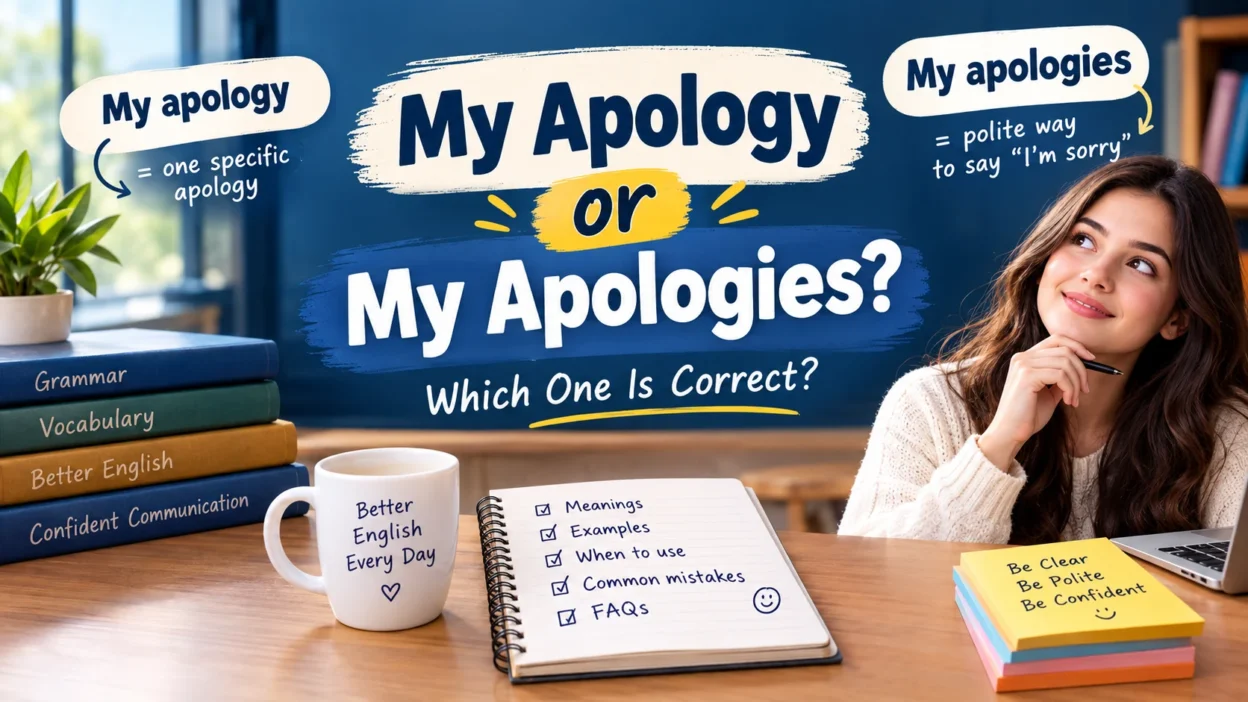
If you are wondering if to say “my apology” or “my apologies,” both expressions are grammatically correct, but they are used in different ways. “My apologies” is much more common when you are expressing regret for a mistake, inconvenience, or misunderstanding. “My apology” is usually used when referring to one specific apology, often in a more formal or deliberate context.
For example, you can say, “My apologies for the late reply” when you are sorry about responding late. You might say, “Please accept my apology for the mistake” when referring to a particular apology. Understanding this small difference can help you sound natural and confident in emails, conversations, and professional writing.
Quick Answer
“My apologies” is the usual expression for saying you are sorry. “My apology” is singular and refers to one specific apology. Say “My apologies for the delay” in everyday or professional situations. Use “my apology” when emphasizing a particular apology or referring to it as an individual act.
Why Do People Confuse “My Apology” and “My Apologies”?
The confusion comes from the fact that apology can be both singular and plural.
- My apology = one apology
- My apologies = more than one apology, or a conventional expression of regret
Although “my apologies” is grammatically plural, English speakers commonly use it as a polite fixed expression meaning “I am sorry.”
For example:
My apologies for the confusion.
This does not necessarily mean that you are making several separate apologies. It is simply a standard polite way to express regret.
What Does “My Apology” Mean?
“My apology” is the singular form. It refers to one particular apology.
It is especially natural when the sentence focuses on the apology itself as something being offered, accepted, or discussed.
Examples
- Please accept my apology for the error.
- I would like to offer my apology to the customer.
- She accepted my apology after our conversation.
- I owe you my apology.
The expression “I owe you my apology” is particularly common when acknowledging that you were wrong or treated someone unfairly.
What Does “My Apologies” Mean?
“My apologies” is a common polite expression used to say “I am sorry.”
It is often used for:
- delays
- mistakes
- interruptions
- misunderstandings
- inconvenience
- forgetting something
- minor problems
Examples
- My apologies for the delay.
- My apologies for the confusion.
- My apologies for missing your email.
- My apologies for the inconvenience.
It works well in both everyday and professional communication.
My Apology vs My Apologies: Comparison Table
| Expression | Meaning | Common Use | Example |
|---|---|---|---|
| My apology | One specific apology | Referring to an individual apology | Please accept my apology. |
| My apologies | A conventional expression of regret | Saying sorry politely | My apologies for the delay. |
| My apology to you | A particular apology directed at someone | Formal or serious situations | I offer my apology to you. |
| My apologies for… | Polite expression of regret | Emails and everyday situations | My apologies for the mistake. |
When Should You Use “My Apology”?
Use “my apology” when you are talking about one particular apology.
It often appears with verbs and phrases such as:
- accept my apology
- offer my apology
- owe you my apology
- receive my apology
- make my apology
Examples
Please accept my apology for the misunderstanding.
I owe you my apology.
I would like to offer my apology for my behavior.
This form can sound somewhat formal, especially in phrases such as “I offer my apology.”
When Should You Use “My Apologies”?
Use “my apologies” when you simply want to express regret.
It is particularly natural before a reason introduced with “for.”
Examples
My apologies for the late response.
My apologies for keeping you waiting.
My apologies for the confusion.
My apologies for the inconvenience.
In many everyday situations, “my apologies” is the more natural choice.
12 Examples of “My Apology” and “My Apologies”
Examples with “My Apology”
- Please accept my apology for the mistake.
- I owe you my apology.
- She accepted my apology.
- I would like to offer my apology.
- He received my apology graciously.
- My apology was sincere.
Examples with “My Apologies”
- My apologies for the late reply.
- My apologies for the confusion.
- My apologies for the inconvenience.
- My apologies for missing the meeting.
- My apologies for interrupting you.
- My apologies for the misunderstanding.
Notice the difference: “my apology” often functions as a noun phrase referring to a particular apology, while “my apologies” commonly functions as a ready-made expression of regret.
Common Mistakes
1. Using “My apology” when you mean “I’m sorry”
❌ My apology for being late.
This is not always grammatically wrong, but it can sound less natural as a direct expression of regret.
✅ My apologies for being late.
2. Thinking “My apologies” always means several apologies
Not necessarily. In ordinary English, “my apologies” is a conventional way to express regret.
My apologies for the delay.
The speaker does not necessarily mean they are making multiple separate apologies.
3. Confusing “apology” with “apologize”
Apology is a noun.
I offered an apology.
Apologize is a verb.
I apologize for the mistake.
Both are correct, but they perform different grammatical roles.
4. Forgetting “for” in common expressions
A common structure is:
My apologies for + noun/gerund
Examples:
- My apologies for the delay.
- My apologies for arriving late.
- My apologies for the confusion.
Memory Trick
Think of it this way:
My apology = one specific apology.
My apologies = a polite way to say “I’m sorry.”
A simple memory sentence is:
If you are simply saying sorry, “my apologies” is usually the natural choice.
If you are talking about one particular apology as a thing, “my apology” works well.
American vs British English
Both “my apology” and “my apologies” are understood in American and British English.
There is no major difference in meaning between American and British English for these expressions.
“My apologies” is widely used in both varieties, especially in polite and professional communication.
For example:
My apologies for the inconvenience.
This sentence sounds natural in both American and British English.
Similar Words and Expressions
Several expressions can communicate a similar idea.
I’m sorry
The most direct and everyday expression.
I’m sorry for being late.
I apologize
A direct verb form that works well in professional communication.
I apologize for the misunderstanding.
Please accept my apology
A more formal expression referring to a specific apology.
Please accept my apology for the error.
Sorry about that
Informal and conversational.
Sorry about that. I sent you the wrong file.
My apologies
Polite and versatile.
My apologies for the delay.
Final Verdict
“My apology” and “my apologies” are both correct, but they are not normally interchangeable in every sentence.
Use “my apologies” when you want to politely say that you are sorry:
My apologies for the delay.
Use “my apology” when referring to one particular apology:
Please accept my apology.
For everyday emails, messages, and professional communication, “my apologies” is often the most natural choice when expressing regret.
Frequently Asked Questions
Is “my apology” grammatically correct?
Yes. “My apology” is grammatically correct when referring to one specific apology.
Please accept my apology.
Is “my apologies” grammatically correct?
Yes. “My apologies” is a standard English expression used to express regret or say sorry politely.
Is “my apology” or “my apologies” more common?
“My apologies” is generally more common as a direct expression of regret, especially in phrases such as “My apologies for the delay.”
Can I say “my apologies for the inconvenience”?
Yes. “My apologies for the inconvenience” is a natural and polite expression commonly used in professional communication.
Can I say “I owe you my apology”?
Yes. “I owe you my apology” is correct and means that you recognize you should apologize to someone.
Is “my apologies” too formal?
Not necessarily. It can be used in professional writing and ordinary conversation. It is usually more polite or formal than simply saying “sorry.”
What is the difference between “my apology” and “I apologize”?
“My apology” is a noun phrase, while “I apologize” is a verb phrase.
Please accept my apology.
I apologize for the mistake.
Remember This
- My apology = one specific apology.
- My apologies = a common polite way to say “I’m sorry.”
- My apology often appears with accept, offer, owe, or receive.
- My apologies commonly appears with for.
- Both expressions are used in American and British English.
Conclusion
The choice between “my apology” and “my apologies” depends mainly on how you are using the word. “My apology” refers to a particular apology, while “my apologies” is commonly used as a polite expression of regret. Both forms are correct when used in the right context.
If you need to apologize for a delay, mistake, inconvenience, or misunderstanding, “My apologies for…” is usually a natural choice. When referring to one specific apology, phrases such as “Please accept my apology” or “I owe you my apology” are appropriate.

David Henry is a language enthusiast and content writer specializing in synonyms, vocabulary, and word meanings. He creates clear, engaging resources that help readers improve their writing, communication, and English skills.