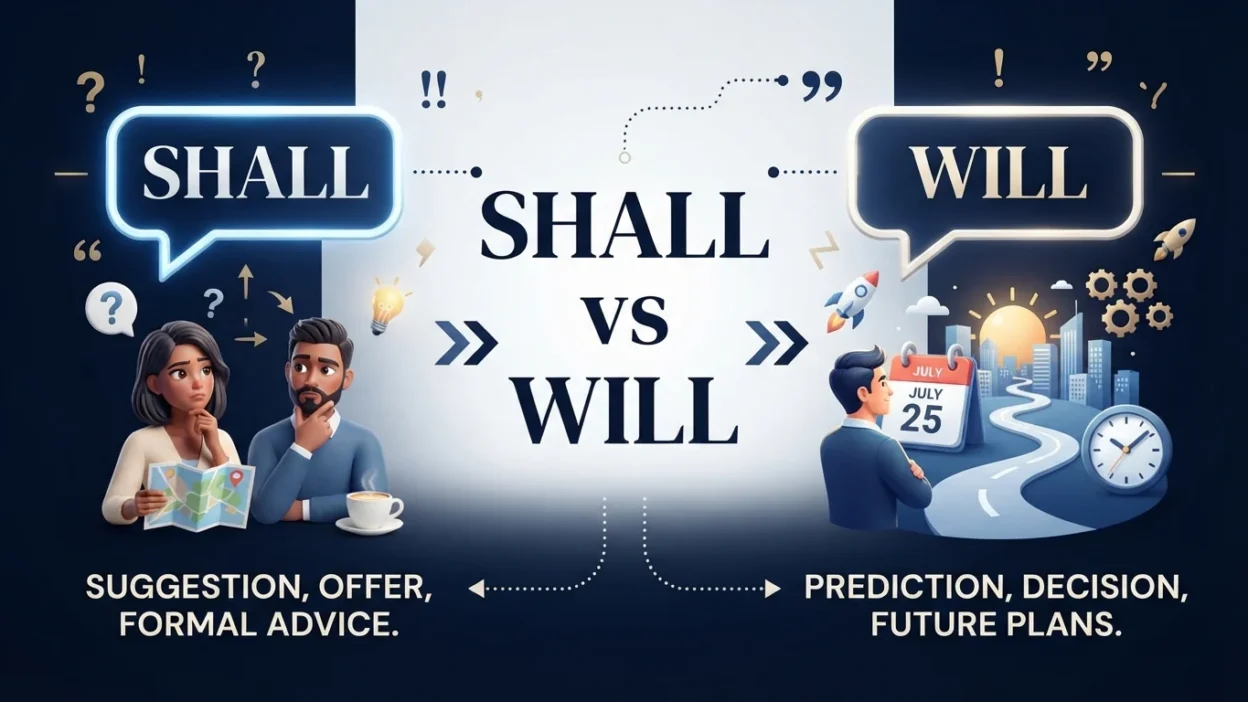
English learners often confuse shall vs will because both words can talk about the future. In modern English, will is the normal choice for most future statements, such as “I will call you tomorrow” or “She will arrive soon.” Shall is less common, but it still has important uses, especially with I and we when making suggestions, offers, or asking for instructions.
The difference also depends on the type of English being used. In everyday American English, will is much more common, while shall can sound formal or old-fashioned in ordinary future statements. In British English, shall is still used naturally in questions such as “Shall we begin?” Understanding these patterns will help you choose the right word confidently.
Quick Answer
Will is the standard word for talking about the future with all subjects: “I will,” “you will,” “he will,” and so on. Shall is mainly used with I and we for suggestions, offers, or asking what to do: “Shall we go?” In formal or legal English, shall can also express requirements or obligations.
Why Do People Confuse “Shall” and “Will”?
Both shall and will are modal verbs that can refer to future time. This overlap makes them confusing, especially for English learners.
Traditional grammar rules sometimes taught different meanings depending on the subject:
- I/we shall → simple future
- You/he/she/they will → simple future
- I/we will → determination or willingness
- You/he/she/they shall → command or obligation
However, these traditional distinctions are not usually followed in everyday modern English.
Today, will is the ordinary future auxiliary for all subjects.
What Does “Shall” Mean?
Shall is a modal verb with several uses. Its most common modern uses are:
- Making a suggestion
- Making an offer
- Asking for instructions or decisions
- Expressing a formal requirement or obligation
Examples
- Shall we go for a walk?
- Shall I open the window?
- What shall we do next?
- The tenant shall pay the rent on the first day of each month.
The first three examples are especially common in British English and formal or polite conversation.
What Does “Will” Mean?
Will is the most common modal verb used to express the future.
It can describe:
- Future actions
- Predictions
- Decisions made at the moment of speaking
- Offers
- Promises
- Willingness or refusal
Examples
- I will call you tomorrow.
- She will probably arrive soon.
- I’ll help you with your homework.
- He will never admit his mistake.
Unlike shall, will works naturally with every grammatical subject.
Shall vs Will: Comparison Table
| Feature | Shall | Will |
|---|---|---|
| Future with I/we | Possible, but less common | Very common |
| Future with you/he/she/they | Uncommon in everyday English | Standard |
| Making suggestions | Very common | Not normally used this way |
| Making offers | Common with I/we | Also possible |
| Asking what to do | Common | Usually not used |
| Predictions | Less common | Very common |
| Promises | Less common | Very common |
| Formal/legal requirements | Common | Sometimes used |
| American everyday English | Relatively uncommon | Very common |
| British English | More common in certain expressions | Very common |
When Should You Use “Shall”?
Use shall mainly in these situations.
1. To Make a Suggestion
Shall we watch a movie?
This means, “Would you like to watch a movie?” or “Do you think we should watch a movie?”
Other examples:
- Shall we start?
- Shall we have dinner?
- Shall we take a break?
2. To Make an Offer
Shall I carry your bag?
Here, the speaker is offering to do something.
More examples:
- Shall I help you?
- Shall I make some tea?
- Shall I call the doctor?
3. To Ask for Instructions
What shall I do now?
The speaker wants to know what action they should take.
Examples:
- Where shall we meet?
- What shall I bring?
- Which room shall we use?
4. In Formal or Legal Language
In contracts and official documents, shall can indicate a requirement or obligation.
For example:
The applicant shall provide proof of identity.
Here, shall means that providing proof of identity is required.
Because legal drafting conventions can vary, the exact meaning of shall should always be understood from the document’s context.
When Should You Use “Will”?
Use will for most ordinary future situations.
1. Future Actions
- I will visit you tomorrow.
- They will arrive at noon.
- She will start her new job next month.
2. Predictions
- It will rain tonight.
- The team will probably win.
- You will enjoy this book.
3. Promises
- I will help you.
- I will never forget this.
- We will keep your information safe.
4. Decisions Made at the Moment
Imagine someone knocks on the door.
You can say:
I’ll get it.
The decision is being made as you speak.
5. Offers
I’ll carry that for you.
Here, will expresses willingness to help.
Shall vs Will: 12 Examples
- I will call you tonight.
Use will for a normal future action. - We will meet tomorrow.
Will is the usual modern future form. - Shall we meet tomorrow?
Shall turns the sentence into a suggestion. - Shall I open the door?
This is an offer. - What shall we eat?
This asks for a decision or suggestion. - She will arrive at six.
Will expresses a future event. - I will help you with that.
Will expresses willingness. - Shall we begin the meeting?
Shall we…? is a common way to suggest starting. - I shall return shortly.
This is grammatical but can sound formal or literary in many contexts. - The company shall provide the necessary equipment.
Here, shall expresses a formal requirement. - Will you help me?
This asks whether someone is willing to help. - Shall I send the email now?
This asks whether the speaker should send it.
Common Mistakes With Shall and Will
Mistake 1: Thinking “Shall” Is Always the Future Form for “I” and “We”
Traditional grammar may teach:
I shall go tomorrow.
While this is grammatically possible, modern English usually prefers:
I will go tomorrow.
Mistake 2: Using “Shall” for Every Future Sentence
Not every future sentence needs shall.
Incorrect or unnatural in ordinary modern usage:
She shall arrive tomorrow.
More natural:
She will arrive tomorrow.
Mistake 3: Forgetting the Pattern “Shall We…?”
Shall we…? is one of the most useful modern patterns with shall.
- Shall we start?
- Shall we leave?
- Shall we order food?
Mistake 4: Assuming “Will” Cannot Make an Offer
It can.
I’ll help you.
This is a perfectly natural offer.
Mistake 5: Treating Legal “Shall” Like Everyday “Shall”
The shall used in a contract may express a formal requirement. That is different from the conversational use in:
Shall we go?
Context matters.
Memory Trick: Shall = Suggest or Offer
A simple way to remember the everyday difference is:
SHALL → Suggest, offer, or ask what to do.
Think:
- Shall we…? → suggestion
- Shall I…? → offer or request for direction
For most other future statements, will is usually the safer choice.
American vs British English
There is an important difference in frequency.
American English
In everyday American English, will is overwhelmingly the normal choice for future statements:
- I will call you.
- We will see you tomorrow.
- They will arrive soon.
Shall is less common and may sound formal, old-fashioned, or especially polite depending on context.
However, expressions such as “Shall we…?” can still be understood and used.
British English
British English also commonly uses will for ordinary future statements, but shall remains more familiar in certain conversational expressions:
- Shall we go?
- Shall I help?
- What shall we do?
So, the distinction is not simply “American = will” and “British = shall.” Will is common in both varieties, while shall has particular uses and is more noticeable in some British contexts.
Similar Words and Expressions
Should
Should often expresses advice, expectation, or what is appropriate.
- You should study tonight.
- Should I call her?
May
May can express possibility or permission.
- It may rain later.
- May I come in?
Can
Can commonly expresses ability or informal permission.
- Can you help me?
- I can swim.
Going to
Be going to is another common way to talk about the future.
- I am going to study tonight.
- They are going to move next year.
Final Verdict
For ordinary modern English, will is the standard choice for future statements with I, we, you, he, she, it, and they.
Use shall mainly when making suggestions or offers with I/we, asking what should happen, or in certain formal and legal contexts.
The most useful patterns to remember are:
- I will… → ordinary future
- We will… → ordinary future
- Shall I…? → offer or ask for direction
- Shall we…? → suggestion
- The agreement shall… → formal requirement
Frequently Asked Questions
Is “shall” better than “will”?
Neither is universally better. Will is the normal choice for most future statements, while shall has specific uses, especially for suggestions, offers, and some formal requirements.
Can I use “shall” instead of “will”?
Sometimes, particularly with I and we, but it may sound formal or less natural in ordinary conversation. For most future statements, will is the more natural choice.
Is “shall” still used in English?
Yes. It remains common in expressions such as “Shall we…?” and “Shall I…?” It also appears in formal and legal language.
Should I say “Shall I” or “Will I”?
Use “Shall I…?” when asking whether you should do something or offering to do it.
- Shall I open the window?
Use “Will I…?” when asking whether something is expected to happen to you.
- Will I need a passport?
Should I say “Shall we” or “Will we”?
“Shall we…?” commonly asks for a suggestion or agreement about what to do.
- Shall we go now?
“Will we…?” usually asks about a future event.
- Will we arrive before noon?
Is “I shall” grammatically correct?
Yes. I shall is grammatically correct, but in ordinary modern English, I will is usually more common. I shall can sound formal, literary, or traditional depending on context.
Do Americans use “shall”?
Yes. Americans understand and use shall, especially in formal writing and expressions such as “Shall we…?” However, it is much less common than will for ordinary future statements.
Remember This
Will = the normal future choice.
Shall I…? = an offer or question about what you should do.
Shall we…? = a suggestion.
Shall in formal documents = may express a requirement, depending on the drafting context.
If you remember those four patterns, you can handle most everyday situations involving shall vs will.
Conclusion
The difference between shall and will is mainly about modern usage and context. Will is the standard way to express the future in contemporary English, while shall has narrower but useful functions. In particular, “Shall I…?” is often used for offers, and “Shall we…?” is commonly used for suggestions.
Although traditional grammar rules created a stronger distinction between the two words, modern English does not normally require speakers to follow those old subject-based rules. For clear everyday communication, use will for ordinary future statements and remember shall for suggestions, offers, questions about what to do, and certain formal contexts.

Daniel Jack is a language enthusiast and content writer who specializes in synonyms, vocabulary, and word meanings. He creates clear, engaging resources that help readers improve communication and expand their English skills.